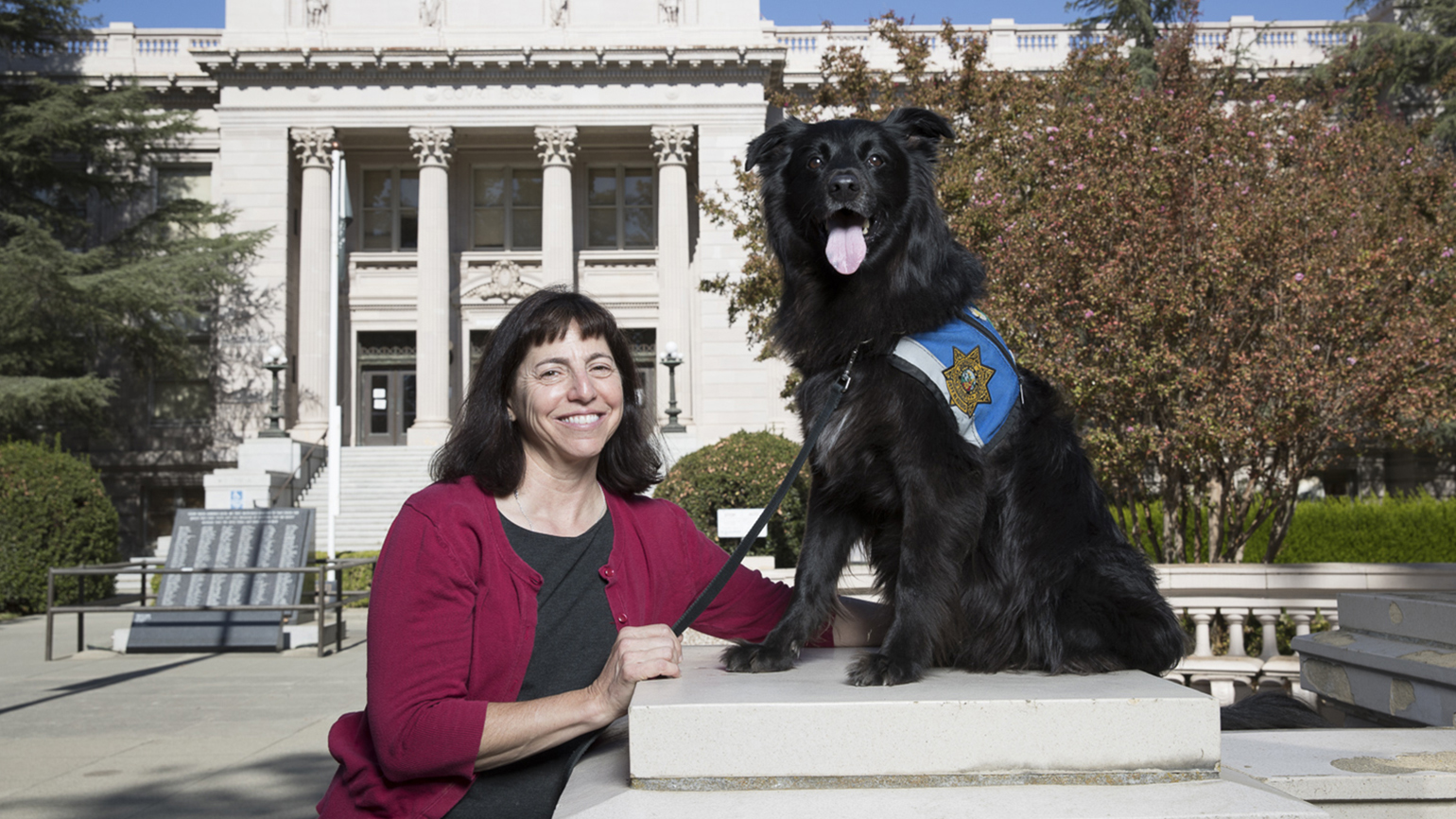
There’s a Jewish concept that Lori Raineri tries to live by: tikkun olam. It means repair the world, do what you can to make it a better place. Lori’s a doer. Type A squared. So even picking out a new puppy at the shelter that day in 2006, she was looking for more than a pet to keep her company.
The Davis, California, resident is single. No kids. When her two senior dogs died, she couldn’t help but think of how their lives had touched only hers.
“I want a dog that helps other people,” she told a friend who’d come with her.
VISIT OUR SHOP FOR MORE BOOKS ABOUT HEALING ANIMALS!
“Have you heard about the therapy dogs they use in hospitals?” her friend, who’s a nurse, said. “They comfort patients. Children especially love them.”
Wonderful. Tikkun olam.
The shelter manager led them to a pen where six puppies, Border-collie mixes, were tumbling about. Except for one. She sat alone in a corner. Lori reached into the pen and lifted her up.
“Hey, baby girl,” she cooed. The pup stiffened. Lori had never seen one so shy.
“You might like this other puppy better,” the manager said. “See how playful he is?”
Lori looked down at the pup in her arms. She seemed like Lori’s opposite in every way, but there was something about the way her eyes took in everything. “No, this is the one,” she said. The puppy’s expression reminded Lori of the dog in the Blondie comic strip. “I’m going to call her Daisy.”
READ MORE: HOW SERVICE DOGS SUPPORT OUR VETERANS
Lori threw herself into raising her new dog. She has a small consulting firm that works with public agencies like school boards to issue municipal bonds that fund new buildings and other public infrastructure. She works 70 to 80 hours a week and always has one or two volunteer gigs—coaching youth sports, teaching Sunday school, community work.
She took Daisy with her everywhere and arranged her schedule to give her blocks of time for bonding and puppy classes. For the first six months, she fed Daisy only out of her hand as a reward for good behavior. The puppy quickly learned that the surest route to a treat was to be calm and patient.
Lori wondered how well Daisy would do with people in the hospital since she was so reserved around strangers. She was determined to make it work. A friend at synagogue recommended a therapy-dog training school run out of an Episcopal church.
There Daisy learned how to approach a person in a wheelchair, to ignore food dropped on the floor, not to react when people were yelling, rushing around or behaving erratically. Soon she’d be ready to work in a hospital.
READ MORE: OUR HEROIC MILITARY WORKING DOGS
One night Lori was talking dogs with a business acquaintance when the woman mentioned a magazine she really liked. “It’s called Bark,” she said. “You should check it out.”
Not long after that, Lori’s assistant came into her office. “You should see this,” she said. “It came in the mail.” She held up a copy of Bark.
Lori couldn’t resist glancing through it. Her eyes landed on a story about how therapy dogs were used in a courthouse in Seattle to help comfort crime victims. How amazing!
She contacted the district attorney, Jeff Reisig, one of the few local officials she’d never met. “I read an article about dogs working in courthouses,” she told him. “I have a dog trained to do therapy, and I think we should have this in our county.”
Long silence. “Funny, I’m just now reading an article about courthouse dogs in my prosecutors’ association magazine,” he said. “Can we meet?”
A few days later, Jeff ushered Lori and her dog into his office. “I’m interested in Daisy working with children, victims of sexual assault,” he said.
“I’m guessing that would only be an occasional thing,” Lori said.
“No,” Jeff said. “Sadly, we see children every day.”
READ MORE: GINGERBREAD FOR DOGS
The enormity of what he’d said hit her. This was serious. Daisy had been training to work with hospital patients. What if she wasn’t ready for this?
“Let’s go and meet everyone,” Jeff said. He led them to another building. “This is our Multi-Disciplinary Interview Center,” he said. “Sexual assault victims go through in-depth interviews here. They also come for therapy sessions and other meetings.” The name sounded familiar. Then Lori remembered. She’d helped arrange the building’s financing.
There were several people waiting in the spacious lobby. Jeff and Lori went over to a cozy array of couches, where he introduced her to Cameron Handley, the director of the MDIC.
Daisy lay calmly at Lori’s feet, observing everything around her. Lori explained how the dog was trained not to react even in stressful situations. “She’s been around children a lot at my synagogue.”
Cameron nodded. “We’d see this as being a kind of pilot program,” she said. “A lot of our children are very fearful. It will be important that Daisy not do anything that might frighten them.”
A woman and a young girl came into the lobby. Even from across the room, Lori could see that the girl was nervous, her steps tentative, her head down. Then she looked up and saw Daisy.
READ MORE: COMFORT DOGS BRING HOPE TO SANDY HOOK
“Would you like to meet my dog?” Lori asked. The girl nodded.
“Her name’s Daisy,” Lori said. “She shakes hands.” Daisy extended a paw and the girl shook it. Lori showed the girl how to get Daisy to do more tricks.
Then another child came in with her parents.
“Would you like to meet Daisy?” Lori asked, moving closer.
“No,” the child said, stepping back.
“I like Daisy,” the first girl said. Unprompted, Daisy returned to her, lay down and rested her head atop the girl’s foot.
Lori looked at Cameron, whose eyes were fixed on the scene unfolding in front of them. In the space of a few minutes, they had witnessed the possibility of what Daisy could offer along with evidence that she wasn’t for everyone. The children would decide if they wanted Daisy’s company.
Soon Daisy was on the job. The DA’s office had planned to spend several weeks acclimating her to the center and its investigators and therapists before putting her to work. But shortly after she began, an eight-year-old boy came in for an interview and refused to be separated from his aunt, who had brought him.
Children are only allowed to be interviewed alone. The boy clung to his aunt with one hand; with the other, he petted Daisy. The investigator decided to bring Daisy into the interview room. The boy agreed to go without his aunt. Daisy spent the entire time leaning against the boy’s leg, comforting him as if she’d been doing it for years, while he described his experience.
Each morning, Cameron would pick Daisy up at Lori’s house. Lori would tell Daisy where she was going the moment they awoke. The dog sprang from her bed fully alert, as if she was saying, “I’m ready to work.” One night, when Cameron brought Daisy back home, she said, “I want to tell you how great Daisy was today. There was a girl who—”
READ MORE: DOGS IN THE OFFICE — MORE HELP THAN YOU’D THINK
Lori stopped her. “I’m sorry,” she said. “It’s too hard for me to hear about what these children have gone through. But I’m glad Daisy can be there for them.”
In time there was no way for Lori to avoid hearing about what her dog was doing. There were stories in the newspaper. Lori and Daisy made appearances at community events to raise awareness. People would come up to them at the mall and tell Lori they knew Daisy, what she meant to them.
She couldn’t help but be moved by the stories she heard. Like the two siblings who were so traumatized that they couldn’t sit for an interview or therapy. They’d cry and scream uncontrollably. Until they met Daisy. They’d pet her and give her treats, and she loved them back. Slowly, they opened up.
It’s not only children that Daisy comforts. One day a man whose child had been assaulted brought the child to the center. The man was extremely upset. This time Daisy stayed with the father in the lobby. He sat and stroked her, settling down some. Then he stretched out on the couch. By the time the interviewer returned with the child, the man was asleep, Daisy right next to him.
The investigators all spend time with Daisy. She comforts them as much as she does the children. She’s become an indispensable part of the center’s work. Lori had her trainer customize Daisy’s lessons to focus on children, teaching her to lay her head in the lap of someone feeling stress.
READ MORE: A DOG’S NOSE KNOWS HOW TO SNIFF OUT DISEASE
Not to move away if a child is crying or trembling. But really, Lori believes that Daisy, with her cautious, observant nature, was made for working with abused children. Daisy senses their boundaries and their need for the comfort and affection only a loving dog can give.
For several years, the two of them visited the hospital on weekends. That’s when Lori got to see Daisy in action with patients. They perfected a skit in which Daisy answered questions and did impressions. “If we go to Lake Tahoe, what might we see?” Lori would ask. Daisy would stand up on her hind legs. “That’s right, a bear,” Lori would say. “What does Lady Gaga do?” Daisy would sing. And everyone would laugh.
It’s been eight years now since Daisy began working as a therapy dog. She’s touched the lives of thousands of people in ways Lori could never have imagined. Looking back, Lori says there was a reason she was drawn to the puppy whose first instinct wasn’t to play with the others but to try to figure out what she was supposed to do.
Lori and Daisy have figured it out together. Daisy is a gift to everyone she meets. And a reminder to Lori that the world is being looked after—and made better—by someone way busier and, of course, far wiser, than even she is.
Did you enjoy this story? Subscribe to Guideposts magazine.





 “She is magic with the kiddos,” says Danielle, whose customers range from four months to 18 years old. “The young children are especially leery after all the testing they’ve gone through. I’ll say, ‘Truffles wants to show you her glasses,’ and she normalizes it for them within just a few minutes.” Truffles also uses her super smarts to allay kids’ fear of testing. She demonstrates how to do a shape test, identifying an apple and a circle with a tap of her paw.