Embrace God's truth with our new book, The Lies that Bind

Where Does Love Come From?

My favorite Mysterious Ways stories are love stories. I told my own in the April/May 2013 issue. With billions of people in the world, there’s bound to be a soul mate out there for everyone of us, and I’m always amazed at the unlikely places those matches are made, the unusual circumstances that spark a lifelong bond between two people. It begs the question… is there a matchmaker working behind the scenes?

A story on ESPN.com today might be the most incredible “meet cute” I’ve ever heard, because of where it took place—amid the absolute dreck and savagery of a popular football blog’s comments section.

On ESPN’s Big Ten blog, somewhere amongst the anonymously-authored posts comparing opposing fans to farm animals and bizarre off-topic rants, two random commenters, a boy and a girl, both Michigan football fans, developed a friendship that against all odds developed into real life love.

Bleu_girl_04 and AAWolv had both gone to Michigan for college, but didn’t know each other. She lived in North Carolina, he lived in Ann Arbor. Yet, from the moment they began responding to each other’s comments on the Big Ten blog, they felt a connection.

“She mentioned early on she thought she might marry him and it was WAY different than anyone before,” Bleu_girl’s friend told ESPN.

Indeed, 3 years after responding to each other’s comments on the blog, Bleu_girl_04 and AAWolv, or Kate and Brandon, as they’re known in real life, have tied the knot. (Watch a video of how the blog couple met and married.)

In our February/March 2016 issue, we’ll be introducing a new section to Mysterious Ways… all about how love can enter our lives at the most unexpected moments. What’s your love story? What unusual places have you discovered true love? How did someone you know find their soul mate? What proves the match was meant to be? Share your stories with us!

Where Does Consciousness Come From?

“I feel that I am where I am today only through divine intervention, because things could have so easily been very different. God knew I existed.” –Martin Pistorius, who spent more than 12 years in a near-vegetative state before regaining consciousness.

Martin shared his story with us in our June/July 2015 issue of Mysterious Ways. Even his own mother had lost hope that he’d ever be able to live a normal life. Today, there is still no medical explanation for how Martin was able to regain consciousness.

I thought of Martin when I read the story of Dylan Rizzo in New York magazine. A 19-year-old from the Boston suburbs, he fell into a coma—and seemingly vegetative state—after a car accident. According to Dylan’s doctors, the connective tissue in his brain—the “wires” that transmit the signals necessary for consciousness—were shredded.

“They told us they didn’t think he would ever be able to live at home, that he would probably be institutionalized, and have moments of clarity where he would recognize us,” Dylan’s mother, Tracy, told New York. “But they didn’t think he would even have that.”

Dylan’s neuropsychologist, Joseph Giancino, didn’t dispute that diagnosis. But he counseled patience. Sometimes, doctors could miss signs of consciousness:

He once consulted on a case where the wife of a supposedly vegetative patient claimed that her husband would cry when she read a letter from his sister. Giacino was skeptical; the man had shown no sign of consciousness. But when the wife read the letter in his presence, the patient began to cry. To make sure, Giacino pulled a physical-therapy manual off a nightstand and instructed the wife to read a passage. She did, and the patient did not cry. “Emotional things,” he said, “I take that very seriously when families tell me that.”

What convinced the Rizzos and the doctors that Dylan was still in there? A fart—yes, a fart. Dylan’s father accidentally made the noise, and Dylan laughed. His Dad made the sound again. Dylan laughed some more. “We were like, Oh my God!” Tracy told New York, “Like, he knew what a fart is, right?”

Six weeks after the accident, doctors discovered that some of Dylan’s brain tissue had begun to mend. Today, Dylan volunteers as a track coach, helps his dad with construction projects, and is a healthy, normal, 23-year-old.

The New York article doesn’t discuss the family’s faith, but Dylan’s Aunt Sandy has called her nephew “an inspiration and a miracle.”

How can consciousness survive such trauma, when the brain is ripped apart? How is it that someone retains who they are?

Our interview with neurosurgeon Eben Alexander, who survived a brain injury himself, suggests one possibility

“The pure scientific materialism that assumed consciousness was a result of the physical workings of the atoms, molecules and cells of the brain, is crumbling,” Dr. Alexander told us. “The more we study the brain, the more we come to realize that the sheer complexity of the human brain cannot create consciousness…”

It’s an intriguing concept—that consciousness comes from outside, not within. If Dr. Alexander is right, then perhaps our memories, our perceptions, are stored “in the cloud,” ready for us to download once our brains heal. Maybe Martin has the right idea—if modern medicine can’t explain these recoveries, we may need to look in a different place.

See a news story Mysterious Ways should investigate further? Tell us about it or share your own experience!

When the Virgin Mary Appeared in Zeitoun, Egypt

For centuries, the divine has communicated with human beings through visions. One of the most prominent figures in these miraculous sightings is Mary, the mother of Jesus. When she does appear, it’s usually to one person, like in Guadalupe, or just a few, like the children who saw her in Lourdes. Those instances are easily dismissed by skeptics as mere hallucination, mass hysteria or schemes for attention. But what happens when hundreds of people see the same vision? Thousands? A million? That’s what happened in Cairo, Egypt, some 50 years ago…

When March Madness Saved Fans from a Tornado

The atmosphere was electric inside Atlanta’s Georgia Dome that evening of March 14, 2008. Nearly 15,000 fans cheered on their schools in the SEC Men’s College Basketball Tournament second-round matchup between University of Alabama’s Crimson Tide and the Mississippi State Bulldogs.

The winning team would stay alive for a spot in March Madness, the NCAA’s championship tourney. No one imagined that real lives hung in the balance as well.

In the closing moments of the second half, Tide fans prepared to head home unhappy. The Bulldogs were up by three with two seconds to play. Alabama had possession and prepared to inbound the ball, but anyone versed in basketball strategy knew MSU would try to stuff the inbound pass or instantly foul the first player to touch the ball, forcing the ‘Tide to shoot two free throws instead of a game-tying 3-pointer.

Except, something strange happened. No one covered the Alabama player passing the ball into play. The ‘Tide’s senior forward, Mykal Riley, caught the pass easily. The Bulldogs’ defender swatted at him, an obvious foul, but the refs, inexplicably, didn’t call it.

Riley turned, and while falling to his left, released a three-point shot a split-second before the final buzzer. The ball hit the back of the rim, bounced high into the air, off the backboard, and then, incredibly, fell right through the hoop.

The wild shot sent the game into overtime. Fans streaming for the exits returned to their seats. No one was going anywhere, not yet.

Eight minutes later, less than two minutes into overtime, the whole Georgia Dome began shaking. “I thought a lot of people in the upper part of the arena were stomping their feet,” one attendee recalled.

But the vibrations had nothing to do with the fans. Debris fell from the roof, a portion of the sidewall ripped away, even the scoreboard began swinging wildly. An F2 tornado was right on top of the Georgia Dome, with deadly winds peaking at 135 MPH:

There’d been no tornado warnings. Bad weather wasn’t forecasted to arrive until the next day. For several tense minutes while the game was halted, fans, players and officials wondered if the dome would hold. Once word spread that the danger had passed, those in attendance made the stunning realization—had Mikal Riley’s shot not fallen, thousands of them would have been outside in the parking lot, right in the funnel’s path, instead of safely inside the arena.

Sports Illustrated called it “The Shot That Saved Lives.” Mikal told the magazine that the experience strengthened his own faith. It was only appropriate that the first event hosted in the Georgia Dome after repairs were made was a sunrise church service for Easter.

It’s certainly not the only story we’ve heard that implies God is a sports fan. Remember the pigeon on the football field who comforted the Oakland Raiders after one teammate’s tragic death?

Or the trade that revealed a running back’s life-threatening condition?

How about the “coincidences” that gave Jeremy Lin a shot at NBA stardom?

In our upcoming June/July issue of Mysterious Ways, you’ll read a story of a high school basketball tournament game—one that had special meaning to a grieving family in the crowd.

As someone wise has said before—God might not have a favorite sports team, but He roots for us.

Who are you rooting for in March Madness this year? Have any of your sports heroes been involved in a game-changing moment in your life? Let us know!

When God Speaks…

All I wanted as a kid in Morton Grove, Illinois, was to be like everyone else. But I wasn’t. I’d lost virtually all my hearing at 18 months of age, after a bout of roseola. My parents were determined not to let my deafness hold me back, though. They got advice from a psychologist at Northwestern University’s clinic for the deaf, and I started speech classes at the age of three, lip-reading and sign language at five.

Mom found a synagogue with services that were both spoken and signed. I loved going to temple and being with other people who “spoke” the same language I did. There in God’s house, I felt like I really belonged.

Nowhere else did I feel truly a part of everything that went on, not even at home. I’d see my older brothers singing along with the radio, but I couldn’t hear the music without the volume cranked up so high it would have blown out the windows.

I wanted to talk on the phone with my grandmother, but I couldn’t make out a word she said. It was hard for me to follow stuff on TV, except cop shows, where there was little dialogue and lots of action. I loved cop shows.

At school there were interpreters, teachers who knew sign language. Even without them, I could read lips and speak well enough to get along with most of the other students. But I got tired of sticking up for myself with the kids who laughed at the way I talked, and of being the only one my age who signed.

Sometimes when I got home I’d be so frustrated I’d rip out my hearing aids and throw them across the room. (The technician who fixed them claimed I set a record for repairs.) “I hate asking for help. Why can’t I do all the things everyone else does? It’s not fair!”

“We all have some things we just can’t do,” Mom would patiently tell me. “But God gives us other gifts that more than make up for that.”

What was my gift then, the thing that I was really good at? At services I’d ask God to help me find it. But before I did, I found something else just as wondrous. A new girl my age came to temple one day. A girl I noticed was signing. I went right up to her. “Hi, I’m Marlee,” I finger-spelled my name.

“I’m Liz,” she replied. “I’m deaf.”

“Me too!” I was so excited my fingers flew. “I think we should be best friends.”

For a second, she was too surprised to respond. Then she nodded and broke into a big smile. Our friendship was sealed from that moment on.

Then the summer I was seven I discovered it—the gift Mom had talked about. One afternoon at day camp the counselors showed me a stage and said, “If you want, you can get up there and perform.” I must have looked puzzled because they explained, “We’re going to teach your group a song. The other girls will sing the words, and you can sign them.”

I will never forget being on that stage at summer camp, signing my heart out to the beat of the music, and seeing all those people looking back at me, smiling and clapping. This is it! a voice deep inside told me. This is where you belong! The rush I got was like that incredible sense of connection I got in temple, when I felt closest to everything and everyone else in God’s world.

At home I’d stand in front of the bathroom mirror and make believe an entire audience was looking back at me. Then I’d pretend to be a camp counselor, a teacher, a mother, a cop like on TV. I would playact for hours … until my brothers complained, “Marlee’s hogging the bathroom again!”

That fall Mom took me to the newly opened Center on Deafness, where the psychologist from Northwestern directed children’s theater programs. The day we visited, they were putting together a musical, The Wizard of Oz, which I knew from television, so I asked, “Who’s Dorothy?” The director told me they didn’t have a girl for the part yet. I didn’t hesitate. “How about me?”

That was the first of many roles I played in their productions over the years. By third grade my friend Liz too had become a regular at the Center. Onstage, it seemed the usual barriers to communication fell away and I had a direct connection with the people watching, like a conversation that went deeper than words.

“You have a real gift for reaching the audience,” the director remarked one day when I was 12. I hadn’t thought of a gift being something I could share; that struck me because I had been studying for my bat mitzvah, the Jewish girl’s coming-of-age ceremony, and learning about my place in the greater community of God’s world. Could acting be what I was meant to do?

“That’s not very practical,” some of my relatives tried to dissuade me. I would have let them too, if not for one evening in 1977 when my friends and I performed at a benefit for the Center. I couldn’t believe who came up to me afterward. The Fonz from the TV show Happy Days. Cool! He shook my hand. “I’m Henry Winkler,” he said. “You were great. I hope you keep acting.”

I couldn’t help myself. “Do you think I can work in Hollywood someday, like you?” I asked.

He didn’t have any trouble understanding me. He looked me right in the eye and said, “You can be whatever you want to be.” He even asked me to keep in touch and to look him up any time I was in Los Angeles.

In high school, though, I got caught up in being a teenager and put acting aside. I did stay in touch with Henry, but Hollywood seemed so far away compared to the immediate excitement of cars, parties, boys. For once, my deafness didn’t get in the way of the things that mattered to the other kids—I could drive, dance, and yes, I’ll admit it, flirt.

I reveled in being just like everyone else. After graduation I studied criminal justice at a local junior college (maybe it was all those cop shows I’d watched growing up), but I dropped out when I found out being deaf drastically limited my career options in law enforcement.

The spring of 1985 my brothers told me about auditions for a Chicago production of Children of a Lesser God, an award-winning play with a number of deaf characters. I hesitated. After all, as I said to Liz, I hadn’t been onstage in years. “What are you waiting for?” she exclaimed. “You love to act! Try out!”

As soon as I stepped onstage for my audition, I felt right at home. I won a supporting role in the play. Things happened fast after that. Movie producers cast me in the lead role in the film version. There I was, a 19-year-old who had never lived away from home, starring in a Hollywood movie and moving to New York City to pursue an acting career.

At the same time, I found my first serious boyfriend. No wonder I was overwhelmed. Fortunately I also found a skilled interpreter, Jack Jason, a graduate student in film and the son of deaf parents, who stuck with me through all the interviews after the movie premiered in the autumn of 1986.

Never did I imagine that six months after my twenty-first birthday I would be accepting the Academy Award for Best Actress. Afterward I made sure to stop by and see my old friend Henry Winkler. He opened his front door, and I just held up the golden statue, my own personal sign language for “Thank you for encouraging me to follow my dreams.”

I should have been on top of the world. Instead, I nearly got crushed in a maelstrom of negativity. Did I truly deserve the award, critics asked, or was it a sympathy vote? One magazine dismissed me as a one-hit wonder. People in the movie business predicted I’d never work again. It was true, opportunities didn’t open up for me as I had hoped.

So many times I was told, “You’re a wonderful actress. But you’re deaf. What else is there for you, really?” I started to wonder myself. I could have handled it if I tried out for roles and got turned down, but I wasn’t even considered to begin with … all because I was deaf. Just like when I was a kid, I felt left out of a world I longed to be part of.

And just like back then, I was too proud to ask for help. My parents and Liz could tell I was unhappy and visited from Chicago often. They’d already given me so much support, I was afraid to let them down. I didn’t want to burden Jack, my only real friend in New York, who worked hard enough as my interpreter. Worst of all, my relationship with my boyfriend was falling apart.

I felt as if I were falling apart too. Don’t I belong in acting? Can something that feels so right be all wrong for me? I kept asking myself.

From inside me, a voice spoke, a voice I heard clearly. The same voice that had introduced me to the joy of connecting with an audience way back in summer camp. This time I knew who it had to be. Only God could reach past the anger and frustration and pain and answer the questions deep in my soul. If you aren’t happy with your life, change it. If the roles aren’t coming to you, go to them. Make the most of what you’ve been given.

I made a break with everything that had been dragging me down, including my unhealthy relationship with my boyfriend. I decided to start over in Los Angeles, where the movie and TV studios were. Surely there would be more roles for me there. Luckily Jack, eager to find more opportunities in film, joined me.

“Marlee, where are you staying?” my old friend Henry asked when I told him I was in town. “A hotel on—” He didn’t let me finish. “Forget it. Stacey and I have plenty of room. You’re staying with us.”

“Only until I find my own place,” I said. “A weekend, tops.”

I ended up living with the Winklers for two years. I needed that time to grow up. To see that turning away help from the ones who cared for me most, like Liz and Jack, Stacey and Henry, was like turning away God, who also wanted the best for me. To learn that really connecting with people, deaf and hearing, onstage and off, meant both opening up to them and being open to what they had to share with me.

I stuck with acting, finding small parts in a few movies. Then in 1991, at 26, I landed the starring role in the television series Reasonable Doubts. Much as I enjoyed playing a fully drawn character whose deafness was only part of who she was, the best thing about the show for me was meeting the love of my life.

When you shoot on location on the streets of L.A., police officers are there to direct traffic. One day on the set I noticed a cute new man in blue. Really cute. There was just something about him. I asked one of the other cops who he was. “Name’s Kevin Grandalski.”

“Is he single?”

He sure was. From our first date, we clicked. My fascination with cops, his ability to sign (he’d learned in order to fulfill his language requirement in college). Not to mention the healthy balance he brought to my life—Kevin’s athletic to my artistic, shy to my outgoing, laid-back to my intense. When he proposed, I exclaimed right along with the voice inside me, “Yes!”

The first people we broke the news to, besides our parents, were Henry and Stacey. “You’re having the wedding here,” Stacey announced. On August 29, 1993, on the Fonz’s front lawn, with my family and Liz and Jack looking on, Kevin and I were married.

All I’d wanted as a little girl trying to come to terms with my deafness was to be like everyone else. I feel so blessed to have ended up exactly where I belong—being me, an actress, wife and mom, guided through my deepest struggles by the one voice I always hear.

For more inspiring stories, subscribe to Guideposts magazine.

When God Shows Up Unexpectedly

I love it when God shows up at unexpected times. I had one of those God-moments recently on a trip my husband and I made to visit our son, daughter-in-law, and grandson.

They live on the Gulf Coast of Florida, so visits to them mean lazy days at the beach, enjoying God’s handiwork in the form of powder white sand and turquoise and green water that’s so clear you can see to the bottom. It looks like a postcard as colorful sailboats drift past.

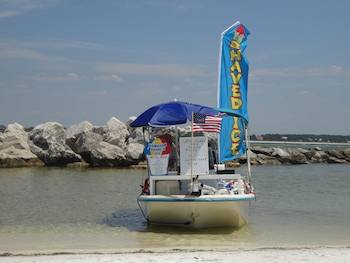
On some of our trips we take a boat and head over to Shell Island, delighting in the pristine beach. I always feel like a member of the Swiss Family Robinson. One of my favorite parts is the snow-cone boat that bobs out in the water at Shell Island. You can wade out about knee-deep and choose from a variety of flavors. Let’s just say that a strawberry snow-cone on a warm day is downright heavenly!

I don’t know what it is about going to the beach, but even sandwiches taste better when sitting in a comfy chair with your toes in the sand.
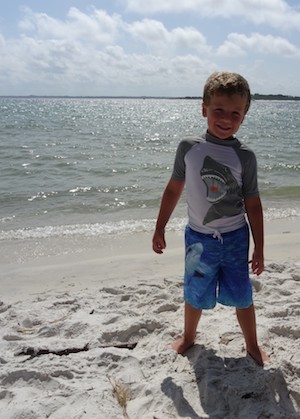
But the absolute best part is spending time with our family, playing with our grandson and watching his joy as he digs in the sand.

Because our kids live there, they know the out-of-the-way spots where tourists don’t frequent. I love that we almost have the beach to ourselves on occasion.

Sometimes, though, I think that we must look like the beach version of the Beverly Hillbillies as we make our way across the sand, our cart piled high with a canvas beach awning, chairs, a cooler, beach towels, and all the other assorted paraphernalia we take with us. Yeah, I’m glad I’m not the one who has to push that through the sand!

I say that especially because just walking across the beach can sometimes be difficult for me.

A number of years ago, I broke my hip and pelvic bone, and fractured an ankle in a car wreck. The other ankle was messed up during my basketball-playing days, so walking through loose sand pulls on all those weak places.

Sometimes we have quite a hike across the sand to reach our favorite spots. One of those moments occurred one evening when we went back to the beach to fish.

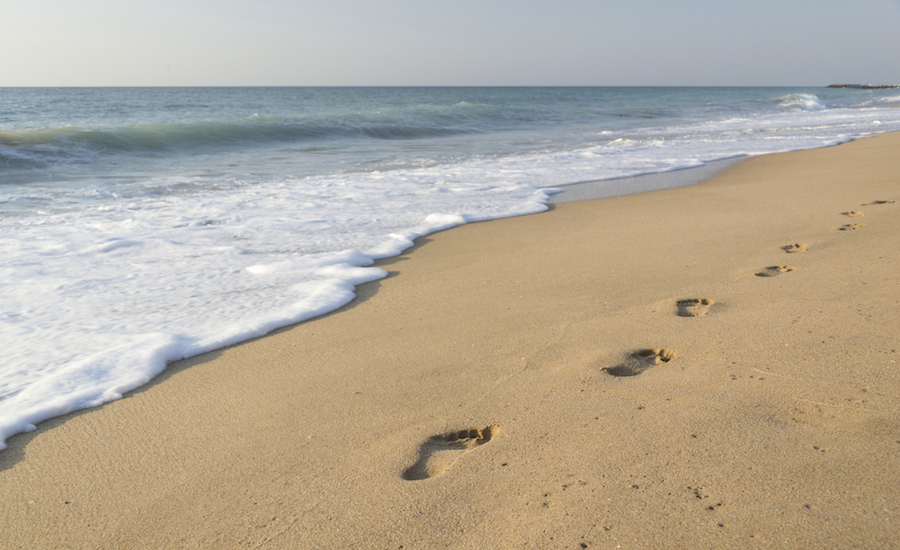
I plodded behind my husband through the loose sand, and then I noticed something: When Paul took a step, it packed the sand down—and I discovered that if I walked in his footsteps, it made my walk across the beach so much easier.

And then it was as if God whispered, “Your life is just like that. If you’ll walk in My footsteps, I’ll guide you—and as long as you keep following in My footsteps, your journey will be much easier.”

Great advice for all us. Don’t you agree?

The steps of a good man are ordered by the Lord. (Psalm 37:23)

When God Sends a Stranger

There was a post on the social sharing site Reddit today that caught my attention: “Have you ever met a stranger who you never saw again, that you still think about on occasion?” While the responses vary wildly, some of the stories were touching:

“I was walking to the bus stop in middle school and a woman walked by with her dog. The dog jumped at me and the woman pulled him back and said ‘Yes, she’s pretty, isn’t she?’ It was a small thing, but after being relentlessly bullied at school for being ugly/’looking like a boy,’ it meant the world to me. Nine years later and I still remember. :)”

“I was in a bad place. I hated my job, hated where I lived and hated the person I was sharing the house with… even hated myself for ‘letting myself go.’ One night I got off my usual bus and went to place my empty cola bottle into the bin but missed it, and it bounced past me. So I stopped, turned around, bent down, picked up the bottle and placed it in the bin. As I did this, an elderly gentleman walked passed and commented ‘You are a good man. Thank you.’ I nodded, smiled and said ‘You’re welcome.’ This single, unnecessary yet kind act sparked something within me to sort out the stuff I didn’t like about my life. Later that night I told my roommate I was moving out, and by the end of the week I had found another (better) job. Five years later, I am generally much happier.”

“I drove down to Point Pleasant, NJ, with my boyfriend one time about a year ago; he had never been and I just wanted to spend the day with him playing at the arcades and such. I’m a master of the claw and my boyfriend loves Pokemon so we were looking around trying to find a machine with a Pikachu. We found one that a man was playing on trying over and over to get one for his kids. It wasn’t till after a few tries that I realized his one son was in a wheelchair and was a special-needs child. The father gave up after half a dozen tries and his son started crying because he obviously loved Pikachu. My boyfriend stepped up as they walked away and started trying himself. After a few tries he admitted he was trying to win it for the kid. He gave up too so I figured I’d give it a shot and after a couple tries myself I eventually won it. We then darted to the boardwalk looking for the family… they were playing a water-gun game while the dad and the son watched. My boyfriend handed the boy the Pikachu and his face just lit up… the dad had tears in his eyes… We said it was no problem and walked away with smiles on our faces. I really hope the dad still sees that Pikachu and thinks of us from time to time.”

Here at Mysterious Ways, we believe people come into our lives for a reason—even if their presence is brief. Reader Dorothy Weis encountered a stranger in a hospital elevator who needed to hear her story. Lucia Cipriano received a stranger’s kindness after immigrating to this country years ago… and recently got to return the favor. Myrtle Potter discovered that helping a stranger from church was exactly what she needed after her mother’s death.

What brief encounters have changed your life?

When God Adjusts the Thermostat

Even in Texas, December gets cold, but we needed to keep our heating bill low. With my husband, James, at work, why keep the house warm just for me? I turned down the thermostat until the display read 66 degrees, then hit the “Hold” button. With a click, the furnace shut off. I started sweeping the floors as the winter chill slowly began to seep into the house. I could practically hear my dad admonishing me—“Turn up the heat!”

It was December 6th, exactly one year since Dad had passed away. The memories were too painful to revisit, yet all day I’d been replaying the 3:00 A.M. phone call that James and I got from Mom. News of Dad’s stroke. His last few days in the hospital.

If only Dad could see me now, shivering to save a few bucks, I thought. Dad was thrifty too, but he always poked fun at me for taking it too far. When I moved into my first apartment, a tiny studio that just barely fit my budget, Mom and Dad came for a visit. “Isn’t it a bit frosty in here?” Dad asked, rubbing his arms. “How about we turn on some heat?”

“I don’t turn on the heater unless I have to,” I said. “I have to watch my money.”

“Honey, it’s freezing,” Dad said. “Turn up the heat!” He whipped out his wallet and paid me to turn the heat on. For years, Dad and I retold that story. I missed his…well, his warmth.

Brrr. I shook off the cold, held a dustpan in place and swept up a dirt pile. A click echoed from the hallway. The thermostat? Within moments, the heat revved on.

I walked into the hall and eyed the thermostat. The black numbers stood out against the gray screen: Current temperature: 67 degrees. Heater’s hold setting: 70.

Huh? Someone would have had to press the button to change the temperature. But I was the only one home! It had to be some glitch.

I told James what happened when he got back from work. “That sounds like just your father,” James said. “Knowing him, I bet he won’t let you keep this place cold.”

I shot James a sidelong glance. Dad? The idea was too silly to entertain. We got ready for bed, and I lowered the thermostat to 66 again. We’d be plenty warm beneath the blankets.

Walking to the bedroom, I heard another click. I turned back to the thermostat. The setting temperature had moved once again—up to 70 degrees!

Now I was convinced. “I hear you, Dad,” I said, like he was right by my side. If he wanted to keep me warm on a difficult day like this, I’d let him.

Nearly five years have passed since that day, and the thermostat? Hasn’t had a glitch since.

When Christmas Came

I sat by my wife’s bed in the Duke University Medical Center ICU, staring intently at Becky’s closed eyelids for the slightest sign of movement.

“Can you hear me?” I asked, squeezing her feverish arm. “Our baby is out of the hospital. Olivia went home with your sister on Christmas Day. The doctor says she’s fine now. The boys are doing well too. They’re with your family. We’ll go home and all be together again…soon…”

I looked at the blown-up pictures of our daughter, now two weeks old, that I had just about wallpapered the hospital room with. I wanted Becky to see our baby’s face the moment she woke from the coma she had slipped into after her emergency cesarean on December 22.

Olivia was our miracle baby, conceived after years of infertility. She’d had some respiratory distress at birth, but she’d recovered quickly. It was Becky who had suffered a massive systemic infection and lay near death. It was Becky whom I’d been praying over almost nonstop for the last two weeks.

“Lord, I praise you,” I said aloud, my voice catching in my throat. “But you promised to never forsake us. Surely, after all the years we waited, you didn’t give us a baby only for things to turn out like this.”

Days had never felt so long. How many hours had I kept this vigil, hoping and praying to see my wife’s eyes open and for her to be healed? I barely ate. Slept for maybe an hour or two each night. I had never prayed this long or hard. I tried not to think about being a single dad to our nine-year-old adopted twin boys, Adam and Andrew, and to baby Olivia. But how could I not? How long could I go on like this?

A nurse came to the door. “It’s 9 p.m.,” she said. “I’m sorry, but you have to go. Your wife needs rest and so do you. We’ll take good care of her and we’ll see you again tomorrow.”

This was the absolute worst part. At the first two hospitals that had treated Becky I’d been able to stay by her side. But here at Duke I was only allowed in her room during visiting hours. “Your wife is very sick,” the nurse had explained four nights ago when we first arrived, rushed by air ambulance the 120 miles from Lynchburg, Virginia. “She needs quiet time without any stimulation.”

I dreaded going back to my hotel room. There the fear and loneliness couldn’t be kept at bay. I walked through the hospital to my car and slowly drove out of the parking lot. We’d been through so much. It seemed like a lifetime ago when it had all started…

We had been all set for Christmas, only four days away. It was going to be the best one ever. I remembered coming home from work, turning on the outside lights before going in the house. Becky had just finished wrapping the boys’ presents.

She looked beautiful by the tree, its branches heavy with ornaments we’d collected in 14 years of marriage. I could just picture her unwrapping the hand-painted mother-and-child figurine I’d gotten her. The whole season of Advent, of waiting for the birth of Christ, that sense of expectation, was even more meaningful as we waited for the birth of our own baby, a child we thought we could never have.

That night Becky was nauseated. She started having contractions. It was close to her due date, December 28. “Time to go to the hospital,” I said. Becky didn’t argue. She was doubled over in bed.

I did everything just as we had rehearsed. Called her father to take the boys. Made sure the dogs had extra food and water. Unplugged the tree and outdoor lights. When her dad arrived, we rushed out of the house together. My heart was pounding. It was really happening! I took one last look at the tree in our living room and imagined the five of us there Christmas morning. We couldn’t get to the hospital fast enough.

But at Virginia Baptist there was no flurry of activity. A nurse calmly took Becky to a bed for observation, hooked wires up to monitors. Becky felt worse with each passing hour, the nausea and cramps giving way to excruciating pain. The doctor suspected a stomach virus. “Your contractions aren’t consistent enough for you to be going into labor,” she said.

Becky’s sister, Beth Ann, along with some lifelong friends, came to the hospital and started a prayer chain. Neither painkillers, muscle relaxants nor whirlpool baths brought relief. The last option, the doctor said, was a morphine drip. She showed me how to press the button to release the narcotic. By late evening Becky was screaming in agony within minutes of each dose.

Those first 24 hours were awful. I felt completely helpless. But I kept telling myself, Once Becky has her baby she’ll be fine.

Then her heart rate skyrocketed and the baby’s plummeted. I yelled for a nurse. It was as if someone had pushed a fast-forward button. The nurse ran into the room, then a doctor. Becky was rushed into the O.R. for the C-section. A nurse escorted me to the intensive-care nursery. There I saw Olivia for the first time. Even with a breathing mask, she looked perfect! Thank God! But another nurse pulled me into the hallway. The doctor, grim faced, was there with Beth Ann.

“Your wife is in a coma,” the doctor said. “When we opened her up everything around the placenta was riddled with infection. We’re transferring her immediately to Lynchburg General across town for surgery.”

I left Beth Ann with my newborn and raced to be with Becky. A Lynchburg General surgeon met me outside the O.R. there with a form consenting to the operation, a look of urgency on his face. I signed the form, sank down into a chair in the waiting room and immediately dropped my head in prayer. Jesus, please save my wife, the mother of my children.

In that moment life froze. Christmas came and went. None of the joy was there. I spent every possible moment by Becky’s side, praying for her to wake up, reading to her, talking to her. Hundreds of people visited, friends, family, people we knew from church. At times they lined the hall. I knew they meant well, but I couldn’t help thinking it looked like a funeral calling.

On January 3, still unconscious, her fever raging, Becky was flown to Duke University. They put another drain in her abdomen and switched antibiotics. She still didn’t wake up. All I could do was sit by her and pray until they told me to leave.

Now in my hotel room I lay in bed, tormented with worry. How long would it be before Becky came back to me? Would she ever? Even the doctors said there was no way to know. It could be weeks, months, longer. How could I raise three children on my own?

Already I felt more separated from them each day. The boys were back in school. I talked to them daily. But our daughter, our miracle baby, I’d only been able to hold her a few times. My thoughts were in a jumble. At some point I was going to have to make some decisions, plan for the future even though I had no idea what it held. I buried my head in my pillow, but it was impossible to relax. I felt so alone, so lost.

But as I lay there, I became aware of a presence in the room. At first it was barely perceptible, but there was no mistaking it, like someone wrapping his arms tightly around me. “Do not be afraid. I am with you,” I heard a voice say. “I have never forsaken you. Look how long you waited for this child. Your prayers were answered. They will be answered again.”

I could feel the tension releasing, first in my shoulders and neck and then my whole body. Nothing had been revealed to me. The future was as uncertain as ever. Yet my worries were gone. My eyes closed and I fell asleep, the comfort that surrounded me never fading.

The next morning I awoke more refreshed than I had been in days. I hurried to the hospital. When I got to the room, there was Becky, her eyes wide open. “Where have you been?” she asked.

I was so astonished it took a few seconds for me to find the words. “You have no idea,” I said. “But first let me introduce you to our daughter.” I pointed to the photos I’d put up, told her about Olivia and how the boys were doing. Then I paused. For days all I had thought about was what was to come and the uncertainty of life; now I wanted only to savor this moment, this miracle. “You need to rest,” I said. “We’ll have plenty of time to catch up.”

Little did I know. It was another two weeks before the infection subsided and Becky’s fever broke. On January 25, she was finally released.

That evening we gathered around the tree in our home, the five of us together as a family, just as I’d imagined. The living room glowed from the light of candles. Becky beamed at Olivia snug in her arms. I didn’t think she would ever put her down.

The boys and I played with their new LEGO sets. I gave Becky her gift and watched as she unwrapped the figurine of a mother and child. Christmas, in all of its glory, had come at last.

Find more stories on hope.

What the Dreams of the Dying Tell Us

Dreams can inspire us, comfort us, confuse us and even frighten us. But the dreams of the dying, science is discovering, are something else altogether. According to a 2014 study in the Journal of Palliative Medicine, more than 80 percent of hospice patients reported intense, “more real than real” visions while asleep or awake. These visions often increased in frequency as death approached.

The study’s author, Christopher Kerr, M.D., Ph.D., the chief medical officer at the Center for Hospice & Palliative Care in Cheektowaga, New York, believes that these end-of-life dreams and visions, or ELDVs, reveal a great deal about death and the hereafter. He talked to Mysterious Ways about his startling findings.

How does an ELDV differ from a regular dream?

The vast majority of study participants were very clear that this was distinct from normal dreaming. There’s sense to it, there’s smell to it, there’s sight to it. The things you hear most from patients are “I usually don’t dream” or “I’ve never had a dream so real.” Thematically, there are people and events the patient hasn’t seen or experienced for many, many years. These dreams are typically therapeutic. They carry profound meaning. They allow for closure, acceptance, forgiveness. There is guidance. It gives the dying the feeling that they are not alone. You have someone who was wronged as a child. The wrongdoer reappears in the ELDV and says, “I’m sorry,” and that allows the patient to let go of hurt, anger or resentment.

What is the content of these dreams and visions?

The comforting presence of someone living or dead is overwhelming—72 percent of study patients dreamed of the deceased. Animals are important. Travel comes up often. A lot of times, patients don’t say where they are going, but they know they’re going somewhere. Often people relive past traumatic events in a different light so that they are reassured. A lot of soldiers see deceased comrades. Forgiveness is a big theme. Reuniting with people. It’s absolutely transcendental. We’ve had mothers whose children ended up in jail and their whole identity was in question. Then their deceased friends and relatives come to them and say, “You’re a good mother.” A lot of healing takes place.

Do ELDVs shed light on what comes after death?

They provide a profound level of comfort that those you’ve loved are there. I don’t think it’s random. Little is said in these dreams. It almost can’t be expressed verbally. There was a 13-year-old to whom a dog came back in an ELDV. She was left with an understanding that she would be okay; she was going to be loved and it was a good place.

Religious figures make up a small percentage of dream content, though. Why?

It’s less about formal symbols of faith. The themes in these dreams are consistent with the core values of religion. They’re not all seeing the Trinity. But the larger message of love and forgiveness and redemption is there.

What was your first experience with an ELDV?

I was 12 years old the last time I saw my father. He was in the hospital, dying of lymphoma. I was standing over his bed and he thought we were heading up north to go fishing, which was something we did every year. He said, “You gotta get ready, Chris. Hurry.” He tried to play with my shirt and push me a little bit. “Let’s go, we have to get on the plane.” He was reliving a meaningful past event. I never mentioned it to my mother because I didn’t want to upset her. It’s funny how things turn out, because clearly it never left me. The last thing I ever thought I’d be was a hospice doctor, surrounded by death.

Were you initially skeptical of your hospice patients’ dreams and visions?

Oh, hugely. In medicine, you’re required to come up with answers to things. It’s easier to blame an ELDV on brain failure or drugs. But there’s this whole other experience that isn’t in front of your eyes that needs to be respected and understood somehow. If I really wanted to care for people, I knew I had to care for them in totality. Now, of course, I love it. You feel like you’re shepherding them a little bit. Asking them about their dreams is a lot more important than asking what day it is. Because I have patients who are spending way more time in the other world than they are here.

Which dream or vision, of the many you’ve witnessed, stands out?

I was very close to a patient, Mary. She was an artist. Her kids were camped out for days in the hospital, understanding absolutely everything she was saying. Until she started cradling a baby that nobody could see. Her kids didn’t know who the child was. Then Mary’s sister arrived from out of town. Mary’s daughter said, “She keeps holding this baby named Danny. It’s the weirdest thing.” Mary’s sister said, “Well, that was her first child, whom she lost.”

Could ELDVs simply be the result of delirium? Or made up by the patient?

Delirium doesn’t bring any peace or meaning, whereas ELDVs do. If you’re dying, it makes sense that what you dream about has a broad perspective. But I don’t think patients can orchestrate all the events that happen in this type of dream or vision. They can’t really orchestrate their own forgiveness. If they could, they would have done it at any point in their life. There’s so much that happens within an ELDV that can’t be explained. Mothers who get to hold their deceased children—they’ve longed, sorrowed, suffered for that for 50 years. But it didn’t occur as real to them as it does right before they die.

How can caregivers and family members better handle ELDVs?

Dying is isolating, and it’s only made more isolating by not talking about it. A lot of people are probably having these experiences and don’t connect dots. Other people don’t report them, deliberately, for fear of being ridiculed. What if you gave them permission? And said, “It’s unbelievably common for people to relive past events and see people you’ve loved before.” To give them permission and support, and even to inquire about what they’re feeling and seeing, is a good thing. It’s one of those things that bring people closer to the bedside, not farther away.

What’s surprised you most about your research?

The theme of love. How, when a dying person dreams, their source of love excludes the person who didn’t love them correctly and only includes the person who loved them well. There’s this natural journey toward less of a mixed picture of wrong and right. More of just love and forgiveness. A patient had six siblings. One was really cruel to him. In his dreams, the bullying sibling is absent. In the end, it’s almost like you drive away the bad and you brighten up the good.

Are you less afraid of death now?

There’s something that’s anticipatory about it now. I’ve seen thousands of people reunited with the people that they love. I can’t say it hasn’t affected me. I can’t explain some things, but I can’t dismiss them. There’s much more grace in dying than one would assume. Much more love. That tells me that people who are lost aren’t really lost.

What’s Your Mysterious Moment?

You’ve heard of “speed dating,” but have you ever heard of “speed faithing”?

It may seem paradoxical for one to share something as deep and meaningful as one’s faith in only a short 10-minute burst, but that’s exactly what students at UC Irvine did last week, and what students are doing all across the country as part of the Interfaith Youth Core’s outreach program.

As the Los Angeles Times reports, the Interfaith Youth Core, a Chicago nonprofit, seeks to promote understanding of different religions through the program, in which students of all faiths rotate around a room, asking and answering questions about their particular faith. “Is it required to wear wraps on your head?” “What exactly do you do on a mission?”

Learning about “speed faithing” got me thinking. In a way, that’s what Mysterious Ways stories are. These stories aren’t long—in Guideposts, they only take 350 to 400 words—but through these short, inspiring true stories, we reveal a lot about ourselves and what we believe. They go deeper than “Why light candles on Shabbat?” or “What does born-again mean?” Instead, they share a very real experience from our lives when we witnessed something too incredible for earthly explanations to suffice.

In every issue, we share “Mysterious Moments,” brief notes from readers (150 words or less) about experiences they’re sure are due to more than just luck or chance. Over on Facebook, our assistant editor, Dan Kessel, shares little moments from his life every Monday. Here’s the one he shared this week.

What about you? If you had 10 minutes to tell a “Mysterious Moment” from your life—or someone else’s story that you believe wholeheartedly—which one would you tell? What story helps to explain your faith in miracles? Which one would get a “wow” from even your most skeptical friend?

Send your moments to us or leave them in the comments below. Quickly! Let’s call it “speed Ways’ing.”

Ok, I’ll work on coming up with a better name for it.

What’s the Meaning of Advent?

I’m a runner. A very sloooooow runner. And I don’t run very far. Most mornings I consider it an achievement to make it up and around the park and back home again. A little over three miles.

All sorts of thoughts go through my head when I run: “This is too hard. It’s too cold out today. Here comes that hill. I hate going up a hill. I wish I could walk it instead of run…”

Truth to tell, such thoughts aren’t very helpful. Instead I try to focus on some of the good things that are coming up: “We’ve got those flights booked to California. That should be really fun. We’ll get to see the family, the kids…”

Somehow looking forward is a spark that puts more energy in my step. Seeing what there is to hope for. That’s what Advent is all about.

I used to think that the word “Advent” meant “waiting.” After all, it was the period of waiting for Christmas, waiting to celebrate Jesus’ birth in Bethlehem. Waiting till we got to open the presents, waiting till the tree went up.

But Advent doesn’t mean waiting at all. It means “coming.” The coming of Jesus into our lives, the coming of Christmas into our hearts, the coming of love on the earth.

I think all those signs that say how many shopping days left till Christmas have got it wrong. They’re looking backwards, counting off the days that have passed (and urging us to shop until we drop).

Instead, look at every glittering light and sprig of holly as a sign of what’s to come. Not what’s here just yet, but what’s to come. What we pray for in hope. What makes some of the tough things we do and the challenges we face worthwhile.

JESUS IS COMING. He’s here. That’s the good news. But He’s always coming to make the world better.

Happy Advent. Remember, the best is yet to come.