Embrace God's truth with our new book, The Lies that Bind

Was Actor Dick Van Dyke Rescued by Porpoises?

On last night’s Late Late Show With Craig Ferguson, actor Dick Van Dyke was promoting the Blu-ray release of Chitty, Chitty, Bang, Bang. He shared a brief story about when he was surfing off the coast of Virginia beach. To hear his incredible story, skip to 8:50 in this video:

“I went out once and fell asleep on that board [a 10-inch longboard], I did, and woke up out of sight of land. And I looked around and I started paddling with the swells, and I started seeing fins swimming around me and I thought, you know, ‘I’m dead.’ They turned out to be porpoises, they pushed me all the way to shore. I’m not kidding.”—Dick Van Dyke.

Were the porpoises somehow sent to help Dick in his time of need? If we take Dick at his word, I’m not sure how else you can explain it.

Of course, no one was looking out for Dick when he tripped over that ottoman…

Using Mother’s Recipe to Nourish Body and Spirit

Sunday soup. I knew I couldn’t put off making it any longer. Every third Sunday at our Des Moines Valley Friends Meeting, we all eat together after worship. Two people bring enough soup for everyone, one that’s vegetarian and one with meat. But I had avoided signing up even though it was long past my turn.

I was a single mom of a teenager and my budget and energy often ran low. Lately, so had my trust in God, and I sometimes wondered why I bothered to attend church at all. Still, I wanted my daughter to be raised in a faith community and I was grateful for ours. So I finally signed up for soup duty.

All week I worried about what I should make. My mother, Edna, would have known. She raised much of our food on our family farm and had a knack for cooking and serving. I looked at her recipes for stews and chowders. This one seemed too complicated, that one required ingredients I couldn’t afford.

Then I came upon Mom’s handwritten directions for a simple scalloped potato soup. It had been a family favorite, and I could still picture her ladling the delicious steaming creamy soup into our gold ceramic bowls.

The recipe called for lots of potatoes, a bit of ham and cheese, celery, carrots, onions, milk and a little fresh parsley. Nothing too pricey.

I rummaged around in my kitchen. I found some leftover ham in the freezer and had plenty of potatoes in the pantry. I dug out my cast iron camp pot, the biggest pot I had. I hoped it would be enough. Our congregation was small and surely the other soup du jour would make up the difference if mine ran a little short.

Sunday morning I got up early. I diced the carrots, celery and onions, doubling the recipe. I peeled the potatoes and cut up the ham. I followed Mom’s steps and felt close to her, remembering her quiet faith. She was a busy working mom like me, but she found time to cook—and pray—for others.

I sautéed and simmered and poured in more milk to fill the pot. The soup grew thick and fragrant. I dipped a spoon in and had a taste. Mmm. Not quite my mother’s fare, but not bad.

Just before it was time to go, I put the soup pot into a box lined with paper bags and a towel to keep it warm, and loaded it into the car. It felt heavy and I thought, relieved, That should be enough.

But when I took it down to the church’s basement kitchen I wasn’t so sure. My pot looked small on the stove next to the large empty pot that people sometimes borrowed. The other soup arrived, the vegetarian one, and it looked slim too.

We two chefs glanced at each other, clearly thinking the same thing. “Maybe attendance will be low,” she said.

I nodded.

But it wasn’t. People kept arriving for worship. Usually I would be happy to see so many old friends and new faces. Today I could only imagine how mortified I would be if we ran out of soup. Please, God, I said silently, bless our efforts and let there be enough soup for the group gathered today.

Soon worship was over and announcements were made. Then people filtered downstairs. The line went down the counter and out into the hallway. I filled soup bowls sparingly, hoping everyone could at least have a little.

By the time the other chef and I had served everybody, people were lining up for seconds. “It’s sooo good,” they said, “the best potato soup we’ve ever had.” Several asked for the recipe. Some came back for thirds.

The vegetarian soup finally ran out, but amazingly there was still a little potato soup at the bottom of my camp pot so I ladled myself a bowl.

I sat down, astonished that we had been able to feed the multitude. My spirit felt lighter than it had in a long while. “Thank you, Lord,” I said.

I should have known I would be sustained even when my faith ran low. Especially then.

Try Ann Robinson’s Scalloped Potato Soup recipe.

Did you enjoy this story? Subscribe to Guideposts magazine.

Unusual Dreams: Was God Telling Her Something?

I’ve always had vivid dreams, even as a kid back in Kansas. Full of strange characters, conversations and symbols. Sometimes I can barely make sense of them, even if I write them down in my journal. Like a series of dreams I had last spring. I kept seeing buses, subways and hallways. But I always got on the wrong bus, missed my subway stop or never made it to the end of the hallway. It felt as if I were being warned. Then again, maybe I was just having stress dreams about the subway, like any other New Yorker!

I never quite figured out those dreams, and my puzzlement only intensified once I started working at Mysterious Ways. I heard story after story about warning dreams from readers and even from my colleagues. My fellow editor Danielle Lyle shared an incredible one. Years earlier, she had worked at a huge seven-level athletic store. One night, in a dream, she saw a blond boy playing on the fourth floor of the store, right by the thick rope railing that overlooked the levels below. The boy was leaning against the railing when he suddenly fell through.

“There was an urgency to what I saw,” Danielle said. “I knew it was real. That it was going to happen soon.”

She got to work early the next morning and took her manager to the spot she’d seen the boy fall in her dream. They lightly tugged the ropes of the railing. The top three were fine. But the last one came right out.

Danielle’s dream floored me. I knew God spoke through dreams. Many an Old Testament hero received a warning in a dream. But is he still doing that today? Why warn us in a dream and not, say, through a text message? Why is the method as mysterious as the message?

I brought my questions to James W. Goll, a minister and best-selling author of Dream Language: The Prophetic Power of Dreams, Revelations and the Spirit of Wisdom. According to Goll, warning dreams are still very much a thing. In fact, God may actually prefer to warn us in our sleep because we’re less likely to get distracted. Dreams that are “sticky” get our attention and spur us into action.

“They feel like flypaper,” he says. “Meaning, you can try and peel it off your skin, but it’ll only get stuck to another part of your skin. You won’t be able to get rid of it.”

There’s a reason Jesus liked speaking in parables—they’re memorable. Similarly, warning dreams are often filled with unforgettable imagery, metaphors, even plots. “God likes to put a hook in us to draw us closer to him,” Goll says. “Sometimes he’ll give us a puzzle to solve so that we have to search for the meaning.”

Goll recalled one such dream from several years earlier. In it, he saw himself lying on the floor. Soldiers in dark green towered over him, their presence overwhelming. He was filled with dread. Then the scene changed. This time, Goll saw himself standing up, looking down at the soldiers, which turned out to be tiny plastic Army men. At the end of the dream, Goll heard someone say, “And your enemies will become like grasshoppers in your own sight.”

Goll woke up, confused. He had no idea what the dream meant. Until three months later, when he was diagnosed with non-Hodgkin’s lymphoma. He remembered the toy soldiers and grasshoppers. This time, it brought to mind a story from the Bible. Of Moses sending 12 spies to Canaan. Ten spies returned to Moses, overwhelmed by the Canaanites, who made them feel as small as grasshoppers. But two of the spies—Joshua and Caleb—reported something different. From their perspective, Canaan was conquerable. Just like Goll’s lymphoma.

“God was warning me about my illness and advising me too,” Goll says. “He was telling me to look at it from his perspective.”

Dreams like Goll’s are far more common than you might think. According to Dr. Michelle Carr, a researcher at Swansea University Sleep Laboratory, dreams can sometimes predict health problems years in advance. In an article for Psychology Today, Dr. Carr cites the example of a man who had a recurring dream of a rat gnawing at his stomach. He was later diagnosed with an ulcer.

“There are several cases cited in [research] of dreams that directly indicated illness through imagery,” Dr. Carr writes. “For example, dreams preceding migraines have been reported to include pertinent images, such as being shot or struck by lightning in the head.” A 2015 study conducted by Dr. Larry Burk in Explore: The Journal of Science and Healing also found that the warning dreams of women later diagnosed with breast cancer “were often reported to be life-changing experiences that prompted medical attention leading directly to diagnosis.”

Could it be that the body knows it’s in trouble long before symptoms actually appear? Or is God warning us about our health as we lie sleeping? While we may never know for sure, the lesson seems to be to pay attention. You might even be able to change the outcome.

That’s what happened to Joy Parrott, a minister and author of Parables in the Night Season. Several years ago, Parrott had a startling dream. She saw herself standing outside her home as it was consumed by flames. Unsure what it meant, Parrott prayed about it. Every day for weeks and weeks.

Months later, while on vacation with her husband, Parrott received a phone call from her teenage son. He’d made plans to go out with his girlfriend after work but felt compelled to rush home first. He entered the house and smelled smoke.

“The smell got stronger as he walked toward the armchair where I always sit,” Parrott says. “Next to the chair was a table where I kept my coffeecup warmer plate. It was on the floor, burning.” Parrott’s cat had knocked it over, and the impact of the fall had turned it on. Her son arrived just in time to put out the fire. Parrott believes her son wouldn’t have made the last-minute stop home had she not prayed right after her dream.

But why does God warn some and not others? Or does everyone get warnings and just not know it? “God is a loving father,” Parrott says. “He’s going to alert his children to look before crossing the street. But sometimes we get so busy with our lives that we might not see or hear what he’s alerting us to.”

Which is why you could be warned through someone close to you or even a complete stranger. “If God warned you in a dream and you dismissed it,” Parrott says, “he might ask someone else to step in and help.”

So how can you know whether or not you’re being warned? Goll recommends noting anything out of the ordinary. “God will speak warnings more than once,” he says. “Either you’ll have the same dream again or you’ll keep hearing a phrase in your waking life that brings you back to the dream.”

As I’ve discovered, it’s also a good idea to write down your dreams. Look for ominous or unusual imagery. Things like dark clouds, cliffs, floods, unfriendly animals. Bridges, doorways and roadways are significant too. They often symbolize impending periods of change or testing.

After talking to Goll and Parrott, I went back to my dream journal and took another look at my dreams from last spring. Buses, subways and hallways that never went anywhere. At the time, I’d been searching for a new job. The process was stressful. I had several offers on the table. But, for whatever reason, none of them felt right. Maybe those dreams were preparing me. Making me uneasy so I wouldn’t take a job that put me on the wrong path.

Sure enough, my dreams immediately shifted this past June. Right around the time I started working at Mysterious Ways.

Two Visions: Otherwordly Glimpses of The Afterlife

When my husband drove me home from the hospital, I asked for a moment to myself. He went out to the garage, and I walked into the living room. I stood there in a daze, fear and desperation welling up inside me. I can’t believe this is happening, I thought.

I’d gone to the hospital three days before for what had seemed to be a kidney infection. I thought I’d just be prescribed some antibiotics and sent home. Then the doctor came in with my test results, her face somber. She reached out and touched my arm.

“I am so sorry, Susan,” she said. “You have Stage IV non-Hodgkin’s lymphoma.”

As my doctor talked me through my diagnosis, my mind raced. It was the most advanced stage with the lowest survival rate. I was only 55 years old. I had lived a healthy, active life. I was happily married, I had a 20-year-old daughter, my own business…. It was hard for me to process that I was so sick.

I stayed the next few days at the hospital for a series of tests and procedures—PET scans, a bone marrow biopsy and blood transfusions. Doctors hoped chemotherapy would be enough to put the cancer into remission, but the chances were low. My prognosis wasn’t good when I was released.

I’d never thought about dying, or whether there was an afterlife. It had seemed too far away to worry about. Plus, I wasn’t a spiritual person. But now, standing in my living room, I was terrified. Was death the end? Was this life all we were given?

I walked over to the French doors that led to our backyard and opened them to get some fresh air. As I stepped outside, my senses heightened, as if I was seeing this familiar scene with new eyes. The green trees on the hills behind our home were saturated with color. They seemed to vibrate with vitality. Mesmerized, I watched the leaves dance in the breeze, refracting light like hundreds of tiny gems. A flock of swallows glided on a thermal against the backdrop of a brilliant blue sky and shining clouds. I took a deep breath and smelled the ocean not far away, the rich soil from our backyard and the rosemary that grew along-side the house. I savored the scents as the sunshine warmed my skin.

Then something shifted. Any separation between myself and the rest of the world vanished. I was part of it all. I was the trees, the sky, the hills, and they were me. It felt like my body and was gone yet my consciousness remained. I was connected to something bigger than myself, something that ran through all of creation. A beauty and peace that was of this world, and yet not. For the first time since my diagnosis, I felt calm. This is what it’s like to die, I thought. I wasn’t scared. I had been shown something incredible. Proof that there was something more. A glimpse of what it felt like to transition from earthly life to the afterlife.

Unsure of how to put what I’d experienced into words, I kept it to myself until a couple of weeks later, when my daughter came to visit. My hair was falling out from the chemo, and she offered to give me a cut. We sat on the back porch as she worked, clumps of my hair falling around me. I looked out at the trees, the sky, the hills, thinking about my vision. I couldn’t keep it to myself if it might bring some comfort to my daughter.

“I had the strangest experience out here,” I said to her. I described the whole thing. She listened quietly. When I was done, she looked at me with wonder in her eyes and squeezed my hand.

“Wow, Mom,” she said. “That is beautiful. Hold on to that.”

I did. During the toughest parts of my chemo treatments, when I was exhausted and nauseous, I’d think back to that vision and tap into the serenity it had brought me. It gave me the strength to go on.

Then, three months into treatment, there was a setback. I was taking injections in my right arm to boost my white blood cell count. I developed an infection at the injection site, which led to blood poisoning. I was admitted to the hospital with sepsis.

I lay in bed at home the night I was released, desperately ill and dejected. It was the worst pain I’d felt up until that point. Sleep was impossible. I usually would’ve taken a deep breath and reflected on my vision, but in that moment, I couldn’t keep my mind on anything but the pain.

As I turned over, my right arm stuck out of the bed for a moment, and I felt something warm and soft. Something supporting my arm. A pink mist hovered at my bedside. I could see its soft dusty rose color in the darkness. It slowly rolled closer. The mist touched my hand and moved up my arm. My entire body relaxed. All the pain I felt, physically and spiritually, was gone. I was weightless, overcome with a sense of tranquility. I recognized this as a different kind of vision, one of reassurance. I lay back down on my pillow, the comforting mist nearby, and drifted off to sleep.

I soon recovered from my blood poisoning and finished my course of treatment. After seven months of chemo, my cancer went into remission. I never experienced anything like my two visions again.

Today, 16 years later, I live with the knowledge that my cancer could return, but I don’t dwell on it. I have the peace I need to keep living this life to the fullest, because a glimpse of what awaits let me know that we are given so much more.

Two Butterflies–One White, One Blue

Today’s guest blogger is assistant editor Daniel Kessel.

Two weeks ago, I wrote about a poem that gave me unexpected comfort as my family continues praying for my aunt’s recovery after her stroke.

Over the weekend my grandmother–who’s no stranger to Mysterious Ways–gave me a call. “I’ve got a story for you,” she said. “It has to do with your aunt.”

She was on her way home one day last week when she spotted a yard sale off Main Street in our New Jersey town. She didn’t need to buy anything and knew she shouldn’t spend any money, but she couldn’t resist the urge to take a peek. She pulled over and started browsing.

One item caught my grandmother’s eye: A beautiful snow globe with a pastel blue base. It was in perfect condition, and it wound up to play a song she recognized from an old Disney movie.

Most of all, she loved the two glass butterflies inside. She bought it on the spot and planned to give it to my aunt in the hospital.

The next afternoon, my grandmother went outside to take out the trash. She glanced up and noticed something flying above her–two butterflies, a blur of blue and white as they fluttered around each other, dancing to some unheard rhythm.

The two butterflies floated just above her head for a full two minutes before they finally flew away.

My grandmother stared up in awe, filled with a sense of peace. Somehow, she felt that the butterflies were a sign from above, a message that my aunt would be okay.

It wasn’t until my grandmother went back inside the house and saw her yard sale purchase on the table that she realized the two butterflies in the snow globe were exactly like the ones she’d seen outside–one white, one blue.

Butterflies have been popping up for my grandmother ever since. In a necklace her niece made for her. In a card she received at church. These butterfly sightings have been a source of strength for the whole family. All those prayers must be working–my aunt is now home from the hospital.

At Mysterious Ways, I’ve come across so many stories about “winged messengers,” tiny creatures that can impact our lives in big ways. Like the butterfly in Quito, Ecuador, that helped bring a father and son closer together.

Or the little bee in Manteca, California, that brought comfort to a woman grieving the death of her brother.

Then there’s the first story I worked on, about a swarm of dragonflies that helped a devastated mother from Ottertail, Minnesota work through the loss of her 27-year-old daughter. These unique encounters show how some of God’s most important messages come in the smallest packages–if only we keep our eyes open.

What about you? How has one of God’s littlest messengers given you much-needed inspiration or hope? Share your story with us.

True North

It was well after midnight when I stepped out of the taxi onto the Alaska Pacific Seafoods parking lot in Kodiak, Alaska. A whipping wind drove snow into my eyes and I shivered in the single-digit temperature.

“Here ya go,” the taxi driver said as he hauled my gear out of the trunk and dropped it in the snow. He climbed back into the cab and drove away. “Wait!” I wanted to shout. “Don’t leave me here. I can’t do this crazy job after all!”

But the taxi’s taillights disappeared into the darkness. I’d never been on more than a ferryboat in my life. What on earth had I been thinking when I signed up for a job monitoring catches on fishing boats in the Gulf of Alaska?

Back home in Montana, the online ad had sounded perfect: “Wanted: biologists to collect regulatory data aboard commercial fishing vessels.” I had a biology degree. And my husband, Jim, and I desperately needed the money.

As newlyweds we’d moved out West and bought a fixer-upper in a small town in the rolling hills of central Montana. Both of us had a soft spot for old construction, and our turn-of-the-century bank building certainly fit that bill.

We were charmed by the Old West façade, the wagon-wheel window. But it didn’t take long for bills to roll in. New roof. Foundation work. Siding. Insulation. Then the furnace died.

Jim’s start-up business—servicing microscopes—wasn’t taking off. Every house repair left us deeper in debt. At least Jim knew construction. He could replace roofs and dig foundations. I couldn’t even start a fire in our woodstove without his help. Every day I felt more useless. The stress and sense of failure were unbearable.

Especially because just a few years earlier, I’d prided myself on my independence. My dream to move to Montana had been born during a cross-country trip I’d taken with a college friend in a rented minivan we nicknamed Weezy. Not long after we married, Jim and I spent a summer with a forest-service crew in Montana, clearing trails.

What had happened to that girl who’d hiked rugged mountains, lugging axes and crosscut saws? Maybe it was her—the intrepid adventurer I’d given up for dead—who’d leaped at the Alaska job. Or maybe I’d been scouring those online want ads looking for an escape, far away from broken furnaces, mounting debts and my feelings of fear and uselessness.

Maybe it was myself I was running away from. I’d prayed to God for help and nothing had changed. Maybe he thought I was useless too.

It wasn’t as if this Alaska job was a hardship assignment. I’d been hired as a groundfish observer, monitoring catches of mostly bottom-dwelling fish like cod and pollock to ensure that Alaska’s fisheries remained sustainable.

The program, overseen by the National Marine Fisheries Service, included a three-week training course in Anchorage. The only thing not included in the training: actual time on a boat.

Of course, it’d help if I could find the boat. I stood in the pitch-black parking lot, imagining myself laughed off the vessel by no-nonsense fishermen.

I headed toward some lights in the distance, lugging my sampling gear behind me. The lights came from a small fishing trawler. A fisherman was lowering supplies onto the deck with a crane.

“I…I’m looking for the Sea Mac?” I said, trying to keep my voice steady.

“This is it,” the man answered, swinging down from the crane. He hoisted my gear on board. I had no choice but to follow. I grabbed the freezing rungs of a metal ladder leading down to the deck. I tried not to think about the dark water lapping below. Soon the lights of Kodiak were blinking past as we steamed out of port.

A fisherman showed me to my bunk. We passed a tidy kitchen with a large TV mounted on one wall and a small washing machine in a corner. Doors were held open with large hooks. He stepped inside the boat’s bathroom and picked up a bucket. “You’ll need this,” he said, handing it to me.

It didn’t take me long to find out what he meant. As we made our way into the gulf, 20-foot seas sent me straight to my bunk. I lay there, head suspended over the bucket, feeling sicker—and more homesick—than I’d ever felt in my life.

The following day, the seas calmed a bit and so did my seasickness. I ventured onto the deck. The air was sharp, and we were moving up a channel between two snowy, mountainous islands with rocky beaches. Here and there the white heads of bald eagles stood out against dark fir trees. For a moment, the immensity and grandeur of it all almost made me feel brave.

Almost. That night, the fishermen hauled from the water a huge net bulging with writhing, silvery fish. They emptied the net into the trawl alley, a large containment area on deck with openings to holding tanks below.

Tonight I was just observing, learning how the boat worked so I could start collecting data in the morning. There were so many fish! Their white bellies flashed in the boat’s sodium lights. I stood there petrified in my brand-new orange rain gear as the men scurried around. I might as well have been right back home. I was useless.

The following morning, just before sunrise, a knock came on my door. “We’re hauling,” a voice called. I gathered my courage, put on my rain gear and walked onto the deck. Freezing spray greeted me. I stumbled as the boat’s stern dipped.

I caught my balance just as the net emerged from the water, groaning with fish. The fish spilled onto the deck, quickly filling the trawl alley. I lifted a gate on a small, waist-high sample bin connected to one side of the alley, and fish flowed into the bin. I was kneedeep in fish before I finally managed to close the gate. I had to identify, sort, measure and weigh every single one of those fish. Hands shaking, I pulled out my scale, braced myself against the side of the bin and got started.

By the time I finished, every part of me stank and my fingers were numb. But I’d done my first sample. I headed back to my bunk giddy with relief.

The next day was the same, and the day after that. In all, I was in Alaska for six months, on five different boats. Each voyage I got a little more confident, a little faster at processing samples. At last, I sat across the desk from a National Marine Fisheries Service debriefer, chewing my lip. This was where my work would be analyzed for even the slightest error.

I’d heard horror stories of debriefers tossing months of painstakingly collected data because the observer had unwittingly introduced statistical bias into samples. The debriefer handed me my evaluation. “Good job,” he said with a smile. I wanted to jump up and hug him.

After a long plane and train ride, I stood with Jim on the front steps of our old bank back in Montana. The July heat felt good on my sun-deprived shoulders. Yet a shiver ran through me as I reached for the doorknob. All of a sudden, I felt the confidence I’d gained in Alaska begin to evaporate.

Through the window I could see a towering mound of insulation. Our house was still a construction zone. And we were still deep in debt, despite what I’d earned as a fisheries observer.

I thought back to my first night in Alaska, when I’d stood watching the taxi lights recede, feeling helpless and scared. Was that the real Erin? I wondered. Was the Erin who drove Weezy across the country and waded into a bin full of Alaskan pollock just an aberration? This endless renovation, our debts—this was real life.

But then another image came: Me, emerging onto the deck of the Sea Mac and feeling transported by the sight of snowy crags and the white heads of bald eagles silhouetted against dark fir trees.

It was as if God was saying, Look again, Erin. Not just at the landscape. But at myself. What would I see if I looked at myself with God’s eyes, alert to the goodness of his creation? I was part of that creation too.

I opened the door and stepped inside. It turned out that pile of insulation was left over from the new loft Jim had added while I was gone. A whole project done! Only cleanup remained—one renovation job I knew how to do.

And I tackled more after that. Let me tell you, spending six months up to your knees in fish makes nailing two-by-fours seem like a piece of cake. Bit by bit our old bank became a home. Jim’s microscope business grew. We paid off our debts.

I’d gone to Alaska seeking a paycheck, maybe even an escape. I’d found myself—or I guess you could say God found me. He showed me the Erin who’d been there all along. Competent. Confident. At home in his beautiful, bountiful creation.

Download your FREE ebook, The Power of Hope: 7 Inspirational Stories of People Rediscovering Faith, Hope and Love.

True Miracle Saves a Life on Interstate 94

An incredible story about a true miracle on Interstate 94 is making its way around the Internet this week, and I just had to share it with you.

Victor Giesbrecht, 61, and his wife, Ann, from Winnipeg, Canada, were driving last Saturday night on Interstate 94 in Wisconsin when they spotted two women standing outside their car on the side of the road. While other cars passed by, Victor pulled over, asking how he could help.

The car had a flat tire, the women said. They were struggling to remove it and put on the spare. Victor got out of his truck, rolled up his sleeves and got to work. Within minutes, he had the tire on. Grateful, the women shook Victor’s hand and thanked him.

“Someone up above put me in the right place at the right time,” Victor said.

Victor and his wife drove off. The women followed shortly afterward. They were talking about their good fortune when they saw a vehicle up ahead on the side of the road. Not just any vehicle. Victor and Amy’s truck.

The women pulled over. Victor was slumped over in the driver’s seat. Amy was panicked. “He’s had a heart attack!” she yelled.

The women sprang into action. One of them, Sara Berg, began to perform CPR. She kept it up until police arrived with a defibrillator. An emergency helicopter landed on the interstate to take Victor to the nearest hospital. Thanks to the women’s actions, Victor’s life was saved.

How did Sara know the proper procedure for CPR? It’s part of her job. She works as a nurse’s assistant.

Someone up above put Victor in the right place at the right time. Sounds like someone put Sara in the right place, too. What would have happened if she hadn’t gotten that flat? What would have happened if Victor drove past, like so many others?

Do you have a right place, right time story, like Guideposts reader Sue Jackson did? Or have you learned an amazing story like Victor and Sara’s from your local news? Send it to us at mw@guideposts.org.

True Miracle: Saved from the Surf

If there’s one thing I learned from last week’s blog story, it’s that anybody can be a hero—even a 9-year-old boy. But a story I read this week reminded me that sometimes heroes may need a little help getting where they need to be. Is it luck, coincidence or something else that delivers the right person to the right place at just the right time?

James Pribram was in Canada on a business trip. A pro surfer, he earns his living as a company ambassador for various youth-and-sports-oriented companies, and also spends time teaching schoolchildren to take good care of the ocean environment. The ocean is his church, he’s fond of saying. He had three days left before he was due to fly home to California.

But something was tugging at him. He couldn’t escape a nagging feeling that he had to be at home—it couldn’t wait three days. His mother had recently fallen and suffered an injury, and although it wasn’t life-threatening, maybe she needed his help. All he knew was that he had a feeling he needed to go see her. And it had to be now. James wrapped up his work early and booked an immediate flight home.

A day later, in Laguna Beach, California, 22-year-old Maira Khan was walking along Pearl Street Beach with her friend Meghan and younger brother Aadil. Maira was careful not to venture too far into the water—she’d never learned how to swim.

Instead, she admired the towering cliffs lining the coastline, the giant boulders and dramatic sandstone arches carved by tides for millennia. She and Meghan snapped some photos. Maira stepped out onto a shallow reef, climbed up one of the larger rocks and turned her back to the ocean, posing for a great shot.

That’s when the wave hit. It slammed into Maira, sweeping her from the rock and tossing her like a piece of driftwood.

Bam! She was thrown into a rock as another wave tugged her under. The reef tore at her arms and legs as she struggled to stay afloat.

The waves had caught them all by surprise. Meghan was knocked over, but managed to scramble to higher ground. Aadil looked on in horror, not sure what he could do.

Just then, a tall figure sprinted towards them, gliding across the sand in his bare feet. He paused briefly to asses the situation and then ran straight into the water, unperturbed by the sharp rocks, muscles and reef just below the surface. He dove into the grinding surf, grabbed Maira around the waist and pulled her safely to shore. Paramedics arrived soon after. “Take care,” the man said, and left the scene as quickly as he’d arrived.

Who was Maira’s mystery hero? As soon as she regained her composure, Maira asked if anyone around had recognized him. “He’s a pro surfer,” she was told. “You can look him up on the internet.”

“His name is James Pribram.”

When she got home, Maira looked James up. She discovered he’d rescued swimmers two times before. It was only after emailing James that she discovered the story of her rescue was more amazing than she knew.

That afternoon, James had brought his mother lunch. They went outside to eat on her balcony—which overlooked Pearl Street Beach. The same beach where he’d first learned to surf. A beach he knew better than anyone.

When he saw Maira, and the approaching waves, he knew what was about to happen.

“Call 911,” he told his mother. He ran down to the beach…and saved Maira’s life.

Was it only concern for his mom that brought James home early? Or did his “church” call him home for a different reason?

We know how Maira’s family feels. To thank their hero, they presented James a clock—with the word “angel” engraved on it.

Do you have your own story of the right person being in the right place at the right time? Or a story from your local news that you think is a Mysterious Ways? Send it to mw@guideposts.org

True Miracles at Work

We recently asked you on our Guideposts Facebook page if you’ve witnessed any miracles lately. You shared some incredibly inspiring stories, many about the healing of health issues. God’s mercy, God’s grace and God’s love are truly at work in your lives!

Maribeth Uhlenhopp says, “My mother was supposed to die within six months of her very rare and aggressive cancer diagnosis. She lived 17 years! She was present for my wedding and the birth of my first child!”

Another amazing story comes from Stacie Moody, who says, “My parents were told to make funeral arrangements when I was born 46 and a half years ago. I am now a social worker who helps children and families. And I get to see my grandson, Aiden. God is so awesome!”

Lea Sevilla Macaraeg is celebrating her sister’s recovery from myasthenia gravis. And Karen McMillian tells us that by all rights she should be in a persistent vegetative state, “but by God I awoke from a 39-day coma; I should not be talking or walking, but thank God I am doing both (kind of).”

Phyllis Belcher Jennings is grateful to be getting around: Every day is a miracle for me. I have severe rheumatoid arthritis and two very, very bad knees The doctor is amazed I am even able to walk!”

Sometimes we experience many miracles in a lifetime, as has Evelyn Kraemer. “A friend from church went for cancer surgery on his throat. Afterward, the doctor came in with a report in his hand and kept repeating in a shocked manner, ‘There is no cancer!’ After a week in the hospital, he is back serving in our church. Miracles are happening in Tampa, Florida.”

Kraemer continues: “My son was born with a condition called thanatophoric (meaning “death-bringing”) dwarfism. We were told he would only live minutes. He did not cry at birth. They put a tube down his throat to help him breathe and put him on a machine. One nurse told me he would never get off the machine.

“But God had other plans. He got off the machine, he was trached, had a g-tube placed and was sent home after six months in the hospital. He will turn six years old this August. If I ever forget that miracles happen, I only have to look as far as my living room into the face of my smiling, laughing, happy son.”

Not all ailments—or recoveries—are physical; Donna Walker Oleary says, “My friend who has had a broken heart over her father’s passing was healed of that broken heart at church. She had suffered from this for many, many years. God is so good all the time!”

When tough times hit, miracles are especially welcome. ”Three years post layoff, God gives us our daily bread,” shares Randy Krusee.

“Hubby’s car broke down on the way to work about a month or so ago,” says Nikki and Sammy Bandy. “We took his car to get fixed and had $155 put up to pay the mechanic. A few days later, I noticed there was a transfer for $100 to my checking account. We have no idea where it came from, but later that day the mechanic called: He had found the problem, got the right part and fixed it. With that extra $100, we had $255 for it. The mechanic bill was $254.03. Definitely a God-sent miracle!”

A miracle can be pure joy, as witnessed by Jeanne Maudsley Fewkes: “Last week I looked at my new granddaughter for the first time!”

When all is said and done, Jane Stites sums it up for all of us: Every day is a miracle!”

Download your FREE ebook, Mysterious Ways: 9 Inspiring Stories that Show Evidence of God’s Love and God’s Grace

Traces of God’s Love

I had just a minute to sit with a cup of coffee, a sweet sip of rejuvenation, and it was simple joy when I sank into the comfort of my favorite chair.

Then I saw them.

There was a plant, spikey and island green, in a heavy, glazed pot. It sat on the marble hearth. But it wasn’t the plant that made me smile. Or the pot that held it.

It was the toys.

Tiny policemen. Six or eight of them. Posed and perched on the slim, shiny leaves.

Oh, the unique blessings of a houseful of boys.

It wasn’t unusual to find such a thing. Batman has been bobbing in the bathtub for two decades. Rubber lizards lounge in the basin of the pedestal sink. A synthetic snake coils around the curtain rod in our schoolroom.

Boys are present here.

Affirmation of their presence delights me.

And although it is a little different from the left-behind treasures of little boys, we, as followers of Christ, can leave a delightful trace of the presence of the Lord.

As believers in Jesus as God’s one and only Son, we have the indwelling of the Holy Spirit. And the Spirit’s very Presence can radiate through me. That means that every person we come into contact with, every living, breathing, desire-of-His-heart, can be left with the grace of His love.

In any situation.

For even a slip of time.

If we’ve forgiven, we’ve left His trace.

If we’ve extended mercy, we’ve left His trace.

If we’ve shown compassion and kindness, we’ve left His trace.

It is always possible to leave the fingerprint of God’s love.

READ MORE: THE ONE WHO NEVER GROWS WEARY

I reached out to pluck the toy troop from my plant. I lifted a single gentleman from the leaves. I turned him over in my hand.

Suddenly I thought better of removing him. I tenderly placed him back on his look-out.

The guys needed to stay.

They were a small but powerful reminder of what I want to leave behind.

To the Man Who Broke into My House

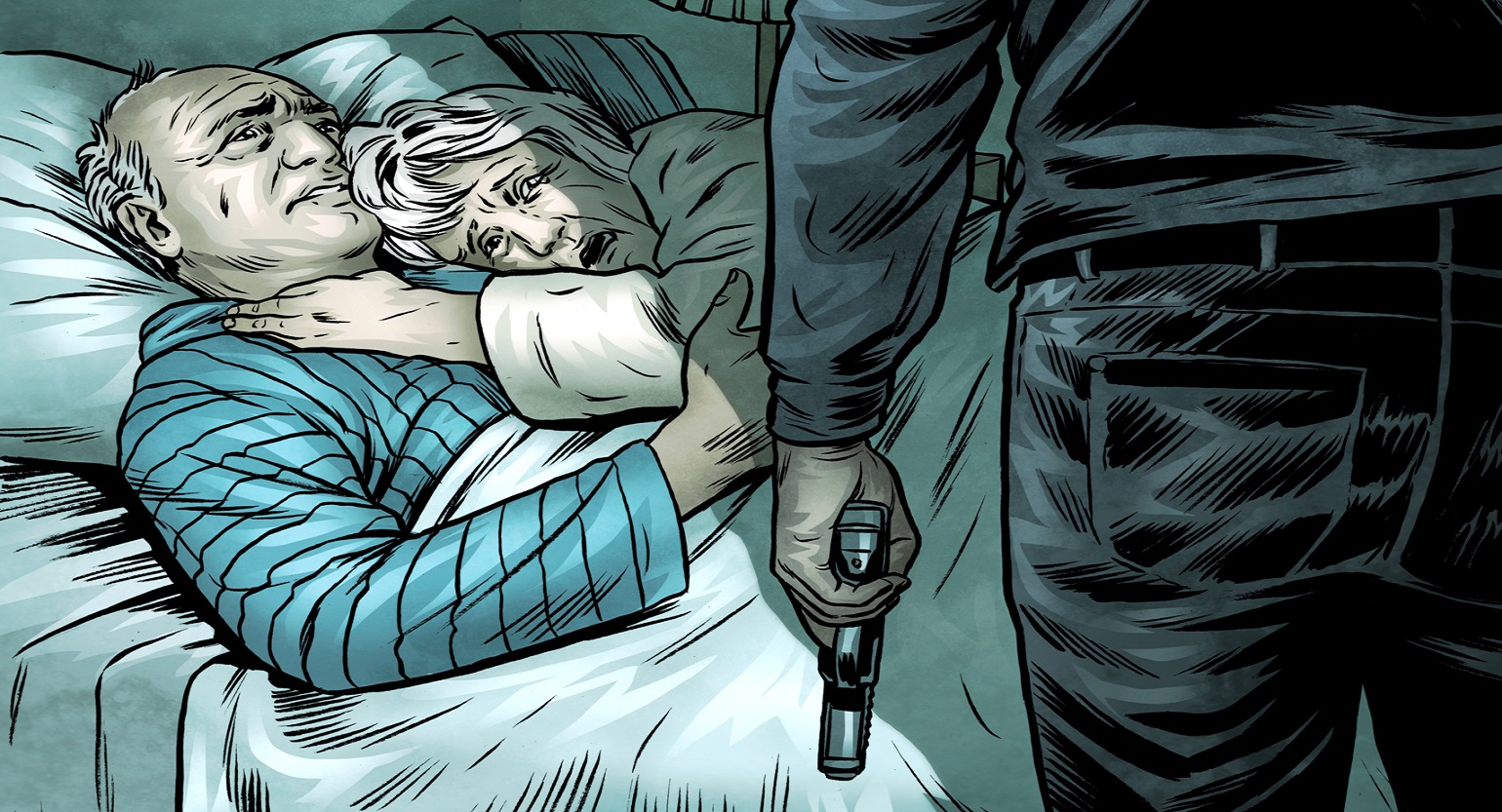
Bonjour. It’s me. The French-Canadian woman you robbed on Lepage Avenue in Dorval, on July 4, 2012, at one o’clock in the morning. You might not remember me. I would understand if you don’t. It was very dark and you were very tense. But as for me, I will never forget you. Or your voice, which roused me from a deep, deep slumber.

“Get up and get me your money and jewelry!” you barked.

You were standing at the foot of my bed. Tall, skinny, dressed in head-to-toe black and that ridiculous Scream ghost-face mask (really, where does one buy an outfit like that?). You had my 80-year-old husband, Walter, in a headlock. That got me mad. I’m sure you didn’t know it—how could you?—but Walter was in the early of stages of Alzheimer’s. I wagged my finger at you.

“Let him go, he could be your grandfather!” I said. To your credit, you released him as if he were made of hot coals.

I told you we didn’t have any money or jewelry in the house. That we were just two old folks living a simple life. You didn’t believe me. You told Walter to take the drawers out of the bureau and empty them on the bed. Your voice quavered. I could tell you were new at this. You had a gun, but it was pointed at the floor. Was it fake? I couldn’t take a chance. If only I could somehow make it to the hallway, I could hit the security alarm and alert the authorities.

As if reading my mind, Walter dropped one of the bureau drawers and you got distracted. I saw my chance and bolted. No easy feat for a sixty-something, mind you. I jabbed the alarm.

Seconds later, you grabbed the back of my pajamas and you pulled me back to the bedroom.

“You shouldn’t done dat,” you said. It sounded like an impression of a villain in some bad television movie. But it must’ve scared me because all of a sudden I felt dizzy, disoriented. When I got my wits about me, you told me to hand over the earrings and necklace I was wearing. I obliged. You were busy examining your loot when I summoned the energy to break free again. I ran out of the bedroom, grabbed my cellular phone from the foyer and called 911 from the porch.

“Help!” I said. “There’s been a robbery—”

You tried to wrestle the phone from my hand, then dragged me back into the house to the living room.

“You shouldn’t done dat,” you said again, same bad accent. My legs wobbled. I grabbed the sofa for support. In the distance, I heard sirens. Thank heavens! Then I blacked out.

Subscribe to Mysterious Ways Magazine

When I came to, you had left. So had I. I was in an ambulance. A man held defibrillator paddles over my chest. Walter knelt beside the paramedic, asking over and over if I was going to be okay. Before I could ask questions, I was out again.

I woke up in an all-white room. The hospital. Nurses, doctors and detectives rushed in and out. I told the police all I could remember about you, then had a CT scan. I was so foggy, so tired. I couldn’t make much sense of anything. Until the following morning when I was transferred to a more specialized hospital in Montreal. The physician shook his head at the scans of my heart.

“Madame, when was the last time you had your heart examined?”

“My heart?” I said. “Never.” Why would I? I was fit as a fiddle, as the saying goes.

“I can hardly believe how clogged your arteries are,” he said. “I’ve scheduled you for immediate triple-bypass surgery. You are very, very fortunate that you got here when you did. A few more days like this, Madame, and you might not have been so lucky.”

I was completely shocked. I had never had any chest pain. No shortness of breath. There was no indication I was a ticking time bomb, other than feeling sluggish.

Young man, I’m not sure why you picked our bungalow out of the dozen or so identical houses on Lepage Avenue. We certainly didn’t have the nicest lawn or the fanciest car in the driveway. Still, you did pick us. So thank you. If it wasn’t for you, I’d be a goner. I wouldn’t have had the surgery. I wouldn’t have recovered. I wouldn’t have been there to take care of Walter.

You were never caught, but if you read this, Monsieur, I would like you to know you are forgiven. You saved my life. I pray you’ve turned your own life around. It’s never too late.

Of course, it would be nice to have my jewelry back. But I will settle for a long, healthy future.

Sincerely,

The Woman You Robbed

Subscribe to Mysterious Ways Magazine

To Heaven and Back

Dennis Hale sits at the bow of the dive boat. It is April 2009. A documentary film crew has brought him to this spot in the middle of Lake Huron to talk about the rusting hulk of an ore boat that lies 200 feet below. He remembers his crewmates, his friends.

Twenty-nine sailors set out on the freighter’s final voyage. He alone survived, and a day never passes that he doesn’t think about that.

It’s been 43 years since the Daniel J. Morrell sank in a historic Great Lakes storm, but Dennis has avoided returning here. He has seen photographs of the ship’s bow resting eerily on the bottom.

This is different. It makes him think about things he’s long tried to forget. The story he’s been afraid to tell, even to those who brought him here today.

“Keep this to yourself,” his priest had advised him long ago. “They’ll all think you’re crazy.” Now, though, he’s decided that not telling the whole story will finally drive him mad.

November 28, 1966, the Morrell embarked on its final trip of the season. Ships did not typically set sail so late in the year, when the infamous gales of the Great Lakes are at their worst.

The company that owned the freighter, however, ordered the crew on one more run, Buffalo to Taconite Harbor, Minnesota, to bring back a load of iron ore. Dennis and his shipmates weren’t happy. He was eager to return to his wife and two daughters for the holidays.

“Don’t sweat it,” said Stu, the wheelsman. “We’ll load up and turn right around. We’ll be home in a week.”

At least Dennis and his shipmates were all in it together. They’d gotten to be like family. Dennis had worked as a painter and chef in the past, but his job aboard the Morrell finally felt right. A second home. As watchman, it was his job to look out for hazards in the water.

That evening, Dennis peered up at the overcast skies from his spot in the pilothouse. A light spray blew over the bow–nothing alarming. No worrisome weather reports on the radio. After his watch, Dennis ate dinner in the galley and brought a plate to Stu. Then he returned to his bunk and went to bed.

Bang! A noise startled him awake. The anchor bouncing against the bow? He settled back onto his pillow. Bang! This time, he felt the ship lurch, heard his stowed gear tumble to the floor.

He tried the light switch. It didn’t work. He jumped out of bed and rummaged through the dark cabin for clothes. The general alarm sounded. No time. Dennis grabbed his life jacket and rushed out on deck wearing just his boxer shorts.

“The hull has split!” a crewman called to him. Huge waves pummeled the Morrell. The ship’s steel was ripping apart below the waterline.

“I’ll meet you at the life raft!” Dennis shouted. He bolted toward his cabin for some clothes. Feeling his way through the dark passageway, he counted doorknobs to keep track of where he was. His room was pitch black. All he could find was a pea coat. That would have to do.

His bare feet went numb on the slushy deck. He ran toward the life raft–a wooden platform connected to two large floating barrels. The raft was designed to detach and float away safely after the ship had submerged. Dennis joined the other men and listened to the screech of the ship’s ripping hull.

Something rose from behind a wave. Another ship, lit up and under power but without a crewman to be seen. Impossible. Then Dennis realized. The stern! The Morrell had torn completely in two. The stern thrashed about in the water, out of control, propellers still churning, headed right toward the life raft.

The collision sent Dennis hurtling into the black, icy water. He kicked and flailed desperately to the surface, searching for anything to grab on to. A dark wooden slab bobbed among the swells. The raft! He swam toward it but a wave tossed him away.

He gathered his strength and lunged forward again. This time, he managed to grab hold of the side and climb aboard. John and Art were there, soaked, out of breath. A fourth man joined them–Fuzzy. The rest… Dennis looked out over the water. No signs of life.

The four men lay helpless. Huge waves washed over the little raft. The wind lashed at their skin. No one talked. The sun came up and Dennis saw that John and Art hadn’t made it through the night.

Please don’t leave me here alone, Dennis prayed. He nudged Fuzzy with his knee. “Still hanging in there,” Fuzzy grunted. But he was coughing, complaining that his lungs were heavy, like they were full of something. He could barely breathe.

He lurched over, taking his final gasp, and landed limp over Dennis’s legs.

Dennis thought of his crewmates’ families, then of his own. He lay among his fallen friends and prayed. Not for survival. For mercy. God, let me die in peace.

It snowed that night. Dennis shivered beneath the damp pea coat. He closed his eyes, resigned to death. But in the morning he was still alive. The sun felt warm. He was so thirsty. He crooked his neck and slurped from a piece of ice that dangled from his collar.

“Stop eating the ice,” a voice boomed out. Dennis looked up. A strange man with white, wavy hair and bushy eyebrows stood before him. Am I losing my mind? Dennis thought.

He followed the man’s command. And then it happened.

Dennis was rising–up, up, up into the clouds. He looked down at the four bodies on the raft–his own among them. But he felt safe.

Finally he stopped rising. He was in a field full of flowers. Is this really happening? he wondered. A man, sitting in a circle surrounded by a golden fence, beckoned to Dennis. He took Dennis’s palm and read out the scenes of his life–from his childhood in Ohio up until his final moments on the raft.

Where were his shipmates, Dennis wanted to know. Where was the Morrell?

At the bottom of a hill he saw the bow of the freighter. Dennis climbed aboard. Everyone was there: John, Art, Fuzzy, Stu. It was so warm, comforting. They laughed and hugged. The ship’s stern appeared, drifting toward them. The two pieces of the ship melded together, the Morrell whole again.

The men cheered. Dennis walked back to the engine room and encountered the rest of the crew. One of the engineers called out to him, “It’s not your time, Dennis. You have to go back.”

Dennis was sucked out of the room. Back down to the hard wooden deck of the life raft. Bring me back! he thought–but it was over. Still thirsty, he tried to suck the ice on his coat again. “I told you not to eat the ice, Dennis!” boomed the voice once more. “You’ll lower your body temperature and die.”

Dennis stopped. He lay in the sun, waiting and drifting. Hours later, a motor whirred in the distance– a Coast Guard helicopter. After 38 hours on the raft, his nightmare was over.

One of the first things Dennis did was describe what he’d seen to his priest, who warned him not to repeat the story.

What if the man was right? Would people think he was crazy? Or that he’d suffered delusions out there, fading in and out of consciousness, his body fighting off hypothermia and dehydration? Sometimes Dennis doubted it himself.

But he knew the man with the bushy eyebrows saved his life. Eating the ice, he later learned, would have caused him to freeze to death. Yet why had he survived and not his friends?

The question tortured him for years. He sank into depression and substance abuse; his marriages floundered. He often thought he’d have been better off dying with his shipmates. Why me, God? Why did you spare me?

Forty-three years later, on the deck of the dive boat, Dennis can no longer deny what happened when he rose from the raft, in the midst of the greatest tragedy he’d ever known. The Morrell is down there, at the bottom of the lake. Twenty-eight lives were lost, too soon.

But he closes his eyes and he remembers his friends, standing aboard a newly mended ship, in a port of call he barely has words to describe. He still feels that warmth. That love. He can’t keep the full story a secret any longer. If there was a reason he survived, he believes, it was to tell the world about this.

Download your FREE ebook, Mysterious Ways: 9 Inspiring Stories that Show Evidence of God's Love and God's Grace.