Embrace God's truth with our new book, The Lies that Bind

The Right Man at the Right Time

Brrr, it was cold. So cold it took an act of supreme will for me to crawl out of bed. I shivered as I made my way down to the basement, though why I was bothering to try and get the furnace going again I couldn’t tell you. I already knew it was hopeless.

My wife and I had finally bought our first home, a 1905 farmhouse just outside of Mansfield, Illinois. It needed work, for sure, but it beat the shoebox we’d been renting from a relative. We moved in the summer of 1970 and started fixing the place up with what little savings we had left.

Then fall came and the weather got brisk. One night I went down to the basement to fire up the furnace. No matter what I tried, I couldn’t get it to work. I called every heating company in the book.

They said the same thing. “That type of furnace has been obsolete for years. You need a new system.” No way could we afford that. For weeks, my wife and I wore coats around the house and huddled by the oven, worrying about what to do. Our dream house had turned into a nightmare.

So I didn’t know why I was bothering to go down to the basement this morning. Maybe I just wanted to glare at the old furnace. “Lord, what are we going to do?” I cried out, sitting on a cinder block to think.

Just then, something slid off the joist above and fluttered to the ground. A dusty, yellowed card. I picked it up. There was the date of installation for the furnace…many decades ago. Below the date was “Mr. Doss.” The installer.

Mr. Doss. I puzzled over the name. In my small town, everyone knows everyone. I seemed to recall a Mr. Doss once worked at the appliance store. But that was long ago. Was he still around? I looked the name up in the phone book and found a listing. I dialed the number. “Hello?” a man answered.

“Is this Mr. Doss, the furnace installer?” I asked.

Mr. Doss told me he was more or less retired now. But he still lived nearby and he agreed to take a look.

He got our furnace running in minutes—and only charged a minimal fee. “It’s just good I had the parts lying around,” he said. “I’m probably the only person in the world who would.”

And good too that his business card was lying around just when I needed it.

Download your FREE ebook, Mysterious Ways: 9 Inspiring Stories that Show Evidence of God’s Love and God’s Grace

The Remarkable Reunion of a Former POW and the Soldier Who Saved Him

Henk Metselaar rarely talked about his time as a Dutch prisoner of war during World War II. Except for one tale—how he was saved two days before the war ended, thanks to the kindness of a Canadian soldier … and two chocolate bars. Henk hoped to meet that soldier again one day.

Some 50 years later, an unlikely encounter led to a remarkable reunion. Henk’s daughter Hillary shared the incredible true story in the October/November issue of Mysterious Ways. Click through the slideshow to learn how the soldier and the POW he saved finally reconnected.

The Prophecy That Foretold Denzel Washington’s Path

Oscar winner Denzel Washington is one of our greatest living actors. But he wasn’t always a superstar. In 1975, Denzel was a 20-year-old journalism major flunking out of Fordham University. He had no clue what to do with his life. Drop out of school? Join the Army?

Sitting in his mom’s beauty parlor in Mount Vernon, New York, he noticed a woman under the dryer. “Every time I looked up, she was looking at me,” Denzel said during a commencement address at Dillard University in 2015.

Suddenly she asked for a pen and piece of paper. “I have a prophecy,” she said, staring at Denzel. “Boy, you are going to travel the world and speak to millions of people.”

Travel the world? Speak to millions? Denzel could barely figure out college! Maybe the woman’s words meant that he’d follow in his father’s footsteps and become a minister?

Months later, Denzel discovered acting. He graduated and won a scholarship to the American Conservatory Theater in San Francisco. Movie roles followed. As Denzel’s star rose, he traveled the world. His films have drawn millions. He still carries the woman’s prophecy with him.

“What she told me that day has stayed with me,” he said. “I’ve been protected. I’ve been directed.… I didn’t always stick with [God], but he always stuck with me.”

Watch Denzel’s inspiring commencement address at Dillard University:

The Prodigal Daughter

Ask any minister to pick the biblical story that encapsulates Christmas. Who wouldn’t pick the Nativity of Jesus? Well, me. I’d choose the parable of the prodigal son. My family had a prodigal of its own, and we’ll never stop being grateful for the Christmas she came home to us.

She was 16, in love with an 18-year-old high school dropout with no job. She believed they were meant to be together. He even wanted to marry her. In Texas, at her age, she needed her parents’ permission, but there were other states, he said, where they could go instead.

“You’ll get a fake ID,” he assured her. He had an inheritance and a house his family owned in New Mexico. The perfect life awaited them. Her parents just didn’t understand.

She ran away. For two years they slept in his car. She learned how to beg. She learned how to steal. They sometimes went for days without food. The promised marriage never happened. There was no inheritance, no home, no perfect life.

But one day in mid-December, she started to suspect there was something else: a baby on the way. She went to a clinic and confirmed that it was true.

Despite all her boyfriend’s talk of love, she was worried about telling him he was going to be a father. After all, they were just barely surviving on their own.

On Christmas Eve they stopped at a mission for dinner. They sat at a plain table, on folding chairs. “I have a present for you,” she said over turkey and stuffing. “We’re going to have a baby.”

He looked at the girl seriously for a long moment. Finally he said, “I think I would rather have a new car.”

He said nothing more about the baby for the rest of the meal. Then he got up. “I have to use the restroom,” he said.

She sat alone at the table, trying to imagine their future. She could get a job. He could get one too. If they worked together really hard, they could make a home for their baby.

She looked around the mission. Her boyfriend had been gone an awfully long time. She searched the whole room. Then the whole building. She ran out to the parking lot. The spot where they’d left their old car was empty.

He’d taken the car, and with it all of her belongings: her purse, her driver’s license, her clothes, the little money she’d earned that week as a day laborer. He’d left her with nothing—except a baby.

That night she slept huddled in a homeless shelter. Staring at the dirty floor, she thought back to other Christmases. The big feast with family members crowded around the table. Carols by the tree. Candy canes. Christmas service. Presents. Laughter. But most important was the feeling of being loved.

How ashamed her family must be, she thought, to have a daughter like her. How ashamed they would be to see her now. She couldn’t turn to them for help. She didn’t deserve their help, or their love.

The next day she moved on. She got work when she could, begged when she couldn’t. The baby inside her grew. As winter turned to spring her fears grew too. How would she ever take care of a baby on her own? With no money, no home, no medical care, no family.

In July, her eighth month, she stumbled into a church on a hot Sunday evening. Not for the service, but to ask the minister for some money. There was no other way she’d find food that night.

She dropped into a seat at the back as the opening hymn began. She barely listened to the prayers and the singing. She was too focused on her own worries. Then the minister started his sermon. “I want to talk to you today about the prodigal son,” he said.

Her interest flickered. She knew that story. The minister described a loving family not so different from her own, and a son who went out into the world thinking he knew best. When he came home, defeated and humiliated and lost, he expected his father to throw him out.

Instead his father ran out to greet him, gave him a new robe and sandals. He ordered a feast to celebrate the homecoming, “for this son of mine was dead and is alive again; he was lost and is found.”

When the service was over she approached the minister, her heart beating fast. She had a couple of ministers in her own family. She thought she could trust this one too. Instead of asking for money, she told her story, start to finish. “Do you think my parents would ever take me back?” she asked.

The minister looked her right in the eye. “If you were my daughter,” he said, “I would welcome you with all my heart.”

He took her to his office to use the phone. It was her father who answered. “Dad,” she said. “It’s me…”

That was all she needed to say. Her father cried for joy. He called to her mother and brothers. “We thought we’d lost you forever,” he said. Then she told him about that horrible Christmas when her boyfriend left her all alone.

Flight arrangements were made. A relative picked her up at the airport. Perhaps her immediate family had second thoughts? As the car turned onto her street, she saw something on the corner: an evergreen tree decorated for Christmas. But in July?

The car rolled past the neighbor houses. In the front yard of her house was another Christmas tree. Images of warm, happy Christmases came back to her once again. She wanted to cry, thinking of the ones she missed. The ones she spent in a shelter, in a car, on the street. Alone, with no one to love her.

She got out of the car and stood at the open door. The biggest tree of all was inside the house: lights, tinsel, Christmas balls, an angel shining on top. There were gifts too. “For the girl who missed Christmas,” her mother explained. pennsylvania fake id

Two weeks later the new baby arrived, a rosy-cheeked baby girl they named Christmas.

Every year since, when we put up our Christmas tree at church, I think back to that day in July, to the girl who didn’t think she deserved forgiveness, and the family who loved her all the more for her mistakes.

Isn’t that just what God gave us that first Christmas? A promise to forgive and love us in spite of our mistakes?

That’s why for this minister, the prodigal son is the best Christmas story ever. And Christmas herself, born at the height of summer, will always be my Christmas baby.

Download your FREE ebook, True Inspirational Stories: 9 Real Life Stories of Hope & Faith.

The Probability and Significance of Coincidences

In 2015, philosopher and author Dr. Sharon Hewitt Rawlette had an experience that changed the course of her career—and her life. She was on a weekend getaway in Pennsylvania with a college friend. In the weeks leading up to the trip she’d been thinking about another friend, one she’d made while living in France. They’d fallen out of touch years ago, but for some reason he was on her mind. She wondered if she should reach out to him, but the situation was complicated, so she decided not to. During her getaway, Dr. Rawlette and her friend were trying to find a grocery store. Using her phone’s voice command, her friend asked GPS to locate the nearest grocery store, then handed the phone to Dr. Rawlette to read.

“When the map popped up, it wasn’t showing me grocery stores in Pennsylvania,” says Dr. Rawlette. “It was showing me grocery stores in Carhaix, France.”

Her French friend didn’t live in Carhaix. Didn’t even visit often, as far as she knew. Still, it was too strange to ignore, and when she returned from her trip she sent him an email. Her friend was happy to hear from her. As they caught up, he told her about his recent trip to…Carhaix! Accounting for the time difference, he’d been visiting there the same day the GPS had shown the town.

Intrigued, Dr. Rawlette vowed to better understand the phenomenon behind her strange experience. Was it random chance, or was it something more? She spent the next five years collecting accounts and reviewing research on coincidences. She compiled her findings in her book, The Source and Significance of Coincidences.

I decided to reach out to her to learn more about a question so integral to all of the awe-inspiring stories you read in Mysterious Ways: What tips the scale from serendipity to something ordained?

Dr. Rawlette found that the events she studied were both highly improbable and highly significant. In some cases, she found that the odds that an improbable event occurred, and that it had significance to the experiencer, were astronomical. So unlikely that it appears to point to a divine force working behind the scenes.

The improbability factor can be calculated mathematically. Of course, each situation is unique, but here’s a hypothetical. Let’s say you’re thinking of calling a friend but you keep putting it off. You happen to play a board game with your family. Each turn in the game requires you to roll the dice seven times. During one of your turns, you realize that, when strung together, your rolls add up exactly to your friend’s phone number.

Incredible, right? Dr. Rawlette calculates that the probability of any combination of numbers on seven dice rolls is 1 in 279,936. That’s pretty unlikely. But what’s the probability of rolling that combination of numbers at the same time that you’re thinking of calling your friend? What’s the probability that this string of random numbers will mean something to you?

Which brings us to the next part of the calculation: significance. “These occurrences are not only very improbable—very hard to explain away—but they also carry with them a strong emotional weight,” Dr. Rawlette says.

She describes the case of a woman who, feeling lonely and dejected, was staring out her window at a magnolia tree. She wished for a sign from God, something to let her know he was with her. As soon as she had that thought, she watched one of the tree’s flower buds, tightly closed just moments before, unfurl before her eyes. Not only was this woman improbably there and watching at the precise moment the flower opened, but the event satisfied a deep spiritual need for her as well.

Even experiences that initially feel negative can turn out to be heaven sent. Dr. Rawlette tells the story of Jenny Saunders, who, on the morning of April 10, 1980, awoke to find that her living room walls appeared to be bleeding. I’ve heard of this happening before. If it gets humid enough, the latex in paint can re-liquefy, leaving behind a reddish residue. (It’s actually a relatively common problem.)

Still, it felt like more to Jenny. Finally she made the connection. Months earlier, she’d had a miscarriage. If the baby had survived, the birthday would’ve been April 10. The day the wall started “bleeding.” Realizing she hadn’t yet worked through her grief and guilt, she sought out therapy.

What was at first a terrifying experience led Jenny to confront the complicated feelings she’d been harboring. “Experiences like this are trying to draw our attention to something in our emotional life that is unpleasant but needs to be dealt with,” says Dr. Rawlette. “Just like nightmares. We have difficult dreams because we’re processing difficult emotions. Improbable coincidences like Jenny’s are like waking dreams.”

Whether initially calming or unpleasant, these experiences ultimately lead us to a place of strong faith and healing. “They help us learn something about ourselves and our relationship to God,” says Dr. Rawlette. “Our spirit is expanded by the way those experiences influence us.”

For Dr. Rawlette, these events also bring a newfound comfort by showing us the intricate interconnectivity between all things. “Look at how the outside world is reflecting what you feel inside! We’re all connected,” says Dr. Rawlette. “We are never as isolated as we feel.”

Since our conversation, I’ve thought about coincidences in my own life. I don’t think I’ve ever experienced something as incredible as the things I’ve heard described during my time here at Mysterious Ways. But something keeps popping up. It’s a number: 218.

I was born February 18—2/18—and it seems that the number always follows me. Flight numbers, receipts, phone numbers. I see it everywhere, especially when I’m dealing with something difficult and in need of some reassurance. I’ve lost count of the times I’ve been having a rough day and been suddenly uplifted by randomly looking at the clock to see that it was 2:18.

I’ve done the calculations. There are 24 hours in a day, 60 minutes in an hour. That’s 1,440 minutes in a day. Every day it’s 2:18 for two minutes. Two out of 1,440 can be reduced to 1/720. So that means there’s a 1-in-720 chance of my checking the time and noticing it’s 2:18. Everyone has the same chance, the same odds, but 2:18 has more significance to me than it does for everyone else. And the fact that it usually happens when I’m feeling stressed or overwhelmed is even more incredible. A divine reminder that I’m not alone.

The Power of Faith

Well, there aren’t many words to describe the day I met Faith. I stood there in awe, hand over mouth! The Lord answers my prayers, but this was a surprise. I wasn’t expecting it—I hadn’t even prayed yet.

I was lecturing at the State Botanical Garden of Georgia in Athens that day about ruby-throated hummingbirds. I had invited my dear friend Heather to do the Q&A for me. I know ruby-throated hummingbirds, but she really knows ruby-throated hummingbirds.

I gave a slide presentation of the many hummingbird photographs I’ve taken and talked about the Hummingbird Trail at the Garden. I shared many facts about how to identify the adult male, female and immature hummingbirds. I also talked about their size, weight, how to find them in their natural habitat and migration habits.

An attendee asked Heather how high the hummingbirds make their nests. There are many websites with many different answers, but they typically build their nests between 10-50 feet high in the air.

So when we took the group on a walk on the Hummingbird Trail, I don’t think anyone was expecting to see a nest, and maybe not even a hummingbird.

READ MORE: A FATHER WHO IS ALWAYS WITH US

Once on the trail we were immediately greeted by a few hummingbirds. One in particular, hovered in an oak tree. We watched for a minute and someone noticed that she was actually sitting on her nest. I was in shock! I never expected to find a nest because of how high they can be and that they are tiny, the size of a walnut.

We could have left the garden then and there, and been satisfied. What could top finding a hummingbird nest? So I took the group through the rest of the trail then went home to get my camera to come back and photograph her. That’s when I named her Faith, and there she is in the photo above. I plan on naming her babies Hope and Love.

It still amazes me that the Lord helped us find a hummingbird nest that day, allowing us to meet Faith. Have you met faith? Have you personally asked Jesus into your heart and trusted Him by faith? If not, do so today!

The People Who Return Lost Memories

For Derek Veal, it all started when he was 12 years old, playing in his grandfather’s tobacco barn in Georgia. While exploring the barn’s nooks and crannies, Veal found an old suitcase. Inside were stacks of old photographs, some of them over 100 years old.

The suitcase belonged to his great-grandmother. She had Alzheimer’s and lived in a nearby nursing home. Veal and his grandfather went to visit her with the stack of photos, hoping she could tell them more about them. What happened next changed Veal’s life.

Everything came back to her when she saw these pictures,” Veal said. “She recognized her sisters, her aunts, her grandparents… It was the first time I ever saw someone’s excitement from an old photo returning to them.”

The experience made Veal realize the power of old photographs to hold cherished and long-forgotten memories and restore a sense of identity. It never left him. It was the first thing Veal, now 54 and living in Jacksonville, Florida, thought about when he stumbled across a stack of old family photos for sale at a thrift store two years ago. “I’d already researched my own family’s history,” he said. “I decided to pick a picture out, research it, and then try to get it back to the family.” Soon, Veal bought more photos and started a Facebook group called Old Photo Project to aid in finding their families.

READ MORE: Learn how a Kansas City family matched abandoned photos with those who posed for them.

Veal is not the only person to take on the hobby of returning lost photographs. Photo and genealogy enthusiasts around the world have taken on the task of digging through thrift stores, flea markets, and antique shops, searching for old, vintage photographs with the objective of reuniting them with their original families.

Other enthusiasts have used the internet and even social media to track down the families and faces in the lost photos. David Gutenmacher, 26, lives in Queens, New York, and started his project, Museum of Lost Memories, in late 2020. He already has over 300,000 followers on Instagram and over 750,000 on TikTok. “Some of my posts have gone viral and twice a person or family was tracked down in a matter of minutes!” Gutenmacher said. The motivation behind this hobby seems to be a combination of enjoying the detective work it takes to solve the puzzle, and the richness these lost pictures can bring back to the families they belong to.

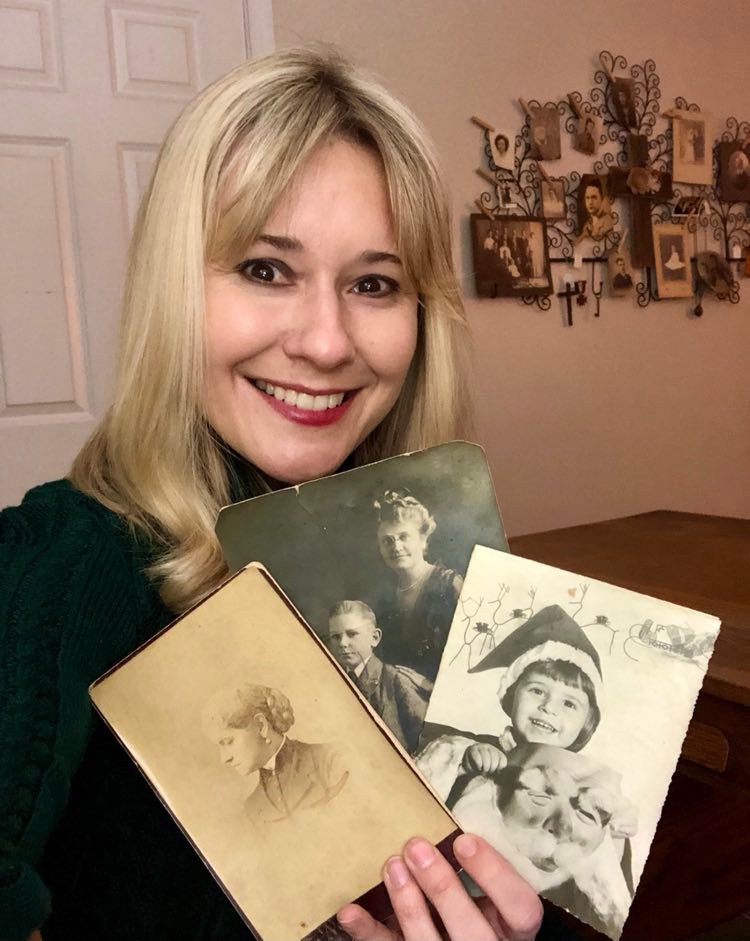
Kate Kelley with some of her photos.
(photo courtesy of Kate Kelley)

The joy of reuniting families with memories is also what drives Kate Kelley, 44, from Attleboro, Massachusetts, who posts her found photography adventures on her Facebook page, Photo Angel. For Kelley, this hobby has always had a touch of the divine to it. “God has a hand in this for sure.” In fact, oftentimes, it feels like these found pictures are meant to be; bringing back pieces of a family puzzle that seemed long since lost and healing old wounds in the process.

Take Kelley’s favorite story of returning a photograph. It involved a snapshot of a couple on their 50th wedding anniversary with only a location and date: Maine, 1924. After countless hours of research, going off the smallest of details, Kelley finally tracked down the couple’s grandniece. It turns out the family had a fire years before and lost nearly all their family photos. “This was the only existing photo of their great aunt and uncle,” Kelly said. “In this line of work, you never know what you’re going to discover next and how you can bless someone else.”

What makes this hobby so unique is not only how it gives people the chance to help others, but it also brings these enthusiasts a sense of purpose. “I feel like this is my calling,” said Kelley. A calling found by many because of a quick stop at a thrift store. It’s as if the sight of these old photos, sitting forgotten, divinely nudges each of them to act. “The more I return memories,” said Gutenmacher, “the more it feels like I’m supposed to be doing this.”

The Packed Car

My family was driving across Canada to Montreal where my husband, Ray, and I were going to be helping out a new church there.

Ray had gotten a head start with our daughter in a rental truck stuffed with our belongings. I took my two-year-old, John, in our family car, a hardtop convertible jam-packed from floor to ceiling with piles of books to use in our work. They hadn’t been able to fit in the truck.

We crossed into Ontario, driving along a narrow two-lane road. A heavy rain fell. Suddenly a truck veered into our lane. I turned the wheel sharply. The brakes screamed. Our tires hit the gravel on the shoulder. We went spinning off the road.

We’re going to die, I thought as the car flipped and rolled into a deep ditch.

Coming to my senses, I heard a man’s voice from somewhere outside my car. “There’s nobody alive in there.” Everything was hazy; fine pieces of glass covered me from head to toe. The metal frame of our vehicle pressed tight against my back. I could barely breathe.

John! Panicked, I reached behind me.

“Are you all right, honey?”

“Yes, Mama.”

I craned my neck toward the window. “We’re alive,” I cried. “My little boy and I. Please help us!” A man reached through a shattered window and pulled John out. A few others pried the metal frame away enough for me to escape. Except for some minor scrapes, cuts and bruises, we were okay.

A kind policeman escorted us as we rode in an ambulance to the hospital. He offered to take us to the impound lot to retrieve our belongings when we were ready.

Four days later we went to the lot. The insurance agent who accompanied us gasped when he saw the wreck. So did I. The policeman looked baffled.

“These hardtop convertibles don’t have a window post to keep the roof up if they flip,” he said.

“Then why weren’t we…” My voice trailed off.

Our eyes turned toward the back seat. The roof had stayed up just enough so we weren’t crushed, supported by an amazing brace. Piled from the floor to the ceiling were the books that hadn’t fit in our rental truck.

Our Bibles.

Download your FREE ebook, Mysterious Ways: 9 Inspiring Stories that Show Evidence of God’s Love and God’s Grace

The Number 40 in the Bible

You may be familiar with the importance of the number 40 in the Bible. After all, it pops up in the Good Book 159 times, across both the Old and New Testaments. God flooded the earth for 40 days and nights. Moses fasted for 40 days, and Jesus wandered the wilderness for, yes, 40 days. Overall, it’s a number associated with testing and the hardships one must endure to become more spiritually aware.

Here are just a few examples of how the number 40 features prominently in the Bible and what it may mean.

1. Moses, Elijah and Jesus fasted in the desert for 40 days each
It’s no surprise that three of the Bible’s most important figures each endured 40 days without food or water. As the ultimate test of faith, these Biblical greats used their fasts to achieve specific goals. Moses proved his loyalty to God and received the Ten Commandments. Elijah gained instruction on how to lead the people of Israel. And Jesus thwarted Satan’s temptations. In each case, they passed their tests and gained new insights into God’s ultimate plans.

2. The Israelites wandered in the desert for 40 years
After being freed from Egypt, Moses and the Israelites weren’t sure what to do next. God wanted them to find the Promised Land, but only after the generation of men who’d doubted His plan had passed. So God made the Hebrews roam the wilderness, subsisting on manna, for 40 years. Only when the last of the preceding generation was gone did God allow His people to proceed further, showing that sometimes patience is necessary to fully reveal God’s divine will.

3. Ezekiel laid on his right side for 40 days to “bear the iniquity” of Judea’s sins
The prophet Ezekiel was instructed by God to lay on his left side for 390 days and his right side for 40 days to “bear the iniquities” of Israel and Judea (respectively). The days corresponded to the number of years each kingdom insulted the name of God through wickedness and rebellion. Ezekiel suffered greatly for the sake of his forbearers, but his insights helped prepare the Israelites for the coming of Jesus.

4. Three kings reigned for 40 years each: Saul, David and Solomon
The three great Hebrew kings—Saul, David and Solomon—were each said to have ruled for 40 years. That’s no coincidence. Forty years is considered a generation in the Bible (i.e. a new group of Israelites that rises up, sustains itself, then dies off). For the three kings of antiquity, this measurement of time also contains a warning—20 years of their rule was marked by prosperity and 20 years by ruin. It characterizes the Prophet Samuel’s trepidations over instituting kings in the first place: eventually, they’ll take from the people more than they give.

5. Goliath taunted Israel for 40 days before David defeated him
Before David and Goliath became the stuff of legends, Goliath was just a massive Philistine soldier who took pleasure in humiliating the Israelites. The Philistine and Israelite armies stood on opposite sides for 40 days. Every day, a new Hebrew champion would come out to meet Goliath face-to-face, only to be destroyed. After 40 days, David, a young shepherd from Bethlehem, was sent by God to defeat the Philistines, opening a new chapter for the Israelites­—namely, the solidification of the kingdom of Israel.

6. God destroyed every living thing on Earth by flooding it for 40 days
Seeing that the sins of man had become too great, God called on Noah, a pious believer. He told him to build an ark that could hold two of every living creature on earth, as well as Noah’s family. Then God flooded His land for 40 days and nights. Once Noah and his family found the shore again, God made a covenant that He would never flood the Earth so completely again, thus reestablishing a level of trust between Him and His people that had been lost since Adam and Eve.

The Night of the Christmas Angel

Emergency medicine doesn’t take holidays off, but this was the first time I’d pulled an EMT shift on Christmas. Already we were racing to a studio apartment in an independent living community to answer the night’s first 911 call. I couldn’t help thinking this was supposed to be a night of miracles, not injuries.

The ambulance had barely come to a full stop when my partner, Dan, and I jumped out with a gurney. A staff member from the facility waited at the apartment door.

“Miss Lily had a fall,” she said as we knelt down around the elderly, white-haired woman on the floor. “She’s one hundred years old,” the staff member informed us with a note of pride.

Miss Lily’s studio apartment was neat as a pin. She’d even decorated for the holidays. “We’re going to examine you to see where you’re hurt,” I told her. Miss Lily nodded. She winced when Dan touched her hip but tried to hide it behind a smile. “Shortening and rotation of the leg and foot on the affected side,” Dan said. Miss Lily winced again. “Increased pain with palpitation to the hip.”

Dan and I nodded to each other. It was a classic case of fractured hip—very common in elderly people. We lifted her gingerly onto the gurney, started her IV in the ambulance and headed to the High Desert Medical Center at full speed.

I knew the harsh realities of a broken hip. Many older patients never fully recovered their strength or stopped hurting from their injury. We learned that Miss Lily had been relatively pain-free and strong for 100 years. Even now she bravely chatted with us between gasps of pain. All that would work in her favor, but it just seemed wrong, somehow, for her to have such a setback on Christmas, of all nights.

Once we got her settled in a hospital bed in the ER, Miss Lily shut her eyes, signaling she was finally overwhelmed by the pain. She looked gray and wilted on the bright white hospital sheets. Colleen, one of the nurses, hooked her up to a cardiac monitor. She pulled the curtain shut around Miss Lily for privacy.

It was Christmas somewhere, but in the ER it looked like any night. Doctors, nurses and EMTs dodging one another to get to patients. I got out of the way and went to the supply closet to restock the ambulance.

Afterward I glanced in at Miss Lily. She lay propped up on some pillows, eyes closed, breathing unevenly. She might not make it through the night, I thought. It still didn’t seem right. Christmas was a time of surprises and miracles, not suffering and death, even after a long life like Miss Lily’s.

I sat down outside the ER to catch up on my paperwork before we got another call. When I looked up from my writing I saw Dan pushing the gurney away from Miss Lily’s area. I went to help. Just then Colleen popped her head out from behind Miss Lily’s curtain. She looked stunned. “What is it?” I asked. ER nurses have seen it all. What was it that had left Colleen speechless?

Instead of answering me, Colleen drew back the curtain. Miss Lily sat there, upright in her bed, beaming.

“Miss Lily,” I stammered, “you look much better.” Her cheeks were all apples and peaches as she nodded. “Yes, yes,” she said. “The medicine worked wonders, just wonders!”

As far as I knew no one had administered any medications to Miss Lily. Colleen confirmed my impression with a shake of her head.

“Which medicine?” I asked.

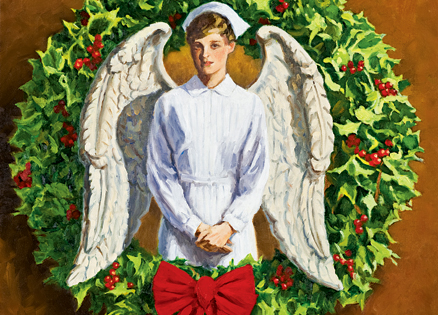
“Why, the little pill the nurse gave me,” she said. “The nice nurse with the white cap.”

White cap? Nurses hadn’t worn them in decades. My own sister, an RN, had complained about having to wear one for her formal graduation photo. No nurse would bother with a cap while on duty—especially in the ER. And besides, no one would have given Miss Lily any pills. Any medicine would have been administered through the IV in her arm.

But there didn’t seem any reason to tell Miss Lily any of that. Instead I just squeezed her hand gently. “Merry Christmas,” I said.

Colleen and I stepped around to the other side of the curtain. We faced each other, baffled. “Do you believe in angels?” Colleen whispered.

How else to account for Miss Lily’s healing? “Yes,” I said. “I do.”

I don’t know if Miss Lily lived to be 101 or 102 or how old. But I do know that an angel watched over her for the rest of her days. The same angel who brought her comfort that night in the ER. Christmas miracles really can happen anywhere, even when it seems like any other night.

Read more stories about heavenly angels and angels on earth.

The Near-Death Experiences of Children

Flowers that stretched as far as the eye could see. Light, ethereal and embracing. Peacefulness unlike anything imaginable.

Decades later, the survivors remember every detail. Memories so vivid, their day-to-day lives seem muted. Less real than what they saw when, as children, they were transported somewhere beyond our world. A place where time and space don’t exist. For Ingrid Honkala, it happened when she was nearly three and drowned in a water tank. For Alma Blazquez, it was at age four, suffocated at the hands of an abusive family member. And for Teresa McLean, it was at age three, after accidentally overdosing on aspirin.

They all died and came back. But not before seeing heaven.

The International Association for Near Death Studies (IANDS) estimates that nearly 85 percent of children who undergo cardiac arrest have a near-death experience (NDE). A rate more than twice as high as that for adults—thousands every year. The experiences are not limited by age. There are even reports of infant NDEs, recounted once the child is old enough to articulate their experience. With medical advances, more children on the edge of death are being saved. And stories of their experiences are becoming more common and accepted.

Psychiatrist Dr. Raymond Moody first coined the term near-death experience in his 1975 landmark best seller Life After Life. Dr. Moody, a self-described skeptic, interviewed hundreds of people while researching his book. “The stories are mind-boggling,” he says. “There’s not a medical explanation that holds water.” And yet he gives extra credibility to the accounts of people who experienced NDEs as children. Without preconceptions of the afterlife, their glimpse is as true of a glimpse as you can get.

“When you talk to these children, they have a maturity way beyond their age,” Dr. Moody says. “It’s astonishing what they come back feeling and knowing.”

Children such as Ingrid Honkala, who grew up in the mountains of Colombia. The country was war-torn in the early 1970s. Her young, working parents struggled to get by. Ingrid was small, sickly. One morning, as she and her older sister were playing catch over a large water tank, Ingrid reached for the ball and plunged headfirst into the tank. The water inside was freezing cold from the morning air, and she sank to the bottom. She struggled but soon found herself surrounded by flowers of breathtaking beauty that went on forever. They seemed to lift her upward. Her aching, sickly body was freed of pain. From her vantage point above, she could see the maid in charge blissfully listening to the radio inside the house. She could see her mother walking to work.

Ingrid felt separate from any sort of body. Her spirit was now one with an all-consuming radiance that felt like her one true home. A kind of spiritual womb. She never wanted to leave it. “I went from a place of absolute horror to absolute joy,” Ingrid says. The feeling of joy has never left her.

Alma Blazquez also encountered an otherworldly light at age four in her Chicago home. A relative in a drunken rampage had suffocated her. Suddenly, Alma felt no more pain, only peace. As she reentered her body, she sensed another presence with her. A tall, muscular, all-powerful being who assured her that he was there to protect her. That he would never leave her.

For three-year-old Teresa McLean, there was no soothing presence or light. She left her body inside a German hospital. Her frantic mother had taken her there after Teresa had accidentally eaten two bottles of chewable baby aspirin. In her NDE, Teresa saw two scenes before her, as if on a split screen. On one, doctors and nurses worked tirelessly to revive her. On the other, her mother sat in the waiting room, sobbing. Teresa felt her mother’s emotions—her pain and fear—as if they were her own. It was terrifying.

Then the scene changed. She saw her mother many years into the future. It wasn’t a vision or a dream. No, these images were more real than real. In the future, her parents had divorced. Her mother was overcome with grief, struggling to survive without her daughter. Teresa knew she had to come back. She couldn’t leave her mother. In the next instant, she returned to her body.

Returning to a world that seems diminished is inevitably jarring and disorienting to children. They barely have words to describe what they’re feeling. And trying to make sense of it all can be isolating.

“Not everyone wants to be back,” says Jeffrey Long, M.D., a radiation oncologist and one of the leading researchers of NDEs. “They feel as if they’ve been where they most belong.” Dr. Long is the founder of the Near-Death Experience Research Foundation and author of God and the Afterlife. His organization has recorded more than 4,000 detailed accounts of people who’ve experienced NDEs, both as children and adults.

“The intensity of what the children are experiencing is much greater than what would be normal at their age,” he says. “And the experience generally grows in importance as they get older—whereas it would be natural to expect childhood memories to fade over time. Ninety-five percent of NDE children say the experience was definitely real, meaning not a dream or hallucination.”

Compared to those of adults, child NDEs “tend to be more concrete and less complex,” according to IANDS; there may not be features we typically associate with a NDE, such as a life review. Children are, however, more likely to see deceased loved ones and pets—even relatives they’ve never met. Talking about a NDE, though, can be traumatic. “Many children tend to withdraw,” Dr. Long says. “They find they literally can’t share what happened with anyone.”

Such was the case with Ingrid, Alma and Teresa. Their parents took them to doctors and psychiatrists, desperate to find out what was wrong with them. At an age when most children are content to play outside, Ingrid felt as if she could no longer relate to her family. She stopped eating. She didn’t want to live. “Don’t call me Ingrid,” she told her mother. “I don’t have a name. I don’t need a name.”

Alma stopped talking. She refused to utter a word until age five, when she started school. “My mother told me I was crazy,” she says.

They couldn’t relate to other children. Things that interested other kids, like playing with dolls, seemed babyish. “I was much more interested in adult conversation,” Ingrid says. “Even as a young girl, I suddenly understood everything they were saying.”

All three excelled in school. Ingrid remembers doing difficult math problems and solving complex puzzles easily. Books on philosophy and religion fascinated her. But most of all, the three girls returned with great compassion and love. For people. For animals. For the earth. And for their families. They sensed other people’s suffering and hurts intuitively, as if they were their own struggles. Their experience didn’t always feel like a gift. Alma and Teresa have had frequent premonitions, warning them of tragedies for family and friends. Their otherworldly journey was anything but a once-in-a-lifetime experience; it seemed to open a door to the metaphysical.

“It’s as if they take a piece of heaven with them,” Dr. Long says. “Where the people around them have doubts about God and heaven, they feel a direct connection that grows stronger as they grow older.”

At five, Alma was visited by the same strong, tall man who had comforted her in her NDE. A man she now knew, from church, to be Jesus. “I am with you,” Jesus told her. “I have always been with you and will always be with you.”

Ingrid was visited often by beings of light. They spoke to her and comforted her and made her want to go on living. “Why does no one understand the things about love and life after death that I try to tell them?” she asked them once.

“Because you are special,” the beings told her. “Everyone is special. In time, they will know it too.”

Like many children who experience NDEs, Ingrid, Alma and Teresa all found meaningful careers. Ingrid, who drowned in a water tank, visited the ocean as a girl and felt instantly drawn to it. “I’m going to be an oceanographer,” she told her parents. For a poor girl from Colombia, the very idea was absurd. Especially from someone going on about dreams and fantasies all the time. When Ingrid was older, she had a vision of two large buildings in a campus setting. Buildings she recognized years later when she became an oceanographer at the John Stennis Space Center in Mississippi, studying the effects of climate change.

Teresa, meanwhile, came back for her mother and then devoted her life to helping others struggling with otherworldly experiences. She tells them her story. It’s given her meaning and purpose. In 2012, her mother was dying of esophageal cancer. Teresa sat at her bedside. Her mother, weak, turned to her and said, “I’m staying here because you chose to stay with me.” Her mother, against all odds, lived another three years.

Alma, who met Jesus during and after her NDE, earned a doctorate and worked with an international organization helping children and adults with learning disabilities. She loved running and bicycling, up to 10 miles a day. One day, her bike was struck by a car. Her spine was badly injured. Then an autoimmune disorder set in: lupus. And arthritis. For years, Alma was miserable, barely able to move. The comfort that had always been there was now gone. In 2012, she had a seizure. In the hospital, she again left her body. She was met by an orb of light, its rays powerful and healing.

“You are here because you have come here often,” a voice said. She saw hundreds of people lined up before a stone wall of breathtaking beauty. She wanted to go where they were going. Instead, she saw scene after scene of people she’d helped and with whom she’d shared God’s love. Alma returned to her body, her pain as intense as ever. But she knew, just as she had as a kid, that she wasn’t alone. Within the year, she was completely healed. Today she is able to walk and even teaches advanced yoga.

“We’re all here to love each other,” Alma says. “It gives life meaning.” Ingrid agrees. “Everything is connected,” she says. “We’re all one—that’s what I’ve come to understand.”


The “Mysterious Ways” Magazine Is Finally Here!

Visit our Mysterious Ways Facebook page this afternoon, and you may notice a new tab at the top, just below our banner: Order MW Today! That’s right. We’re now taking orders for the first ever issue of Mysterious Ways magazine.

It’s been a long time coming. When we first began developing this magazine more than two years ago, we had no idea what form it would take, what stories we would include and most importantly, how a full-size, stand-alone publication could translate that feeling of awe and wonder that the Mysterious Ways section of Guideposts has delivered to readers for so long. I’m proud to say that when you finally hold this magazine in your hands, I believe your eyes will be opened even wider than before.

In Guideposts, we help readers achieve their maximum personal and spiritual potential. In Angels on Earth, we share stories about heavenly angels and humans who have played angelic roles from day to day. Mysterious Ways is about something different—the unexpected and wondrous experiences that reveal a hidden hand at work in our lives.

You’ll read about the strange series of coincidences that helped catch a car thief; the unlikely events that led to a daring rescue from a flooded creek; how an errant golf shot saved a woman’s life; and how a fish that fell from the sky—yes, you read that right, the sky—answered a woman’s prayer. Those are only a few of the odd, surprising, yet incredibly true tales that we’ve prepared exclusively for our premiere issue.

I’m excited to hear what you think. Order your free first issue today, and don’t hesitate to send us an email with your thoughts.

Of course, our new magazine also means new opportunities to share your own Mysterious Ways stories. We love to read them!