


Embrace God's truth with our new book, The Lies that Bind

How ‘Indiana Jones’ Helped to Preserve Her Sobriety

I was 30 days sober, and I was pretty sure I wasn’t going to make it to day 31.

I dug my nails into my mattress and squeezed my eyes shut. One minute I’d been folding laundry in my bedroom, the next I’d been overtaken by a craving for alcohol so strong, I had to cling for dear life to my bedsheets.

I thought I’d already experienced every withdrawal symptom possible. The shakes, nausea and headaches. But this was the worst one yet. Not a dream. A vision that played out before me like a scene from a movie. I saw myself as a thirsty golden retriever, frantically lapping up liquid from a golden lake that sparkled like diamonds. A lake filled with Chardonnay. My drink of choice. Or maybe I should say I’d lost the ability to choose. I was like that thirsty dog. No choice.

I took a deep breath and tried to remember everything I’d learned in my outpatient treatment program. “Go home, don’t drink, come back tomorrow.” That’s what my sponsor kept telling me. Those seven words had become my mantra whenever I had a craving, which was all the time. But what on earth were you supposed to do when you started seeing yourself as a dog drinking from a bottomless lake of Chardonnay?

Part of me knew it was just my disease talking to me. That, on a subconscious level, I wanted to drink so badly that I conceived of myself as a thirsty golden retriever. But another part of me was scared to death. Was I going crazy? I was supposed to be getting better, not worse! Was I one step away from ending up like my father?

My dad had always been a heavy drinker. I was just a freshman in college when he died of liver disease at the age of 54. Even though he was an alcoholic, as I realized now, he was still a good dad. My rock. The one person who really got me. So when he died, I turned to the one thing that made me feel closer to him—alcohol.

By the time I was in my 20s, my occasional social drinking had turned into a bottle-of-wine-a-day habit—and sometimes a glass or two more. I was building a successful career in advertising. The perfect cover for a budding alcoholic and an overachiever like me. In my field, it was normal to start drinking at noon. Nobody blinked an eye if I downed a few glasses of wine at lunch with colleagues.

Things got worse when I went through my divorce. I drank more. Sometimes I didn’t quite remember going to bed. I still didn’t see myself as an alcoholic, though. I was thriving in my career, raising two young daughters and maintaining a beautiful home. Alcoholics slept in doorways and drank out of paper bags, right?

One morning, nursing my daily hangover, a voice popped into my head: “Mary, you’re one glass of Chardonnay away from losing everything.” My kids, my job, my home. The voice scared me, really scared me. The idea of losing my girls was too much. I sought treatment.

People at rehab were always talking about “God shots,” those moments of divine intervention in the midst of recovery. I knew the voice that popped into my head could’ve only come from God. As much as I wanted to believe he cared for me on a real, personal level, though, where was he when I really needed him? Like when I had a hallucination about drinking from a lake of Chardonnay? Was I having the DTs? Was I losing my mind?

I got up from my bed and paced the room. I drew in a deep breath and released it. Again and again. With every breath, I imagined just a little something to take the edge off. I’d long since thrown out every bottle of alcohol in the house, even my vanilla extract, as well as my crystal stemware. But my keys were on the kitchen table, my car was in the driveway and the liquor store was less than a mile away. I didn’t need a wineglass. I could drink straight from the bottle. Nobody would ever have to know.…

My hands shook. I picked up the phone and dialed my sponsor. “Come on, pick up, pick up,” I said. No answer. I dialed the number of one of my rehab friends. No answer. I called another friend. And another. No one was there! I sat back on my bed and did the last thing I could think of. I prayed. The only word that came to mind was “help.”

It happened just like in the first vision. A scene playing in slow motion, like an IMAX film projected onto my brain. This time I saw an old man lying on the floor of a cavern. He’d been shot. A younger version of the man, dressed in khakis and a beatup fedora, crouched by his side. The man’s son. He knew how to save his father, but first he had to go through a series of deadly tests to prove himself. Finally, he reached the edge of a canyon. Across the chasm was the source of his father’s healing—the Holy Grail. It was impossible to jump across such a great distance, though. He was only human.

Then it dawned upon him. “It’s a leap of faith.” The man put his hand to his chest, momentarily paralyzed by fear, and made a decision. He extended his left leg and took a step into the void. He fell forward, seemingly to his death. But a stone bridge appeared, making his footing sure. He took another step and another. Crossing the abyss…

The vision was gone as quickly as it had come. I blinked. It was so bizarre, but I’d seen it before! It was the final act of Indiana Jones and the Last Crusade. Of all the movies in the world, why had I seen that one? I wasn’t a fan of action flicks or even Harrison Ford. I’d seen the movie once, about 15 years earlier. So how on earth did I remember it so clearly? So vividly? And what was I meant to do with it? Was it a message from God or just another sign that my mind was going?

Except for one thing. One amazing thing. My craving for alcohol was gone. Lifted. I curled up in bed, exhausted, and fell into a deep sleep. After I woke up, my sponsor called back. “It’s okay,” I said. “I’m okay now. I got through it.” I didn’t tell her about the visions. How could I? She’d think I was crazy if I told her my mind was playing scenes from Indiana Jones!

“I’m so proud of you, Mary,” she said. “You fought back against your disease. Good for you!”

I guess. But how much longer could I keep going like this? I was terrible at being sober. What if next time I wasn’t saved by some weird scene from an old movie?

I hung up the phone, got some snacks from the kitchen and plopped back on my bed. I just needed to get through the night. I turned on the TV, flipped the channel…and almost fell off the bed.

On the screen was the same exact scene, to the second, that had played before me hours before. The scene that finally convinced me to put my trust in my higher power. The scene that I still turn to today, 13 years of sobriety later.

Professor Jones stepping out into the void, stepping out into apparent nothingness—a leap of faith.

How I Found True Love

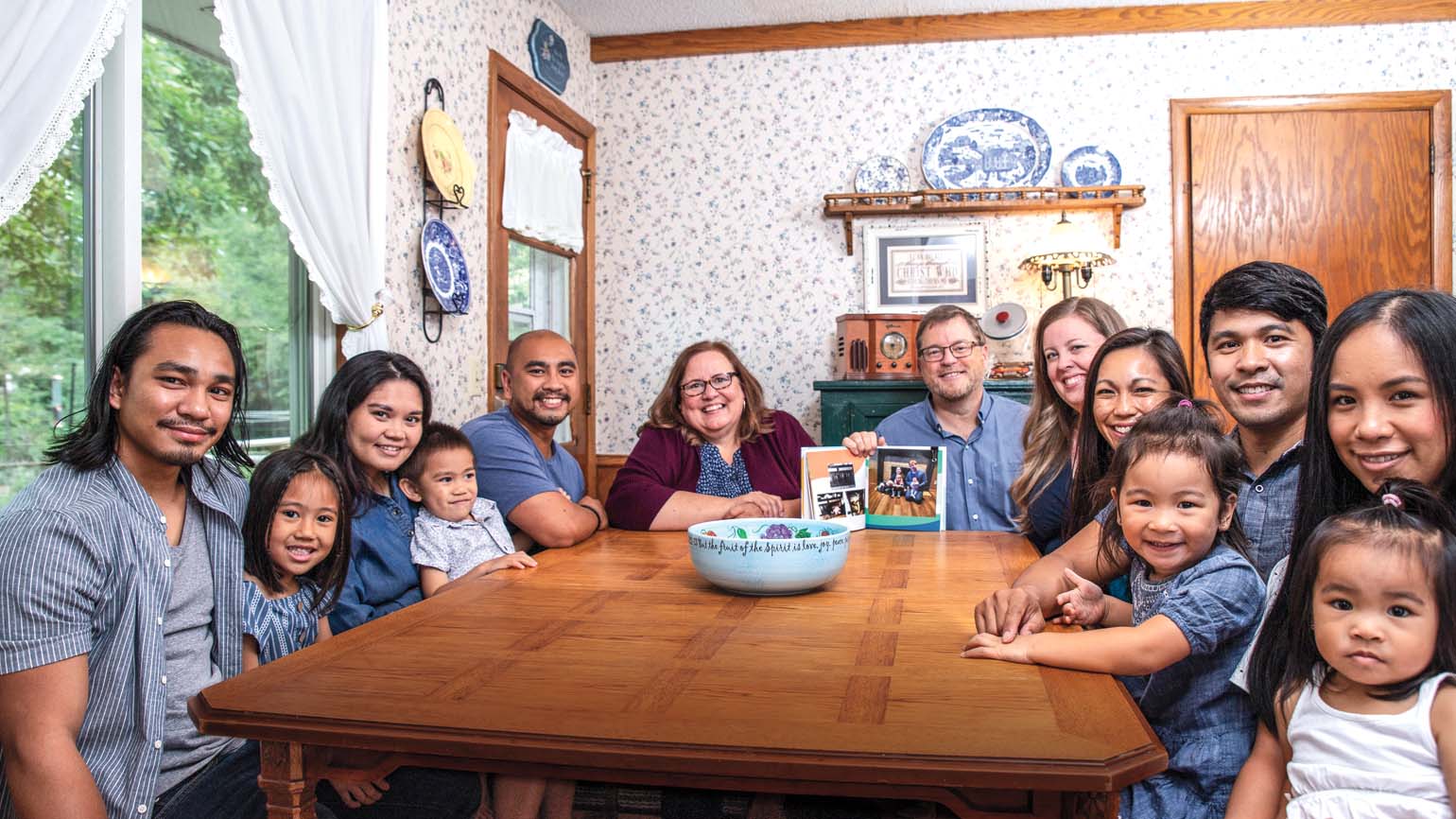
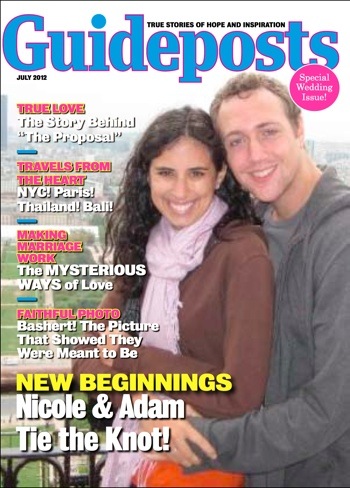
No, this isn’t the cover of next month’s issue of Guideposts magazine. It’s a card from my Guideposts family, to congratulate me on my upcoming wedding. On July 3, I’ll marry the love of my life, and I’m happier than I’ve ever been before.

It’s a long way from how I felt in September 2008. My best friend since childhood was engaged to be married; my roommate, Seth, was in a serious relationship and headed toward marriage. And me? I had yet to find true love. In my lonelier, self-pitying moments, I wondered if maybe such a thing didn’t exist for me.

I was wallowing in this attitude when Seth’s girlfriend came to the apartment one afternoon. “Hey, Adam,” she said, “I’ve got a girl for you. Her name is Nicole.”


The last time someone had tried to set me up, I called the girl only to be told that she had a long-term, serious boyfriend. Yikes. So when Seth’s girlfriend showed me a picture of a cute, tanned, dark-haired girl with maple brown eyes and a sweet smile, I said, “No thanks.” I’d had enough disappointment. She didn’t press the issue, but I could tell she thought I was making a big mistake.

A few days later, on a Saturday afternoon, Seth and I were in the midst of a videogame marathon. We must have played for four hours straight—not an unusual occurrence for us. “Should we get outside?” Seth wondered aloud.

“What for?” I asked.

Seth pondered that a moment. “I’ve been meaning to buy a teapot,” he said.

So out we went into the sunshine, in search of a teapot. On the street outside our building, two girls were out for a walk. Seth’s girlfriend, with a friend. The friend she’d wanted to set me up with. Nicole.

She was even more beautiful in person than in her picture. The teapot was forgotten. Instead, we all went out to a Mexican restaurant and had mango margaritas.

Nicole and I talked for only an hour, but it felt like more. We talked about our love of the New York Yankees, our close-knit families. She kept kosher, to a degree, avoiding mixing milk and meat, pork products, shellfish. “Me too!” I said. Such a thing was rare among my Jewish friends. Seth himself used to tease that he’d put bacon into my mouth while I was sleeping, so I’d know what I was missing.

As Nicole and I began dating, we kept noting similarities—and discovered strange ways our paths had crossed before we even knew each other. Nicole’s Uncle Sam was good friends with my parents’ good friends—they’d all attended the same wedding together. I’d been to the Jewish Community Center just steps from her house on many occasions for youth group events, and she went to the beach nearly every year at the same place I did—Bradley Beach. Nicole had gone to summer camp with my sister—they were even in the same “Camp Memories” videotape.

The connections weren’t always direct, and maybe not all that unique. But as our relationship grew, it felt more and more like the two of us shared a common past. Nicole felt like the person I had been with from the start. We knew each other better than anyone. Bumping into her that day in New York wasn’t a first meeting. It was coming home again.

Home. That’s what true love is to me. I’m at home with Nicole, and that feeling has only gotten stronger with time.

OK, I’m a sentimental guy. But I do believe that when we find these strange connections, these weird coincidences, these crossing paths—they are a sign. A sign that none of us ever has a reason to be lonely. We just have to step outside for a walk, open our eyes … and start looking for a teapot.

I’ll see you in three weeks, readers, after my honeymoon. In the meantime, share your “How We Met” stories with us (like these people did). Write in the comments section below or email your story.

Happy Fourth of July, and enjoy your own summer of love!

How His Vivid Dream of Dogs Became a Divine Sign

In the dream, I stood at the end of a long, straight gravel driveway. At the other end, I could see a white two-story farmhouse. There were no power lines leading to the house. No car in that long driveway. Details revealing that it was an Amish farmhouse, similar to the ones I often drove past near my home in northern Indiana. There was something inside that house that drew me there, but what it was, I didn’t know.

Fields spread out on either side of me, but I focused on the house. As I got closer, I saw a shimmer of gold out of the corner of my eye. I turned to look. The field was fenced and full—not with rows of crops but with puppies. Golden, fuzzy puppies. There were dozens of them, dotting the field like dandelions. One of them approached me. I felt a connection with her.

Then, abruptly, the dream ended. I woke up.

As I got ready for the day, the dream didn’t fade as my dreams usually do. It stayed with me. It felt important—and unfinished, since I never made it inside that farmhouse. Was it some kind of a sign? Something that had to do with our family pup, Charlie?

If I was going to dream about dogs, I would have expected one about Charlie crossing the rainbow bridge. Our beloved Charlie had passed away only a few weeks before. My wife, Kathy, and our kids had adored him. I’d had dogs my whole life, but Charlie was special. He may not have been the brightest dog in the world, but he was kind and gentle and loved to be around people, tail wagging.

Then, at almost 12 years old, Charlie’s tail didn’t wag so much. His health declined. An examination at the vet uncovered the problem. He had tumors throughout his body. Charlie had cancer, and there was nothing we could do. When he could no longer walk, I knew it was time. Our vet came to the house to put him down. Charlie passed away peacefully in our front yard, cradled in my arms.

Friends and family had already started asking when we were getting a new dog. I shrugged it off. We were still grieving. I didn’t know when I’d be ready to let another dog into my heart again, even one as delightful as the dandelion dogs in my dream.

A few months later, Kathy was reading the newspaper and stopped on a page, folding the paper in half.

“Look at this,” she said, pointing to an ad. “Goldendoodle Puppies for Sale,” it read, followed by a phone number. I’d never had one of these golden retriever and poodle mixes, but I’d heard they were intelligent and affable.

“I’ll think about it.”

Though I was hesitant, I kept the newspaper. A few days later, I called the number. A woman answered. “We have one puppy left,” she said. “You can stop by and meet her if you’d like.”

She gave me the address. It was only about 15 miles away. I was familiar with that area. As Kathy had pointed out, it wouldn’t hurt to have a look. I hopped into my car and headed north.

Half an hour later, as I turned down the long gravel driveway, I had a sense that I’d been there before. Then I caught sight of the white two-story house up ahead. And when I pulled up behind the house and parked, an Amish woman came out to greet me.

Okay, this is really strange, I thought. I didn’t know what to make of everything.

The woman led me to a back room of the house and went to get the puppy. When she returned, a golden ball of fluff came around the corner, following behind her. The puppy trotted right up to me. Even though I was a stranger, she showed no fear. She plopped down at my feet and licked my leg. Then she looked up at me with her gentle brown eyes.

She gave me a doggie smile just like the little dandelion pups in my dream had, and that’s when it all clicked. The puppy was what was waiting for me in that house. She was meant to be ours.

“I’ll take her!” I told the woman.

We named her Missy. For the past four years, our beloved Goldendoodle has been a wonderful addition to our family. The dog I was guided to even before I knew my heart was ready.

How Her Father’s Hammer Became a Spiritual Symbol

”Remember what Dad always told us,” my twin sister, Brenda, said as I took out my toolbox. “‘You can do anything you set your mind to.’” It was true that Dad never set limits on us. But building a new porch from scratch? Maybe that was pushing it.

Initially I thought I would just be replacing a few of the rotten planks on my deck. That would have been an easy project, the kind of thing I’d been familiar with since I was a kid.

When our parents decided to build a weekend cabin, Dad drew up the plans and enlisted Brenda and me as helpers. He showed us how to do everything from floor to ceiling. I had my own lightweight hammer, but sometimes he’d let me pound the nails with his big 16-ounce. After Dad died, Brenda let me keep the ham-mer, which I displayed in a place of honor in the den.

How I wished Dad were here to answer my questions now. When I pulled up the rotten boards, we found the support beams were deteriorating too. The entire deck would have to be rebuilt, and all we had was Dad’s can-do spirit to inspire us.

“I wish I could be more help,” Brenda said. She was staying with me while she recovered from shoulder surgery, so construction work was out for her. “But I can do little things with my good arm and cheer you on!” Rather than a simple deck, we designed a new porch together—screened in, with an angled roof. Now it was time to get to work. I measured, sawed and hammered. Brenda stayed one step ahead, so I knew what was coming next. I imagined Dad right there with us, encouraging and building our confidence. “How do we know when it’s ready?” I’d asked him, just 11 years old, as we mixed concrete for the cabin’s basement floor.

“We drag a hoe through what we’ve got mixed and see how it acts,” he said. “If it crumbles along the sides, it’s too dry. If it sags into the middle where we just dragged, it’s too runny. Once the consistency is just right, it’s time to pour.” Why shouldn’t a couple of 11-year-old girls know how to pour concrete?

After a few months of hard work, Brenda and I had set new posts with concrete anchors, finished the floor and laid down support beams for the rafters. We set up scaffolding and stacked the two-by-eight-foot boards so they were ready to install. Brenda had already cleared everything off the scaffolding so I didn’t trip while nailing them down. Now she was on the ground, reaching up with her good arm to space them right where they needed to go, so I didn’t have to measure.

“These boards would be easier to place if I could just tap them with a hammer,” she said. “Would you grab Dad’s off the shelf for me, please?”

Maybe Dad’s hammer is just what we need out here! But when I looked inside, the hammer wasn’t on the shelf. It never left its special spot in the den. I searched all over, but the old hammer was nowhere to be found. It felt like a bad sign for our project. I went outside, where Brenda was still absorbed in her work. “Brenda, I have some bad news.”

Before I could tell her, we both looked over at the scaffolding. It had been empty minutes before—everything moved off for safety—but now, sitting right in the middle of it, was Dad’s hammer. “How did that get there?” Brenda said. Dad may not have been able to supervise our new project in person, but his can-do spirit was close at hand. This was going to be some porch.

How Hearing God’s Voice Provides Comfort and Reassurance

Go back into the house!

Sandra Farney, of Reno, Nevada, was backing out of her driveway when she heard the voice. It was a man’s voice, coming from inside her own mind, cutting through her thoughts with surprising force. Shocked, Sandra slammed on her brakes. She debated going back inside, but she was late for work. She had to go. Then she heard the voice again. It was more insistent.

Go back into the house, now!

This time she got out of the car and ran inside her home. She checked each room. All seemed fine. Then she opened the back door to check the yard, which her two dogs had access to via a dog door. She was met with a horrifying sight. One of her dogs, Goofy, was hanging from the fence, vines wrapped around his neck. He wasn’t moving. Sandra raced to free him, frantically tearing at the vines. Goofy collapsed into her arms, gasping for air. He was stunned but otherwise unharmed. Sandra held Goofy close until he calmed down.

“I cut down all the vines to make sure this nightmare could never happen again,” Sandra said. “And with each cut I thanked God for the divine voice that saved Goofy.”

What Sandra experienced—hearing a divine voice—is miraculous but not as uncommon as we might think. Adam Powell, a research associate at Durham University in England, spent four years studying this phenomenon as part of a research project called Hearing the Voice. Powell estimates that 5 to 15 percent of the population has one of these “unusual or anomalous” auditory experiences in their lifetime.

Accounts of divine voices vary greatly, from when it happened to how it happened and what the voice sounded like. For Sandra, the voice was internal but masculine. Powell says that this experience is fairly common. However, other people report the voice was neither male nor female. Some say that the voice came from outside themselves, almost as if someone were standing right next to them. “It’s also somewhat common for people to say it came from their right side,” Powell adds.

Whether the voice was internal or external, Powell noted several similarities. Experiencers said the voice was clearly distinct from their own internal voice, that it was speaking directly to them and that it was trying to help them. Frequently, the voice offers clarification around a particular problem. Sometimes it’s prophetic. Other times it gives its listeners direction in life and purpose. Often people report that this mysterious voice provides comfort and reassurance.

These various accounts of what a divine voice sounds like and how it manifests don’t negate the idea that it’s God speaking. Laura Harris Smith, ND, a pastor and author of the book Seeing the Voice of God, says that experiencing God’s voice differently actually aligns with Scripture. Smith points to several stories in the Bible in which people heard God’s voice differently—Paul receiving a message from God on the road to Damascus, John hearing a voice from heaven after he baptized Jesus, Elijah when he went searching for the voice of God, Moses hearing God’s voice from the burning bush. “In Scripture, it happened in different ways for different people,” she says. “Sometimes it was an external, audible sound. Sometimes it was a small voice… It’s going to be different for everybody because everybody is different.”

In some cases, the divine voice can even sound like someone we know. This happened to Jen Myers, of Aurora, Colorado. She’d recently lost her close friend, Kit, to an autoimmune disease. One day, while driving alone, she approached an intersection. The light turned green. She was about to step on the gas to go when a voice rang out next to her.

“No!”

Jen slammed on the brakes just as a car blew through the red light. She was safe but it had been close. Jen recognized the voice that warned her. It was Kit’s. It had come from the passenger seat, almost as if Kit had been in the car with her.

“I don’t know if it was Kit or God speaking through Kit, but I was saved from a serious accident,” Jen said. She later wondered if she’d heard Kit’s voice because it was a voice she knew and trusted. Perhaps God had used Kit’s voice to be certain Jen would listen and stop just in time.

But how can we be sure that the voice we are hearing is God’s?

Smith says that aside from an innate sense of knowing within your soul, there’s another way to determine whether the voice is divine.“No matter what it is—there are times when the voice is going to tell you practical things, when it is going to tell you helpful things…it will align with God’s written word,” she says, “and it will never harm you or anyone else.”

While voice-hearing can be a symptom of mental illness, the main difference is the feeling the experiencer is left with. According to Powell, people who hear voices due to a mental health condition typically report negative effects. They can feel distressed, threatened or a loss of control. Whereas those who hear a divine voice most frequently feel comfort, encouragement and a sense of peace. That peaceful, comforting feeling imparted by the voice is so all-encompassing that some people report a physical sensation of warmth whenever they remember it.

That lasting, positive impact is what Marta Kennedy, of Springfield, Ohio, took from her experience.

Marta was packing for a trip with her daughter, Trudie, who had breast cancer. They were going to a special clinic a few towns over for her treatment and planned to spend the night. As she packed, Marta suddenly heard a voice telling her to pack scissors.

“It was a gentle, calm voice,” she said. “A medium tone, not a man or a woman. It felt close by, like it was in the room with me.” Marta brushed it off. Why would she need to bring scissors?

“I said, pack scissors,” the voice insisted.

Marta relented and tossed a pair of scissors into her suitcase. She and Trudie went to the appointment and then to the hotel room. Trudie was exhausted. She just wanted to put the hospital visit behind her and relax, but her patient armband was plastic and difficult to remove. Exasperated, she pulled at it. No luck.

“Mom,” she said, “you don’t happen to have any scissors, do you?”

Marta was shocked. “Actually, I do have scissors,” she said. “I was instructed to bring them.” She explained the voice to Trudie, who was amazed. It brought joy and wonder to both of them after a long, stressful day. They even got matching scissor charms for their charm bracelets so they’d never forget it.

“I know that removing hospital bracelets might not be a big issue, but it was quite apparent that the voice I heard needed to get my attention,” Marta said of the experience. “Perhaps had I not packed scissors, we might’ve missed this joy.”

Marta wasn’t anticipating hearing from God, but the experience left her with a beautiful memory from an otherwise difficult time.

Indeed, it is the unexpectedness of hearing a voice that is often another indicator that it is divine. It’s common for people to hear God’s guidance when they are praying, or to hear the comforting voice of a deceased loved one after their death. However, Powell was surprised in his studies by the number of people who heard a voice when they weren’t praying for any sort of guidance or direction—or even when they didn’t have a strong faith background.

“Oftentimes they were thinking about something unrelated,” he said, “and then suddenly this voice says something that had nothing to do with what they were focused on.” This proves to many experiencers that the voice did not originate from themselves but came from somewhere else. A source that knew what they needed in that moment.

Each of us experiences God in our own unique way because each of us is unique in God’s eyes. Whether his voice is a whisper in our hearts, a booming pronouncement or the gentle voice of a friend, God reaches us in ways we can’t ignore.

How Grace Finds Us

Have you ever found yourself in a place or situation and quickly realized that it is exactly where you should be? Some might call it good fortune or happenstance. I would call it grace.

Like so many others, I can find myself stretched thin with job and civic responsibilities, meeting the needs of the students at the school where I work, meeting the needs of my family, and meeting my own needs for exercise and mindfulness. Stretched thin is where I found myself most of this fall.

Last Wednesday I arrived at Mohonk Mountain House in New Paltz, New York, for a three-day conference entitled “Counselors and Health Educators Conference: Exploring Roles, Responsibilities and Resources to Promote Student Wellness.” What was left out of the title was the opportunity for attendees to renew body, mind and spirit. That’s where grace comes in.

To be at Mohonk is a respite in and of itself. Set atop a mountain, Mohonk Mountain House is an enormous, rambling structure, the epitome of rustic luxury. There are picturesque views of Lake Mohonk and pristine wilderness, and the coziness of the interior is soothing. This was the perfect place for this conference—just what I needed.

Read More: The City of Angels

On top of this, the conference leaders, all incredibly knowledgeable and engaging, gave those of us in the field of counseling and student wellness a wonderful opportunity to be together, to collaborate, to learn more about ourselves and our work, to be supported and affirmed, and to have fun.

On the first afternoon, each of us was asked to share a word that described how we were feeling at that time. My word was “grateful.” At the end of the conference we were asked to share again. My word then was “gratified.” How did I know that I needed this conference as much as I did? I knew I needed something to ease how stretched I was feeling, but I did not know this was where I would find the grace I was longing for. As Anne Lamott has written, “I do not understand the mystery of grace—only that it meets us where we are, but does not leave us where it found us.”

As hard as it can be to hold onto that feeling of grace once you leave that place or situation, make the effort. It’s worth it. My time at this conference met me where I was and did not leave me where it found me. For this, I am grateful and gratified.

How God Divinely Provided for Her Adopted Children

I sat at our small kitchen table, working on a list of the things we’d need for the adoption of four children from the Philippines. Our family was about to double in size. Prioritize! I told myself.

A larger kitchen table was definitely a priority. Unless we were planning to eat in shifts, we’d need to find seating for eight. I penciled that in, under my note for the extra freezer we’d need to store the massive amounts of food we somehow had to buy. We needed bunk beds, a minivan so we could fit the whole family in one car. The list seemed endless. How would we ever manage?

I’d started praying about adoption almost three years earlier, after a miscarriage. Our children, Amy and Matthew, were 10 and 7. I couldn’t shake the feeling that Jeff and I were meant to bring another child into our family. And finally, earlier this year, I felt a conviction that now was the time. I’d written in my journal the letters “p.a.” for pursue adoption, because adopting even one child seemed so overwhelming that I couldn’t bring myself to write out the actual words. But I did tell a few friends what was on my heart.

One friend had recently been to the Philippines to visit her sister, who was working in an orphanage.

“There is a wonderful little girl there who is up for adoption,” she told me. “Her name is Annabel.”

Perfect, a little girl! I thought.

“And she has three older brothers,” she added.

“Four kids! We can’t adopt four kids.”

“They’re so sweet,” she said. “Their mother died when Annabel was just a year old. Their father was disabled and felt they’d be best cared for at the orphanage.” She showed me a newsletter that had photos of the children. As I stared at the photo, time seemed to stand still. I knew that God meant for these children to join our family.

How exactly we were going to make that happen was unclear. My husband, Jeff , worked as a youth minister and was studying at seminary at night. Our family budget was stretched to the max. Plus, how would the family dynamic change? Could we meet the needs of not just one child who’d lost their birth parents but four? How would Amy and Matthew adjust?

That night, I told Jeff about the four siblings in the Philippines who needed a home. No, not just a home. A family. We discussed it over the weekend. He was having the same concerns I was. But that Monday night, he returned home from school with confidence.

“I was praying about the adoption,” he said. “And I heard God speak to me. He said: ‘Haven’t I always provided?’ I think we should do this.”

We dove right in. First, we told our kids, who were thrilled. We applied for the adoption and filled out reams of forms required by the state of Minnesota and the Philippine government. Jeff and I were fingerprinted for a background check, and we scheduled a home visit to be interviewed. We attended a seminar on parenting adopted children. We talked about how we’d organize the kids’ bedrooms: one for the boys, one for the girls.

Now, seven months after we started the process, we’d just been approved! It was September, and we’d be going to the Philippines in November to bring our four new additions home. I was over the moon—and completely overwhelmed.

I stared at the too-small kitchen table again. It had been in Jeff’s family since he was a kid. But it would fit only six at the most. It just wouldn’t work. To me, it symbolized this whole crazy notion. I wanted to trust in those words that God had told Jeff, but with this unfinished list in front of me, I was finding that difficult.

A few days later, my mother called. “The neighbors are selling their freezer. I’ll buy it for you if you want.”

“Yes, that is one thing I’ve been praying for,” I said. I was grateful, but I didn’t think too much about it, until the next call. A mother I knew.

“Do you like beef?”

“Sure we do,” I said. It seemed like such an odd question.

“Do you have a big freezer?”

“Well,” I said, “we will soon.”

“Oh good,” she said. “Because I felt led to buy you 250 pounds of beef.”

Haven’t I always provided? The words echoed in my mind. I had wanted a freezer. But the meat to fill it? That wasn’t even on my list.

A day later, my phone rang again. A friend I’d worked with years before. “Do you need a big table? My husband found one at an estate sale, but it’s too big for our dining room.”

Calls and offers kept coming in. An older minivan we could afford. Three sets of bunk beds. By November, every item on my list was accounted for. We flew to the Philippines and after four days came home to frigid Minnesota, a family of eight.

The first night back, we sat down at the table big enough for all of us. The kids talked and laughed over pizza. I glanced at Jeff and squeezed his hand. It was clear. This was going to work out just fine. God always provides.

How Florence Nightingale Changed the World

How many historic figures made positive impacts because they answered God’s call? Perhaps a call they’d heard during a mysterious experience such as having a vision or dream or hearing a voice?

We might never know for sure. But Florence Nightingale (1820–1910), also known as the mother of modern nursing, was definitely one of them. Her revolutionary practices saved countless lives and paved the way for other women to pursue medicine.

And it might not have happened had Florence not heeded God’s call.

Florence came from a well-off English family, with a learned dilettante of a father and a socially ambitious mother. No one had to work for a living. They were free to read, to ride, to entertain and to travel.

From the start, Florence’s native intelligence shone. She read voraciously, learned several foreign languages and had a good head for numbers, noting as early as age seven what dose of a certain popular medicine people should take: “16 grains for an old woman, 11 for a young woman and 7 for a child.”

Florence was an empathetic caretaker from a young age, nursing the ill back to health, beginning with four-legged creatures. When a nest of newborn mice was discovered in a mattress, 12-year-old Florence came to the rescue, feeding them with drops of milk and keeping them warm by the fire. Florence sprang into action once again when a sheepdog named Cap was attacked by ruffians and injured so badly it couldn’t put weight on its leg. Had Florence not offered to heal the dog’s injury with a warm compress and a bandage, the dog’s owner, a shepherd, would have had no choice but to put down the poor animal—it would’ve been a drain on his meager income.

Even back then, she boiled the water before using it to soak the bandage, ridding it of germs—decades before anyone knew what germs were or how they spread. Was it a penchant for cleanliness or a mystical prescience? However you look at it, Florence Nightingale was ahead of her time.

It’s easy to read stories like these about her life and think, Of course, she’s going to become a nurse. It was destiny. What else would she have done? There’s account after account of her dashing off to care for some ailing relative or injured creature. Yet the circumstances into which she was born made it highly unlikely. It was considered unseemly for a woman of her stature to work—let alone in such a disreputable profession as nursing.

According to the mores of Victorian England, Florence would forgo a career, marry a suitable husband, settle in a country house somewhere and produce a large batch of children. She might very well have done so—if not for God’s intervention.

On February 7, 1837, before she was to be presented to society as a debutante, Florence heard God speak to her. The day that changed the course of her life has been marked in history. The key word that she heard that day from God was service. She knew she was called to serve.

Florence was conflicted. If this were indeed God’s calling, wasn’t she also called to obey her father and mother? She found herself caught in one of those guilt-inducing struggles that give a bad name to the Victorian era, torturing herself miserably at times. An opportunity for service would open, she would be eager to follow it—after all, wasn’t it God’s will?—only to face fierce opposition from her mother, provoking dreadful scenes.

It became easier to avoid disappointing her mother and instead just say no to all of the suitors who came calling instead. By all accounts—and early photos—Florence was beautiful, charming and quick. Men did come, flirting, pursuing and even boldly asking, “Will you marry me?” No, she said. Adamantly, no. Her heart was already claimed by God’s call to service.

Over the years, however, socializing in Victorian society paid off. She made some important friendships. Among her dearest friends was Sidney Herbert, a bright, passionate politician. He was Secretary at War in 1854, when England was caught in the Crimean War. The British were fighting the Russian Army on the Crimean peninsula, and a shocking number of soldiers were dying in barrack hospitals. Perhaps Florence could help.

By then, in that era, she would have been considered an old maid, 34 years of age and unmarried. Still, God had been insistent in his call, once telling her during a trip to Egypt to “do good for him alone without the reputation.” Perhaps for want of people to nurse, she’d rescued other animals, including an owl she named Athena and kept in her pocket. She even took it to Germany, leaving Athena with her sister Parthe while Florence studied nursing there. She had pursued her calling against all odds.

In 1853, she’d been given charge of what we would think of as a private clinic. It was situated on London’s fabled Harley Street, known for its doctors. But Florence had no ambition to be a doctor, only a nurse.

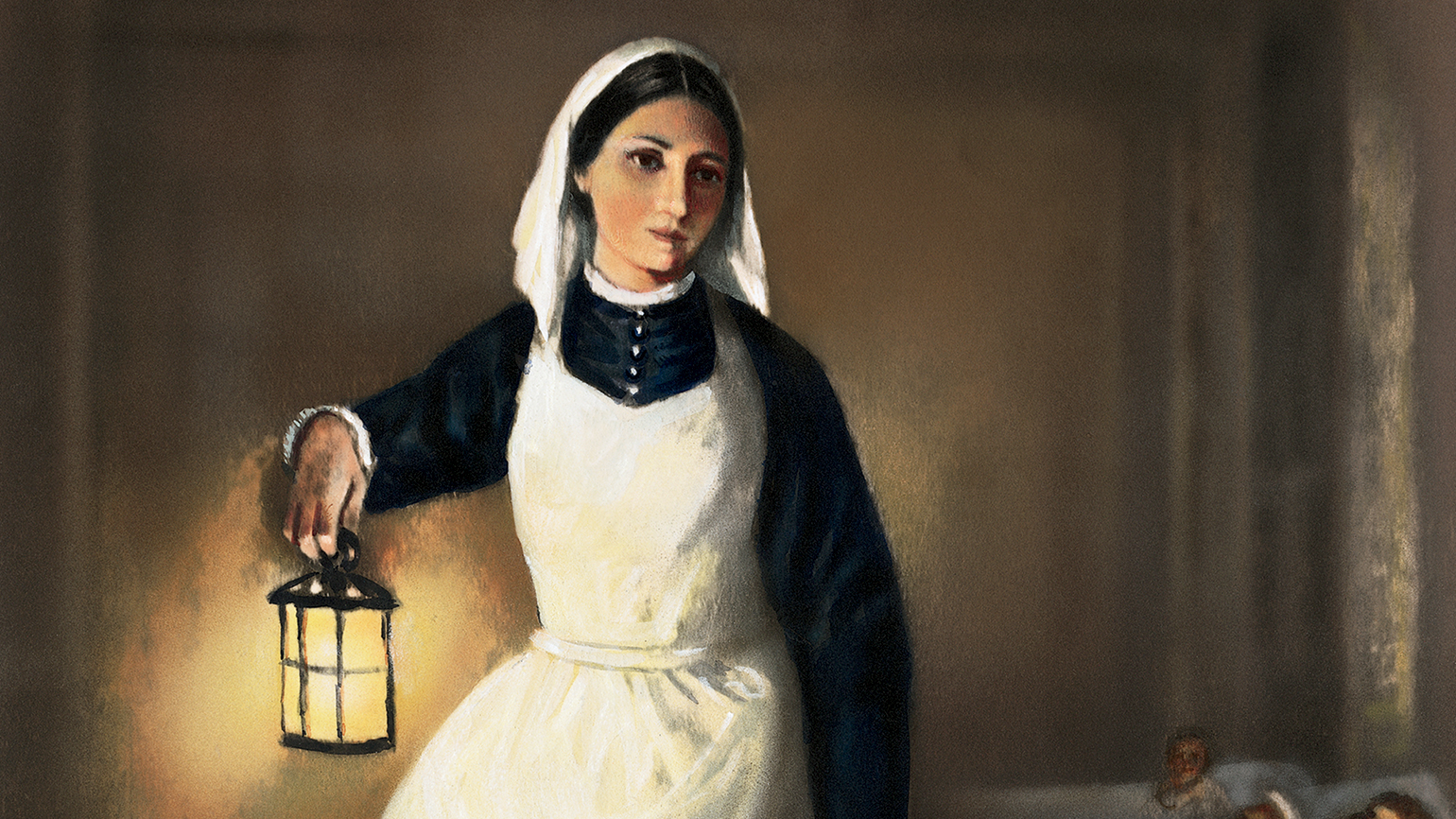
At Herbert’s request, she gathered a coterie of other nurses and went to Turkey, where the injured soldiers had been transported. There her reputation was burnished. She became famous as the Lady With the Lamp, going from bed to bed, nursing the wounded soldiers into the late hours.

She discovered the soldiers had been dying in droves from preventable ailments. Linens had gone unchanged, meals unserved. Chamber pots overflowed, and the hospital was filthy, resembling more a putrid charnel house than a place of healing. Florence immediately created a basic standard of care. Using some of her own funds, she bought supplies, established practices of sanitation and dealt with a military bureaucracy that opposed her at every turn, hoping she’d go away.

Along the way, Florence continued to be touched by mystical experiences. In Turkey during the war, she had a vision of her beloved pet owl, who’d died shortly before she left England. She was walking home from the hospital one night “when Athena came along the cliff quite to my feet, rose upon her tiptoes, bowed several times, made her long melancholy cry and fled away.” Far from home and up against incredible odds, Florence found the vision was a great comfort to her. It was a reassurance that she was still on her God-given path.

Florence stayed in Turkey through the end of the war, remaining until the last wounded man left. Then, avoiding any furor, she made her way secretly back to England, as though to reaffirm that what she had done was for God alone.

Upon her return, Florence plummeted into depression and nearly died. She was understandably exhausted from undertaking such a long stretch of 18- to 20-hour days. She was also suffering from a mysterious illness that historians have only recently diagnosed as severe chronic brucellosis, which comes from drinking infected goat or sheep’s milk. The water in Turkey would have been undrinkable, and Florence wouldn’t have turned to beer, wine or spirits as most of the other doctors and nurses did. (Drunkenness was a serious issue for some of them.)

For the next 52 years, she lived in England as a recluse, but her work was far from over. In fact, you could say that her greatest impact came during this time. She spent her days haranguing the powers that be with letters and tracts, prompting them to set new standards of medical care that we have come to expect as normal: clean beds, clean sheets, clean rooms and caring nurses.

Florence died at the age of 90, after saving countless lives and changing the world for the better. She’d done what she’d been meant to do. She’d heard God’s call—and answered it.

How Faith Helped Her Find Her Lost Cat

It was Christmas Eve morning, and I awoke with a mission: to find my lost cat, Baby-Girl. As I got ready, I could hear icy rain pelting the windows. I said a quick prayer for Baby-Girl. She was out there somewhere in the storm, I could just feel it. Sure, it had been six months since she’d gone missing, but I still had faith. It was the season for miracles, after all.

That summer, my sweet kitty had disappeared from my parents’ house in Indiana. Baby-Girl had been staying with them while I was between apartments. I’m a nun and Catholic school teacher. At the time, I lived and worked in Washington, D.C. I was staying with friends until I signed my lease on a new place. Baby-Girl had gotten out of my parents’ house three days before I was set to fly back home to pick her up.

My dad and I spent that entire visit searching for her. Dad was the family’s resident “realist,” which meant he spent a whole lot of time trying to prepare me for the worst. “She’s either been hit by a car or been taken in by someone who found her,” he said. I rolled my eyes. Dad always supported me, but he could be so skeptical. He could do with a little more faith!

Besides, though I couldn’t explain it, I knew I’d see Baby-Girl again. She’d been a stray when I found her. A scrappy little tabby that had survived all on her own. If any cat could do the impossible, it was my Baby-Girl. Even after I returned to D.C. without her and the weeks stretched into months, deep down I had this feeling that we’d be reunited.

Now, home again for the holidays, I was determined to pick up my search right where I left off. I grabbed Baby-Girl’s cat carrier and loaded it into the car, then asked my dad to drive me to the shelter, hoping she’d been found.

“Sharon, you have to be realistic,” my dad said as we headed to the garage. “She’s been gone too long. You’re not going to find her.”

“Well, I just have a feeling,” I said.

Dad raised an eyebrow as he climbed into the driver’s seat.

“Don’t you believe in Christmas miracles?” I asked.

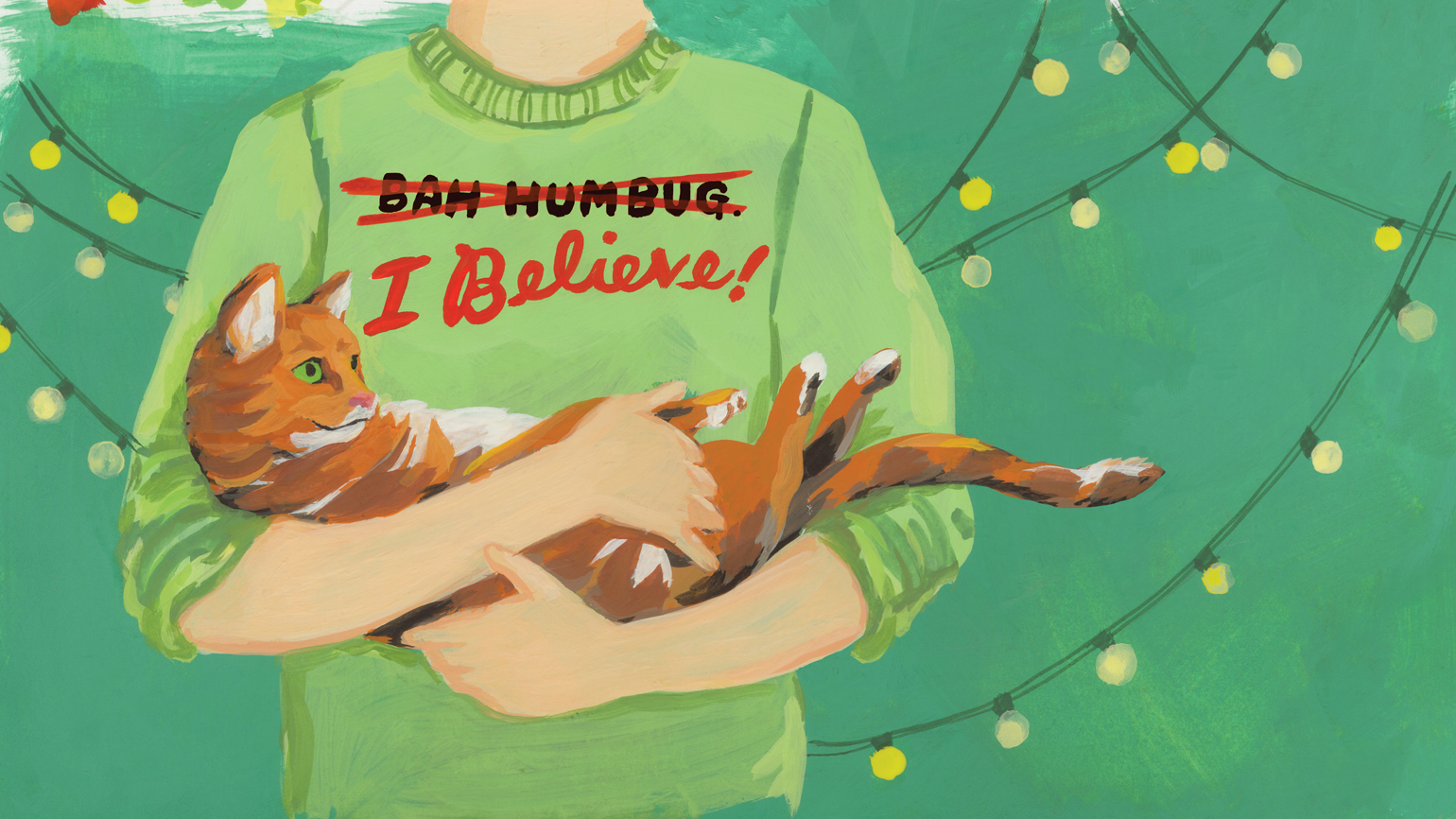
“Bah humbug,” he said, lightening the mood. It was his favorite Christmas saying and an inside joke in our family. He even had a shirt with the phrase emblazoned across the front, which he wore every Christmas morning. I threw my hands up in mock despair.

At the shelter, the woman at the front desk greeted my dad warmly. “Good to see you again, Mr. Dillon! Still looking for your cat?”

Ah, I thought, maybe he’s not such a pessimist after all.

A staff member took us to see the cats. “When did she go missing?” the woman asked.

“Six months ago.”

“And was she chipped?” No, I had to admit, Baby-Girl was not. The staffer noticeably winced at the words. “When we get unchipped cats, they’re put up for adoption after three days,” she explained. “Even if your cat was brought in, she’s probably gone by now.”

We walked through rows of cages. My eyes scanned cats of all shapes and sizes. None of them was my Baby-Girl. Then I noticed a room farther back. I pushed ahead. “Sweetheart, that’s where they keep the cats that just came in,” Dad said. “Your cat wouldn’t be in there.”

“It doesn’t hurt to look!” I said.

I stepped in the room and heard a familiar meow. My eyes zeroed in on a little tabby cat with big green eyes. She was skinnier than I remembered, but it was Baby-Girl all right! My eyes welled up with tears. I opened the cage door. Baby-Girl practically jumped into my arms. I held her close as Dad looked on, mouth agape.

“Dad! It’s Baby-Girl!” I cried.

“There’s just no way….” he mumbled to himself.

I returned to the front desk to let them know I’d found my cat. The shelter staff was skeptical. I pointed out that this cat matched Baby-Girl’s description perfectly—right down to her hind left white paw. Still they looked uncertain.

“Wait here! I can prove she’s my cat,” I said, excusing myself to grab the carrier. I’d trained Baby-Girl to walk inside the carrier when I opened its door. Sure enough, when she was let down in the middle of the room, she made a beeline for the carrier and scooted right inside.

“That’s definitely your cat,” a staffer laughed. “I’ve never seen any cat do that willingly.”

I asked when she’d been brought in. She’d arrived during the ice storm—likely about the same time I’d prayed.

Back home, the rest of the family welcomed Baby-Girl. She purred like a motorboat, rubbing up against everyone’s legs. She seemed completely at home. Dad remained stubbornly skeptical.

“It just cannot be her,” he said. “Not after all this time.”

I rolled my eyes. Eventually, Baby-Girl made her way down to the basement, where her litter box was kept.

“See? How would she know that the box was there if she hadn’t been here before?” I said to Dad.

“Fine,” he said. “I’m 40 percent convinced it’s her.”

“What would it take to change your mind?” I asked.

He considered for a moment. “If she sits in her favorite spot in the hearth, I’ll believe it’s her.”

Baby-Girl loved to sit curled up inside my parents’ decorative fireplace. And that’s exactly what she did as soon as dinner was done.

“Okay, maybe it’s her,” Dad admitted. “I’m about 60 percent sure.”

We all groaned. Dad took to his armchair to read as we wound down for the evening. All of the sudden, he burst out laughing.

“What’s so funny, Bill?” Mom asked him.

“My book,” he said. “It says: ‘Baby-Girl, I have lost you. Now I have found you. I will never lose you again!’”

We all roared with laughter. “Is that enough, Dad? Or does the Holy Spirit himself have to appear and tell you?” I asked.

“Okay! Ninety percent!” Dad said. “But only because the Baby-Girl in the story is a lost dog, not a cat.”

We were all almost in tears from laughing so hard. My heart was filled with gratitude—I was surrounded by family and, against all odds, my cat was home again, six months after going missing.

It turned out, Baby-Girl’s return wasn’t the only Christmas miracle that year. The next day, when Dad came downstairs for Christmas morning, he was wearing a new holiday shirt. It read: I Believe!

Did you enjoy this story? Subscribe to Mysterious Ways magazine.

How Do You Define a Miracle?

How do you define a miracle?

It seems like a simple enough question. But I’ve come to find that just about everyone has a different answer!

For example, here’s how Merriam-Webster defines a miracle: “An unusual or wonderful event that is believed to be caused by the power of God.”

Frederick Buechner puts it a little differently: “A miracle is when the whole is greater than the sum of its parts. A miracle is when one plus one equals a thousand.”

Then there’s one of my favorite miracle definitions of all time from Lemony Snicket’s The Lump of Coal: “Miracles are like pimples, because once you start looking for them you find more than you ever dreamed you’d see.”

My fellow miracle aficionados, Joan, Katie and Meb–miracle experts and authors of The Miracle Chase–view a miracle as “a sign of divine intervention in the world that creates an unfolding and beneficial connection between God and humankind.”

And my mom–my go-to source for wisdom!–has this definition: “It’s not just visions or lightning in the sky. It’s seeing God’s handiwork everywhere in your life.”

There’s really no correct definition, of course. Just like everyone has a different relationship with God, we each have our own understanding of miracles.

With that in mind, I thought it’d be fun–and illuminating–to collect definitions of the miraculous from you, the Guideposts family. That way we can see where we agree and disagree, and better understand God’s wonder.

Here’s my rough definition to get us started. A miracle is: God’s way of talking to us in ways both big and small. (Any act that involves God is inherently miraculous in my book, regardless of magnitude.)

Now it’s your turn. Share your definition of a miracle in the Comments below or on Facebook. I’ll feature the definitions in an upcoming blog post. Stay tuned!

How Does God Hear All Our Prayers at Once?

On a typical day, if someone asked me, “What are you doing right at this moment?” I would have one or two answers. (Well, as a mom who has honed the art of multitasking, I might have three or four!)

But the easy answer to the question would cover only the things I was consciously and intentionally doing at the time. It would not include my arteries pumping blood throughout my body to distribute oxygen to my cells. Or the mitochondria in those cells metabolizing carbohydrates and fatty acids to generate energy. Or the dendrites of my brain’s neurons receiving the electrical messages that together translate into to all my thoughts and motions.

The fact is that, at any given moment, our answers to the simple question, “What are you doing right now?” should be, “Millions and millions of things.” So, I believe, it is the same with the way God hears and responds to the prayers of any and all.

I don’t see God as a Superhuman Switchboard Operator who has to take the calls of thousands of desperate callers jamming the switchboard with their simultaneous prayers. Our prayers are not outside of God any more than your mitochondria are outside of you (even if you have no idea what a mitochondrion is!).

Rather, I see God as Ultimate Consciousness: an eternal, all-knowing, pure-loving reality that birthed and continues to sustain the universe. I see the universe itself as the physical manifestation of this consciousness. God’s ultimate consciousness permeates the cosmos. It infuses every proton, neutron and electron, and it comprises the spaces and forces between them. The cosmos is word made flesh, love burst forth into matter—Christ Consciousness.

And so, our prayers—our desires, hopes and needs as they bubble up into our own consciousness and intention—are already in God. They are part of the fabric of this awesome universe. Perhaps, when we make our humble efforts to bring our limited human consciousness into sync with Ultimate Consciousness by praying, we open ourselves up to God’s order. We let ourselves be moved by this loving consciousness that permeates all, rather than acting out of a sense that we have all the answers.

The simultaneous prayers offered up to God by countless people throughout the world are like a “sound check” between humanity and our Creator. The miracle of it all is not only that God hears our prayers through this sound check. But that, collectively, we open the human spirit to God’s frequency through prayer. We hear God.

Here’s how other theologians, writers and scholarsboth past and presenthave answered the question, “How does God hear all our prayers at once?”

“God is timeless and has ‘all the time in the world’—literally. Saint Augustine first proposed that concept, and Einstein’s theory of relativity demonstrated how. A being as big as the universe would experience all time in history at the same moment. So attending to seven billion prayers at once would be no problem for such a God!”—Philip Yancey, author of Prayer: Does It Make Any Difference?

“We can sometimes fall into the trap of thinking of God as an old man in the sky having to juggle millions of telephones constantly ringing. But God is in us, and we are in God. That mutual indwelling means that our prayers are not even our prayers: They are God’s, and God is praying within us with ‘sighs too deep for words,’ as Paul said. And so there is no gap between the prayer and the hearing of that prayer.”—Brother Aidan Owen, Benedictine monk

“‘Am I a God who is only close at hand?’ says the Lord….‘Can anyone hide from me in a secret place? Am I not everywhere in all the heavens and earth?’”—Jeremiah 23:23–24

“Far too many people think of God as a sort of divine vending machine. But God is infinite, and prayer is not a transaction. Prayer is the way we human beings hear the heartbeat of creation and connect with the sacredness of life. If we understand that God is the animating love of all that is, then how can God not hear our prayers?”—Dr. Diana Butler Bass, scholar and author of Grounded: Finding God in the World

“Almost certainly God is not in Time. His life does not consist of moments following one another. If a million people are praying to Him at ten-thirty tonight, He need not listen to them all in that one little snippet which we call ten-thirty. Ten-thirty—and every other moment from the beginning of the world—is always the Present for Him.”—C.S. Lewis, author of Mere Christianity

“God, being omnipotent and all-powerful, not only hears all of our prayers at once but knows them even before we ask them. He knows each and every one of us, inside out. Not just because we’re made in the image of him, but because he is our divine creator.”—Jarrid Wilson, pastor and author of Love Is Oxygen

“God is not bound by the same rules of nature that we are. He exists outside the limits of time and space. Beyond that, I do not know how he hears each of us separately. But what I do know is that he hears me individually because he speaks back to me daily.”—Carlos Whittaker, motivational speaker and author of Moment Maker

Got a Big Question? E-mail it to us at MW@Guideposts.org—it could be featured in our next issue!

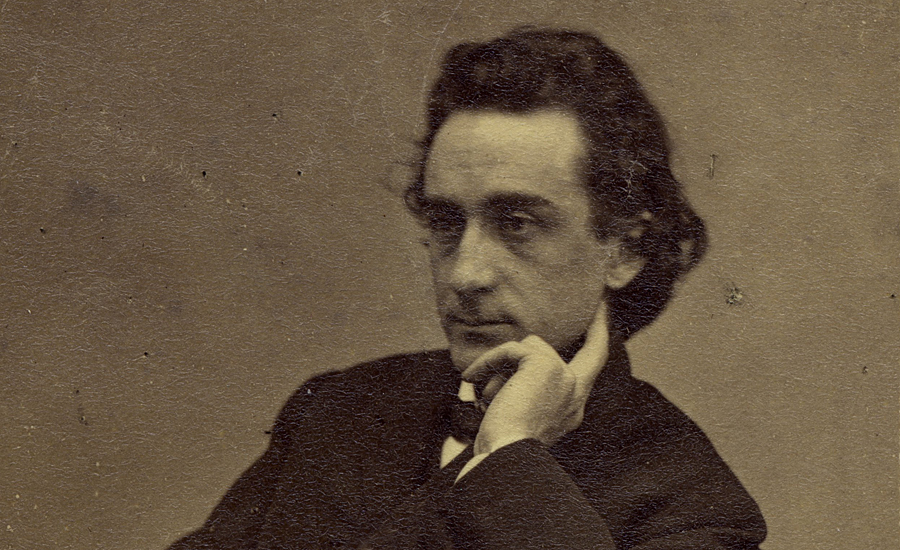
How Booth Saved Lincoln

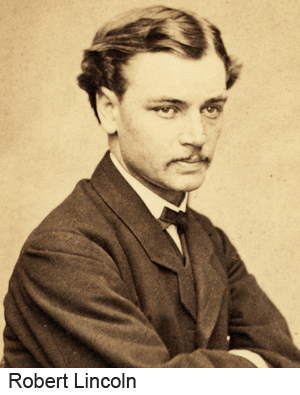
History is full of mysteries, the fates of nations pivoting on an unexpected and seemingly random turn of events. One extraordinary moment in American history happened on a train platform in Jersey City, New Jersey, in the darkest days of the Civil War. Abraham Lincoln’s oldest son, Robert, a 20-year-old Harvard student, was waiting for a train when a rowdy crowd put him in mortal danger.

“There was a narrow space between the platform and the train car,” Robert later recalled. “There was some crowding, and I happened to be pressed by it. The train began to move and I was twisted off my feet, and dropped, with feet downward, into the open space, and was personally helpless…”

President Lincoln and his wife, Mary, had already endured much tragedy. They lost their son Eddie when Honest Abe was still a rising Springfield lawyer, and Willie, a much-doted-upon 11-year-old, had recently died of typhoid fever, throwing the president and the First Lady into a deep depression. Their youngest son, Tad, was often sickly (he’d end up surviving his father by only six years).

Is it any wonder that Mary was so protective of her eldest, Robert? She protested against his enlisting, much to his dismay. But that evening in Jersey City, it seemed Robert was destined to become another tragic death in the saga of the Lincoln family.

Robert Lincoln, Abraham Lincoln's sonThe train lurched, coming close to crushing Robert, when he felt someone tug his coat—“vigorously seized” it, as he later wrote—jerking him back up onto the platform and out of harm’s way. Robert’s rescuer had no idea whose life he’d just saved, how important a role he’d play in the course of both a family and a nation. But Robert never forgot that man. How could he?

Robert went on to have a distinguished career. He managed to enter the Union Army late in the war, serving as a captain under Ulysses S. Grant, and was an eyewitness to Robert E. Lee’s surrender.

On April 14, 1865, he was in Washington, D.C., but decided not to join his parents at Our American Cousin at Ford’s Theatre that terrible night, when John Wilkes Booth emerged from the shadows and took President Lincoln’s life. Robert later served as secretary of war in one administration and minister to England in another. He was often recommended as a presidential candidate.

The sole heir to the Lincoln name, he corresponded with his father’s biographers, providing tremendous insight into the Lincoln presidency. He died at the age of 82.

Robert was forever grateful to his rescuer. While the man hadn’t recognized him, Robert had known exactly who the man was: one of the greatest Shakespearean actors of his day. An adamant Unionist, who had proudly voted for Lincoln, the actor was devastated when the news of the president’s assassination reached him.

For a time, he retired from the stage, refusing to perform, until a letter from a friend, who’d heard the story from Robert, told him the identity of the young man he’d rescued. The truth helped inspire the actor’s return to the stage.

While John Wilkes Booth would forever be known as a notorious assassin, his brother Edwin Booth is remembered today for defining Shakespearean characters for American audiences, founding his own theater, donating his home as a club for actors and artists…and saving Abraham Lincoln’s only surviving son.