


Embrace God's truth with our new book, The Lies that Bind

How a Chance Phone Call Saved Her Life

”I think I can help find your brother,” Anne said.

My friend had taken me by surprise. I gripped the phone tighter. “How?”

“From a search engine that publishes people’s names, addresses and phone numbers online.”

I hung up the phone feeling conflicted. I knew I needed to stay realistic, but a part of me felt a glimmer of hope. My life depended on tracking down my brother.

Four months earlier, I woke one morning with blinding back pain. A quick Google search indicated a kidney infection. I went in for a checkup, thinking I’d be prescribed antibiotics and be on my way. But 30 minutes into my appointment, my doctor was pointing out the bright spots on my chest X-ray, as big as hailstones.

I had mantle cell lymphoma (MCL). Considered incurable, MCL patients have an average life expectancy of five years.

At the time of my diagnosis, I was Stage IV. My bone marrow was a cancerous mush. I had so little oxygen in my bloodstream that without emergency transfusions a heart attack was inevitable.

The treatment began that day. After months of intensive inpatient chemo, I was emaciated and bald, but—against all odds—in remission. The bad news? To prevent a recurrence, I needed a stem cell transplant. I had to have a donor who was a genetic match.

According to my oncologist, each of my siblings had a 25-percent chance of being genetically compatible. I had two brothers who were willing to be donors, which raised the odds to 50-50. Neither brother, however, tested positive for a match. I hadn’t told my oncologist about Johnny, my youngest brother. He and I hadn’t spoken in years. When I finally mentioned him, she said, “You have to find him.”

An abusive mother and an alcoholic father created a traumatizing childhood for all of us, but especially for Johnny. After high school, he moved out of our mother’s Los Angeles home and headed for Huntington Beach, where he loved to surf. We communicated infrequently. Phone calls were strained. I was married with a daughter, a career and a house in Northern California. Meanwhile, Johnny supported himself doing odd jobs, growing psychedelic mushrooms and embracing the beach culture of Southern California. I encouraged him to find a job that did not carry the risk of prison. He believed I judged him unfairly. That was our last conversation, 30 years ago. After that call, he disappeared from my life. No one in my family had any idea where he was now.

Could my friend’s internet sleuthing do what my family couldn’t? And did Johnny even want to be found?

Anne knew all of this painful family history and was at my door the next morning to hand over some print-outs. I would be the one to make the calls.

There were more than 40 addresses for a Johnny Schultz in Southern California, all with phone numbers that took up three pages. The sight of my brother’s name listed over and over made my heart pound.

The third page contained only one entry. There was no address, but the 707 area code for the Sonoma County region told me this one wasn’t him. Sonoma County was not far from where I lived, beautiful in its own right, but with its rugged beaches and cold climate, it was an incompatible world for a beach boy like my brother.

I sat down at the kitchen table with my work cut out for me. Trembling, I dialed the first number…and the second…and the rest, until I’d called every phone number on the page. People answered: some kind, some brusque. No one had a sister named Susan. I left messages when a machine picked up.

I did the same for every number on page two—same results. If messages were returned, they weren’t my Johnny. I had no way of knowing if my brother had heard a message I’d left and just decided not to return the call. I didn’t know if I should leave a second message for those who didn’t call back. It was awkward enough when people answered, and I didn’t want to harass strangers on voicemail. I appreciated my friend Anne wanting to follow every lead, but I went to bed thinking we’d hit a dead end.

The next day, I got up my courage and looked over the list again—most of the names now confirmed to be a different Johnny. The lone number on the last page stared out at me from the whiteness. I dialed, just to be done with it. The phone rang and rang. No answer. Not even a machine. I had left no stone unturned and still had come up with nothing.

Almost nothing, I thought after I’d gotten into bed that night. The endless ringing of that one last number seemed to hang in the air. I turned on my bedside lamp and picked up Anne’s list, certain that my effort would be useless. I redialed the 707 number. Again, it rang and rang. No answer. No machine. I was just torturing myself. I hung up.

Just one more time, something told me. I redialed. The phone rang…

“Hello?” It had been three decades, but I recognized the voice with that one word. It was my Johnny.

My brother was surprised to hear from me, but the conversation flowed easily as we caught up. He asked how in the world I’d managed to get ahold of him. His 707 phone number had always been unlisted, he said, except for one recent week, when someone at the phone company had made a mistake. Anne must have done her research during the short time Johnny’s number was erroneously listed.

My palms were damp when I explained why I’d called. I needed him to possibly save my life. Johnny didn’t hesitate before agreeing to help.

The hospital sent him a testing kit. My youngest brother was a match! His stem cells and the new immune system they created have kept me alive and well for the past 16 years.

Johnny and I have reconnected on a deeper level too, something I never dreamed possible. It felt good to say I had three brothers again, and angels of every kind who never gave up on me.

For more angelic stories, subscribe to Angels on Earth magazine.

Hope Grows in a Garden

Spring was never going to come. That’s what it felt like when I looked out the window of my new house at another gray and gloomy morning. I couldn’t remember the last time I’d seen the sun.

Rain pattered the windows as I made breakfast. My children finished eating and went back upstairs. I grabbed an umbrella and stepped out to look for signs of life in the garden. But the ground was soggy and cold. Not a bud anywhere, and they were way past due. It’s not a garden with no flowers, I thought. That about summed up my life these days. A garden with no flowers. And no hope of seeing any anytime soon.

Once I never would have doubted spring was on its way. No matter how long or cold the winter, I could count on everything getting brighter eventually. Just like I had counted on my marriage of 17 years, or the job I’d loved. But this year my marriage had ended, my job was downsized, the kids and I had moved to a new house. Could I ever again feel the hope that had once come so naturally to me?

It was my dad’s idea to buy a new house after my husband and I split. “I don’t know,” I’d said. When I’d bought a house with my husband I had been full of hope for the future. Even when it was just the two of us I knew our family would grow to fill the house as sure as a garden filled with flowers in the spring. Now I felt safer in a small apartment, the perfect size for my downsized expectations.

Read More: Inspiring Angel Quotes

“A house would be a new start,” Dad had insisted. “It’s like preparing the ground for all the blessings to come. Besides,” he’d added, “you need a garden for your angel.” The angel had been a gift from Mom and Dad, a foot-tall stone carving. I’d collected angels since I was a little girl. I knew Dad was right: What better place for an angel than in a garden, surrounded by flowers? And so we’d moved to a new house.

The angel hadn’t gotten near any flowers, though. She sat in the garage, gathering dust. In our old home I could look out at her in winter and trust in spring’s promise. Her presence announced “there is a garden here” even when no plants were growing. I no longer trusted in that kind of promise.

I walked back toward the house, the muddy ground sucking my boots down with every step. As I passed the garage I caught sight of my angel. She looked as hopeless as I felt but surrounded by concrete and metal. Even the soggy garden is more likely to sprout flowers than the garage, I thought.

I went in and kneeled down beside her. “Dare I risk my disappointment if I set you in a garden that will never bloom again?” I asked. I brushed the dust from her flowing gown and carried her around to the front of the house. I put her down outside the big bay window. “There is a garden here,” I said as I brushed the dirt off my hands. “Maybe I don’t have my flowers, but I do have my angel.”

The weather wasn’t any warmer or brighter, but for the first time in weeks it felt like it might be one day. Just maybe. This is what hope feels like, I thought. How I missed it.

The following week held no change in the weather. From the bay window I checked on my angel. She’s no match for this weather, I thought as I fixed dinner one evening.

The late school bus pulled up out front, dropping off my 14-year-old after basketball practice. Heavy footsteps pounded up the walk. “Wipe your feet!” I ordered as Mackenzie burst in through the door.

“Mom!” he cried breathlessly. “There are flowers!”

“Flowers?” I repeated. What did that mean?

“Outside,” Mackenzie insisted. “There are flowers in the yard!”

“Maybe you saw dandelions,” I said. “They’re just weeds, Mackenzie.”

“No, come and look,” he insisted. He tugged me by the arm to the front of the house. My hands flew to my mouth. Hundreds of tiny, delicate flowers dotted the lawn. They looked almost like violets, but were the color of summer clouds. I’d never seen flowers like them before. They were so fragile I couldn’t imagine how they’d grown in all this rain and cold.

And even more amazing was where they had sprouted: in an almost perfect circle around my angel. “There must be more somewhere,” I whispered as I bent down to brush the petals with my fingertips. Mackenzie and I scoured the entire yard, front and back. There wasn’t a single bloom except for those growing around the angel.

“I guess the angel brought life into the garden,” I said.

Mackenzie nodded. “She must have planted the seeds herself.”

Planted the seeds, I thought as we went back inside. Seeds, like hope, couldn’t grow unless you planted them. I’d planted mine when I moved my angel even though I didn’t believe the garden would bloom. That simple act had planted a seed that created all these flowers. Who knew what else that faith could bring to my life if I only let it. I’d been waiting for a new life to give me hope again. Now I saw hope was the only thing that could give me a new life.

I couldn’t wait for Dad to see the angel’s flowers. Each one a promise of the blessings sure to come.

Download your FREE ebook, The Power of Hope: 7 Inspirational Stories of People Rediscovering Faith, Hope and Love

His Glimpse of the Gates of Heaven Was Her Blessing

The house Marv and I had called our home was deathly silent as I moved aimlessly from room to room. Our three grown children had gone back to their lives. The same with my friends. Five days after the funeral there was only me, alone with my thoughts. No one to tell how much I missed hearing his voice, his warm laugh. He’d been such a rock for me in our marriage, with his banker’s sensibility, dependable, faithful. His faith had always been stronger than mine.

Now he was gone, killed by complications from pneumonia and a progressive palsy that would have left him paralyzed had he not died. I’d spent my career as a nurse. I knew the toll disease can take on a person. I was glad Marv hadn’t suffered any more than he had. But that didn’t make the pain of losing him any easier.

I wanted to believe he was in God’s hands, in heaven, just as our minister had said at the funeral. I wanted to be truly happy for him. But in the silence it was hard to feel anything but sadness and loneliness.

I settled into Marv’s comfy armchair. My mind went to another time, 12 years earlier, when Marv had seemed distant, unreachable. He had been home for five months after surgery to remove a pancreatic tumor. He should have been back to his old self, but this was a man I barely recognized. He moped around the house. Hardly spoke. He’d been an avid golfer, but he hadn’t been to the links once since his surgery. I was worried about him. He wouldn’t tell me what was wrong. It was as if he’d lost his will to live.

Then one day we were sitting at the table after lunch. “Something happened to me in the hospital after the surgery,” he said, his voice halting. “I barely know how to put it in words.”

“Marv, you know you can tell me anything,” I said, but I couldn’t imagine what it could be.

“I was in a lot of pain,” he said, looking down at his empty lunch plate. “You’d gone to the hotel for the evening. I kept pressing the button for a dose of pain meds, but couldn’t get a nurse. I looked to the door. Two men I’d never seen before walked into my room. They were 40ish, average height. One had longish brown hair and the other had shorter hair.” Marv looked up and held my gaze. “Both wore long white robes.”

I was on the edge of my seat. “You think they were…”

“Angels, yes,” Marv said. “I’ve never been more certain of anything. They stood on either side of me, freed me from all the tubes and IVs, and put their arms around me. I was lifted. I saw the bed below me. The walls of the hospital vanished. I was flying through a brilliant blue sky. I wasn’t afraid. I felt the strength of the angels’ arms, supporting me, guiding me. Peace enveloped me.”

Marv went on to describe lights in the distance, shimmering waves of white, blue, red and green, like the aurora borealis, only the colors were brighter and deeper.

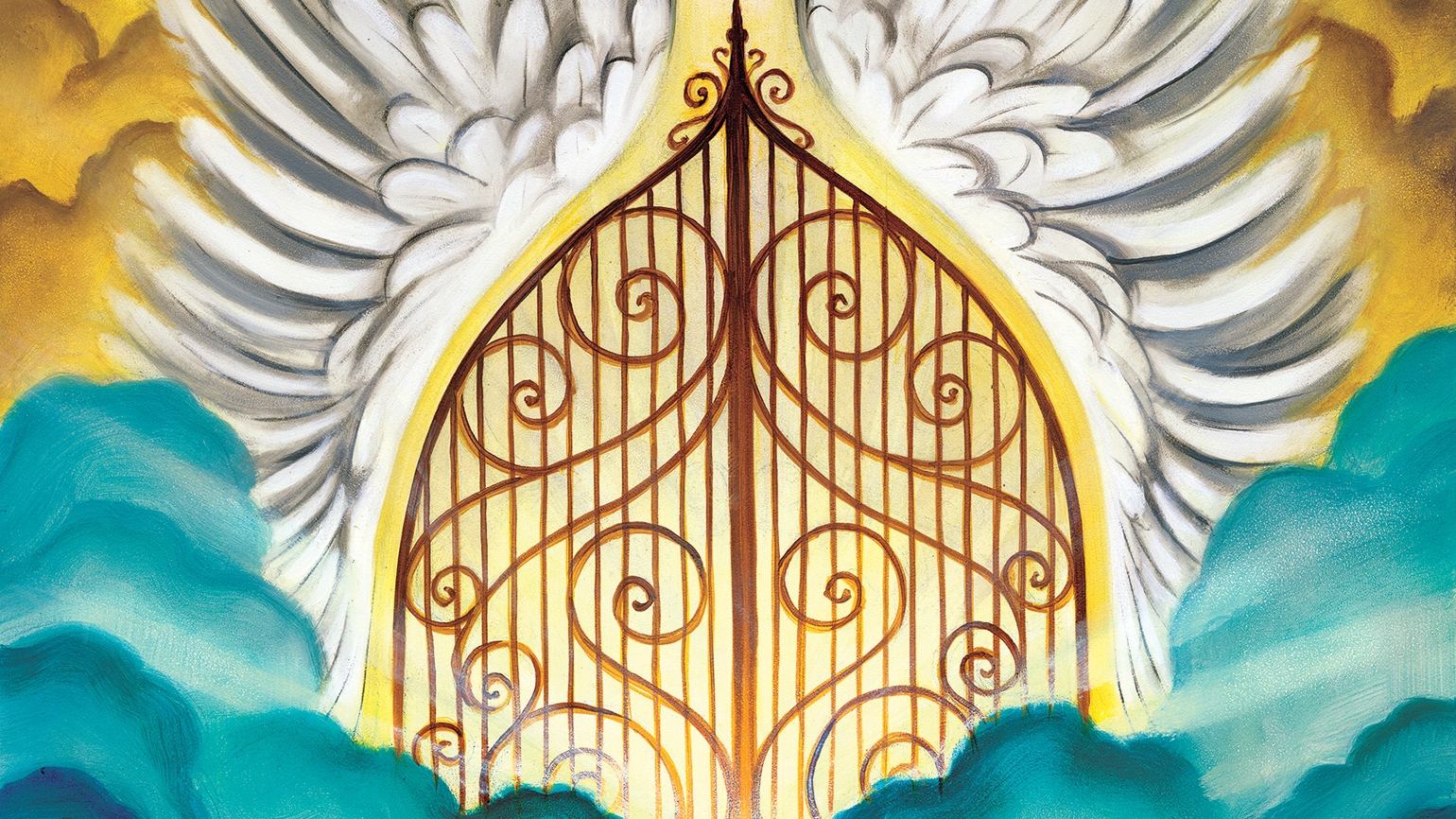
“I found myself outside a vast wooden door and a wall that seemed endless,” he said. “I was at the gates of heaven! The joy I felt was indescribable. I craned my neck but couldn’t see the top of the door and realized the angels were gone. There were about 35 people ahead of me, all of them smiling, beaming, as if to say, ‘We finally made it!’ Every minute or two the door would open and the next in line would go in. Finally no one was in front of me. The door opened to a large man with shaggy hair, a scrubby beard, sandals and a robe that looked like it had been worn for at least a thousand years.

“He stuck out his hand. ‘Hello, Marv, my name’s Peter. Welcome to heaven.’ ”

With every word Marv’s story grew more incredible. I didn’t doubt a word he said, yet it was more than I could comprehend. “Then what?”

“I was in a kind of entryway,” Marv said. “And Peter turned a page in what I understood to be the Book of Life. ‘Marv,’ he said, ‘I can’t find your name for today.’ I was dumbfounded. I argued with him. All that mattered to me was to be in heaven.”

At that point Marv could see a world beyond where he stood with Peter. Green grass, thick and inviting, the sky a sea of vivid blues, periwinkle, aqua and sapphire. Far in the distance he saw Grandma and Grandpa Besteman, his mother and three of his best friends. They each smiled and waved, as if inviting Marv to join them. They seemed to glow with happiness. Marv wanted to run to them, but Peter was insistent. It wasn’t Marv’s time.

“The next thing I knew I was back in the hospital room, connected to tubes.” Marv paused. “I’ve been struggling with how to tell you all this. And how to deal with these feelings of wishing I was in heaven even now.”

I took Marv’s hand and squeezed it. “Marv,” I said, “you have been truly blessed. And I’m here for you. Those angels too are still watching over you.”

Now, sitting here with only the memory of Marv to keep me company, I recalled that conversation as if it had just taken place. In the weeks that followed, Marv’s spirits slowly improved. He told the children what he’d seen, then our minister and the people at church. With each telling he grew stronger. He saw how his account of heaven gave hope to others. He spent months reading everything he could about the angelic world. In time he wrote a book, My Journey to Heaven. But I’d felt a bit disconnected from it all. Hearing someone talk about heaven, even Marv, wasn’t the same as actually experiencing it myself.

Almost six years went by. It seemed Marv had made a full recovery. Then in mid-December he was hospitalized with pneumonia. I assumed he would be released in two or three days, but his condition only worsened. By early January I noticed he was markedly weaker on his left side. He struggled to speak. A CT scan showed a blood clot on his brain, and he was transferred to the ICU.

Four days later I made the hardest decision of my life, to remove Marv from life support. He was moved to hospice. I sat at his bedside day and night. Marv barely moved—barely aware, it seemed, of my presence, or the kids and friends who came to pay their respects. One afternoon he raised his arms skyward. “Do you think he’s reaching for Jesus?” a friend asked. I thought of the angels who had escorted him to heaven and wondered if they were there in the room with us. A short while later, Marv breathed his last.

With the funeral preparations and a house full of family, I hadn’t thought much about the day Marv finally confided in me about his first trip to heaven. But now, remembering the details of that journey, I truly understood Marv’s joy. The experience had been as much for his benefit as for mine. I imagined my husband in heaven as if I were standing right there beside him being greeted by those he loved. I smiled at the thought, and I knew it wasn’t only Marv who was in the arms of angels. The silence had brought me a blessing of my own.

Did you enjoy this story? Subscribe to Angels on Earth magazine.

His Father Taught Him How to Sail

My dad was a sailor. A serious amateur sailor. He and his buddy Chuck won the North American Championship in their class—sailing the beautiful wooden-hull Dragons, as the boats were called. One year the duo was second in line to go to the Olympics. And speaking of the latter, Dad headed up the yachting venue when the Olympics came to L.A. in 1984.

My brother, Howard, also caught the gift. Howard became an international champion in the sleek fiberglass-hull boats he sails.

Me? Not so much. I can skipper a dinghy around the Southern California bay where the family still likes to vacation, but my siblings would be quick to remind you of the time I took my mom out, getting an earful of instructions all the while, and ended up tipping us both into the water. Mom, drenched, was shouting so loud that everyone on the beach could hear her. (She apologized. Later.)

What I still love about sailing is how close you are to nature, no rumble of an engine or stench of an outboard motor. Just the feel of the wind in your hair, the splash of the water, the billowing sail taking you to your destination.

As a kid I loved lying in Dad’s Dragon—a kindly beast if there ever was one—and listening to the water on the other side of the hull. Is it any surprise that the arched wooden beams of our church and the roof they held up reminded me of Dad’s boat? There we were, hearing stories of fishermen who had to trust in the wind too, as they followed Jesus, the one who could calm the waves.

Dad didn’t become a success overnight. He had to work at his skill. As a kid, that first summer he had his own little sailboat, he competed in all the races in the bay and came in last every time. Sometimes he finished even after the committee boat had left. But he always finished.

At the end of the season, when awards were being given out, an elderly lady, who had watched Dad’s slow but steady progress from her front porch, stepped forward and offered a trophy made especially for him. “The Hope Cup,” she dubbed it. No other reward could match the promise of hope, a quality instilled in my dad and passed along to us.

“As a parent, he was more patient than Mom was and, if truth be told, a better sailing instructor. How well I remember him taking me out in the bay in our little dinghy, the wind still soft, the water smooth in the morning hours.

I clutched the tiller, and he sat across from me. “Where do you feel the wind coming from?” he asked. Was that it over my left shoulder? “You can look at the flags on the beach and they’ll show the direction the wind is blowing, but every good sailor learns how to feel it.” I could feel it.

“Now,” he said, “look at the sail.” If it was luffing—if it fluttered back and forth—I needed to pull in the main-sheet. Better yet, if the wind was behind us, I was to let out the sail so it could fill with the breeze, carrying us across the waters. Effortlessly. As though God’s angels were pushing us along, taking us on a blissful journey.

Dad was a man of deep faith. His long-winded graces at the dinner table were a witness to that when he prayed for each one of us by name. We were in our father’s—and our Father’s—hands. Embarking on the journey of life. Smooth sailing as long as we kept track of the wind. Trusting in the breath of angels.

For more angelic stories, subscribe to Angels on Earth magazine.
His Daughter’s Concert Helped Him Discover the Divine Gift of Music

God fills the autumn afternoons in Wisconsin with soft breezes. He paints the forests in yellows, oranges and reds, and wrings the humidity from the air. And God gives Wisconsinites one more gift on Sundays in the fall: the Green Bay Packers.

On a particularly perfect Sunday for a game last year, I was meant to be in front of the TV watching my team face off against the Cincinnati Bengals. But I had a dilemma. My daughter, Katie, was a student at Gustavus Adolphus College in Saint Peter, Minnesota, a couple hours’ drive from home. She played piccolo in the band, and had invited her mother and me to attend the Sunday concert—my Packers vs. Bengals Sunday—in Christ’s Chapel at the school. If Katie wanted me there, I had to be there. That didn’t make it any easier to give up my front seat to the televised game. The teams were pretty evenly matched, and it was going to be a nail-biter.

David and his daughter, Katie.

“Don’t they have any respect for professional football in that state where Katie goes to school?” I said to my wife, Trish, on the way there.

“You’ll survive,” she said, but I wasn’t finished. “It just seems like somebody didn’t get the memo,” I continued. “How could they schedule a band concert this afternoon? I feel like God’s calling me elsewhere.”

“God is not calling you to watch football,” said Trish.

It’s not that I was against band concerts in general. I appreciate a rousing march played before kickoff as much as the next guy. But band concerts, in my experience, tended to be short on rousing marches. Or rousing anything. They favored multi-movement pieces written by men I’d never heard of. At least I had Katie’s piccolo parts to concentrate on while she was onstage.

“By the way,” Trish said casually, “it’s not just Katie’s band playing this afternoon. The elite band is performing too, and so is the orchestra.”

“Anyone else?” I asked just to be sarcastic.

“Yes,” said Trish. “Both choral groups will perform, as a matter of fact.” I wanted to bang my head against the windshield.

When we got to Saint Peter, we took Katie out to lunch, then dropped her off at her dorm to pick up her piccolo and music. Trish and I headed over to the chapel to find a seat.

I’d heard a lot about Christ’s Chapel—the school was quite proud of it—but I’d never been inside. It was designed by the same man who designed the chapel at the Air Force Academy and was specially constructed to provide excellent acoustics. Stepping through the door, I stopped to look up at the vaulted ceilings and soaring stained-glass windows. When Trish and I walked down the aisle, our footsteps rang out with amazing clarity. “They weren’t kidding about these acoustics,” I said. “Why don’t we go up front?”

Trish looked at me in surprise, since I usually preferred the back rows of an audience. But I wanted Katie to see us there supporting her. We sat close enough to overhear the conductor giving the musicians a last-minute pep talk. It made me wonder what Coach was saying to the Packers in the locker room. To keep myself focused, I picked up the concert program. Big mistake. Fugues, quartets, concerto in F flat—the list of performances was long, and all the italics made it seem even longer. I am definitely going to miss the whole game. I turned off my cell phone to guard against the temptation to watch it in secret. I couldn’t risk the possibility that I’d start cheering in the middle of a fugue.

Already I squirmed in my seat. Tapped my foot on the floor. My taps echoed in surround sound. Trish glanced over at me sharply. I had to do something to relax while I was stuck in this…chapel. But of course! A good prayer was in order: God, let me feel your presence. Guide my spirit to find yours. Bring me closer to you. And above all, help me stop worrying about the Packers and keep my mind on the concert. I was ready to face the music.

A choir took the stage. As a final preparation, I put my program away so I wouldn’t get involved in a countdown. God was here to help me through this, I told myself.

All at once, the choir members opened their mouths in song. I’d heard plenty of choirs in my life, from neighborhood church choirs to professional choirs who sang on the world stage. I thought I knew what to expect. But this was a completely different experience. The melodic voices seemed to wash over me. I listened, transfixed by the sound. The music seemed to touch all my senses. I not only heard it; I felt it in every fiber of my being. This is more than song, I thought. More than acoustics.

I closed my eyes and felt myself being carried. Literally carried, as if on the wings of angels, beyond the vaulted ceilings and up into the sunlit sky. My earthly distractions fell away as I rose. The world was in God’s hands. All of it. I felt strangely relieved when I realized I’d lost all interest in who would win the game. There would always be another game, but this was a moment to celebrate. I was so elated I almost joined the choir in singing.

Eventually I came back down to earth. I was a little disappointed when I opened my eyes, looked around, and realized I was still part of the world—and, admittedly, I still really wanted the Packers to beat the Bengals. But I knew I was right where I was called to be on that particular autumn Sunday. Katie had never played so well, and the Packers even managed to win without me.

For more angelic stories, subscribe to Angels on Earth magazine.

His Daily Routine as a Postman Turned Into an Extraordinary Rescue

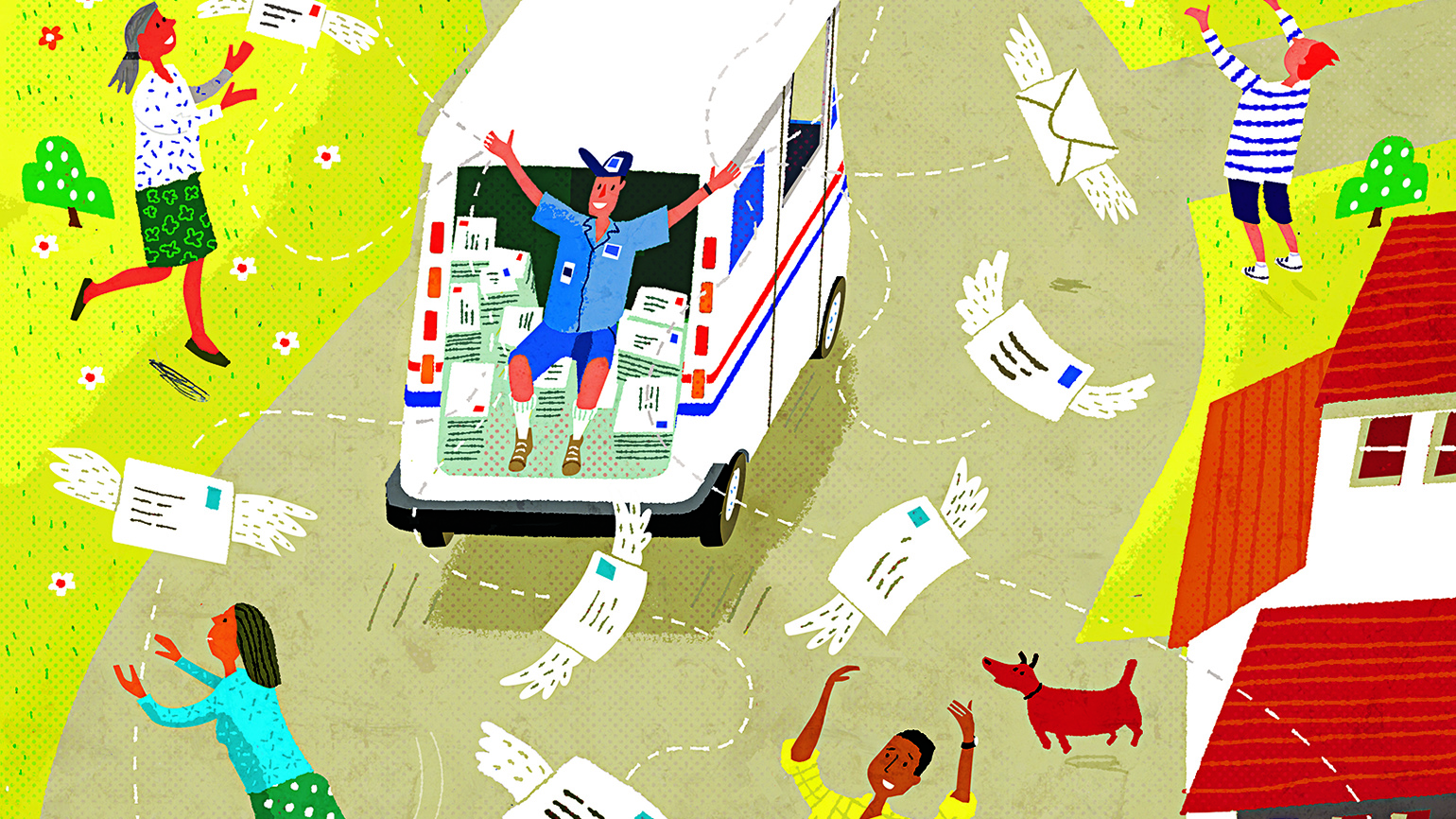
Children played in the yards along the block. I waved to them as I walked by, delivering mail at houses along the way. Just an ordinary Thursday afternoon. I turned up the next walkway. The lady who lived there opened the door wide. “Hello,” she said. I knew what she was waiting for. “I’ve got your book club selection,” I said, handing over her package.

There were only about 700 people on my route. Over the years I’d gotten to know most of them, if not in person then by their mail. There were the folks who got magazines, or book after book, those who loved their catalogues, some who had steady pen pals. Mrs. Dorman at the end of my route got a package from the Home Shopping Network almost every day. She was an older lady, and I liked being able to bring a little joy into her life with my delivery.

Some mailmen preferred routes where they drove a truck and slipped the mail into a collection of mailboxes without seeing anyone face-to-face. Not me. I wanted to be outside talking to people. Where the excitement was.

Except to be honest, there wasn’t much excitement on a local postal route like mine. Besides a sudden rainstorm or a white Christmas, every day was pretty much the same. I tucked a bundle into the next mailbox and noticed a postcard on top from Hawaii. Maybe I’m missing out on the real action of life, I thought, wishing I was there.

I continued down the block. I knew I provided an important service in my job. College acceptances, birthday presents, postcards from all corners of the world—they could all make someone’s day. I also brought doctor bills and insurance notices. Mrs. Dorman down the street got her blood pressure pills and blood test kits for diabetes in the mail. Convenient, yes. But I was just the messenger, showing up every day like clockwork. It wasn’t me who was making a difference in people’s lives. Not me personally. A friendly hello, a chat with a lonely person. That was the most I could offer. That should have been enough, but the routine was getting to me.

I dug in my bag for Mrs. Dorman’s mail—and the inevitable Home Shopping Network package. She’d be glad to get this, whatever it was. Mrs. Dorman often waited for me at the door and we always had a nice talk. Once a few years back I’d mentioned I’d noticed she got a lot of cards each August. Turns out, we shared a birthday. Now we never forgot to wish each other happy returns. This year she’d turned 78.

Mrs. Dorman wasn’t at the door today, but I heard the TV going inside so I knew she was home. Probably watching her shopping shows, I thought. I fit all the envelopes into her mailbox, then bent down to put the package by the door.

I froze. What was that? Something like a cry, barely audible. I leaned closer to the door. Maybe the sound came from the TV?

“Mrs. Dorman?” I called.

No answer. But then—that same faint cry.

“Hello?”

I tried to open the storm door, but it was locked. So I pressed my ear against it. This time I clearly heard words: “Help me.”

I pushed against the storm door until the latch broke. Luckily the wooden door behind it wasn’t locked. I pushed it open and stepped into the house, not sure what I might find.

Mrs. Dorman lay face down in the hallway, not far from the door. An armchair had fallen on top of her. Her arm was caught in it.

“I…think…” she said weakly. She seemed to be having trouble breathing—probably from the heavy chair on top of her. I carefully moved it, gently disentangling her arm before calling 911. “I think I dislocated my shoulder,” she whispered.

“Do you know if she has any medical conditions?” the operator asked me.

“Yes, she’s diabetic,” I said, remembering all those test kits. “And has high blood pressure.”

The EMTs arrived fast. They lifted Mrs. Dorman onto a stretcher and carried her to the ambulance. I called work and told them I would be a little late finishing my route.

Mrs. Dorman was back home within a few days, her broken shoulder in a sling. Some of her family members came to stay and look after her. I was sure happy the day she greeted me at the door herself again.

“I was watching TV on Thursday morning and lost my balance getting up,” she explained. “I tried to grab the chair. Instead it came down on top of me. It happened around eleven-fifteen. What time did you come by?”

“Four-thirty,” I said. “I wish I’d been here sooner!”

“That’s okay,” Mrs. Dorman said. “All that time I was praying. Praying for you. I knew you’d come just like you do every day. That’s what gave me comfort.”

It was just an ordinary Thursday. And that was extraordinary.

Did you enjoy this story? Subscribe to Angels on Earth magazine.

Hillside Angel

On school days Mom had our Chevy Suburban at her disposal. We needed room enough for us five kids, sacks of groceries and whatever supplies the animals required.

Our house in the Santa Barbara foothills sat on a high plateau with steep drop-offs front and back, reaching hundreds of feet down. We could see the entire city far below, but ours was like a place deep in the country. We had lots of animals running around—chickens, pigs and of course our dogs and cats.

One late afternoon we headed up the three-mile dirt road to our house. Mom had picked me up after my piano lesson, and my brothers after soccer practice. I was 11, Daniel was 12, and Alex was 9. We’d also stopped off at the feed store for bags of grain for our chickens.

“Quit bothering Chloe,” I said to 4-year-old Simon, scrunched in beside me. My baby sister was asleep in her car seat, but he liked to tickle the soft spot behind her ears. “You big kids unload the bags,” my mother said. She backed the car up to the chicken coop.

“Okay, let’s go,” Mom said. Chloe was still asleep in her car seat. Daniel, Alex and I climbed out, opened the rear door and started unloading the grain. I heard Simon scrambling around inside the car. Everything was turning rosy red in the sunset. “Dad will be home soon,” Mom said. “Let’s hurry so I can start dinner.” We were having my favorite, macaroni and cheese.

Thank you, God, I thought. Thank you for the best family in the world.

I set down a bag of grain and turned to help Daniel with another. The car started to pull away from us. “Mom, wait!” I yelled. “We’re not finished yet.” But Mom wasn’t in the driver’s seat! There was noise behind me in the chicken coop: Mom appeared, her face white with shock. The Suburban rolled toward the edge of the precipice. The sun dipped behind the mountains. The sky went dark. The car disappeared over the hill.

Simon and Chloe! My brothers and I ran to the edge. Mom scrambled down, her dress parachuting behind her. I couldn’t scream. I couldn’t speak. The Suburban turned over and the hood smashed against the ground. The front tires flew off. The car flipped again and again until it came to a crashing halt upright at the bottom of the hill. “I’m coming! I’m coming!” Mom cried.

Tears welled in my eyes. My legs were so weak that I could barely stand up, but my brothers and I ran down the dirt road. Mom stood by the car. Simon was at her side! “He’s alive!” Mom cried. She had pulled him through the shattered windshield. But my heart stopped. I could see Chloe’s car seat. It was still inside the car—empty.

Daniel knelt and held Simon. Mom tried to crawl through the shards of the rear window to search for Chloe. It was useless. My legs gave way, and I crumpled to my knees.

I bowed my head and prayed, but it was more with emotion than words. Simon was safe, but my baby sister could not have survived the accident without a miracle. I looked up. From my knees I could see under the Suburban. And I heard crying! Chloe! She lay in a hole in the ground just big enough to protect her.

Dad came home right away, and Mom drove Simon and Chloe to the hospital. We soon learned that the doctors in the emergency room were stupefied by my siblings. Simon had a scratch on his forehead, and Chloe a small cut on her shin. They came home with Band-Aids and a number to call in case of an emergency. A number that we never had to use.

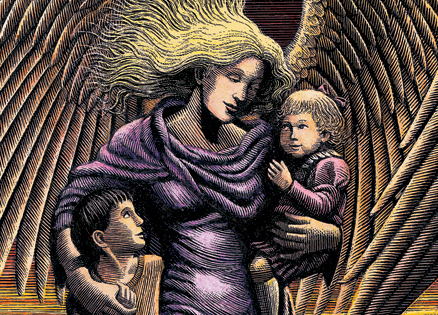
I’ve heard people say they don’t believe in miracles. How else can I explain what happened that day? Simon was shielded from the accident, and Chloe was carried from the car on protecting angel wings.

Thank you, God, for the best family in the world—and for your angels, who hold us in their care.

Read more stories about heavenly angels and angels on earth.

Hidden Blessings

Twelve fifty-eight P.M. That can’t be the time, can it? I thought, squinting at the clock by the bed. Two months ago I would have been up for eight hours by now. I’d be deep in some project for Angels on Earth, where I worked as an editorial assistant.

Times had changed. Now I was unemployed. There was nothing for me to get up for.

I got out of bed and made some coffee before booting up the computer for my daily job hunt. It had been two months since I’d quit and so far I hadn’t had any offers. The truth was I wasn’t excited about the local jobs I’d applied for anyway.

My job at Angels was perfect. I loved the work, loved the readers, loved discussing angels all day at the office. Too bad it took two and a half hours to get there in the morning. I stuck with the commute as long as I could–nearly two years. But in the end it was too much.

Plus my husband, Alan, had started traveling to Boston regularly to care for a sick relative. With my work hours and his schedule, we were lucky to see each other more than a couple of hours a week at most.

Quitting my job to look for something closer to home made sense, but on mornings–sorry, afternoons– like this one, I felt like I’d made a big mistake. Filling out yet another online job application form, I wondered what was going on back at the office.

What new stories had come in the mail that day? What illustrations were finished? I was missing it all. By the time Alan got home I was more miserable than ever. “If I had only tried harder, I could have handled the commute,” I told him. “I’m just a wimp.”

“You’re not a wimp,” Alan said. “A wimp would never have lasted so long. A wimp wouldn’t have even tried at all.”

Try, I told myself. That’s what I had to do now.

The next morning I got myself up early. I was determined to focus on the future. The first thing I did was check my e-mail: two rejection letters. It almost felt like a sign. “I’ll never find another job. I blew it.” Clearly, when I quit my job, I’d left all my angels behind.

When Alan got home he could see the shape I was in. Not that it was hard–I was lying face down on the couch, flat and listless as a deflated party balloon.

“We need to cheer you up,” said Alan. “Let’s do something fun.”

“Fun?” I muttered into the couch. “What’s fun around here?”

Alan thought for a second. “We haven’t gone to find a letterbox for a while. Why don’t we do that today?”

I turned over on the couch. It had been a long time. So long I’d almost forgotten how much I loved doing it. A friend had turned me on to letterboxing years before.

Letterboxers hide waterproof boxes in secluded locations for searchers to discover using clues they find on the internet, or by word of mouth from other letterboxers. The messages weren’t exactly left by angels, but they were exciting just the same.

You never knew what you might find inside a box, but there was usually a book to sign and write a note in for others.

“Let’s check on the Appalachian Trail,” Alan said, clicking on a letterbox website. “There’s bound to be some boxes there.”

Sure enough there was one not far away, if we could find it. The next morning I awoke feeling different. For the first time since I quit my job I felt like something exciting might happen. I had a purpose again!

Alan and I drove into the mountains and started walking the trail. I checked my phone, where I’d saved a list of clues to help us find the box. “Turn right at the forked tree,” I instructed. “Then follow the path with the fuzzy stones.”

“Fuzzy stones?” said Alan. “What does that even look like?”

I had no idea, but I was eager to find out. Hunting forked trees and fuzzy stones gave me an excuse to really pay attention to my surroundings. The mountains were beautiful, the sun shining through the trees full of brightly colored leaves.

Those same leaves carpeted the ground in red, orange and yellow. I loved the way the sound of my feet crunching along mixed with the call of distant crows and the wind whistling in the branches. I’d have missed all this if I was at my desk back at work, I thought.

“Here’s the tree!” Alan said. “The rocks really are fuzzy. They’re covered with moss.” We moved onto the next clue, then the next. Some were relatively easy, like our forked tree. Others were written as riddles.

“Walk up the stairs, and you’re almost there?” I read. “There are no stairs on a mountain trail. Unless… oh my gosh!”

We rounded the corner and discovered a waterfall running over the rocks. Right beside it was a set of stone steps. I ran up them into a clearing where I examined tree stumps and checked under rocks.

When I brushed away some leaves from around the base of a mossy overhang, I felt cold metal against my hand. “Alan! I found it!” I yelled.

Alan crouched down beside me as we opened the box. Inside was a little notebook and a collection of trinkets. But the real treasure was the messages written in the book. Notes from the East Coast, West Coast–one letterboxer had come all the way from Spain!

“This place seems so isolated,” Alan said, “but look at all the people who have come here. It’s wild to think about.”

I signed our names in the book, wondering who would find the box next. Then I put the box back into its hiding place. “Bury me in leaves!” I shouted suddenly. In minutes Alan had me completely covered. I couldn’t stop laughing.

The wind on my cheeks, the smell of the earth, the sound of the waterfall–and my husband beside me. This day was almost too good to be true. And you thought you were missing out on everything, I thought.

All the reasons I’d had for leaving my job made sense now. As much as I enjoyed the work, my free time was just as important, especially time spent with the people I loved. I missed my job, but I missed this too. I’d forgotten how much.

Hand in hand, Alan and I walked back to the car. I no longer had trouble keeping my mind on the future. Maybe I didn’t know what was next for me, but whatever it was it would be full of surprises. Life was a treasure hunt. And wherever I went, I would take angels with me.

Download your FREE ebook, Rediscover the Power of Positive Thinking, with Norman Vincent Peale.

Her Persistence Saved Her Husband’s Life

January 31. I circled the date on my desk calendar at work with a blue felt-tip pen. It was only the Wednesday before Thanksgiving, but there was a long wait to see the neurologist and I was lucky to get my husband, Wayne, in to be seen at all. Meanwhile I didn’t want him to overhear me making the appointment.

I drove home from work, praying Wayne would agree to go. From day to day I never knew what kind of mood he would be in. He’d recently retired after a 39-year career at an international tech company, a job he loved. Retirement had required an adjustment, but to me that didn’t explain what was different about Wayne. Something was off, I was sure. I just couldn’t say what.

At home I found Wayne sitting in the living room. “What’d you do today?” I asked, trying to sound cheerful.

“I filled the tires, like you wanted,” he said.

Filled the tires? I walked out to the car and realized Wayne had meant he’d filled the gas tank. It made sense, as we were driving to see family for Thanksgiving, but the mix-up was the kind of mistake my husband made all too often these days—too many senior moments.

Initially, I’d thought it was me. I second-guessed myself, wondering if I needed to have my hearing checked. Wayne hadn’t really asked for a towel on his hamburger—surely he had asked for cheese. But the closer I listened, the more obvious it was that Wayne was confusing his words without ever realizing it. Trouble was, the signals that something was wrong came and went. We weren’t young anymore. Who wasn’t forgetful? No one else was around Wayne enough to see any kind of pattern. “It’s like he’s speaking in Mad Libs,” I said to my sister on the phone that evening.

“I do that sometimes,” she said. “I know what I want to say, but the wrong word comes out.”

“It’s other things too, though. Like when he watches Jeopardy in the evenings. He doesn’t play along, like he used to.” I could see how that example seemed trivial too, but after 40 years of marriage, I knew when Wayne wasn’t himself.

“You know, retirement is a big change,” my sister said. “He could be depressed. That can change someone’s personality.”

Wayne himself was quick to dismiss my concerns, and I didn’t want to make him self-conscious. He assured me he wasn’t depressed, and he’d already humored me by having a general checkup. Wayne had answered the doctor’s questions without error, but I did get the referral for the neurologist just to play it safe. All signs said I was worrying unnecessarily, a wife getting used to having her husband at home all day.

I hung up with my sister, thanking her for listening. All I can do is wait, I told myself and went to start dinner. The familiar sounds of Jeopardy came from the other room. Wayne stayed quiet.

He didn’t say much at Thanksgiving either. As we were leaving to go home, Wayne’s sister pulled me aside. “Is Wayne okay?” she said. “He seems a little…” She hesitated the same way I did when I tried to put my finger on it. “I asked him a question and he didn’t answer. That is, he said something, but it didn’t really…fit.”

“We have an appointment with a specialist in January,” I said.

She relaxed visibly. “Oh, good,” she said. “That’s not such a long wait.”

The next day I got started on my Christmas shopping. January will be here before I know it, I told myself at the mall. Wayne’s sister was right. I loaded my packages in the back of my car. And as a last resort, I could take Wayne to the ER. A nurse had once told me ER doctors were obligated to give someone a blood test and a CT scan.

The ER idea stuck with me, and by the time I unloaded the car at home, I summoned the courage to present the idea to Wayne. “If it will make you feel better, let’s go,” he said. I jumped at the opportunity, and off we went.

The ER was packed. Wayne wasn’t in any immediate danger, so we were told to wait. And wait. And wait. Hours went by. Any minute now, Wayne would want to leave. I looked at my watch—11 P.M. Maybe we’re just meant to wait until January, I thought. Everything in the world seemed to be telling me that. But something else wouldn’t let me go.

“Wayne Palka,” someone called. Our turn at last! We were led to an examination room.

“Why are you here?” the doctor asked curtly. He was obviously exhausted, probably from listening to patients like me all day and trying to make head or tail of vague symptoms. I took a breath and did my best to explain. As I talked, tripping over examples of how my husband was off, I felt myself slipping back into resignation. My voice trailed off. What did I have to go on, really, but my instincts?

“This is not really something for the ER,” the doctor said, ushering us out. “You ought to see a specialist.”

I hooked my arm in Wayne’s and planted my feet. “No,” I said.

The doctor looked at me with surprise. So did Wayne. Even I wondered where my sudden confidence had come from. It wasn’t like me to be so forthright, but I wasn’t going to be denied. “My husband needs a full evaluation, and he needs it now. Right now. Tonight.”

Without argument the doctor ordered a CT scan on the spot. I waited only 20 minutes back in the examination room for him to return with Wayne. The scan revealed a large cyst behind Wayne’s left eye and a small tumor on the surface of his brain. “I really didn’t expect to find anything,” the doctor admitted. He looked at me. “I’m glad you insisted.”

On December 2, more than a month before his scheduled appointment with the neurologist, Wayne underwent surgery. He showed immediate improvement, this husband I’d known for 40 years. After his recovery, many people confessed that they’d noticed something off about Wayne too, but weren’t sure how to broach the subject with me. I forgave them for keeping quiet. After all, I knew how hard it could be to speak up. An angel had to step in and do it for me.

Did you enjoy this story? Subscribe to Angels on Earth magazine.

Her Foster Dog Taught Her a Lesson in Trust

“Come on, Tuck,” I said, patting the floor of the 4Runner. “Load. Let’s go for a walk.”

This was our first afternoon with the black-and-white border collie I was fostering, and it was time for the daily hike. My dog, Keeper, had jumped into the 4Runner as soon as I opened the hatch. Our young guest, Tuck, danced nervously at my feet, then sat and looked up at me with sad eyes. He wouldn’t jump in.

Tuck and Keeper had hit it off right away, running and playing in the yard while I visited with my friend Tammy, who’d come by with Tuck that morning. Tuck had found plenty to keep him busy since Tammy drove off. Why was he hesitating now?

I’d taken Tuck in reluctantly, as a temporary solution for my friend. She was in a bind, trying to rehome her mom’s three-year-old border collie in the environment an energetic dog needs. Tammy knew I had a special place in my heart for the breed. She also understood why I wasn’t willing to give Tuck a permanent home.

Three months earlier, I’d lost my beloved Bantam, the border collie who’d been my rock for 12 years. I wasn’t the only one grieving after the stroke that took her life. Keeper had lost her best friend. She’d been lonesome, and I saw joy return to her eyes as soon as Tuck ran into our yard. Still, I wasn’t ready to let a new dog into our lives for good. I couldn’t imagine I ever would be. But I’d agreed to help Tammy out while she continued her search.

My faithful Keeper looked down from the car’s cargo area, surely wondering what was stopping Tuck from quickening our adventure. Tuck wouldn’t budge, no matter how much I coaxed. Knowing there was always a reason for a dog’s behavior, I finally scooped the dog up and deposited him in the back. “Load,” I said, teaching him the command. “Good boy.”

But every day, when it came time to load for our hike, we went through the same ritual. Tuck didn’t trust my invitation to load. For two weeks, the scene replayed itself: I opened the hatch to the 4Runner, Keeper leaped in, Tuck sat on the ground looking at me with those eyes. I tried my best to coax him but always had to pick him up and load him myself. When it came to exiting, Tuck would leap out into the endless rolling hills, romping and frisking with Keeper as they followed me along. Jumping wasn’t the problem, so what was it?

I felt some relief that the situation was only temporary. Tammy had promised to come back for Tuck if it took too long to find him a new home. At the end of the third week, I became impatient. Tuck was a sweet dog and seemed to love everyone. He had this boyish enthusiasm toward strangers. It was kind of endearing to see him greet every person who pulled into the driveway as if he was sure they had arrived just to see him.

This was the polar opposite of my Bantam. She was always hesitant with strangers and remained my constant protector. I missed the loyal affection Bantam bestowed on me. She would curl on top of my feet in the evenings when I read or watched TV, and never missed a chance to get extra love. Anytime I sat down in the yard, I could depend on the sound of a ball plunked near my feet, Bantam begging for a game with her intense amber eyes. Tuck, on the other hand, might bring the ball back. Sometimes. When he wasn’t playing with Keeper or chasing mice or birds, he’d flop into an exhausted lump of fur and sleep for hours. Keeper’s joy balanced out any minor disappointments I might have had with Tuck. I knew it wasn’t fair of me to compare him to Bantam.

Days crept into a third week. I found myself grinning at Tuck’s antics, appreciating him for who he was. One afternoon, in the middle of his passionate play with Keeper, he came to the steps where I sat. He shyly looked at me, then walked over and put one big foot on my knee. The gesture caused me to gulp back emotion. He did want affection, but on his own terms.

Our main problem, though, went unresolved. Tuck still refused to load. I got angry one day. “You load,” I said, raising my voice. “I can’t lift you up for the rest of your life.” Tuck went down to the ground and put his head on his paws. His eyes swam with fear.

“I’m sorry,” I said, lifting him into the 4Runner as usual. “Lord, I need a little help here. What is troubling this dog? Why won’t he trust me?”

Back at home after another exuberant outing, I rested in front of the TV. I happened to catch a show about crate training. A puppy left too long in confinement could show lingering trauma. I knew that Tammy’s mother had adopted Tuck from a pet store and immediately thought of the crate in the back of the 4Runner. Bantam’s crate. She’d had a powerful fear of thunder that made her dive into a secure space at the first crack. At home, she’d hide under the bed. I kept the carrier in the car for her in case we got caught in a storm while we were out. Over the past few months, I’d never gotten around to removing Bantam’s safe space. Maybe it was my way of holding onto Bantam.

The next afternoon, when I called the dogs over to load, I let Tuck watch as I removed the crate. “We don’t need this anymore,” I told him. I slapped the floor of the 4Runner. “Come on now, Tuck. You can trust me.”

To my surprise, Tuck jumped up on his own, tail wagging. He gave me and Keeper sloppy kisses, as if proud of his accomplishment. Mystery solved. I swallowed the lump in my throat. While I was trying to trust that fostering Tuck was the right thing to do, Tuck was fighting a battle to trust me. He didn’t disappoint when it was time to load for home.

Upon our return, a late spring storm came rolling in with booming thunder. I dashed into the house with the dogs behind me. Tuck grabbed his toy, completely oblivious to the noise. Unlike Bantam, he had no fear of thunder.

“You aren’t Bantam,” I said, sitting down near him. “But you’ve worked your way into my heart.” His tail flopped against the couch and he walked toward me. One big foot came clumsily onto my knee as I reached to rub him behind the ears. Those knowing eyes focused on mine.

I called Tammy. “Keeper and I have decided to give Tuck a permanent home here with us.” Tammy admitted that she and her mom had been praying for this outcome. The dogs curled up on their rugs, content. We’d had a big day. I had asked God to help Tuck trust me, but I’d forgotten to ask that he also help me trust his plan for a life without Bantam. Keeper saw before I did that Tuck was the angel we didn’t expect.

For more angelic stories, subscribe to Angels on Earth magazine.
Her Faith was Restored While Waiting at the Drive-Thru

Every man for himself. That seems to be everyone’s motto these days, women and young people included. Even a quick stop at McDonald’s reminded me of it. Just as I started to pull into the parking lot, a white Camry cut right in front of me!

“Is it really that important to be first?” I muttered. The man behind the wheel couldn’t hear me, which was probably for the best. If he had heard, he might have had some angry words to shoot back at me right there in the blazing hot parking lot. Just like the grouchy lady at the supermarket the other day. I hadn’t even said anything to her, when she wheeled around and accused me of invading her space. Even when I apologized, she still wasn’t satisfied. She had to have the last nasty word. People these days!

I sighed and headed for the drive thru, keeping a safe distance from the Camry. My faith in humankind was flagging. And it wasn’t just a disappointment in strangers. I got steamed all over again, thinking about the mechanic I’d used for years. He’d turned out to be untrustworthy, charging me unnecessarily and off the books for his own gain.

This is just the way the world is now, even in Huntington, I told myself as I pulled up to the end of the short line of cars. Everybody’s out for number one.

The red door at the back of the restaurant opened and a young woman appeared. It was Jessie, who often worked behind the counter. She’d waited on me many times, and always with a smile. At least that’s the way she was in the past, I thought, my skepticism taking hold.

Jessie propped the door open with one hip, dragging out an oversize watering can and then another. She struggled to carry both at once, water splashing over her feet. They must have been filled to the brim.

I assumed she was headed down the pebbled path of boxwoods lined with sun-parched tubs of hot-pink petunias. That’s not her job, I thought, pulling up in line. The only person I’d ever seen working on the flowers was a dark-haired gardener from the landscaping company. Maybe Jessie has to do it now, I thought, watching her walk back inside the McDonald’s. Probably cutting costs. The bottom line. That’s all that matters. Not people.

I pulled up to the intercom and rolled down my window to order a Sprite. A blast of hot air blew into the car while I inched up to the pickup window. Jessie was returning to the parking lot with two more heavy watering cans. The dark-haired gardener from the landscaping company pulled up and hurried over to her.

“I thought it would be easier if I carried these out for you!” Jessie said once she’d caught her breath.

The gardener’s face lit up at this unexpected kindness. Jessie went back to her job inside. By the time I paid for my Sprite, the gardener was halfway through watering the petunias.

“What happened back there did my heart good!” I called to her.

“Mine too,” she said. “And my back as well. What a day!”

My first sip of Sprite was refreshing. But not half as refreshing as the reminder to never let negativity color my expectations of people in this world. God’s good neighbors were everywhere, if I kept my eyes open to them.

For more angelic stories, subscribe to Angels on Earth magazine.
Her Care Packages Comforted These Vietnam Veterans on Valentine’s Day

Red hearts decorated the windows inside the dollar store, but that wasn’t what I’d come in for today. I’d stopped off on my way home from my nursing shift at the V.A. Mental Health Clinic as a favor to one of my patients.

Irv was a Vietnam veteran who struggled with alcohol abuse. So much so that I’d referred him to a rehab center out of state. Irv wasn’t happy about going, but he went. “You wouldn’t believe it here, Bert,” he’d told me over the phone. “Saddest bunch of soldiers I’ve ever seen.”

“Alcoholism will suck the spirit out of a person,” I said. “I can imagine.”

“It’s not just that,” Irv said. “There are fourteen of us, and boy, are we are a ragtag group. Buttons missing, popped seams, torn pockets. I’m itching to teach the guys to sew; I took care of things like that back in Nam. But try finding a needle and thread in this place. It’s impossible. I don’t suppose you could find me a sewing kit?”

Irv didn’t like to ask for help, so I was glad he had reached out with even this simple request, one not just for himself but also in the interest of others. It was a good sign.

I wheeled my cart into the appropriate aisle and came upon an entire row of sewing kits. Enough for each one of the soldiers in Irv’s group. Why not send them all a Valentine gift? I tossed the kits into my cart, counting them out and thinking of the men who’d been through so much.

Irv had first arrived at my clinic in the middle of an April downpour that reminded him of the soaking rains of Vietnam. “It was monsoon season when I got there,” he’d told me, burying his red-bearded face in his hands. “I’d just graduated high school and thought joining the Army would be a way to support myself. I was a good shot. That earned me a spot on the front lines. I’d never felt so alone, just me and that gun.” Near the end of his tour of duty, Irv was wounded. He took a bullet to the chest on September 24, 1968. The date resonated. On my fifteenth birthday, Irv was lying bleeding in the jungle, earning his purple heart.

Speaking of hearts…I thought, turning my cart toward the cash register. According to Irv, the men in his group had plenty of obstacles when it came to feeling loved and cared for. Broken families, broken relationships, broken dreams, broken hearts, to name just a few. Why not add chocolates and wrap each gift specially for men who might not have anyone to remind them that they were? At least Irv had a wife and a son back home praying for his recovery. Surely some of the others had no one. It was the least I could do, even if it might seem trivial in the scheme of things.

At home I filled a big cardboard carton with Styrofoam pellets and my gifts. I got carried away and drew a heart-shaped door on the box, where I wrote, “To my Valentine’s Day heroes: Open your door. Open it wide. Someone is standing outside.” I sent it off, worried Irv might think I had overstepped. These were grown men—did I really need to have decorated the box?

Around 2 p.m. on Valentine’s Day I got a phone call at the clinic. It was Irv. “I’ve got a few guys here with me by the phone,” he said. “They want to say something.”

Irv passed the phone to one of the soldiers. “I’ve never gotten anything for Valentine’s Day,” he told me. “I wish I’d saved a piece of chocolate, just to remember how it made me feel to get it. But it was so good, I ate it all!” His gratitude seemed completely out of proportion to my small gesture, but I could hear in his voice that he meant every word. One by one, all of the men took a turn on the phone, each with his own story of loneliness or love or loss.

“It was those sewing kits that did it,” Irv said when he got back on the line. “Something about sitting together, me teaching the guys how to stitch up those tattered clothes, sew on a button. We just started talking. Really talking. In a group that understood one hundred percent. It was a big deal for us.”

Not long after, I left the Mental Health Clinic to take a job in another department. Irv surprised me one day in the hospital parking garage.

“You’re home!” I said, with a big hug. He opened his wallet to show me a picture of his family on a riverbank.

“Take my boy fishing every chance we get,” he said proudly. “My wife brings a book. But she goes. She says I’m still tough, but I’m soft now. Can you beat that?”

Sticking out of the billfold was a piece of cardboard that looked as though it had been handled many times and shoved back into its handy spot. I recognized it easily—a heart shaped door, open wide.

Did you enjoy this story? Subscribe to Angels on Earth magazine.