Embrace God's truth with our new book, The Lies that Bind

An Earth Angel at Her Mom’s Grocery Store

Stacks of full files and loose papers covered the ping-pong table in my parents’ basement. My husband, Eric, my brother, Tim, and I had pulled out all my parents’ financial records. “This is the last of it,” said Eric, making room for one more pile on the table. “Keep an eye out for a life insurance policy.”

I grabbed a folder and started sorting, still in shock. Two days earlier, my stepfather, Doug, told my mom he wasn’t feeling well and went to the bedroom to lie down. When Mom checked on him a couple hours later, she couldn’t wake him. He was 64.

“Are you sure Mom doesn’t know where Doug kept things?” said Tim.

I shook my head. “She never asked him. She thought he’d be here to take care of whatever was needed.”

We all did. Doug was the type of person everyone relied on, including me. When my first marriage fell apart, Doug had welcomed me—and my two young children—into the brand-new home he and my mom had just built. Even when my son’s remote-control car left a big black mark on the freshly painted wall, Doug shrugged it off. “I’m just really glad you guys are here.”

It was Doug who eventually helped me find a little rental house to move into. Doug who paid my security deposit. Doug who paid for the wedding dress I wore when I married Eric. My children knew they could depend on him too. But no one relied on him more than Mom. They’d been married 21 years. With Doug gone, who would take care of her?

My oldest brother lived fairly close to Mom, but as a single dad, he already had his hands full. My sister lived out of state, and Tim and I each lived a few hours away. We all had young children, our own responsibilities. We couldn’t take care of all the little things Doug had done for Mom every day.

Since his death, Mom had hardly spoken. She wasn’t eating enough, if anything, and moved around the house in a daze. Doug would have known what to do for her, I thought. I was afraid he was the only one who could comfort her.

As we rifled through papers, I thought of one thing I could do for Mom. She had mentioned she wanted to pack up some of Doug’s belongings, photo albums and mementos, to give to his family. “I’m going to pick up some boxes,” I said to the guys. It wasn’t much, but it was something.

I drove to the grocery store and asked the manager if he was throwing out any boxes. “Are you moving?” he asked. When I explained, he expressed his condolences.

“Do your parents have a shoppers’ card for our store?”

“I don’t know,” I admitted. “I know they shop here.”

He asked for their names. “Can you come back in an hour?”

Unbelievable, I thought as I walked back to my car. He couldn’t give me a few boxes unless my family shopped at his store? I guess that’s the world we live in, I thought. My stepdad was a rare type. I drove off more worried about Mom than ever.

When I returned, the manager loaded a dozen neatly flattened boxes into my car. Then several bags of groceries. “I didn’t order…” I began.

“I looked up your parents’ account and duplicated their last grocery order,” he explained. “I hope it’s helpful for your family. No charge.”

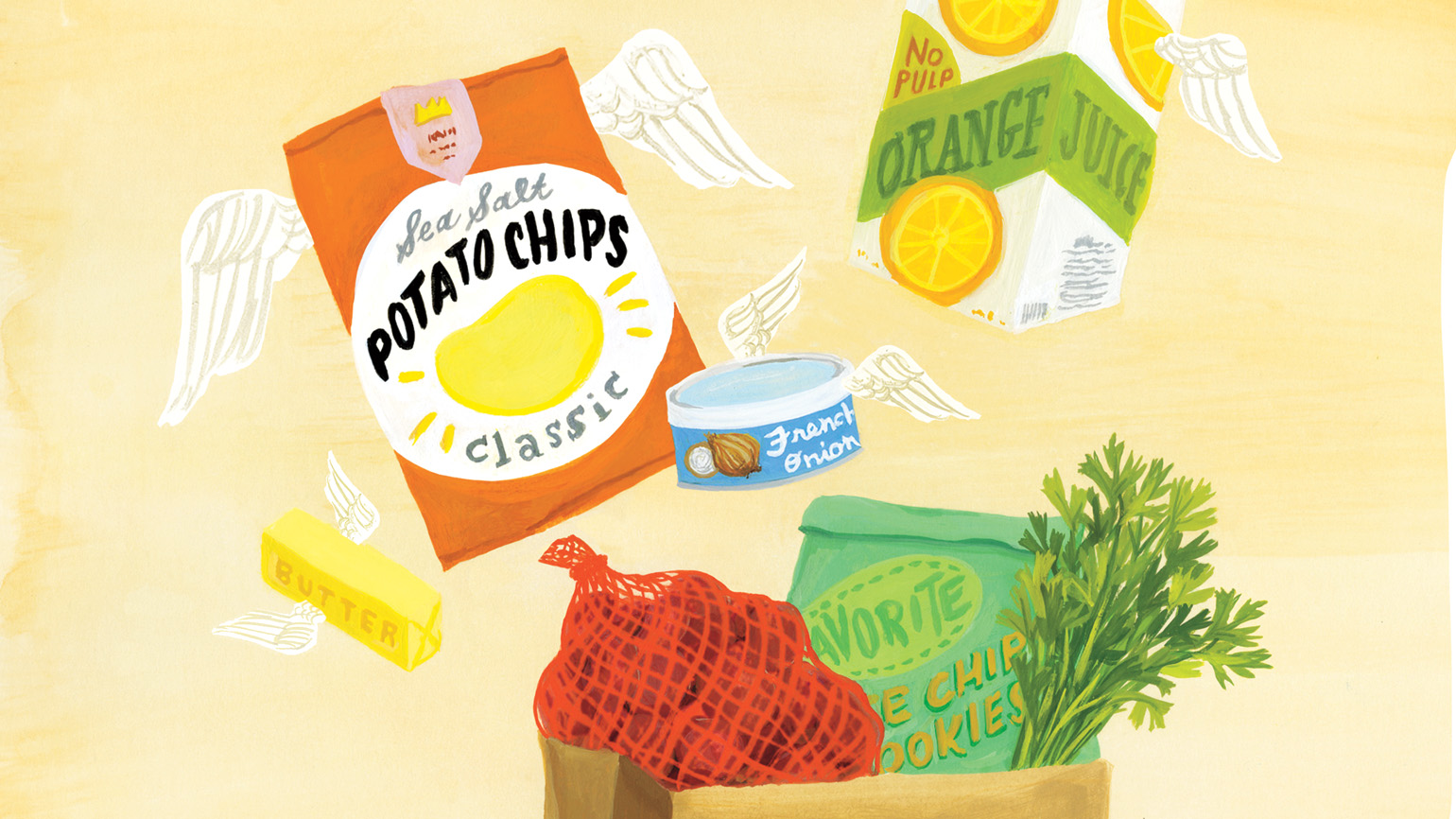
Back home, Mom stared into space at the kitchen table while I unpacked the bags. Mom’s favorite cookies. Pulp-free orange juice. French onion dip and Lay’s plain potato chips. Deli ham and rye bread. Small red potatoes. I explained where the groceries had come from. “You must have gotten all your favorites the last time you shopped,” I said.

Mom blinked at the food. “Oh, that was Doug. Since the pandemic started, Doug did all our grocery shopping online,” she said. “He was better with the computer than I am.”

Of course, Mom could depend on Doug to buy all her favorite foods. But it turned out that she could depend on a caring store manager too. I’d been quick to judge, without any inkling that I might be experiencing an act of kindness from a stranger. No one could replace my stepdad, but God reminded me that the world was full of people who cared, earth angels he would send us when we least expected it.

For more angelic stories, subscribe to Angels on Earth magazine.

An Angel Watched Over Them For More Than a Decade

The call from the hospital came in the morning. Our son, Chad, had been in a terrible accident, his car totaled while he drove in the fog. He had stitches in his left temple and a fractured ankle, plus a bruise on his chest from the seat belt that saved his life. My husband, Randy, and I raced to his side.

“They’re just keeping him overnight to make sure he has no internal injuries,” Randy reminded me during the two-hour drive to the hospital. “He’s in no immediate danger, thank God.”

Yes, thank you. As we got closer to the hospital, I remembered the car accident I’d had 10 years earlier. Driving home from my nursing shift, I’d hit a patch of black ice and spun into a parking lot—only to be hit by another out-of-control car. Eleven cars in all were involved. I’d emerged with minor injuries and come home to my husband and three children. God had been watching over me that day. If I needed confirmation, I got it two weeks later. Chad, then eight, called me to the back door. “Mom,” he said, “you have to see this!”

I couldn’t imagine what he might be seeing in the darkness. I went to the door and looked out into our unlit yard in the country. I wasn’t prepared for what I saw. Something hovered above the playhouse, radiating light. I thought I could make out three sets of wings, even the outline of a face. “It’s an angel,” Chad said. He was the first to name it, and I knew instantly that it couldn’t be anything else. Chad and I gazed at our guardian for several minutes, until she slowly disappeared into the night sky.

Now, driving along the highway, I looked up at the sky through the windshield. I knew that guardian angel was still there, even if I couldn’t see her. I wish Chad still believed that, I thought. He’d told the kids at school about our vision, but they didn’t believe him. Worse, they convinced Chad that we hadn’t seen what we saw. Whatever it was we’d seen in the sky that night, he decided, it wasn’t an angel.

That vision continued to bring me comfort in my life. Especially now, as Randy and I drove to the hospital. But Chad had never regained that childhood faith. On the rare occasions he brought up the incident, he referred to it as “the angel we thought we saw.” I knew there was no point in correcting him. Chad was grown now. He was 18, in the Navy, engaged to be married. If he was going to accept the truth, it had to be on his own terms.

By the time we got to the hospital, Chad was settled in a room. He gave us more details about the accident. As he was trying to pass a semitrailer in the fog, he was hit by an oncoming semi with no lights. He spun into a ditch and passed out. It had taken 30 minutes and the Jaws of Life to extract him from the car.

It was horrible to imagine what my son had been through. I tried to picture that gauzy guardian angel lighting up our backyard. The angel I knew was watching over Chad now. Randy and I spent the night at a hotel. The next morning we were able to take our son home.

He was quiet as we set out. Then he said, “Mom, do you remember that angel we saw years ago?”

My heart skipped a beat. “You mean the angel we thought we saw?”

“We did see an angel,” he said. “I know we did.”

Chad turned around to face me in the back seat. “When I came to in the car, I thought I was paralyzed. A lady was at the window talking to me, telling me to stay awake, but I couldn’t move my head to look at her. The first responders didn’t see her. No one did. But I heard her, and when she left, all the feeling rushed back into my body.”

Maybe the first responders hadn’t seen her, but Chad and I had. We’d seen her together, 10 years before, and we would never forget it.

For more angelic stories, subscribe to Angels on Earth magazine.

An Angel on a Bike

It was the 16th of February, 1985, on a cold, dark Saturday in Red Bank, New Jersey, and I was determined to die having a good time.

I had nothing to live for. Just a thankless job as a gunnery sergeant in the Marine Corps. I was going to go to every bar I could find and drink myself into a stupor. Then, defiant in the face of my misery, I’d tell the world that I just didn’t care anymore, and hopefully end my life for good.

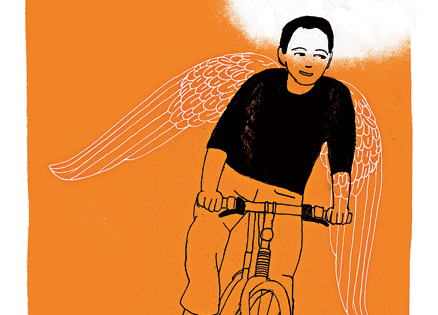
This is fitting, I thought as I swung a leg over my bike. I didn’t even have a car. Riding a bike to a bar was absurd—just like my life. God’s really let me go. I peddled off into town, shivering.

My wheels wobbled in the snow. I glanced over my shoulder before crossing the street. Another cyclist rode up behind me. Someone else is riding a bike in the middle of February? I thought. What a jerk.

I shrugged it off. My front tire wobbled all over the place. A darn flat. I walked the bike to a gas station and unscrewed the cap on my tire. “Looks like you’ve got air pressure problems.” Behind me stood a pimply young man wearing secondhand clothes. The other jerk on a bike.

“As a matter-of-fact, I do,” I said. “What made you pull in here?”

“I’ve been watching you,” he said. That startled me. Why would he be watching me? Maybe for the same reason I watched him. A couple of real jerks. Except there was an innocence about this kid. He couldn’t have been more than 20.

“Where you headed?” I asked.

“Anywhere and everywhere,” he replied. “How about you?”

I wished I hadn’t asked. “Just a little shopping,” I lied. “Nice meeting you.”

“Likewise,” he said, and peddled off. I filled my tire and screwed the cap back on.

My stomach growled and I stopped for a slice of pizza at the strip mall. With a little food in my stomach, I’d be able to drink more.

Now I was ready to begin drinking. The first bar on my list wasn’t too far. I left the pizza parlor and got on my bike. “Hi, there!” said a familiar voice behind me.

I wheeled around. The young man on the bike was standing there smiling. Where did he come from? “Early lunch?” he asked.

“Wait a second. How do you know where I’ve been?” I asked.

“I saw you go into the pizzeria,” he said. “Sheer coincidence.”

It didn’t feel like one. I needed to get rid of this kid. “Where are you off to now?” I asked, so I could take off in the opposite direction.

“Anywhere and everywhere,” he said, flashing me a grin.

“Well, take care,” I said. I peddled off as fast as I could.

“Hey!” the kid called after me. “Where are you going?”

What was up with this kid? I stopped on my bike. I should just keep going. But it was too late. I didn’t want to be rude. “Back to the barracks, I guess.” No kid would want to go there.
“Can I come?” he asked, eager as a puppy about the idea.

My head dropped. I couldn’t tell him to get lost. “Come on,” I said.

My plan to drink myself into a stupor was falling way behind schedule, but I led the kid back to Fort Monmouth, where I was stationed. We pulled up to the red-brick structure where I lived. “So this is it, huh?” the young man asked.

“Yep,” I said. “Listen, I’ve got to take care of a couple things before tonight. I should go inside.” I got halfway to the door before the kid stopped me again.

“What about tonight?” he asked.

I’m going to get drunk—alone! I wanted to shout. But I didn’t say it. Instead I thought of the last place a kid would want to spend Saturday night. “I’m going to church,” I said.
The kid didn’t miss a beat. “Great! I’ll see you at tonight’s service!”

I watched him ride off and fade into the distance while I thought about the events of the day. I left my room this morning intending to obliterate myself. Now, here I was, sitting on my bike outside my home, as the sun went down, sober as a stone. And all because this annoying, pimply kid couldn’t take a hint. And to top it off, I was going to church. You’ve got to be kidding me, I thought.

I got to church on time that night, but took a seat in the back so I wouldn’t miss my new buddy, the one I couldn’t shake. Funny thing was, he never showed up. Funnier still, I was disappointed.

Because I wanted to thank him for my sitting where I was instead of on a bar stool—or worse. I thought God had let me go. But it was me who let God go. So he sent an angel on a bicycle to chase me down and bring me back.

Download your free ebook, Angel Sightings: 7 Inspirational Stories About Heavenly Angels and Everyday Angels on Earth.

An Angel Named Maria

“There was a baby born here two weeks ago that no one knows what to do with,” the doctor said into the telephone.

He went on to explain that the infant was a vegetable: a hydrocephalic without sight or hearing or any human potential. The mother had disappeared from the hospital after seeing it and the state had no provision for handicapped children under the age of six.

“It will never live that long,” the doctor’s voice continued hastily. “At the outside it might live six months. Meanwhile there is the problem of care…”

“Bring us the baby,” answered the voice at the other end of the line. It belonged to Sister Marie Patrice, the nun in charge of the day-nursery which the Sisters of Mercy ran for working mothers in and around Charlotte, North Carolina.

Sister Patrice was at the cottage door when a car pulled into the driveway that afternoon. The doctor carried a bundle in, then pulled aside the hospital blanket for the nun to see.

For a moment she could make no sense of the two shapes before her. Then she realized that one was an enormous head; the other, where a back should have been, a tumor the size of the head. Stumps hung where there should have been legs and feet: only the little arms and hands were properly formed.

Sister Patrice stretched out her arms. “Give her to us,” she said.

And so another baby joined the nursery—a baby for whom nobody called when day was over. A “vegetable” was the last thing she made the Sisters think of, for she cried constantly as though in pain. Whenever they picked her up, however, the crying stopped.

So the Sisters began carrying her about with them while they looked after the other babies and while they ate and went to chapel and even while they slept.

Six months came and went. The baby they had baptized Maria grew so heavy that the nuns had to pass her more often from one pair of arms to another.

But she would not startle at a noise, nor blink when a hand was passed before her eyes. Never once in all those months had she given a hint of awareness.

And then one day as Sister Patrice rocked her in the nursery playroom, the unbelievable happened.

“She smiled!” the Sister cried. “Maria smiled at me!”

Sister Patrice was the only one, that day, to see the smile. But a few days later another nun saw it, and then another, until the whole convent glowed with Maria’s smile.

After that, the weeks and months sped by as the Sisters discovered first one talent, then another, in the baby who had no potential.

They plunked the nursery piano and discovered that Maria had hearing. They placed her hands on the light switch just inside the cottage door and discovered that she had the muscle control to turn it on and off herself.

She was playing this favorite game one winter afternoon when she was almost two, making the room bright and then dark again while one of the Sisters held her up to the switch, when suddenly she turned to stare at the bulb burning in the ceiling. Her lips parted.

“Light!” said Maria.

As a first word it could not have been better chosen. For it seemed to the Sisters that with it came light from God about this child, that the next step to be taken in faith was removal of the tumor that dwarfed the little body on which it grew.

The surgeon they consulted was dubious. Without the tumor, he reasoned, all the excess fluid might settle in the head, distending it still further and hastening the inevitable death.

But the Sisters had glimpsed the hope that is stronger than reason. The tumor was removed and the very reverse of the doctor’s fear occurred. Instead of gaining fluid, the head began to drain. Over a period of two years it shrank nine inches until, as Maria herself grew, it looked very nearly normal.

They were wonderful years. The Sisters bought a tiny wheelchair that Maria herself could roll with her strong arms and hands. They made a swing for her and a play table and a special seat in the chapel.

Most important to Maria, they bought her shoes. As other children dream of being ballerinas, Maria dreamed of wearing shoes.

She would never walk, but the Sisters understood that shoes are for more than mere transportation. And so they took her back to the surgeon, and he shaped a place on the unformed legs for shoes to go.

But meanwhile great changes had come to the little cottage on the convent grounds. As word got around that the Sisters were sheltering a handicapped child, another such infant was brought to them. Then another and another.

These children took more time than other babies. Some, like Maria, had to be held constantly. Others went into spasms when touched. Some had to be tube-fed, some needed oxygen.

The Sisters worked around the clock and still the babies kept coming, from all over the state and far beyond: babies with Down’s Syndrome, microcephaly, cerebral palsy. And to the Sisters, God’s light had grown blindingly clear.

There were other traditional nurseries around Charlotte, but for these injured children, there was nowhere else.

I went to visit Holy Angels Nursery wondering how a home that held only handicapped babies would affect me. A curly-haired little girl met me at the door, the ruffles of her starched blue dress concealing the arms of a wheelchair.

“I’m very pleased to meet you,” she said politely, “do you like my shoes?”

Of course it was Maria. Her shoes were white, with little bells on them and lace around the top, and I told her truthfully that they were gorgeous.

Maria and Sister Patrice led me through the sunny new home built with gifts from Protestants, Jews and Catholics from all over the country. And as we walked from room to room, misgiving gave way to a feeling I could not name.

Baby-blue cribs with new toys in them lined walls hung with Mother Goose scenes. Every baby girl wore a pretty dress, every boy a crisp romper, no two alike. Volunteers from a nearby girls’ school crooned to babies in rocking chairs around the room.

It was like stepping into the private nursery of a treasured only child—multiplied by dozens.

I believe they were each an only child to Sister Patrice as she recounted the life-and-death struggle waged over each crib.

“We were so worried about Johnny last week, but penicillin is helping.”

“I did 80 miles an hour getting Ellen to the hospital Thursday. The police gave me two motorcycles, and the convulsion was halted in time.”

“The doctors don’t give George another month. But”—squeezing the tiny hand—”we’re going to fool them, aren’t we, George?”

On we went, crib after crib—67 of them—and in each one, Sister’s favorite child. I saw Jewish babies, Protestants, Catholics, blacks and whites, children of architects and mill hands, doctors and migrant workers. The only thing I didn’t see was a secondhand toy or a threadbare blanket.

“Most of them can’t see, you know,” said the Sister. “That’s why it’s up to us to be sure they have only pretty things.”

We reached the last room and I realized what it was I had been feeling. In each crib Sister Patrice had made me see a person, an individual unique in all creation, a human soul of infinite worth. When I told her so, she beamed.

“Oh, yes!” she said. “And do you know what the greatest moment of all is? When this person leaps free at last from his poor, hurt body!”

She had been at the cribside each time a baby died, she said. “God tells me when he is taking one of them. And then this little person stands suddenly free, whole and straight, more beautiful than you dreamed. It’s only an instant, you know, for these babies fly straight to the heart of God.”

I stared at the Sister, at the bottles of blood plasma behind her, the oxygen tents, the rows of drugs. I hardly knew how to phrase the question that was in my mind.

“Why struggle then to keep them here as long as we can?” she asked for me. She ran her hand through the gold-brown curls that make a halo of Maria’s head.

“God has all the bright angels of heaven for his joy,” she said gently. “We struggling servants of his here below—we need angels too.”

********

Read about Elizabeth Sherrill’s return to Holy Angels four decades after her original visit.

For more information about the numerous books written by Elizabeth Sherrill and her husband, John, visit her website.

Download your FREE ebook, Angel Sightings: 7 Inspirational Stories About Heavenly Angels and Everyday Angels on Earth


An Angel Named Jim

Knoxville, Tennessee, looked to be all crowded streets, tall buildings and smoggy air. It was nothing like home in the Smoky Mountains. But that year of 1949 when I was seven Mama and Dad had brought all us kids to the city so Dad could take a job as a machinist at a tool and die shop.

One chilly afternoon my brother, Buddy Earl, and I walked along the railroad tracks near our rented house. I carried an empty bucket that bumped against my knees as I walked. “See any coal on the ground?” I called.

“Not yet,” Buddy Earl called back. At this part of the track there was a railway crossing, and the train always slowed down here at the intersection. If we were lucky, bits of coal fell off the train and onto the ground where we could gather them up.

A lot of the coal wasn’t the best quality, most of it clinkers and burned-up lumps, but we needed everything we could get to keep warm.

Things hadn’t gone so well since we came to Knoxville. Flatlanders—that’s what we called the folks in the city—thought we were pretty strange. They had a name for us too: hillbillies. Just last week in school I’d gotten laughed at for telling the time. “It’s nigh on one o’clock,” I’d said.

The other kids laughed. “Nigh on one o’clock?” they repeated. “You talk funny.” I kicked some pebbles by the train tracks and frowned at the ground.

I wasn’t ashamed at being a hillbilly. I loved our little house on the mountain. We grew our own food in the gardens, the stream was full of fish for catching, and the woods were full of game. Here in the city you needed money for food, and money was hard to come by.

Dad had come down with pneumonia, probably because our house here was so cold. You could throw a cat through the cracks in our walls, they were so big.

“Train’s coming!” Buddy Earl shouted. We stepped back from the tracks. The train slowed to a stop. Coal rattled down over the sides to the ground. Buddy and I dove to get it.

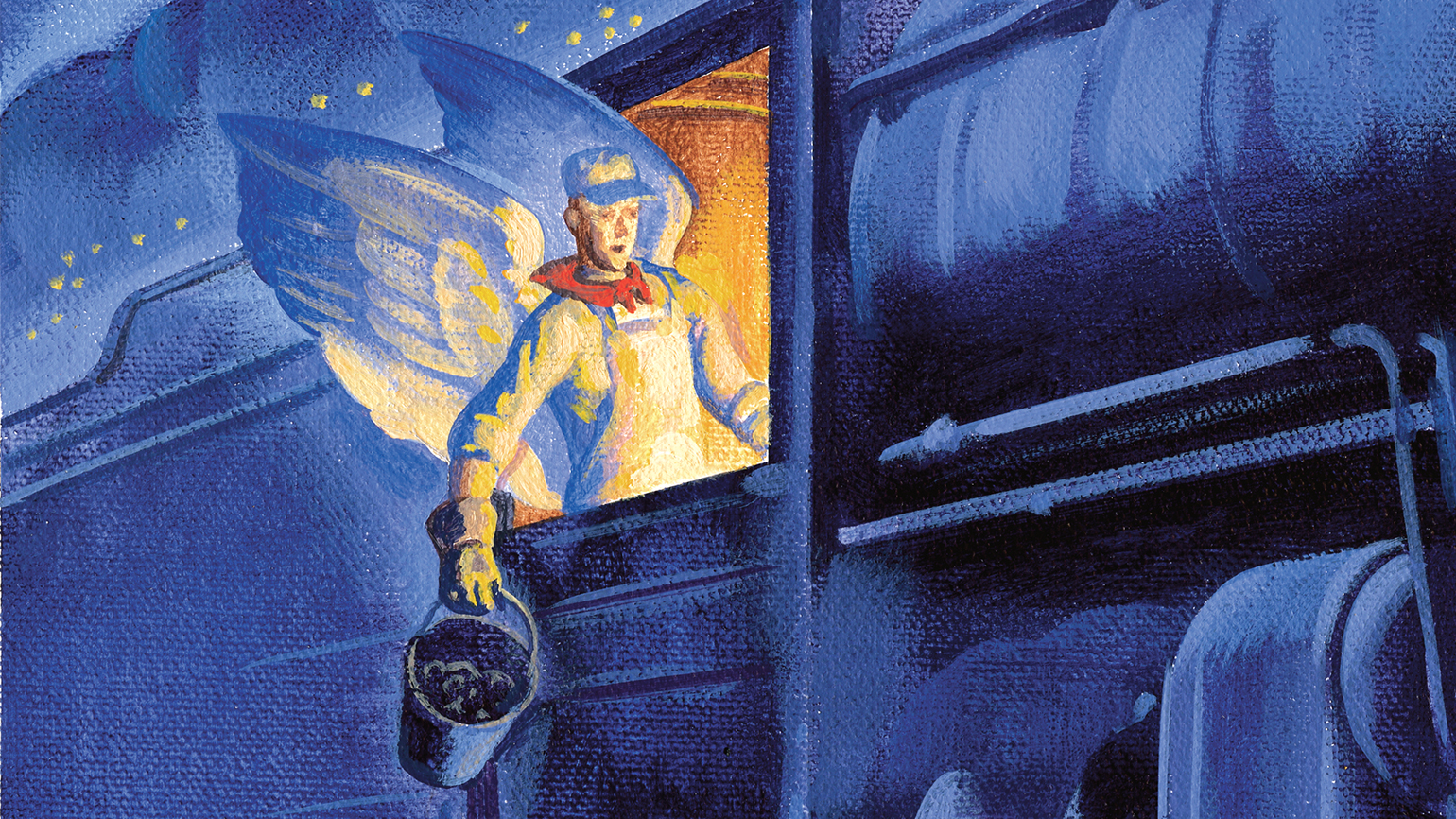
“Why are you boys digging in the snow?” someone called from the engine cab. It was a fireman. I could tell by the soot on his face and the red bandanna around his neck. “You looking for fishing worms?” He laughed.

“No, sir,” I said. “We are finding coal that falls from the cars.”

“It’s mighty dangerous for two youngsters to be running these tracks,” he said. “You tell your daddy he ought to buy coal from now on.”

“Our daddy is on sick leave,” I informed him. “We ain’t got any money to buy food, much less coal.”

The fireman stepped away from the window. Buddy and I resumed our search for coal. A second later the man came back to the window. “Hey!” he said. “You little fellows bring that coal bucket over here. I got something for you.”

We brought him our bucket. The fireman filled it with good, clean coal straight from the train’s own supply.

“What’s your name?” I asked the fireman. “I need it to remember you in my prayers tonight.”

He smiled the kindest smile I’d seen since coming to Knoxville. He wiped the back of his neck with his red bandanna.

“You just call me Jim,” he said. “The Lord will know who you’re talking about. Now you boys stay away from the train when it comes through day after tomorrow. I’ll throw off a scoop of coal for you so you don’t have to step on the tracks.”

Our bucket was so full of coal it took both of us to carry it home, side by side.

“We might actually be warm tonight!” I said.

Everyone was sure surprised when we bumped our way up to our house with our bucket so full.

“No cinders or clinkers at all,” Mama exclaimed, picking out a couple of lumps for the fireplace. “Where did you get all this coal?”

“Our guardian angel gave it to us,” I answered. I gave Buddy a wink. “And the day after tomorrow, if we’re lucky, we might see him again.”

Mama looked at Buddy and me over her glasses. “Does this angel have a name by any chance?”

“Just Jim,” I said. “He’s guardian angel for us and for the steam engine that pulls the coal cars.”

Mama shook her head and went back to fixing supper. The kitchen was already getting warmer.

Two days later, as promised, Buddy and I stood back from the train as it steamed up to the crossing. Jim appeared in the window and gave us a wave. A second later a large scoop of coal flew out of the engine cab, followed by a bright red scrap of cloth.

“Looks like Jim lost his neck bandanna,” I said, running over to pick it up. “Wait, there’s something tied up in it.” I untied the scrap of cloth and pulled it open.

“Well, just look at that,” Buddy said. “Two pieces of bubble gum!”

“And a dollar bill!” I said, waving the money in the air. “Our guardian angel must be rich!”

Buddy and I returned to the train tracks regularly all that winter. Three days a week, we met Jim in his engine cab. Each time we received a bucket of coal, and sometimes a treat, like penny candy or money. You can bet I never forgot to put Jim in my prayers each night.

In the spring our family moved back to the mountains. I had never been so happy to see our old house and our gardens, the woods and the streams. City life was not for me.

But whenever I thought about Knoxville I smiled, remembering Jim, our guardian angel. I still remember him in my prayers. I still don’t know his full name, but the Lord knows exactly who I’m talking about, even all these years later.

For more angelic stories, subscribe to Angels on Earth magazine.

Download your FREE ebook, Angel Gifts: Inspiring Stories and Angel Crafts to Nurture Your Creativity

An Angel Named Bill

That June of 2004, out in Portland, Oregon, Mother struggled with pneumonia. This was not the first time she had made the high-speed ambulance ride to the ER, then the gurney trip to ICU, then the slower journey to recovery in the rehab unit of her assisted-living program.

But what could we expect of my 92-year-old mother, Cecilia, a Southern belle from Georgia who had stolen the heart of a Montana man named Herb, our dad, and years later ended up in the Pacific Northwest? She had Parkinson’s disease and a few other senior ailments that seemed to require a multitude of pills. None of this had weakened her spirit.

But now, a week or two into rehab, she needed oxygen constantly. She barely ate. “Just this morning,” the nurse on the phone alerted me, “she’s begun hallucinating. The doctor said it might be the medication.”

READ MORE: THE ANGELS WHO TOOK HER HOME

At the Town Center Village, where Mother lived, she protested when I informed her that the doctor thought she might be having side effects to the medication.

“I am not hallucinating,” she declared from her mound of pillows. Her brown eyes snapped, and I could distinctly hear—despite the plastic nose mask—“I tell you, he’s right there!” She pointed to a spot beside her bed.

“He calls himself Bill,” she announced. “And I think it’s highly inappropriate for a strange man to be in my room! Right next to my bed!”

“Well,” I asked, “is he behaving himself? Has he done anything inappropriate?”

“No,” she admitted.

“Mother, could you describe Bill?”

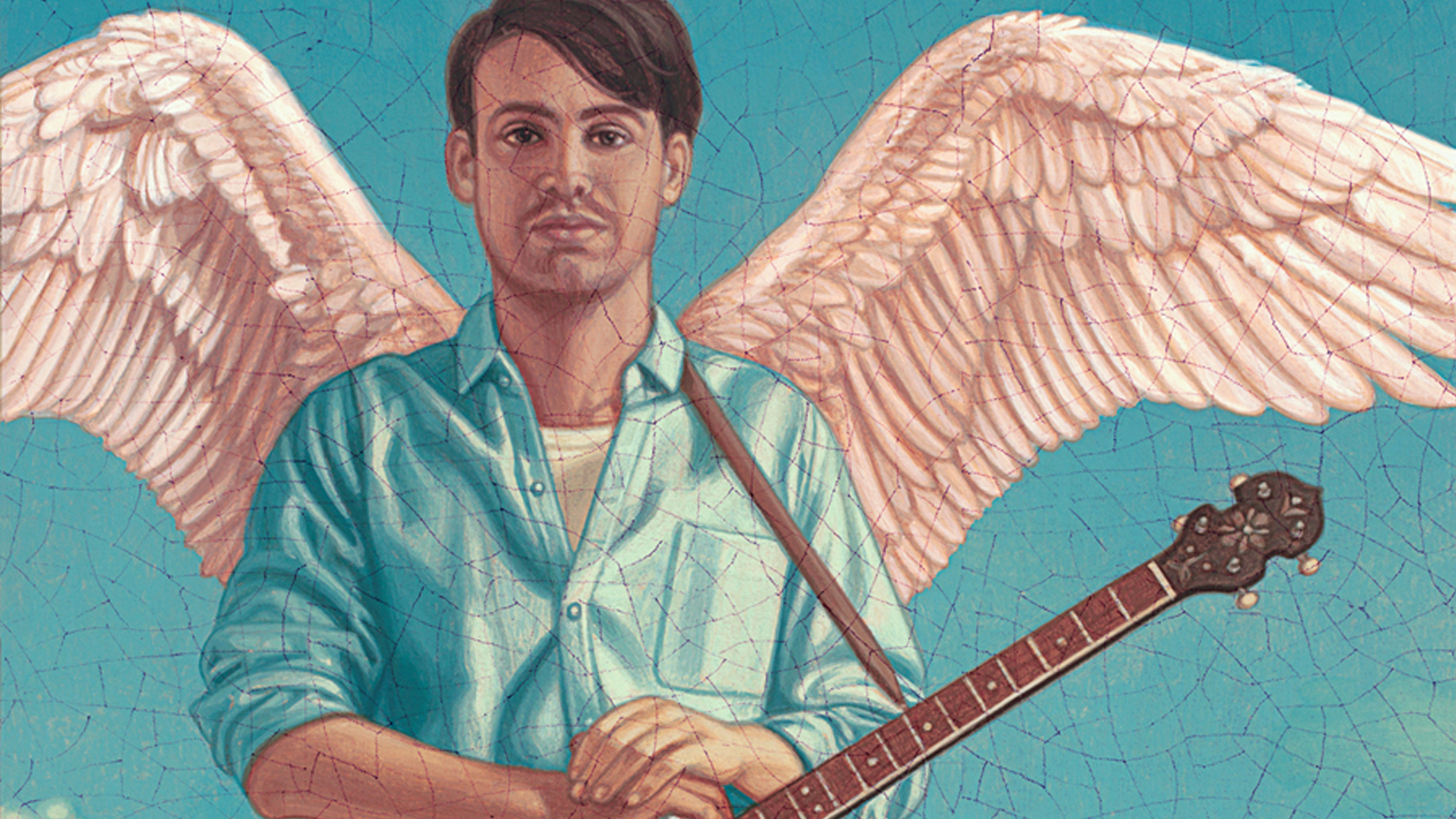
“He’s about thirty years old, medium height with dark hair, and he’s got a banjo,” she said between gasps for air. Mother loved to talk. She could make friends with almost anyone, carry on lengthy conversations with strangers, and no oxygen mask was going to stop her.

“Is he playing the banjo?” I asked, curious.

“No, he just wears it on a strap over his shoulder.”

“Maybe he’s here to help. If he’s not doing any harm, I wouldn’t worry about him.”

And so, as the days passed and Mother’s condition remained serious, we tolerated Bill. I asked her if he talked much.

“No, very seldom,” she replied. “Just sort of stands around?”

“Seems to.”

READ MORE: CHAPERONE TO HEAVEN

There were only a few days that month, two or three perhaps, when Mother mustered her strength to travel by wheelchair to the sitting lounge. Once or twice, we even went outside into the sunlight. The ubiquitous oxygen tank rode with her. And just before leaving her room, Mother would wave good-bye to Bill.

So would I. He remained an invisible mystery to me, but to Mother, a vivid presence. I liked to think a comforting one.

I read to her some, mostly her Bible, sometimes a magazine piece. Those days when she felt strong enough to talk we remembered people long gone and events long over. One afternoon we sat outside in the warm summer air. She looked so small wrapped in a pink cardigan and a couple of blankets.

“I had a dream last night,” she said. “I dreamed about your dad.”

Dad, the tall, silent guy who loved geology and could tell you how to get the ore from rocks, who’d packed into Glacier National Park with horses as a youth and traveled up the Amazon and all over South America as a young man prospecting for American mining outfits. Dad died Christmas Day of 1993, a decade earlier.

“How did Dad look?”

“He looked great, like a young man. He told me we were going on a trip and not to bother to bring any luggage. That was odd, wasn’t it?”

Really odd, I thought. I felt disheartened. I wished she would regain her strength, that vigor that had been such a prominent part of her personality. Daily she seemed to diminish. What was happening to my life-of-the-party mother?

One afternoon she recounted again a story from school days, a memory that always brought chuckles. She and her sister, Eldredge, two years younger, had performed in a play at North Atlanta Presbyterian School. The auditorium was packed with family and friends of the young cast and crew.

All in the audience held their breath as performers came onstage. In the middle of the drama, Mother forgot her lines, except for one, and she turned to her sister Eldredge, her dramatic partner, and repeated over and over, “Let’s get out of here, Bill! Let’s get out of here, Bill!” each time with more intensity, more desperation. The rest of her lines erased from memory.

Finally too embarrassed, both sisters rushed off stage. Later it became an inside joke between them. When together, and in a boring or bewildering situation, one would whisper to the other, “Let’s get out of here, Bill!” and they’d escape, leaving a wake of uncontrollable giggles.

“Bill, that’s the name of your new friend in the room, isn’t it, Mother?” She nodded. Her condition remained grave and she went into hospice, returning to her own room, the home containing her treasures for the past six years. Four days later she slipped away, right before midnight. I watched her go. I’m guessing that her last words, though not out loud, were “Let’s get out of here, Bill!”

The two of them probably burst into laughter. No bags were taken, just one banjo. It was Father’s Day, and I’m guessing Dad must have met them somewhere along the way.

Did you enjoy this story? Subscribe to Angels on Earth magazine.

An Angel Named Beth

One day my friend Bob, who has multiple sclerosis, mentioned how Angus had helped him retrieve something he couldn’t reach from his wheelchair. I knew his wife, Rita, and his cat, Patches, but Angus? “Oh, Angus is what I’ve named my guardian angel,” he explained.

I’d always been a skeptic but Bob was a pretty smart guy, so I decided maybe there was something to this guardian angel business after all. Still, even if I did have my own angel, the idea of naming it seemed presumptuous.

About a week later I was putting pans away after baking a batch of cookies when I strained my back trying to close the drawer under the oven. I called my handyman to come fix it, but there was no answer. Then the thought of Bob and Angus popped into my head.

“God, if I have one,” I prayed, “let my guardian angel help me with this drawer.”

I heard a knock at the garage door. I couldn’t imagine who would come to the garage door at the back of the house, or how anyone had gotten by our dog without him barking. I cautiously opened the door to two older gentlemen in overalls.

“We got your call,” one said, “and we’ve come to fix your door.”

“I don’t need my door fixed; I need my drawer fixed,” I said. “Are you sure you’re at the right house? I didn’t call you.”

He showed me the work order. I admitted that everything except the first name was correct. “This says Beth called,” I pointed out. “I’m Joan.” I didn’t know any Beths. “But since you’re here, could you look at my drawer?” I pleaded.

They agreed, and in no time they had it refitted. I tried to pay them, but they refused.

“At least take some cookies,” I insisted, and off they went, each with a handful of chocolate chip cookies, grinning like schoolboys.

Later that evening, I realized God hadn’t just sent me help, He’d actually told me my angel’s name.

An Angel in the Fire

Every second mattered.

The blaze was less than two miles away, but it seemed like we’d never get there. Our fire squad barreled down the road. The siren screamed. My heart pounded inside my heavy turnout coat.

My job was to lead the charge into the blaze. The other men would follow. They were depending on me to deliver the knockout blow to put out as much of the fire as I could on my own.

I looked over the other firefighters on the squad. You could see their experience in the craggy lines on their faces. I was the young one, volunteering while I was in college.

I admired their cocky, macho confidence, relished being one of the guys. It reminded me of my four years in the Air Force, where I’d first learned to believe in myself and the men around me.

“Hey, Gary,” Captain Willie said. “Can you guess how much wood I chopped this morning?” The other firefighters started hooting and hollering, burning off nervous energy.

Captain Willie was a legend. He was at least 75, tough and leathery, and yes, he did still chop his own wood. He could practically put out a fire just by glaring at it. In the hottest blaze, Captain Willie never broke a sweat. He always remained calm and cool.

I remembered another fire I fought with Captain Willie at a convent. That same afternoon the Mother Superior came to the station to speak to the chief about the language someone had used at the scene. The chief tried to explain that it took a certain breed to be a firefighter.

He said, “Sometimes in the heat of the moment the men might call a shovel a spade, if you know what I mean.” “No, that’s where you’re wrong,” the Mother Superior gently chided. “They would call it a dang shovel. Or worse.” Still, she had faith that with God’s help we could change. “I’ll be praying for you,” she said on her way out.

All of us had gotten a good chuckle out of that. Praying was one thing I didn’t do very often. It’s not that I wasn’t aware of the dangers. We risked our lives every time we left the station. But we were conditioned to be fearless.

At 24 I thought I was invincible anyway. I didn’t see any need to ask God to protect me. I put my faith in my training and in my fellow firefighters. I was confident that would see me through.

We could see the flames leaping into the night sky before we even reached the fire—a five-car garage totally engulfed. The heat was so intense that the shingles on the house 25 feet away were smoldering. The fire was spreading to surrounding bushes.

I jumped out of the squad, pulled the high-pressure hose from the reel and headed up the driveway to the garage. Flames shot 30 feet in the air, twisting and turning as if they were alive.

It felt like I was approaching a blast furnace, the heat so strong it literally pushed against me. Garages held gasoline, solvents and other materials that could explode at any moment. Still, I ran toward the blaze as fast as I could.

As close to the fire as humanly possible, I turned the hose on it. I soaked the roof of the house to keep the fire from spreading and doused the bushes. Then I turned to the garage, the heart of the blaze.

It was as if the fire and I were in combat. It retreated and I advanced. I felt the familiar rush that meant I was in control. No backing off. I’d put this sucker out all by myself!

The hose went limp. The spray of water became a useless trickle. The fire roared back to life. The heat was overwhelming. My face got hot, as if I had a sunburn. Steam rose off my coat. I backed away, the fire popping and banging at me.

Captain Willie came toward me, smoking a cigarette. “Stay where you are, son,” he said. “The water pressure will be back on soon. The boys just had to move the engine. You don’t want to get out of position.”

“Are you sure?” I asked. “I felt like I was too close.”

“Nothing to worry about,” he rasped. “But I’ll stay here to keep you company. This fire’s a real son of a gun, ain’t it?” He added a few more colorful adjectives about the heat.

I wondered what the Mother Superior would do if she could see Captain Willie and me in this heat. Probably say a prayer for us, I thought, wryly.

One thing I knew, prayer wasn’t going to put out this fire. That was up to me and the other guys. Once the water came back I would have to dominate it. I sized up the garage and planned my attack.

It seemed like forever, but it was likely only a minute or two. The water returned. Captain Willie went back to direct the squad. Again, I sprayed the roof of the house and drenched the landscaping. Then I went at the garage once again. I broke out the windows and directed a high-pressure stream directly onto the hot spots inside.

Suddenly, out of the corner of my eye, I saw something hurtling toward me—a burning object about the size of a basketball. It came right at my head, flames and smoke billowing out behind it. Fireball!

Someone pushed me down hard from above and behind. I fell flat against the driveway, my hands reaching out to catch me at the last second. I rolled over just as the red-hot flaming missile whizzed over me.

I looked around to find the person who had saved my life. Captain Willie? But there was no one within 100 feet of me. The guys were busy connecting hoses. But who else could have…Was it possible? I’d heard of people being touched by an angel, but I’d been tackled.

Looking up at the night sky, I said: “Thanks, boss. If that was you, I definitely owe you one.” I got to my feet and returned to fighting the fire with the others. Within a minute or two, it was mostly extinguished.

That night at the station I couldn’t stop thinking about the fireball. I asked around, thinking maybe I’d find someone who had shoved me down out of harm’s way. Was there some other explanation for what happened? Everyone on the squad confirmed what I’d seen with my own eyes. No one had been near me when I got up off the pavement.

Captain Willie was full of praise, slapping me on the back. “Great job,” he said. “You were a real fighter out there tonight.”

However, I felt incredibly small. With all my training and skill I hadn’t been able to save my own life. I would have needed superhuman reactions. Either God or a guardian angel had saved me. Any power I had was insignificant, not even measurable.

I thought about the Mother Superior and her faith. It had taken courage for her to come and confront the chief that day. Mother Superior was plenty tough, but she knew better than to take on a challenge without God. This tough firefighter decided to take a page from her book.

After that incident, every time the alarm rang and I grabbed my turnout coat, and pants, helmet and boots and hustled to the squad, the first thing I would do was say a silent prayer for our safety. Prayer had become the most powerful tool in my arsenal.

Did you enjoy this story? Subscribe to Angels on Earth magazine.

Download your free ebook Angel Sightings: 7 Inspirational Stories About Heavenly Angels and Everyday Angels on Earth.

An Angel in Scrubs

Oh, God, why must I continue to suffer in this dark valley? Why couldn’t this birth be easy?

For the second time in my pregnancy, I battled premature labor. After 22 weeks, I endured surgery to close my cervix. Then I was confined to bed for three months. Spiritual battles intensified as the months progressed.

My body was being pumped full of ineffective sedatives and contraction-ending drugs. My unborn baby was unresponsive, and my mental stamina eroded along with my physical state. Now, in my seventh month, I was alone in a dark hospital room. And terrified of the outcome.

Almost two years earlier, our precious daughter Victoria died during a delivery that almost ended my life as well. My husband Chris and I had grieved deeply and struggled to recover. We had prayed earnestly until we were certain God was with us and we should try again. I closed my eyes and returned to a favorite prayer by James Dillet Freeman that I had learned:

The light of God surrounds me;
The love of God enfolds me;
The power of God protects me;
The presence of God watches over me.
Wherever I am, God is.

Over and over I repeated it, with additional fervor during the worst waves of breath-stopping contractions. It helped me to focus on the loving presence of Jesus.

My doctor, who monitored my condition and gave directions from his home, seemed unresponsive to my distress. Medication levels elevated repeatedly as my contractions worsened. Already fearful, I grew even more concerned for the effect of the drugs on my unborn baby.

At six the next morning, contractions still crushed against my pelvis. I gripped my pillow and repeated my prayer more intensely. My nurse evaluated the monitor yet another time. She said nothing, but she seemed nervous and left abruptly. Only minutes later, my doctor called on my bedside phone.

“I think it’s time to hang this one up. I’m going to stop the medication,” he said. “When I get there, I’ll cut the stitches and let whatever happens, happen. I think we’ll be having a baby here within the next several hours.”

Excitedly I called Chris. “Hurry to the hospital,” I said and repeated what the doctor had told me.

One of the nurses notified the Neonatal Intensive Care Unit (NICU) that a six-and-a-half-month preemie would likely be delivered in a few hours. The nurses seemed extremely excited. The contractions came and each one seemed harder. But by six-thirty the pain bordered on unbearable.

“Oh, dear Jesus,” I choked, “please help me bear my burden. You took me through this once before, so please help me again. Please.”

Suddenly an unrelenting contraction slammed my body. Terror pierced me. The next contraction escalated ferociously. My baby was arriving in a dark, lonesome hospital room. Hysterical, I screamed for someone to help me. As my nurse hurried into the room, I wailed, “It’s here. My baby’s here.”

“Stop pushing!” She placed one hand on my unborn baby’s head. She called for help through the wall intercom. Within seconds a barrage of nurses swarmed in, and a call went to the NICU.

My doctor hadn’t arrived, so someone on staff called an emergency room doctor. We waited, and I prayed in hyperventilating jerks. For ten minutes, a nurse kept my baby from complete delivery before the doctor suddenly appeared and stared aghast at the chaotic scene.

“Is there a heartbeat?” I asked several times. No one answered. The monitor had slipped, and everyone had forgotten about checking the baby’s condition.

Quickly and calmly my doctor instructed me to push gently. Three times I obediently followed his order. Finally, my baby was born. “It’s a boy,” a nurse squealed.

Before long, I was able to sit up and take in the beautiful vision of my newborn baby. He lay absolutely still and lifeless on the bed; his little form in a dreadful hue of blue.

Collapsing on the pillow, I dragged a wet washcloth over my face and mumbled into the damp cotton, “Oh, God, I can’t lose another one. I just can’t lose another baby. Please don’t make me go through this again. I thought I could, but I can’t.”

Just then, a nurse I didn’t recognize grabbed my right hand and arm, leaned over me, and began praying magnificent words of power and conviction. Her voice was soothing, and I felt instant gratefulness for her presence.

“Are you a Christian?” she asked matter-of-factly.

“I certainly am.” I stared at the young woman who had appeared so suddenly. She continued to pray while puffing up my pillows and cleaned the area around my head and arms. I couldn’t seem to take my gaze off her.

Each gesture felt like a silent signal for more inner peace. I wasn’t the only one staring at her. Other nurses observed her somewhat questioningly, as if they didn’t recognize her or understand why she was there.

She ignored them and continued to smile and talk softly to me.

“Is he breathing?” I asked.

“They’re working on him,” came the reserved and succinct reply from a voice near my bed.

Everyone seemed busy while anxiously waiting for some noise to escape from the baby warmer in the corner where a team of NICU nurses blocked my view. A hush, stretching like eternity, filled the room. “Is he breathing yet?” Feeling as if I would crack from the choking volume of silence, I asked again.

“They’re still working on him,” another nurse said without meeting my eyes. I was ready to ask yet again when a beautiful, tiny cry emitted from the table over which the group huddled. A cheer erupted from the staff as the team whisked my son to the NICU.

In that instant, the terror, the bottled-up emotions, doubts, and anguish dissolved. My baby had arrived. He was real; he was breathing. I knew he would be fine.

My gaze scrutinized the room, seeking the face of my praying nurse. She was gone. She hadn’t said anything—not a single parting word before she left. Vera, a nurse who had cared for me during the first bout of premature labor three months earlier, stayed to change my pillows, remove my IV, and return the room to some semblance of order. When the two of us were alone together, I asked, “Who was that nurse? The one who prayed?”

“I don’t know. I’ve never seen her before.” She stopped and stared at me. “I’ve worked here a long time. Maybe she came from the emergency room. Would you like me to find out?”

“Yes, please. I’d like to thank her.” “I’ll order breakfast for you, get some clean towels for your shower, and ask around.”

“Thank you.”

Within half an hour she returned. “I asked the nurses in the emergency department, and they’d never seen her before. They thought it was strange too. No one I talked to has ever seen her before.”

“You’re saying that she just came, prayed for me, and then disappeared?”

“Kind of strange, isn’t it?”

I nodded. Nothing more needed to be said. Vera left, and I lay in bed, once again staring at the ceiling.

Could it be, God? Could You have sent an angel just for me? An angel in nurse’s scrubs? Or a dedicated nurse moved to deliver comfort to a weak, terrified mother?

God had walked me through a blackened valley and onto a mountaintop. If the birth had been easy, would I have missed His miraculous love, provision, and power? Thankfulness and awe of my loving God engulfed me. I closed my eyes and wept.

Now years later, whenever I remember that day, I wonder anew. And I’m humbled. Regardless of whether it was a human being or an angel (which is what I believe), I know that God sent that messenger—that ministering spirit—to meet my need.

An Angel in Every Lap

The trip started out like hundreds of others. Lorie Torbeck of Appleton, Wisconsin, helped by her teenage daughter, Eryn, buckled the seven children who attended Lorie’s home daycare into their seats in her big Chevy Suburban to go to the high school.

“Eryn was a cheerleader, and it was yearbook picture day for the team,” Lorie says. “The kids and I had made this quick trip dozens of times.” Now, as they were driving along a narrow stretch of highway, a white panel truck came toward them. Lorie moved over a few inches, onto the shoulder, to give the truck ample room to pass. But as she tried to return to the highway, her tires became stuck in a six-inch drop from the concrete to the gravel shoulder. The vehicle began to fishtail. “Hold on!” Eryn screamed. The van rolled over.

Community Newsletter

Get More Inspiration Delivered to Your Inbox


Dear God, not now—the children are with me! Lorie remembers her silent plea, as the van rolled a second time. Immediately she heard a voice saying, “Don’t be frightened. God is with you and you will all be all right.” She also had a vision of angels sitting on the children’s laps, wrapping their arms around each little one. “An overwhelming sense of peace came over me,” Lorie says, and she was able to relax even as the truck became airborne and flipped twice more, then came to a rest upright on a small hill.

The sudden silence was horrifying. Lorie was afraid to turn around and look, and instead fumbled for her cell phone. Where was it? Suddenly everyone was crying. Cars around them were stopping. “Call an ambulance!” Lorie yelled, then turned to help the children.

Seeing everyone alive, she flew into action, pulling back two of the boys who were attempting to scramble through the broken windows, then passing four of the preschoolers to bystanders who had come to help. Eryn unbuckled Makayla, the screaming baby, from her carseat—she had probably saved Makayla from serious injury by wrapping herself around the baby as the van rolled. As the second-to-last child was removed, it suddenly occurred to Lorie that the van might roll again, but three-year-old Cody was still inside, too far for her reach! “But the people would not let me crawl back to reach him,” Lorie recalls. “I had to wait until the police arrived, and they got him out.”

Wearily, Lorie climbed the hill. Good Samaritans had set all the children on a blanket and were keeping them warm and safe. Lorie did a quick exam, and discovered that four had escaped all injuries except bruising from their seatbelts. The other three had glass cuts on their hands but nothing more serious. As the ambulances arrived, she realized that she was covered in blood from a severed artery. She didn’t know yet that she also had broken a vertebra. “A policeman told me later that when he saw the damage to my truck, he expected to be pulling bodies out of it,” Lorie says. “No one could believe that there weren’t serious injuries.”

Later, Lorie discovered that her aunt, who lived 70 miles away, had been moved to get down on her knees and pray for a relative who was traveling. The feeling came upon her at 3:30 pm, the exact time Lorie’s truck began to roll.

It was a miracle. But a few days later when her daycare reopened, Lorie discovered she wasn’t the only one to recognize it. “There were angels in our laps in the truck that day,” a boy told Lorie matter-of-factly, then ran off to play. Before she could react, another child told her the same thing. Lorie remembered her vision: an angel in each child’s lap protecting each little body and the calm voice which assured her that everyone would survive. She had not mentioned this experience to anyone except Eryn, and yet the children knew. She gives thanks each day for this gift.

An Angelic Superhero Rises to the Challenge

Every kid dreams about growing up to be a superhero, but not many expect that dream to come true. My twin brother, Travis, couldn’t believe it when I told him mine had. “What do you mean you’re going to be Captain America for real?” he asked.

Superheroes had been important to me since I was a little kid. Travis and I really needed heroes back then. We had a difficult childhood, bouncing around from one tough situation to another. When we didn’t think things could get any worse, they did.

The one thing Travis and I could rely on was our comic books. When you’re a small boy, and afraid, it’s a great comfort to imagine you’re big and strong, rescuing other children from danger.

BROWSE OUR SELECTION OF BOOKS ABOUT ANGELS AND MIRACLES!

One night, when we were about eight, Travis and I huddled together in bed wondering if we’d always be surrounded by people stronger than us. “We’ll find a way out of this mess,” I whispered to him. “Someday we’ll overcome, like all of our heroes. You’ll see!”

With each other—and God—to lean on, that’s exactly what we did. Travis worked for the would-be governor of Washington State. I’d spent years as a professional wrestler and been awarded the Armed Forces Service Medal in the Navy for my work as a surgical technician.

Now I’d been offered an even more important job.

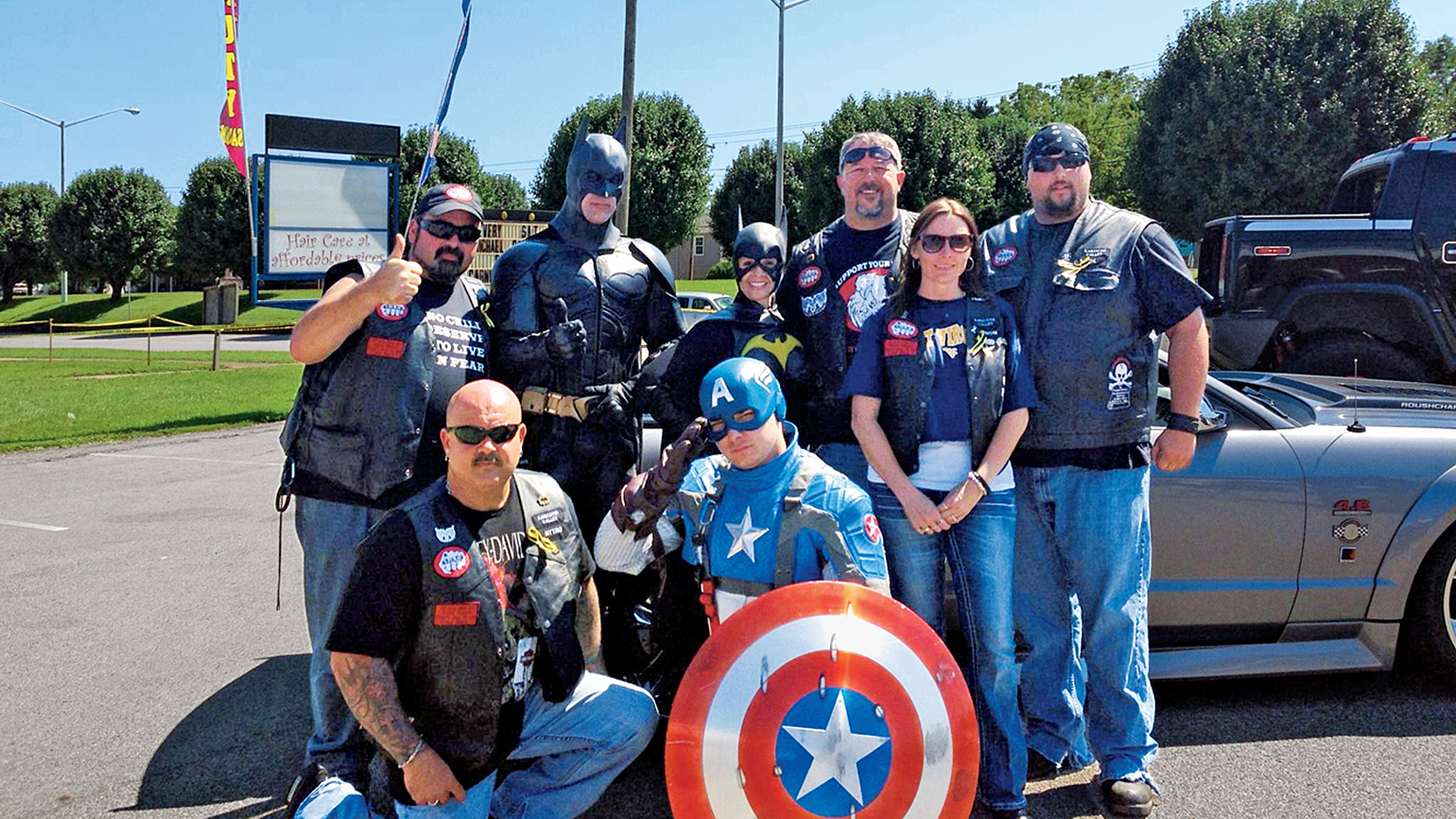
“I’m going to be Captain America,” I repeated to Travis. I’d gotten a call from a man named John Buckland, an Iraq War vet and a former firefighter. He ran a group called Heroes 4 Higher. They dressed up as superheroes to teach kids how to be a hero in their own right.

John had seen a picture of me from my wrestling days. I competed dressed as Cap—red, white and blue uniform, star on my shield. It was a big hit with the crowd, but it had special meaning for me.

In striving to become a hero like him as a boy, I didn’t feel like a victim. Maybe in this program I could share that feeling with other children. “If anyone can do it, you can,” my brother said.

I started “work” right away, visiting elementary schools, hospitals and community centers. John dressed as Batman, his wife was Batgirl.

There was nothing better than talking to kids one-on-one, having them look at me and see a hero. Courtney from Milton Elementary wanted us to visit her school on her birthday to teach everyone to be nice to each other.

Abby met us at an anti-bullying rally at the mall where she appeared in a tiara. Cameron, a boy losing his fight against cancer, said we gave him courage.

“You really have become one of the heroes from our comic books,” Travis said. Well, not really, I thought as I suited up for an appearance for local kids at the American Legion last fall. I wasn’t capturing bad guys or saving lives. The kids just thought I did those things because of my costume.

Our hosts at the American Legion introduced us, and John and I—as Batman and Captain America—took the stage. The kids clapped and then quieted down.

I spoke about some of the challenges they might face at school and gave some tips about standing up to peer pressure. The kids were taking it all in. John suddenly stepped forward and pointed out the window to a house across the street. “That place is on fire!”

Brown smoke poured out of the windows, turning black. The ex-firefighter didn’t waste a minute. “Call 911,” he told the room, and both of us ran across the street, followed by some of the bikers who were there to give an anti-drug presentation. One of them, Tank, helped John to kick in the front door.

“Throw a rock through the window,” John then ordered me. “We need to get some of that smoke out!” John went inside the house, disappearing into the thick smoke. “Anyone home?” he shouted. No answer, thank goodness.

Across the street the kids shouted, “Go, Batman, go! You can do it, Captain America! You can do it!”

John emerged from the blackness with something in his arms—something furry. It was a gray and black cat. “He needs air,” I said.

Firefighters hosed down the house. John laid the cat on the grass, and we exchanged a desperate look. Neither of us had ever performed CPR on a cat before, but we had to try!

“Captain America and Batman will save him!” one of the kids shouted. John breathed air into the cat’s mouth. The cat twitched. His eyes sprang open. He hissed angrily. Success! By the time the family returned home, their pet was good as new.

EMTs treated John for smoke inhalation, while the kids stared at us, awestruck. “You saved him!” they said. “Batman and Captain America saved the cat!”

John turned to me. “Guess this really was a job for Batman and Captain America!” he said. My brother agreed when I told him all about it. “Superheroes giving a cat CPR,” he said. “That’s like a scene from a comic book!”

John and I received many accolades for our actions that day. At the West Virginia Pumpkin Festival Parade we were reunited with Bob the Cat and family. The fire damage wasn’t nearly as bad as it could have been, and they were back in their home already.

Now people were not only calling us heroes—they were calling us angels. All I knew was, for one day God had truly granted my adventurous boyhood wish.

For more angelic stories, subscribe to Angels on Earth magazine.

For more inspiring stories, subscribe to the free Angels on Earth email newsletter!

An Angelic Presence

Usually we don’t see angels, but we can feel a presence, sense there’s someone in the room with you. You turn your head; there’s nothing there. What was it? A spirit? A guardian? The next story tells of an actual visitation.

She was three-and-a-half months pregnant with her second child, a girl. She woke in the middle of the night and lay, eyes closed, thinking how cold her hand was, lying outside the covers. She started to draw it in under the blankets, when she realized it already was!

Waking more, she opened her eyes and saw a figure standing over her in a flowing robe and shoulder-length hair. Its face was turned, so she could not tell if it was male or female, but its right hand, outstretched, held onto her very cold hand. Her first reaction in a semi-wakened state was fear. She closed her eyes. When she opened them, moments later, the figure had gone.

Her hand began to warm and, for the first time, she felt the quickening of life from her unborn child.

“I not only felt life,” she wrote me, “but that little fetus churned non-stop the rest of the night! I kept thinking, this is a soul that is overjoyed that in a few months it will be born.”

This mother had two other children, and each time she first felt life inside her, she experienced the strong sensation of a Presence in the room.