

Embrace God's truth with our new book, The Lies that Bind

A Lost Hiker’s Guide Home

The sky was blue, the sun was warm. A perfect summer day for hiking.

Atop 13,507-foot Mount Ypsilon, where my husband, Wes, and I had just eaten a packed lunch of sandwiches, apples and fruitcake, the view extended for mile after glorious mile of snowcapped Rocky Mountain peaks.

It was Friday, the day Wes and I hiked together each week. Mount Ypsilon was one of our favorite routes. We’d climbed it at least three times in the 41 years we’d lived in Colorado, where Wes had taught geology at the University of Colorado and I’d worked as a nurse.

Now we were retired with grown kids and schedules blissfully free for getting outdoors. We spent as much time in the mountains as possible. We felt at home there. Close to God and the angels. Safe.

Which probably explains why, when Wes stopped to take a photo, I didn’t wait for him but instead kept right on descending the gray, rocky talus below the summit. There was no trail, just occasional cairns of stones marking the way to where the tundra began. It was chilly and windy up there, still dotted with remnants of winter snow.

I shouted back to Wes I was turning off the ridgeline toward the trail. I wasn’t sure of the exact way we’d come up—I always let Wes the geologist do our map-reading—but I figured I’d hit the trail eventually. There aren’t too many ways you can go from a summit but down. Besides, I usually walked ahead of Wes on descents. A bad knee slowed him downhill. I’d wait for him once I reached the trail.

I clattered down, clicking on rocks with my trekking poles. The wind pushed and pulled. Suddenly I stopped. Before me a steep cliff dropped away, plunging hundreds of feet. Huh? We hadn’t passed any cliffs coming up. I turned around to show Wes. But I couldn’t make him out. A wall of talus rose behind me. The wind blew against my face.

Figuring I’d taken a wrong turn, I climbed back to where I thought I’d left Wes. He wasn’t there. I took off in a new direction. Moments later I stood atop the same cliff. I shaded my eyes with my hand. Everywhere the view was the same. Featureless gray rock, peaks ringing the horizon. I assured myself I wasn’t lost.

I retraced my steps twice more. The fourth time I found myself at the cliff I admitted the obvious. I was lost.

I took my water bottle from my pack. It was empty. Wes and I had drained it that morning like we always do, lightening my load first. A twinge of nervousness seized me. The sun was halfway to the horizon. Where was Wes? No doubt he’d figured I was way ahead as usual. How long until he realized I wasn’t on the trail? The trailhead was five miles down. Wes wouldn’t reach the car until late afternoon.

I looked around. The sun was warm but I knew the minute it set the temperature would plunge. Like always I had a wool hat, gloves, fleece, rain parka, poncho and a down sweater in my pack, along with a first aid kit and plenty of nuts and raisins for snacking. Would that be enough for a night below freezing?

Keep calm, Heather. Just that morning Wes and I had listened to a news segment on the radio about lost hikers. Stay put, experts recommend, so rescuers can find you. Okay, I’d stay put. Maybe Wes would reach the trailhead in time to alert rangers and they’d have someone up here before nightfall.

Nightfall. The word loomed in my mind. I needed to do something to keep busy. I began stacking rocks into an improvised shelter. Already the wind was finding its way into my parka.

An hour later I had a small circle of raised stones. I sat in it. The wind howled around me. I stared at the landscape. Suddenly the mountains I so loved seemed altogether different. I was seized with fear. I did not want to sleep on this peak.

In desperation I cried out, God! Help me! I need an angel!

With a sudden burst of energy I picked myself up, stuffed my water bottle with snow and set off along the slope, determined to find that trail. I ranged this way and that, always keeping my little shelter in view.

Suddenly my heart leapt. There, over a rise, I saw a tiny pile of rock. A cairn! A trail marker. “Thank you, God!” I cried.

From the cairn I could see another cairn. And another. It was definitely the trail. I picked up the pace, glancing at the sky. Could I make it down before dark? Never had I hiked so fast.

My spirits soon fell. The cairns ended at the beginning of grassy tundra. I saw no trail. It was too early in the year. Not enough people had hiked up here to flatten the grass. Wes must have navigated by map. Was I lost again?

I stared down the slope toward a saddle between two peaks. To my immense relief a man stood in the middle of the saddle. He wore dark clothes. I waved my trekking poles and shouted but he didn’t seem to notice me.

Staring at him I realized he was standing directly on the trail. I hadn’t seen it before but now I discerned it continuing down the slope behind him. I hurried down, watching my footing. I reached the saddle. The man was gone.

I continued along the trail, thinking I might see the man. Instead, a few miles down, I came to a crossroads. Which way had Wes and I come? Surely I was near the trailhead. Just pick the right trail, Heather….I set off down one that looked right. It plunged into a thick wood. The setting sun barely illuminated the trees.

I was just beginning to lose sight of the trail when it ended at a damp marsh. The sun was gone. With a sinking feeling I knew I was not going to make it home that day. I was going to have to spend the night outside.

Wearily I hiked away from the marsh until I couldn’t see a thing. I lay between two downed trees surrounded by close, damp woods. I ate some nuts, drank my melted snow water, took two Advil and prayed. The wood became utterly silent.

In the dark I felt a wonderful sensation—someone cradling me, dispelling all fear. I fell asleep and awoke to the sound of birds. I hastened back up the trail.

I’d barely reached the crossroads when I saw a man walking quickly uphill. My heart flooded with relief. That must be the way down. Oddly, the man was wearing nothing but shorts and a t-shirt. It was cold!

I asked if he’d come up from his car. He said yes and continued on without another word. Eager to get home I hurried down myself. Not 10 minutes later I came to the end of the trail and heard a shout. A ranger clambered out of a pickup saying she’d been praying for me all night. I practically collapsed from joy.

The ranger told me Wes had come down the trail late the previous afternoon and reported me missing. Rescuers had sent him home to Boulder to e-mail photos of me. What an awful night he must have had! He was on his way back now, the ranger said. Had I been gone another 15 minutes they’d have sent helicopters to look for me.

The ranger said one more thing. When I told her how grateful I was for the man I’d seen on the trail that morning, she gave me a funny look and said no one had been up that trail since she’d come on duty at 3:00 a.m.

All those hours I’d felt so lost and alone on that vast, beautiful mountain—I wasn’t lost at all. I was right at home. I was close to God and the angels. I was safe.

Did you enjoy this story? Subscribe to Angels on Earth magazine.

A Lone Watermelon Reminded Her to Let Go and Let God

I was beyond frustrated one day last summer when I walked out to the patch of fertile land that had once given us a bumper crop of watermelons and I found it barren. Not a shoot to be seen after all the work I’d put in. I was doing everything I could to repeat the success we’d had, and it just wasn’t enough. Still I kept at it, determined to make the patch grow again.

My husband, John, and I had inherited our property two years earlier. We rented out most of it for wheat fields, keeping enough land near the house for the cattle we raised. They loved the watermelon rinds we tossed over the fence into their pasture. And in summers past we’d had no shortage. I’d picked the perfect spot for our homegrown patch, where God would provide lots of sunlight while I worked in plenty of compost and watered regularly. I gave that garden my all. What more could I do to make it grow this summer?

I went inside to tell John the garden remained an utter failure and went off to the supermarket in a funk. I rolled up and down the aisles and tossed a box of detergent into my cart to drop off at my son’s apartment. It wasn’t just the melons that had me feeling helpless. My 29-year-old son had struggled with a narcotic addiction since he was a teenager. At each of the rehab facilities he entered, I prayed that we’d find an answer. When he moved from his latest rehab into sober living, I dropped in with groceries, took him out to lunch. I’d convinced myself I’d solved the problem, only to find out I hadn’t. He’d left the sober living house and was now renting an apartment I’d agreed to pay for—even though I was sure he was still using drugs. Sometimes it seemed as if the only time I wasn’t worrying about my son was when I was worrying about those watermelons. I was just trading one failure for another.

I turned my cart into the fruit aisle, where rows of bright green watermelons were waiting. I surrender, I thought, loading a big one into my cart. I vowed to stop tending the unyielding soil. That would give me more time to concentrate on finding a solution for my son’s problems.

“It’s not fresh from the garden, but…” I said to John when I cut into the watermelon that evening.

“I don’t mind,” John said, crunching into a slice. “I’m sure the cattle won’t either.”

“Maybe we’ll never know what went wrong this summer,” I said.

“Remember that first year?” We’d harvested enough watermelons to feed the whole county. John laughed, always happy to hear me talk about something other than his stepson, no matter how much he loved him. My other two children felt the same. They didn’t let their brother’s choices consume them. But how could a mother do that?

After dinner, I went out and tossed the watermelon rinds over the fence. They landed a few feet from the cattle guard that ran along the ground to keep the herd from wandering out of the pasture. The animals would find the rinds easily. “Bon appétit,” I called.

I picked up another watermelon from the supermarket later that week. It felt a little freeing, so I went for a facial to take in a measure of peace. It was short-lived. “I know I shouldn’t be giving him any money,” I found myself sighing to the aesthetician. “But part of me still sees him as a little boy whose heart is hurting. He needs…”

“Lady,” she said, “what you need to do is stop focusing on your son.”

“What?” I said.

“It’s not good for him or you,” she said, not unkindly. “A good friend of mine is a therapist who specializes in your situation. I’m going to give you her number.”

I was pretty stunned by her bluntness, but her words rang true. I called the therapist as soon as I left the salon. I was a little nervous when I arrived at my first appointment, but soon I looked forward to our regular summer sessions. My therapist introduced me to Al-Anon, where I met other people who had addicts in their lives. I learned that by financially and emotionally enabling my son to continue in his lifestyle, I might have been keeping him locked in his struggles. Al-Anon encouraged me to admit that while I was powerless to change my son, God wasn’t. I had to put my son’s future in his hands.

The advice made sense. That didn’t mean I could do it. “Surrendering a watermelon patch is much easier than surrendering a child,” I told John over yet another lunchtime conversation I’d monopolized. John got up to check on the herd. Maybe I just can’t let go, I thought as I cleared the table.

Before I was done, John called me outside. “You won’t believe what I found,” he said, leading me toward the fence where we tossed our rinds. “Look.” He pointed to a thick green vine snaking through the overgrown grass. “I followed it and…” The vines led under the cattle guard. Wedged underneath was an enormous watermelon. “A seed must have fallen from the rinds,” John said.

And just sprouted out here all on its own. The ground in this area wasn’t prepared for growth. Not like the patch I’d worked so hard all year in my attempt to will my watermelons into existence. Gazing at the unlikely miracle in the tangled grass, I considered my own journey. I’d done everything humanly possible to help my son. Except release him. Only God could make good things grow when all seemed hopeless.

John unloosed the watermelon from the cattle guard, and I carried the melon inside. God, I am powerless over my son’s future. I wholly entrust his care to you. I would not get in the way of the miracles he had in store. A weight lifted from my shoulders as I set the melon on the table. I was finally ready to have a hard and honest talk with my son.

On days I still found myself wanting to backslide, I had the support I needed and the faith to stand firm. My son knew I was here for him when he was ready to get sober. I had prepared the ground and scattered plenty of seeds, and now I would let go and let God relieve my son’s heartache—and mine.

For more angelic stories, subscribe to Angels on Earth magazine.

All God’s Gifts

People shifted in their seats as I walked toward the podium to read for the first time in my family’s new Florida church. It was much bigger than the Ohio church where I had grown up and studied to be a lector with Clarence Rivers, a well-known writer of liturgical music. When I signed up for his class, I’d never really spoken in public before, but I knew I wanted to play a more active role in the church service.

Approaching the podium now I remembered those early Saturday classes in an old stone church building without any heat. Five of us shivered in our coats on winter mornings, but it was worth it. Father Rivers was a strict teacher—he expected a lot from us. But he was also inspiring.

“When you read Scripture, I want you to reach down inside yourselves,” he said. “You’re going to learn to find your untapped voice. That’s what you’ll use to bring God’s words to life.” He believed we could do it, and he made us believe we could do it too.

We worked on pronunciation, inflection, tone, pace and body language. He taught us the importance of making eye contact with the audience. Perhaps the most crucial thing he taught us was what we were doing when we were giving a reading. “When you participate in the church service, you are giving people a gift from God. That’s why we work so hard to open ourselves to the words on the page.”

Under Father Rivers’s guidance, I learned to stop thinking of myself as a woman speaking in public. I was the tool God used to share good news with others.

Now I was ready to share that gift with my new church. My husband, son, daughter and I had been attending for several weeks, but we still didn’t feel like we fit in. Our young family was very different from a lot of the other church members—many of them were senior citizens, most of them white. I’d hoped seeing me up at the podium now, where I’d always been back in Ohio, would help my family feel more at home.

I found the reading in the Bible and looked out at the audience, just as Father Rivers had taught me. Once again I was struck by how many people filled the church—and how few of those people looked like me. I took a breath to calm my nerves. “A reading from Psalm seventy-one…”

Momentarily I was distracted by a cold sensation on my right. Not a draft, exactly. It crossed in front of me and stopped to my left, like a presence. Despite the coolness, it seemed to radiate love, and it awakened in me an incredible joy. I’d never felt anything like it.

My voice rang out and filled the church. My gestures flowed smoothly from the meaning of what I was saying. My body, my voice, my mind—they all seemed to come into a perfect alignment. All Father Rivers’s lessons came alive as I spoke. “In you, Lord, I have taken refuge…”

READ MORE: GRACE NOTE

I looked out at the congregation. My husband and children gazed up at me, but few other people did. Some looked at the ceiling. Some at their feet. Some whispered to each other. The few whose faces were turned to me looked uncomfortable. But I wasn’t thrown off my reading. I didn’t stumble or lose my place. On this morning nothing could get in the way of the message.

This is what it feels like to share God’s gift, I thought. “My mouth is filled with your praise, and with your glory all the day…”

As I finished the reading I looked out once more on the congregation. The cold sensation crossed in front of me, back the way it came. Then it was gone. I returned to my seat beside my family, taking the peaceful feeling with me.

The church pastor stood up at his podium in front of the altar. Instead of beginning the Gospel reading, he made an announcement. “When someone volunteers to help out in the service, they are giving every one of you a gift,” he said sternly. “And you should receive that gift as if it comes from God—because that’s exactly who it comes from.”

The pastor had used almost the same words Father Rivers had used to teach me in Ohio all those years ago!

“That was the best reading you’ve ever done,” my husband said afterwards. He’d seen me give a lot of readings, and always gave me an honest critique. “You didn’t look nervous at all. I’ve never seen you that confident. I was proud of you!”

I realized, then, what that presence at my side had been.

My family didn’t stay long at that church. We moved on to an even bigger—and much friendlier—one. But months later I ran into one of the other parishioners there, one of the few black members of that church.

“We miss you all so much at church,” she said. “But you know, in your short time there, you made a big difference. There were a lot of us feeling isolated, not really part of the church, and people have made a real effort to change all of that. You were the start of the change, you know, that day you got up in front and read from the podium.”

Sometimes God puts us in a place for a purpose. And he puts an angel beside us to help us fulfill that purpose. What a wonderful gift.

Did you enjoy this story? Subscribe to Angels on Earth magazine.
A Little Girl’s Glimpse of Heaven

I couldn’t wait to get into the ocean. My sister, Peggy, and I ran ahead of our parents, dashing up the Clark Street ramp to the boardwalk. We threaded through the crowd, bumping into the adults, craning our necks to see the beach through their legs and knees.

“Slow down, Marie,” Daddy shouted. He set up the big beach umbrella while my mother, aunt and grandmother spread out on the baking sand. I stripped off my shorts and sandals and followed Peggy into the water. It rushed up over my bare feet. “Catch me!” Peggy shouted, splashing me. I ran after her, giggling, until a big wave picked us both off our feet and sent us tumbling—soaked—back to shore. “Be careful!” my father shouted from his blanket. “Those waves are mighty big today.” Daddy was the disciplinarian of the family, but even he couldn’t slow us down. Peggy and I were having much too much fun to listen.

My family always spent August at the beach in Wildwood, New Jersey, where my aunt Ethel owned a boarding house. After dinner, we’d go for a walk on the boardwalk. I’d hold my mother’s hand, staring up at the bright neon lights over the movie theaters and the arcades. It was like peeking into a different world. Then there was the ocean. I could smell the saltwater everywhere I went and hear the faint pounding of the surf, almost drowned out by the music from the merry-go-round and the roar of the wooden roller coaster. All year long I looked forward to August. The beach was my favorite place on earth.

Peggy and I played in the waves until our fingers were wrinkled from the saltwater. “I’m getting out,” Peggy declared. “I’m hungry.”

“Five more minutes,” I begged her. I knew Daddy wouldn’t let me stay in the water alone. But Peggy was already running up the beach. I hesitated, wondering whether I should follow her. I don’t know what happened next. I never saw the wave that hit me—never even heard it. One moment I was standing in water up to my waist, the next I was under the water. My feet couldn’t find the ground. I opened my mouth to scream and choked instead. The current pulled me and spun me through darkness. I squeezed my eyes shut, certain that I was going to die. Daddy always said that was it, when you die, you die. Death was the end. I couldn’t breathe. My lungs burned. Everything went still. I was sitting cross-legged on the cold, hard sand of the ocean floor, breathing in and out. I wasn’t afraid. I felt good. I touched my bathing suit. It was dry. How could that be? I looked around. The water was murky and dark, but I could see flat stones, tangled seaweed, stiff ridges in the sand. In the distance was a pinpoint of white light as bright as a star. That must be the way out, I thought.

I crawled toward the light on my hands and knees. As I got closer, I saw a ladder in the sand—an old-fashioned wooden ladder painted shiny white. It stretched up for a long way, disappearing into the light. I put my foot on the bottom rung. It seemed solid.

Hand over hand I climbed. The farther I climbed, the greater the space between the rungs. I had to stretch my whole body to reach the next one, pulling myself up with all my strength. I was panting by the time I reached the top. But what was this? I’d come to a small room, like a waiting room, with benches on either side. Empty benches. If only someone would tell me where to go! A door stood open at the far end of the room. That’s where the light was coming from. Shielding my eyes, I stumbled toward it and collapsed at the entrance. I lay on my stomach, halfway across the threshold. The light was so brilliant, I couldn’t lift my eyes. I stared at the ground in front of me.

What I saw surprised me. Feet. Lots and lots of bare feet. Hundreds of people walking back and forth. I could make out the hems of their white robes. It was like peering through the crowd at the boardwalk. I knew there was something exciting on the other side, something I wanted to see. Something just beyond my reach. Like what Grandma said about heaven. When Dad wasn’t around, Grandma told me a different story about death. She said it was a beginning. Of a new life where we’d live with God in heaven. The way Grandma talked about heaven made me think that one day I’d like it even more than the beach in August. God, is this the heaven Grandma tried to tell me about?

I began to push myself into the room, but a voice called out, “You can’t come in.” Gripping the door frame, I raised myself up on my knees. I squeezed my eyes shut and felt a warm shiver rush through my whole body. Then a hand grabbed mine. I plunged forward. Searing pain gripped my lungs. I gagged.

“Take it easy.” Daddy! I felt his strong arms cradling me before I opened my eyes. I was back on the beach. Mom, Peggy, Grandma, Aunt Ethel—they all crowded around as Dad laid me out on a towel. He slapped my back, and I went into a fit of coughing.

“We looked everywhere,” Mom was saying. “Thank goodness Daddy saw your hand reaching out of the surf. What were you doing?”

It all came back: The bright light, the ladder, the doorway, all those people on the other side.

“I … I don’t know,” I managed to say. How would they believe me if I didn’t know what to believe myself?

For the rest of the afternoon, I drank cold spring water and dozed under the shade of the umbrella. After the scare, my family relaxed. Peggy was even swimming again. No one knew how close I had come to dying.

No one but me. Those vivid images circled in my mind: the light, the ladder, the beckoning door. Had I seen Grandma’s heaven?

The sun began to set and my mother rolled up the blankets. It was time to go home. Before we left, Daddy took my hand and led me down to the water. A shiver ran through me as I looked at the breaking waves. “I want you to go in,” he said. I stared at my feet, not budging an inch. “What are you afraid of?”

I hesitated, then blurted out the whole story, tears streaming down my cheeks. “I was in heaven, Daddy,” I told him. “I really was!”

“Heaven isn’t real,” he said. “Only this is real. This beach, this earth, this life. Promise me that you will never ever tell anyone that silly story again.”

As the sun sank below the horizon, I stepped into the waves. And for so long, I kept my promise to Daddy. I never told a soul about my vision. Not my mother or grandmother, not my husband, not my closest friend. Still, hardly a day went by that I didn’t think of it. God had planted a seed in my heart that day at the beach, a seed of faith. And it grew until I could no longer deny the truth. There is a heaven waiting for us beyond the sun setting over the ocean. A heaven more beautiful than the beach in August.

Did you enjoy this story? Subscribe to Angels on Earth magazine.

A Lesson in Faith from a Four-Leaf Clover

I held my Mother’s Day card close as I walked into the house.

I’d just returned from a visit to the Mother of God Monastery in West Springfield, Massachusetts, where my daughter Mary was finding her vocation as a contemplative nun. The monastery made a business of creating handmade greeting cards, and this one was really beautiful. Of course, I looked forward to cards from all my kids. But this one was extra-special.

We got to visit Mary only once a month for a couple of hours, except during Advent and Lent. She spent her days reading, praying, and learning to play the church organ. In a few years, she would be taking her vows, dedicating her life to God. Today Mary was self-confident and optimistic, but she hadn’t always been that way.

Sitting down with my card, I remembered a spring day when Mary was six. The kids and I were out in the yard enjoying the warm weather. The grass was fresh and green. Clover had sprung up everywhere, and I was a positive thinker. “Look,” I said. “Did you know that if you believe you’ll find a four-leaf clover, you will?”

The children didn’t seem to get the message. I knew I’d have to prove it to them. Every day I scanned the yard while walking to my vegetable garden, believing with every step. After about two weeks, I found my first four-leaf clover and showed it to the kids.

“See?” I said. “I had faith I would find one, and I did.”

My daughters Gretchen, Mary, and Felicity gathered around to see it. Their 12-year-old brother, Joseph, glanced up from the book he was reading, shrugged his shoulders and grinned. “I’ve found hundreds of four-leaf clovers,” he said. “But mysteriously every one of them was missing a leaf!” The girls giggled and I smiled. Joseph had his own priorities.

Gretchen, 10, had a tenacious spirit and wouldn’t think of resting until she finished whatever task she set her mind to. My find had inspired her. In one week, she collected six four-leaf clovers—and one with five leaves! “They were so easy to find,” she said.

Felicity, at three, could be patient and quiet. When I talked about finding four-leaf clovers, she listened silently and took it all in. I knew she would come upon one in her own time. Sure enough, while we were weeding the garden one day, Felicity toddled over to me.

“Look, Mommy,” she said.

In her little hand, she held a perfect four-leaf clover. But the exercise wasn’t so easy for Mary. Every time one of her siblings found a new clover, she threw a tantrum. She hated feeling left out. “It’s not fair,” she complained. “I’ll never find one.”

“Yes, you will, Mary,” I said. “You just have to keep looking and believe that you will.”

But Mary didn’t want to look. Perhaps she was fearful of investing her-self too much. What would it mean if she never found one after looking so hard? By the end of the summer, every one of us had forgotten about four-leaf clovers, but I didn’t give up hope that I could teach Mary to think positively. We prayed together daily as a family and attended mass at the Benedictine monastery of St. Gregory the Great. The positive influence of the monks there was a great blessing.

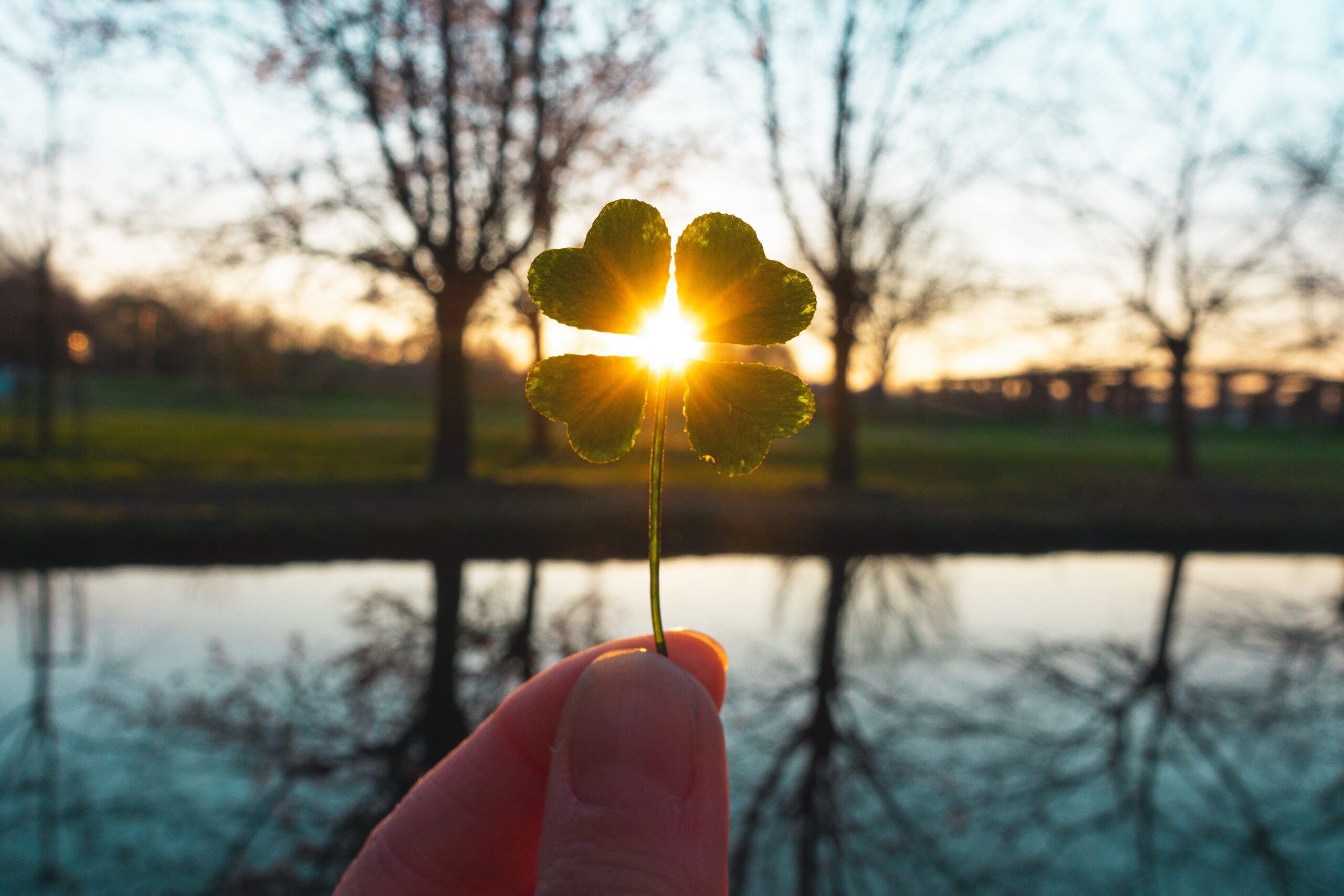
After graduating from high school, Mary earned a degree in theology from St. Anselm College. Then she entered the monastery. Once again I opened my card and looked at the smaller card tucked inside. On it was a beautiful pressed four-leaf clover. I reread the hand-written note: “Dear Mommy, thank you for teaching me to seek and believe…even if it takes time and a changing attitude. Love and prayers, Sister Mary.”

It was the best Mother’s Day gift I had ever received.

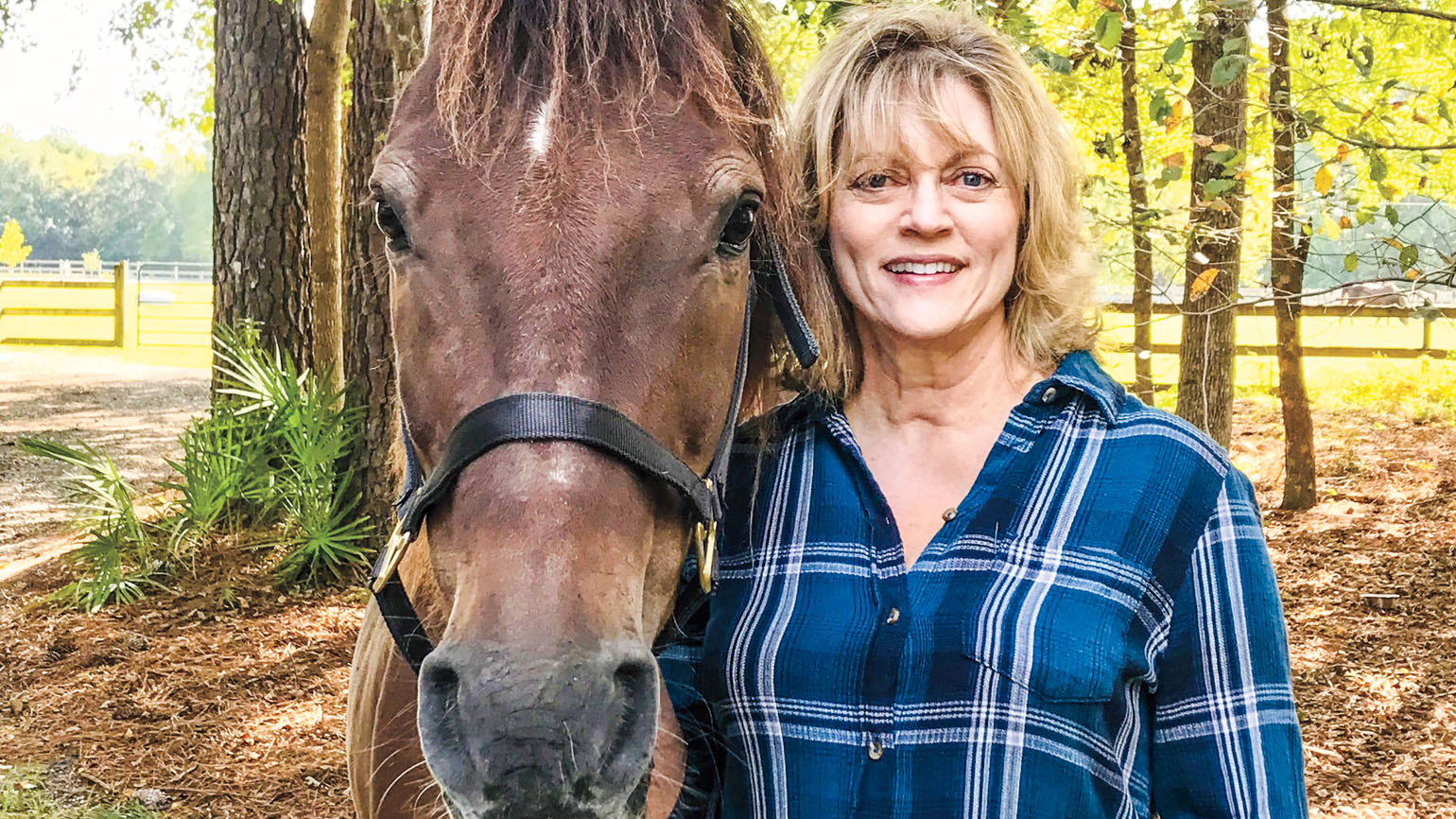
A Horse Helped Her Heal From the Death of Her Son

The vet had made yet another emergency visit to our farm to treat my injured horse. “If he rips the stitches out again, there’s nothing I can do,” she said.

I put a hand on Harry, my beautiful Morgan horse. For most of my life, at a moment like this I would ask God to help Harry be patient, to help him understand we were trying to make him better. But I no longer believed that God was there for me. Not since he’d let my son die.

Hunter’s death happened so fast. One Saturday he confessed to his father that he was struggling with depression. We invited him to come home and stay with us. Made plans to take him to get the help he needed. But he never made it home. He took his own life the next day.

In the months that followed I didn’t know what to do. No human could make things better, and I found no relief in turning to my faith. All my life I’d trusted God’s word. But he had said he was there for me. I felt no evidence that was true.

Harry shook his head and stepped away from me. At least he’s not snapping at me, I thought. Harry’s fear sometimes made him aggressive. “He looks at me like I caused this pain,” I told the vet. “As far as he’s concerned, I’m the enemy.”

“The two of you were nearly strangers when Harry got hurt,” she reminded me, packing up her equipment to leave. “Give him time.”

Harry had injured himself just a few weeks after he came to live at our farm. My husband, Ernie, and a riding buddy had encouraged me to get a new horse to take my mind off my grief. My first impression of Handsome Harry, as his owner called him, wasn’t the best. When I tried to mount him, he jumped around so much I could barely get my foot in the stirrup. I got off him as soon as possible. When his owner offered to let me walk him back to the stable to untack him, I only agreed out of politeness.

But alone in the barn, brushing out his mane, something changed. Harry pressed his soft nose at me, sniffing me over and over. When he looked at me so closely with his big, kind eyes, something stirred in me. A feeling I hadn’t felt since Hunter’s death. I knew I had to have him.

“What happened to that horse who looked at me like that?” I asked Harry now. He refused to meet my eyes.

When Harry first came to our farm, I put him in a paddock by himself, away from the elderly pony and the lame mare that shared our barn. I hoped to introduce him to his new family slowly, one at a time, as soon as he’d gotten settled in his new surroundings.

Then came the storm. Thunder and lightning are common in southern Georgia in the summer, but this was one for the record books. At first light I went to check on the animals. Everyone was accounted for except Harry. His paddock was empty.

I spotted him in the distance, standing under some trees. From the way he hung his head I could tell immediately something wasn’t right, but I wasn’t prepared for what I saw up close. Harry had run right through the paddock fence, tearing open his chest. I called the vet in tears. “He must have been terrified,” I said. “He tried to get to the other horses and tore himself open on a broken board. The wound’s so deep, I can see his muscles and tendons!”

The vet rushed over right away. Harry was in such pain he could barely walk, but we got him into a stall in the barn, where she stitched him up. “Keep him in here where he’s safe,” she said.

I was still shaky when I waved goodbye to her, but at least the worst was over. Or so I thought. In the weeks that followed, Harry ripped out his stitches not once, not twice, but three times. His wound got infected, and the antibiotics wreaked havoc on his digestive system. I mucked out his stall every day. Administered his medicine, fed him every meal, took him out by hand to graze. But despite it all, Harry lost weight from the stress. As a last resort the vet had left me a collar to fasten around Harry’s neck to keep him from biting at his stitches.

Looking at him now, I saw a horse who looked as if he might have been starving, he was so skinny. A horse barely recognizable from the Handsome Harry who’d looked at me with eyes full of kindness. Caring for an animal who seemed to hate me was exhausting, but Harry had only me to rely on. “If only you could understand that,” I said. “I’m right here. I’m trying to help you. If you would just trust me, I could help you heal.”

But Harry couldn’t understand. It seemed hopeless. I couldn’t help Harry any more than I could help my son, and I couldn’t face another loss. I imagined myself just collapsing here in the stall and never getting up. Ernie would have to drag me out when he got home from work. But I knew I needed to get my rest to keep going for Harry.

Back in the barn the next day, I went into Harry’s stall to give him fresh water—and stopped. Something’s different, I thought. Harry was still as skinny as ever. His stitches were still in place. Then I realized what it was. His eyes. For the first time in months, Harry was looking at me the way he had looked at me the first day we met. There was no anger or fear in his eyes. He had given up—not in resignation, but relief. I’m ready to trust you, Harry seemed to say. Because I don’t know what else to do. Harry finally understood.

I understood too. God was right here. He was trying to help me heal. If only I would let him. I looked back at Harry, saw peace in his eyes, finally.

I’m ready to trust you again, God, I thought. I don’t know what else to do either.

Harry no longer fought me when I gave him his medicine. Instead of reacting to me each morning with wide nostrils and a stiff body, Harry started greeting me with the horse version of a smile, as if he was happy to see me. Now that Harry was no longer resisting my efforts, he could focus on healing. There was hope.

The same was true for me. I stopped fighting God, stopped refusing to accept the comfort he offered. My wounds, like Harry’s, took time to heal. I still carry the scars. But I trust God’s word, and he is there for me.

For more angelic stories, subscribe to Angels on Earth magazine.
A Hopeful Answer to Her Prayers

So many beautiful items lined the tables at the craft booth where my husband, Tony, and I were shopping, but my eye went straight to the woman behind the counter. She had long, snow white hair and an air of… I didn’t know how to describe it, but she was the first thing to have gotten my attention all day.

I’d spent the day before in the hospital, visiting a good friend in the mental health ward. The hospitalization wasn’t a surprise. It came after months of worry, late-night phone calls and troubling conversations. Nothing Tony or I had done—listening, helping out with shopping and cooking, making doctor appointments—had helped. Even our prayers haven’t had any effect, I thought as we drifted to a table full of knitwear. Feeling useless was exhausting, and I had to keep hope alive. For my friend’s sake.

Tony looked up from a pair of mittens. “Oh, look!” he said, gesturing toward the counter. A second woman had joined the salesperson there. “I know her. We used to work together.”

We went over to say hello. Tony and his former colleague got caught up while the saleswoman and I stood by. Close-up she was even more striking. Eventually, my mind drifted back to my friend in the hospital. I closed my eyes. God, I need some hope.

Tony wrapped up his conversation. The saleswoman took my hand in one of hers and Tony’s in the other. “You’re so important, both of you,” she said. “You don’t know how much you help, but you do. You really do.”

She knew nothing about us, or our friend. Yet she’d not only named my greatest fear, she’d taken it away. Prayers are never useless. And where there was prayer, there was hope.

Did you enjoy this story? Subscribe to Angels on Earth magazine.
A Heaven-Sent Princess Visited His Grandmother

Nana my beloved grandmother, was in the hospital with bone cancer, and I’d picked up my mom so we could spend the afternoon with Nana together. It was hard to imagine that her days on earth were dwindling. She’d lived with such exuberance.

”I still remember those doctors who said she’d die young from a weak heart,” Mom said on the way over.

“She outlived all of them,” I said. “That weak heart never stopped her.”

Not in the least. Mom again reminded me of Nana’s journey from Germany to the U.S. in the 1920s. That couldn’t have been easy. Once she was here, she practically single handedly founded a Lutheran church in her new hometown. I could picture her walking through the neighborhood inviting everyone to come. Once the church was settled, Nana served as its head caretaker, supervising the cleaning and maintenance.

”I remember the other ladies who worked there,” Mom said with a laugh. “Nana would have them polishing those pews until they shone. She always wanted the church to look its best to welcome visitors.

Nana’s own home was just as welcoming. My family lived with both my grandparents for a while when I was growing up. Nana raised three children of her own and fostered countless others, many of them living with her until they got married right in Nana’s living room. They became frequent visitors after that. There was always a crowd around the table for Sunday dinner.

It seemed as if Nana would always be taking care of others, until cancer took its toll. Sometimes when Mom and I arrived at her bedside, she’d be asleep or not up to talking. But that afternoon, Mom and I found her sitting up, wide awake and in good spirits.

“I had a visitor last night,” she announced excitedly. This was the Nana I knew. No one was a better host, even in a hospital room.

“That’s great,” Mom said. “Was it a friend from church?”

Nana shook her head. “I’d never seen her before. She came in right through that wall.” She pointed to the solid wall opposite her bed.

“Through the wall?” Mom said, shooting me a worried look. Was Nana hallucinating?

“Yes,” Nana said. “Late last night that wall opened up and a princess entered through it—a beautiful princess with sparkles and lights. We had a nice talk, then she went back out through the wall.”

Mom and I were speechless. Nana had never lost touch with reality before. We were careful not to show our distress or pepper her with questions. We just nodded and said how nice the princess sounded. I ducked out to find the doctor, and he came back with me to examine her.

“Hello, doctor”, said Nana, as if it was just another day. She cheerfully answered all of his questions: What year was it, what was her name, who was the president? Nana was clearly in her right mind, and we enjoyed the rest of the afternoon with no more talk of the princess.

Nana died peacefully in the hospital a few weeks later. She didn’t have any other hallucinations. I was grateful for that, at least. I hated to think of Nana imagining people who weren’t there. Nana who had welcomed so many into her own home and church throughout her life.

I didn’t think about the incident much after that—until years later, when I was running a grief group at my church. I wanted to help others, something I hoped Nana would be proud of. It was in my preparation for the group that I encountered fascinating studies about angel escorts. I immediately wondered if an angel had come to lead Nana to the Lord’s house. And then I came across first hand descriptions of angel escorts from those who’d had near-death experiences. Several accounts told of an angel who looked like a princess surrounded by sparkling lights.

That’s when I knew without a doubt: Nana hadn’t had even one hallucination. She’d seen the angel who was there to comfort her in the end, an angel with every bit of the exuberance with which Nana lived all the days of her long and blessed life.

Did you enjoy this story? Subscribe to Angels on Earth magazine.

A Heaven-Sent Path of Flowers

I sat alone on the love seat in our family room, wondering how Carl could truly be gone forever. Surely he would walk in the back door at his usual time or call and ask if I wanted him to pick up something for dinner. I stared out the window, hoping to see him trimming the bushes or watering our crepe myrtle in the yard. Where was he? Of course, I knew where.

It had been a week since my husband left this earth for his heavenly home. A week of emptiness and deep mourning. Wretched, raw grief left me sobbing into my pillow each night. Married 45 years, I hardly knew a life without Carl. Add our years of dating to that number and we had been together nearly half a century. How would I go on without him?

Carl and I met in college when we were both 18 years old and dating other people. But there was a spark between us, a chemistry that neither of us could ignore. Before that year was over, we were inseparable. We married at 20, just hours before Carl headed overseas with the U.S. Army. That year-and-a-half separation sealed our commitment like nothing else. We wrote long love letters to each other and promised never to be apart again.

I was at the hospital during those horrific last days and hours. I was present when his spirit slipped from this world. At the cemetery, I sat under a tent in triple-digit heat and listened to taps play. I watched young soldiers fold the flag from his casket and place it in my hands, but my heart just couldn’t accept that Carl was never coming home. He had promised to be with me forever. He had written it in letters and told me in person. My husband had never broken a promise to me in all our years together, so he had to be with me somehow.

My gaze fell on the bench that Carl had put at the edge of the yard, where the grass met the trees. I tried to summon the energy to get up and do something, anything. I used to sit on the bench, tearing up slices of old bread to throw on the ground for the birds. The smaller ones nibbled on the crumbs, while crows stuffed their beaks with large pieces and flew away. Carl knew I made good use of our stale bread. There was a sack in the kitchen now, but what was the point?

Instead I sat at the window and thought back over the last month. Carl was diagnosed with pancreatic cancer only 17 days before his death. We never saw it coming. He was tired, had lost some weight and had chest pain. There was nothing wrong with his heart, but a CT scan of his abdomen gave doctors their answer. The cancer had already spread to his liver. Carl’s energy seemed to wane daily.

He was just six months away from retirement. One day at the hospital a nurse stepped inside the room while Carl and I sat on the side of the bed talking. She asked if I was his girl. He circled his arm around me and said, “Yes, she is, and I couldn’t live without her.” I followed with my own comment, “I can’t live without him either. That’s why we need a miracle.” The nurse cried.

The same thing I did at the doctor’s office when we heard the diagnosis. At home, I leaned on my husband’s chest and cried again, wondering how life could ever go on. He was my rock. Carl wrapped me in his arms and said, “We need to agree on one thing.” I looked up at his gentle face and into those sky-blue eyes that had turned my heart upside down nearly a half century earlier.

“What?” I asked.

“We need to agree that from this day forward everything will be done for the glory of God.” I cried some more, wondering how he could be so strong in his faith and how many months of chemo he was facing. Prognoses of pancreatic cancer are seldom good. We’d be seeing an oncologist right away, but most of what I read gave six months as the norm for survival. It was already May. Would Carl be with us for Thanksgiving? Christmas? I would pray and plead desperately for a miracle. Surely God would heal my husband.

Somehow we got through the rest of the day, and Carl sat at his desk in the kitchen while I cooked. He was trying to pay bills and get things in order for me to take over. I pushed the sack of stale bread to the back of the counter and tried to lighten the mood. “If you really do go to heaven before I do, would you drop bread crumbs so I can find the way?”

Carl looked up at me and smiled. “Angels will carry you,” he said. “Remember that.”

From the moment of his diagnosis, Carl was trying to help me stay strong. Now here I was, looking out the window at a yard that seemed as lifeless as I felt. I couldn’t sit still any longer.

Numbly, I moved to the kitchen for that old bread. I took it out onto the back deck. I was surprised at what I saw. Part of the yard seemed to be strewn with crumbs already. I hadn’t noticed from the window.

I walked onto the grass to examine the morsels, but instead of bread, I found tiny white flowers, clumps of them, scattered over the yard. Trails of miniature blossoms led into the trees near the bench. Where had they come from? We had lived on this acreage for 10 years and I had never seen these flowers. They seemed to be scattered randomly… as I did with the stale bread. I caught my breath. Carl!

The flowers were back the next morning and the next. For weeks my yard was filled with heavenly blossoms. Not even the triple-digit Oklahoma heat destroyed them. I could hardly bear to have the lawn mowed, not wanting to lose them, but they were there again the morning after mowing. They required no water or cultivation. They simply appeared every morning, Carl’s heavenly bread crumbs, scattered by angels who carried him—and watch over me—every day since.

Did you enjoy this story? Subscribe to Angels on Earth magazine.
A Heaven-Sent Miracle Saved His Son’s Life

There wasn’t the slightest breeze that hot morning, but I had three more hours of work to do before I could go home to my family in Ohio. Masonry work had dried up there recently, but my friends Bill and Eli needed help with some of their jobs in West Virginia. So I’d reluctantly left my wife and daughters behind on our farm and taken the trip down with my 14-year-old son, Doug. I hoped things weren’t too much to handle back home. My wife tried to be reassuring. But I felt pulled in two directions.

Doug and I had spent the week helping to build a retaining wall for a church parking lot. We just had to finish the last course of block, the top row, to complete the job, and we were waiting for the final delivery.

“Almost eight a.m.,” Bill said. “The slush block’ll be here any minute.” I looked up the road, impatient. Much as I enjoyed the chance to work with Doug and earn some money, I was more than ready to go home.

I climbed up the scaffolding we’d set up by the wall and took a good look at the West Virginia mountains. We had nothing like them back in the flatlands of northwest Ohio. I’d never seen such strength and beauty as in those Appalachian hills. As I let my gaze sweep over them, a movement caught my eye.

An animal? I thought. It was moving slowly at the top of the ridge. Probably feeding.

“Dad!” Doug called. “The block is here!”

I got busy. Eli stocked the scaffolding with block, and Doug mixed the mortar we’d use to lay this course. The mixer was heavy—about 500 pounds—with a hook on the lid and a shaft handle. But it was portable enough that we’d brought it to the site in the back of our truck.

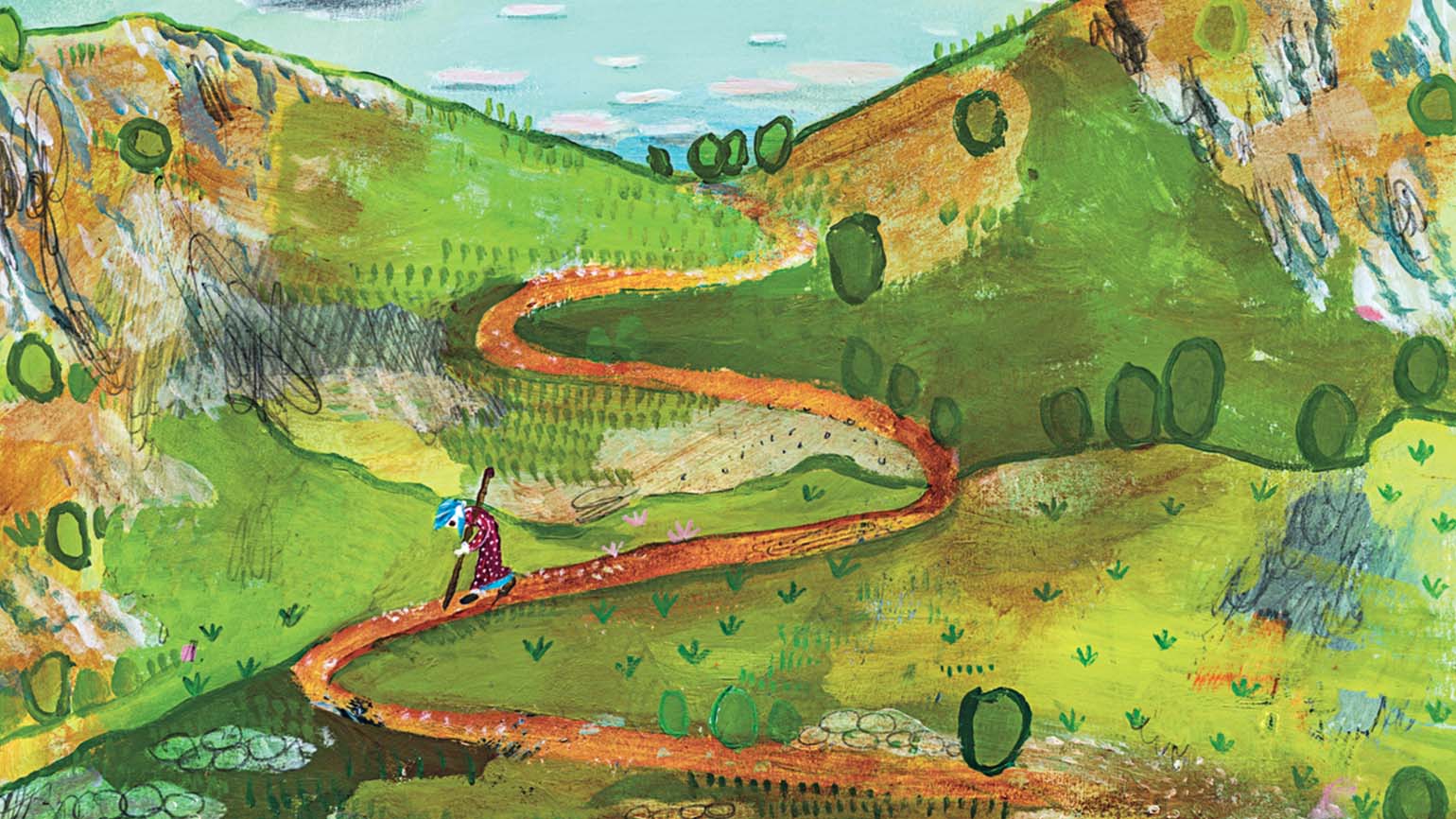
Once the mortar was ready, Eli and Doug prepared to keep me supplied. Before we started, I glanced up again. The animal was still there. It made its way slowly down the side of the mountain. I peered more closely and realized it wasn’t an animal at all. It was a person. An old woman. Her back was curved forward so that the front of her dress almost touched her shoes. She had a scarf tied around her head. She leaned on a stick taller than herself— I guessed for balance.

“Hey, Bill,” I hollered. “Is there a road coming down that mountain?”

Bill looked where I was pointing. “Not a road,” he said. “Just a trail winding back and forth so the walk winding isn’t steep. Ends over at the edge of the church parking lot. Why?”

“Looks like there’s an older lady coming down,” I said. “She’s moving pretty slowly. Barely moving at all, actually. I was thinking it was a shame she couldn’t get a ride down.”

All heads turned to look.

“I see her,” said Bill. “She’ll get down eventually. She’s not in any danger.”

The walk would probably have taken Doug about 20 minutes. Maybe less. The other guys and me a little longer, at our age. But it seemed like the old lady would never make it down. I couldn’t get her off my mind. But I had to. My work was what needed my attention. This was no time for distractions. It was hard enough to keep my worries off my family at home.

Our crew worked steadily on the wall, moving down the scaffolding, laying the block. From time to time, as we worked, I glanced back at the hill to check the old lady’s progress. It was very slow but steady.

Little by little the wall took shape. The closer we got to the end, the more determined I was to finish, the less I checked up on the mysterious lady on the mountain. It took us about three hours to work from one end of the wall to the other. Just what I’d figured. By the time we were done, the wall was 200 feet long and 6 feet high.

“Hey, Byron!” Bill called. “Looks like you got a friend coming. She’s got her eye on you!”

Friend? I thought. Then I saw her. It was the old lady, walking across the parking lot. I expected her to go straight to the church. Instead she was coming right for me. She wasn’t moving any faster, and her steps were just as careful and deliberate. Despite her hunched posture she didn’t seem fragile. Her gaze was unflinching. Wisps of white hair poked out of her head scarf. She must have lived in these hills all her life.

The woman stopped below me, where I perched on the scaffold. “Do you know Jesus?” she demanded.

“Uh, yeah, I do,” I said, surprised. I looked around, self-conscious. Bill, Eli and Doug cleaned up, loading our tools into my trailer. My mind was already on the long drive Doug and I were about to make. I was hoping to get through the mountains and reach home before dark.

I climbed down from the scaffolding. The woman stared. Beyond her, the guys had almost finished packing the trailer. All that was left to do was load the last section of scaffolding I’d just climbed off of, rinse out the mixer and load it into the back of my pickup. I didn’t have time to chat.

While I had been climbing down, the old woman had rounded the end of the wall. She moved closer. She was practically on top of me. Right there in my face. “Do you go to church?”

“I don’t live around here, ma’am,” I said quickly, afraid she was going to ask for money. Or maybe she was trying to invite me to worship here. I softened my tone. “Back home my family and I go to church every Sunday,” I said. “Now, if you don’t mind, we’ve got equipment to load up. Please move back so you don’t get bumped or hurt.” It’s not as if she could move quickly if she had to.

“You know, it’s all about believing. Do you believe?”

I took a calming breath before I answered. I didn’t want to be rude. “Yes, ma’am, I do.”

The woman looked into my eyes for another second or two, then shuffled backward. She didn’t go far, but the five feet or so was enough to make me feel comfortable. She continued to watch me as I worked.

Doug and Eli tore down the last section of scaffolding and loaded it on the trailer. I rinsed out the mixer. Bill drove the truck close to the front of it. When the mixer was clean, I grabbed three wooden planks to use as a ramp to load the mixer onto the truck. Normally I use five planks. Two for each mixer wheel and one in the middle for me, pushing the mixer with the tongue.

“Where are the rest of the planks?” I called. “I only see three.”

“Oh, I think we loaded them,” said Doug. “Should we unpack them?”

That would take a while and I wanted to get on the road. With the job finished, that’s where most of my attention was now. “No, three should be enough. I’ll just use one for each wheel instead of two.”

Bill stood next to the right plank, ready to push on that wheel. Doug stood next to the left. Eli stood by at the ready.

“Ready?” I said.

I glanced back to make sure the old woman was safe. She hadn’t moved from her spot. I pushed the mixer from the third plank. Slowly, we rolled the mixer up until it was about tailgate height. And then—

CRACK!

The plank under the left wheel snapped in two. The mixer slammed down—on Doug! “Get it off him!” I yelled, jumping to grab hold of it. Time seemed to move in slow motion as we all got our hands under the mixer and pushed. Doug hadn’t made a sound. I didn’t know if he was conscious. Finally we got the mixer off him. Before I could reach down to him, my son stood up and brushed himself off. I was so stunned I didn’t know what to say. “Are you all right?”

“Yep,” he said. “I’m totally fine.”

And he was. No cuts. No bruises. No broken bones. No pain.

My heart pounded a mile a minute and my hands trembled. How did the 500-pound mixer not injure him?

“Hey, Byron,” Eli said suddenly. “Where’d your friend go?”

I looked to the spot where the old lady had been standing. The old lady who’d taken three hours to make a 20-minute walk. The lady who’d been standing five feet away when the mixer fell.

She was gone. But her words stayed with me. All week I’d felt pulled in different directions, between work and family. But all I really needed to focus on was God. He watched over it all. Didn’t I believe, like the old woman asked? Now, for sure, I did.

For more angelic stories, subscribe to Angels on Earth magazine.

A Heaven-Sent Message in His Recurring Dreams

Blueprints for my next construction job were spread out on the kitchen table before me, but I couldn’t focus on them. My mind was on a different kitchen table, one I hadn’t seen in decades. “What are you thinking about?” my wife, Arbutis, asked me. She could always tell when my mind was somewhere else.

“I had that same dream again last night,” I said. “Night after night, the same dream.”

“The one about your grandmother?”

“That’s the one.” In the dream, I was sitting at Mamaw’s kitchen table. I recognized it right away. Growing up, I spent summers with Mamaw. In the dream I was alone at the table—or at least I seemed to be. I could hear Mamaw’s voice speaking to me, but she wasn’t there. It was troubling.

“Didn’t you and Mamaw used to sit together at that kitchen table at night?” Arbutis asked.

“We did,” I said. I remembered just how it started. I was seven years old, spending my first night by myself with my grandparents. Sometime after going to bed I woke up. I looked around the bedroom, lit by the soft glow of an old kerosene lamp outside the door. I heard a sound. Someone was in the kitchen.

I sat up and looked out the window at the star-filled sky. There wasn’t a hint of daylight. It must be the middle of the night, I thought.

From the kitchen, I heard someone speaking. It was Mamaw’s voice, but I couldn’t understand what she was saying. So I slipped out of bed and tiptoed to the kitchen door.

Mamaw was alone at the kitchen table, her hands folded as if in prayer. She was speaking, but when I poked my head into the kitchen, I couldn’t see anyone else there.

“Come in, child, and sit with me for a while,” Mamaw said.

I pulled up a chair and climbed into it. “Who are you talking to?”

“God,” Mamaw said, as if the answer was obvious.

“Does he listen?” I asked.

“Of course he listens. The creator will listen to all who call upon him in Jesus’ name.”

“Does he ever talk back?” I asked. I tried to imagine what God’s voice would sound like. It would probably be big and gruff, like a bear’s growl.

Mamaw gently touched the side of my face. “God doesn’t always speak in words,” she explained.

“If he doesn’t use words, how does he talk to you?” I asked.

“Sometimes his message may come in a dream or a feeling deep in your heart. That’s how he talks to me here in the kitchen.”

I looked around doubtfully. The kitchen seemed very big and dark so late at night. As if anything could be hiding, waiting to jump out and get me. Mamaw must have seen I was afraid, because she turned up the kerosene lamp to show me there was nothing there.

“Now I’m going to dim the lamp,” she said. “This can be our quiet time together.”

Mamaw lowered the flame to a soft glow, then blew it out completely. It was so dark I couldn’t see Mamaw. She might have disappeared completely. Then, out of the dark, I heard her voice. I didn’t speak Cherokee like my grandmother did, so I couldn’t make out what she was saying. But God understood all languages. The slow rhythm of her chant was like a lullaby, and I lay my head on my arms and fell asleep.

When the rooster woke me up the next morning, I was back in my room with sunlight streaming across my bed. Mamaw’s voice in the dark kitchen seemed like a dream, a wonderful dream. Had it really happened at all?

“It wasn’t a dream,” Mamaw assured me when I asked her about it. “You were with me last night during my quiet time with our creator, and then I walked you sleepily to bed.”

“If I promise that I can be still and not talk, could I share the quiet time with you again?”

“Nothing would make me happier,” she said.

For the rest of the summer, every morning before daylight Mamaw and I would sit at the kitchen table. She talked to God and I listened. Those times always filled me with peace.

But Mamaw was gone now. Gone from her prayer time at that kitchen table, gone from this world, gone from me. Maybe that’s why the dream I’d been having all week left me feeling so unsettled.

“If you really want to understand your dream,” Arbutis said as I rolled up my blueprints, “you should do what Mamaw would do. Get up before dawn and listen to God.”

Getting up before dawn wasn’t as easy these days as it was when I was a young boy. “You know what? I think I should get my rest instead of trying to talk to God,” I said.

Arbutis raised an eyebrow. “No one said you had to talk,” she said. “Just listen.”

So there I was the next morning, alone on the sun porch, darkness surrounding me like a black shroud, Venus shining brightly in the eastern sky.

“God, you know these dreams I have been having. The ones I just can’t understand. Just me alone in Mamaw’s kitchen. I hear her voice, but I’m still alone…”

I could almost see that kitchen, just the way it used to be. Mamaw should be there with me, I thought, closing my eyes. Listening.

A feeling of well-being passed through me, as gentle as a baby’s sigh. And I dreamed again, a daydream with Mamaw right there with me, dressed in white. She touched my face, just like she had all those years ago. I reached out for her, and though she faded from my vision she in no way faded “away.”

I blinked my eyes open to a bright morning sun. And deep in my heart I knew the message of my dream.

Mamaw was as close to me now as she was when we sat together praying at her kitchen table. She was still talking to God. And she wanted me to keep listening.

For more angelic stories, subscribe to Angels on Earth magazine.
A Heaven-Sent Bouquet of Flowers

Some people wouldn’t be happy about having to work on Mother’s Day weekend, but I felt pretty lucky when I climbed into the florist delivery van on Saturday morning. My own mother was no longer alive to appreciate the flowers I always gave her on her special day, so brightening the day of other moms seemed like the best thing to do.

I pulled out onto the road, enjoying the smell of the bouquets behind me. The scent took me back to my childhood, choosing blooms from my grandmother’s garden to give to my mother. I could almost see Grandma’s massive field of daffodils spread out before me. Or the purple and blue irises that grew on the slope down to the railroad track where the N&W picked up my conductor grandfather every day for work. And the bell-shaped lilies of the valley under the holly tree. My favorites were the hydrangeas surrounding the wraparound porch and the roses Grandma ordered specially from the Jackson & Perkins catalog. If love had a scent, I always thought, it would smell like roses and hydrangeas.

Still pretty new at this job, I counted my blessings as I took in the fresh flower garden I seemed to carry inside the van. I’d spent most of my life working in the X-ray department of the VA hospital. After I retired, I missed the daily routine and the patients. I’d always admired the arrangements in the window of Garrisons Designs, so when the shop advertised for a part-time driver I applied. I’d become friends with the florists while we made small talk about our own favorite flowers. I admired the personal details they worked into each bouquet. Now I witnessed the joy brought by their handiwork.

First up on my list of deliveries was a nursing home. Someone named Mary was getting a vase of pink roses from her children. I announced the recipient’s name to the nurse on duty.

“Roses for Mary?” the nurse said. “Room two twenty-four. Just set them by the window. It’s a nice gesture, but sadly she won’t know the flowers are there.”

Carrying the vase down the hall, I remembered all those visits with my own mother in her last years. I always came bearing flowers and made sure to put them in view from her bed. Roses like these couldn’t just be set on the windowsill and forgotten.

“Happy Mother’s Day, Mary,” I announced at the doorway of Room 224. “Your children sent you these beautiful flowers.”

Mary didn’t respond. I brought the bouquet nearer so she could smell it and brushed a velvety petal against her cheek. I stepped back again to hold the vase in full view. Mary’s eyes followed the flowers. “Your daughter called to order these just for you.”

I had an idea. I set the roses down on the bedside tray and pulled out my cell phone. Mary’s daughter lived out of state, but I had her number on my delivery list. I combed Mary’s short gray hair into place and took a picture of this loved mother with her roses. Was I imagining the hint of a smile on her face? I didn’t think so. The flowers had done their work. “Just look at your mama,” I texted Mary’s daughter. “The roses were a blessing.”

I was a little behind schedule by the time I got back to my van, but it was worth it. I had many other deliveries at nursing homes like Mary’s. Carnations for Bonnie, daisies for Lucille, lilies for Maryanne. I took a lot of pictures, sent a lot of texts and shared a lot of joy.

The sun was setting by the time I began my last delivery, a bright mix of tulips for the mother of a man named Billy who lived in Florida.

That delivery took me down a winding road up a West Virginia hollow. I pulled up at an enchanting white cottage. Out front were two huge rhododendrons—West Virginia’s state flower. I’d never seen rhododendrons grow like trees vibrant with silk purple blooms in May.

Billy needs to see this, I thought, whipping out my phone. I snapped a picture of his mom’s cottage with the rhododendrons out front. I had a moment’s hesitation after pressing SEND. Was I going too far? Billy’s mother wasn’t even in the picture. My phone pinged back instantly with an answer. “Thank you for bringing back my homeplace!” Billy wrote. “How I miss my mother and those rhododendrons!” Once again, the flowers had spread their joy.

It was dark by the time I got back to the shop with the van. It felt empty without all those cheerful flowers in the back, and I was a little sorry my job was done. All that remained were a few scattered petals on the floor and an empty box tucked into the corner behind my seat. I swept out the petals, but when I went to toss the box, I saw a flash of pink. The box wasn’t empty. I opened it fully to find flowers inside. An exquisite arrangement of pale pink roses and white hydrangeas. The familiar scent overwhelmed me, the most beautiful combination I knew.

It had been a day full of love. But had I messed up? I felt around in the box for a card and checked over my list of deliveries again. No card, no address for these—somebody was out there feeling forgotten!

I rushed into the shop, the bell on the door tinkling. “These weren’t on my list,” I said as I set the box on the counter. “Roses and hydrangeas! I’m afraid someone’s missed her flowers by mistake.”

“No mistake, Rita,” my coworker said. “Those flowers are for you. Your friend Patrick wanted you to have some flowers of your own today, so of course we arranged your favorites.”

All day I’d watched flowers bring joy to others, the same joy I’d gathered for Mom from Grandma’s garden. I couldn’t wait to put my roses and hydrangeas in water. The love I’d known since childhood, that love I’d shared all day, had come right back to me.

For more angelic stories, subscribe to Angels on Earth magazine.