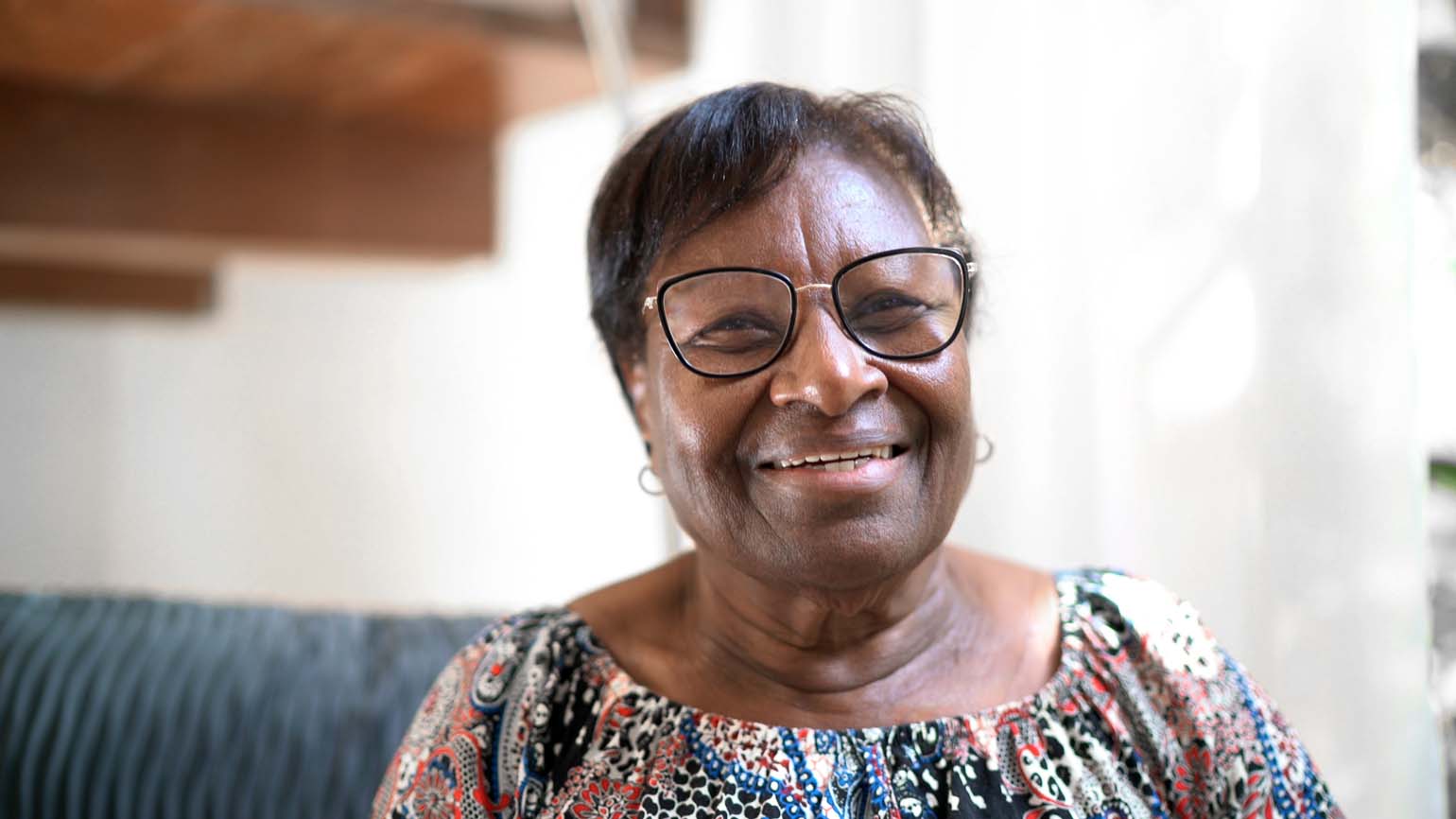
Marsha seemed like a nice enough lady, 96 years old, surrounded by photos of her family members, wearing a faded pink nightgown. She had a weak heart and only months to live. That’s why I was visiting her at the nursing home. She was glad to hear me read from the Bible, but then all of a sudden, she burst out in inexplicable anger—and not for the first time. “When I get to heaven,” she said, “I’m going to tell God to kick my father out of there. I don’t ever want to see him again.”
I didn’t know how to respond to that. My training as a hospice volunteer hadn’t prepared me for this. I tried to distract her. I pointed to different photos, and Marsha rattled off her grandchildren’s and great-grandchildren’s names and ages. There was nothing wrong with her mind. Just this one topic that she returned to again and again. Her father and what a terrible man he had been.
“I tell you,” she continued, “God should know that my father does not belong in heaven. If he’s there, I will do all I can to get him out.”
Beneath that faded pink nightgown was a red-hot rage. It rattled me. Was it possible to reach the age of 96 and still hold on to such resentment?
I went home, wondering if I would be like Marsha at her age. I had so much to be grateful for. Not just my wife, Kathie, but my career as a manager in the oil business and the ability it gave me to retire early and do volunteering like this. I saw myself as a natural caregiver. I wanted to help. “It sounds as if you need to forgive your father,” I imagined telling Marsha the next time I visited. Yet a louder voice inside me was forcing an uncomfortable question: Isn’t there somebody you need to forgive?
Frankly that was something I didn’t want to think about.
I’d grown up outside Chicago, one of three kids. I adored my big sister Joan. And then there was my brother, John.
John was 12 years older than me. I looked up to him—naturally—and wanted to be like him. Except I’d sit down at the breakfast table and he’d say, “You smell. Didn’t you take a shower this morning?” Or at dinner, “Stop picking at yourself. Sit up straight.” Or I’d be poring over my homework and glance up for a moment. “You idiot, always staring into space. You’re going to flunk out of school.”
John himself had never been much of a student. He’d dropped out of high school, gone into the Army, served two years and then come back home, bouncing between jobs. Mom and Dad would try to stop him whenever he got on my case, but I think they were just as intimidated by him as I was. I wasn’t like John at all. I was bookish, the quiet youngest kid.
I finished high school, went straight to college—the first in my family to do so—and graduated. Like John, I served in the Army for two years. Afterward John invited me down to visit him in Miami, where he was working as a truck driver. Maybe this could be the beginning of something. Something brother to brother.
He’d bought a slick 24-foot, three-hull sailboat, his pride and joy. He was eager to take me out on Biscayne Bay. We motored out into the open water. John let me take the tiller while he unfurled the jib.
“Turn to port,” he yelled at me.
“How do you do that?” I asked, mystified. I’d never been on a sailboat before in my life.
“To the left. Port. Don’t you know anything?” Just like that, it was my childhood all over again. He kept yelling at me. Everything I did was wrong. Didn’t I learn anything at that college I went to? What an idiot I was. I clammed up, didn’t speak to him for the rest of the trip. No wonder he wanted to get me out on that boat.
I took a job in Baton Rouge in the oil business and was soon working 12- hour days, six days a week. Dad had died by then, but I managed to go back home to see Mom and Joan. They kept me up on what was going on with John. He’d turned into a health and exercise nut, working out at the gym every day, lifting weights. A serious bodybuilder. I was—I must confess—still a sleep-deprived, two-pack-a-day smoker.
The one time I saw John back at home—he’d driven up from Miami— the first thing he said to me was “Take that cigarette out of your mouth.” No “Hello,” no “How are you doing?” Just: “You trying to kill yourself? You always were dumb.” I drove home early rather than take it anymore.
I saw my brother again at Mom’s funeral. Then I cut him off. I couldn’t relate to him anyway. He didn’t have much of a family. Married twice, divorced twice. One son. Just his boat, his truck and the gym. There was something sad about that way of living, but I refused to feel sorry for him.
When I retired, Kathie and I might have considered moving to Florida like a lot of other retirees. Not a chance. I didn’t even want to be in the same state as John. We chose Tennessee to be closer to Joan. I was glad to see her more often, even as her health took a turn for the worse. Complications from COPD. Those last few days, I was able to spend a lot of time at her bedside, listening, talking about our family, reading the Bible and praying. The last thing she said to me was “I hope you’re not left to deal with John the rest of your life.”
It was those last precious days with Joan that made me want to become a hospice volunteer. So much healing can happen as we approach death. I believed the Lord was opening a door for me. I visited patients in their houses and at nursing homes. I really felt I was helping. Until I met Marsha. I could see how old wounds festered, how this could suffocate us even in the last days of life. As my sister had said, it was just John and me now. And my brother still had a hold on me, still infuriated me, the way Marsha’s dad still tormented her.
I read all I could about forgiveness, including everything I could find in the Bible. I told myself it was to help Marsha, but truth be told, I was desperate to help myself. Like they say, when you can’t forgive someone, the person you end up hurting the most is yourself. Holding on to that kind of deep resentment is indeed like drinking poison and expecting the other person to die.
I sat with Marsha and found out more. “My dad left us when I was six,” she said. “He never contacted us, was never in touch. Mom had to work her fingers to the bone just to keep food on the table for the two of us. I could never forgive him for that.”
“Forgiving someone doesn’t mean saying they were right,” I said, as much to myself as to Marsha. “It’s a way of putting the past in the past.” I turned to my Bible. “Jesus said, ‘If you forgive other people when they sin against you, your Heavenly Father will also forgive you.’” The more I talked with Marsha, the more I knew I needed to contact John, no matter how difficult that would be.
One day, I finally got up the courage to call him. “What do you want?” he said.
“John, I know we haven’t had the best relationship….”
“Well, Ken, if you would ever listen to me…”
It took all my power to resist slamming the phone down. To fight back against my anger, the anger that was poisoning me.
“I don’t want to be mad at you anymore,” I said. “We’re all that’s left of our family. I’m ready to start over. Whatever our problems have been are in the past.”
There was silence on the other end. “I agree,” John said at last. “I’ll try to do better.”
I didn’t say “I forgive you, John” aloud, but I said it in my heart. “I’ll call you next week,” I said.
John and I have stayed in touch. We call. We talk. Sometimes he still gets on my case. Sometimes I want to hang up. But we’re trying to work through it. “Mom and Dad always made me feel like a loser,” John admitted during one of our conversations. Maybe John had been trying to help me back then. Correcting me was the only way he could show he cared.
I was able to visit Marsha several more times. “I need help getting rid of these thoughts in my head,” she said. “I can’t do it on my own.”
“You don’t have to,” I said. “God will help you.” We prayed the Lord’s Prayer together. How God forgives us as we forgive each other.
The last time I saw Marsha, she was too weak to talk. I read the Bible and then held her hand. Her face was relaxed. She seemed at peace. Thanks to her, I knew what that felt like. I don’t know if she forgave her father or gave him hell when she got to heaven. Either way, I bet they worked it out.
For more inspiring stories, subscribe to Guideposts magazine.












 When we learn we have cancer, panic doesn’t kidnap our emotions. Stalwart trust in our sovereign God gives us strength to smile at the future.