


Embrace God's truth with our new book, The Lies that Bind

New Year, New Habits: 5 Ways to Make Habits Last

Christine made two resolutions for the new year: to read the Bible more often and to lose 20 pounds by Valentine’s Day. She hit the ground running, whipping through two Bible chapters on January 1 and joining a gym the next day. For three weeks, working out and reading Scripture were part of her daily routine. Then life got in the way: Her family caught Covid, and she had a big work project. When February 14 rolled around, she had lost only one pound and hadn’t touched her Bible in weeks. So much for a new year with new habits…

Christine is not alone. Researchers suggest about 40 percent of Americans make New Year’s resolutions—losing weight tops the list—but by year’s end, less than 40 percent have achieved their goals. Should you even bother making resolutions?

“Yes!” says John C. Norcross, Ph.D., author of Changeology and an expert on the science of self-change. “Making a New Year’s resolution is a valuable opportunity for annual reflection. It’s like Lent. These moments remind us to recommit to one’s best self.” And there’s no better time to make a change. Research shows that people who have New Year’s resolutions are 10 times more likely to change than those who attempt transformation at other times of year. Here’s how to make your resolutions stick.

READ MORE: To Start a New Habit, Do This First

Woman marking her new year new habits on a goals poster

Set realistic and meaningful goals.

Stay away from grandiose goals, Dr. Norcross advises: “‘I’m going to run a marathon; I’m going to lose 30 pounds; I’m going to write the great American novel.’ These rarely work.” Instead, start small. Commit to running around the track a few times a week. Eat dessert only on weekends. Write in a journal for 15 minutes every other day. Another strategy: Build incrementally on previous successes. A few years ago, Dr. Norcross resolved to floss his teeth every day. “I did it regularly when I was home. But I realized that I skipped it while traveling,” he says. “The next year, I committed to flossing even when I was on the road.”

Does your resolution truly matter to you? That’s key. If it’s a goal you feel you should achieve but don’t really want to, keeping a resolution may prove difficult. “Maybe it’s your mother who wants you to get a more prestigious job,” Dr. Norcross says. “If you start with a goal that truly energizes you, you’re more likely to stick with it.”

Pastor and best-selling author Mark Batterson believes you need to spend time in quiet contemplation before setting your resolutions. That way, you can discern what God is calling you to do. “Is God the loudest voice in your life? Make sure that other voices, including your own self-talk, aren’t drowning him out,” he says.

Guideposts.org blogger Holly Lebowitz Rossi phrases her resolutions in the form of a question, much like the game show Jeopardy. “‘I will make at least one new friend this year’ becomes ‘How can I connect with new people this year—and what will it feel like to grow my social circle?’ Asking yourself how you can make your life more positive puts far less pressure on you. You can’t fail a question,” she says. “And asking yourself the why is very powerful.”

Woman writing her new year new habits in a journal at her desk

Develop a specific action plan.

Once you have a goal—paying off that credit card debt, for example—think about how you are going to get there. “How will you cut back on spending each day, each week and each month?” says Dr. Norcross.

Batterson says that writing down resolutions—and your game plan—is imperative. “The first benefit is clarity. The process of putting things on paper forces us to be precise. Second is the fact that writing encodes things into long-term memory.”

Another tip: Schedule the hardest thing to do first thing in the morning. It’s what Batterson refers to as “eating the frog” in his bestseller Win the Day. By getting the task over with, you’ll feel both relieved and proud. Plus, adds Batterson, “how you start the day sets the tone for the rest of it.”

READ MORE: A Simple Morning Habit to Improve Your Day

Man talking with friends about his new year new habit

Publicly declare your resolution.

If writing down a resolution helps you focus, saying it to others takes it a step further. “One reason this is so effective is because you risk embarrassment, even humiliation, if you don’t follow through,” Dr. Norcross says. “If you walk into a party and say, ‘I’m giving up desserts,’ you can bet people will pounce all over you when you eat that first slice of cake.”

But do be selective. “Tell the important people in your life, those who are part of your support system,” Dr. Norcross says. “Saying it out loud makes the resolution more real.”

Man walking his dog on a path in the foods for a new year new habit

Stay the course.

According to Dr. Norcross, it takes approximately three months to make an initial change, struggle with it and then cement the new behavior. How can you give yourself the best shot at success? “Track your progress,” Dr. Norcross says. “Apps are great tools.” Two of his favorites are Fitness Buddy, for exercise, and Mint, for budgeting. “They combine self-monitoring, reminders and rewards.”

Resisting temptation is good, but one school of thought says removing temptation is an even better strategy. If your house is full of delicious cookies, it takes a lot of effort and self-control not to eat them after a bad day. But if you remove junk food from your house, you don’t have to worry about it.

If you make it past mid-January—“Ditch your New Year’s Resolution Day” is held on the second Friday of the month—reward yourself. Dr. Norcross suggests creating a “reward contract” with one of your supporters that clarifies beforehand how you will celebrate. “This is particularly useful for people who have trouble rewarding themselves,” he says. “For example: ‘If I stay on track with my studies all week, I get to pick the Friday night movie.’”

Despite the best of intentions, most people mess up at some point. In fact, Dr. Norcross says, most successful resolvers slip in January. “But a slip is not a fall; pick yourself up and recommit to your resolution,” he says. “Don’t let one missed exercise class end the exercise program. Research shows that one slip-up can actually strengthen your resolve.”

Amy Wong, lead editor at Guideposts, relies on a simple rule: Don’t go more than two days without _____. “Fill in the blank with the positive change you want to make in your life,” she says. “I’ve used this for practicing mindfulness, cooking from scratch, reading fiction.”

Two friends talking about new year new habits over coffee

Get support.

An accountability partner, or better yet a team, is critical. “The buddy system works,” Dr. Norcross says. “The goal is to obtain support and honesty, not criticism.” It can be a spouse, an online support group, a local Bible study, a friend who regularly checks in and encourages you.

Last year, Dr. Norcross spoke to an online book group focused on New Year’s resolutions. “There were 20 people, and everybody shared their worst behavior change story. It was hysterical. There was so much bonding. People kept in touch and supported each other remotely all year. Don’t underestimate the power of humor to keep you going when you most need a boost.”

This year, a friend and I were moaning to each other about not getting through our daily to-do lists. We set up a challenge. Each morning, she texts me and asks, “What are three things you are going to get done today, no matter what?” After I’ve shared my three items, I may still procrastinate. But as our 5:30 check-in time approaches, I take action. I make the call. I finish the article. I send the email. Sometimes all it takes is a friendly reminder.

For more inspiring stories, subscribe to Guideposts magazine.

READ MORE ABOUT POSITIVE HABITS:

Create an Action Plan to Do Great Things This Lent

This Lent, be strong and do great things. And by “great things,” we don’t mean simply giving up chocolate or caffeine (although those can be pretty tough, too). No, we’re talking about really making a difference in your life and the lives of others. Create a Lent plan so you can get the most out of this Lenten season.

Woman putting a calendar on the wall to mark her lent plan

1. Use the beginning of Lent to set goals for the next 40 days.

Lent is an exciting time to make meaningful life changes. It’s a rewarding journey of reflection and spiritual growth, which allows us to cultivate discipline and determination. During these 40 days, we can set new goals for ourselves, whether it’s devoting more prayer time or making better food choices. Starting Lent with a clear plan and intention can help open the door to slower living and stretch our growth mindset beyond our comfort zone. And at the end of this special season, we will have a new appreciation for the beauty of life — one that could last long after Easter Sunday!

Woman writing down her goals in her lent plan journal

2. Figure out what you want to accomplish during Lent and write it down.

Committing to achieving goals during Lent can be a great way to build spiritual discipline, deepen your faith, and set yourself up for success. Finding what is most important to focus on and making it tangible by writing it down can help you confront the hard and inspiring tasks ahead. Setting clear, but attainable goals that lead to developing a closer relationship with God not only can serve as a source of strength when adversity arises but also bring comfort each time those goals are accomplished. Seeking guidance from the word of God and asking friends or family for advice can also be useful in developing an achievable list. Put your Lent plan somewhere you will see it, like on your bathroom mirror, on your fridge, or even in your Bible. There’s nothing better than feeling the contributions you make every day amount to lasting transformation!

Woman in a light blue sweater marks her lent plan with goals on her kitchen calendar

3. Make steps for achieving your Lent plans, including what steps you’ll take and when you’ll take them.

The best way to achieve one’s Lent goals is to have (and follow!) a written set of steps. This season can be the perfect time and opportunity to get yourself organized and put your Lent plan in writing. Making a timeline of what steps you need to take, and when you’ll complete them, creates visibility and clarity in reaching your goal. So if your heart desires something that requires organizing actions, Lent is the perfect time to make it happen. You can use these steps for creating positive habits to make your Lent plan even more effective:

  • Try habit stacking, or the the technique of adding new habits to your existing habits, to make your Lent goals a part of your daily schedule.
  • Don’t throw in the towel if you slip up. Go easy on yourself and remember you can always try again tomorrow.
  • Consider making your Lent goals more manageable by turning them into micro habits.
  • Keep track of your accomplishments by writing down which parts of your Lent plan you achieved.
Man prays with his eyes closed as part of his lent plan

4. Get rid of distractions that might prevent you from accomplishing your Lent goals – this may mean giving up social media, watching less TV, or spending less time with certain people.

Taking time to eliminate distractions can be beneficial in helping you accomplish your goal. Make a decision to stop watching too much television, being glued to social media, or spending too much time on leisure activities that aren’t moving you forward. Making these changes will free up time and energy and help you focus on your goal with renewed motivation and dedication. Clearing distractions is like taking a deep breath before taking a plunge into something new; it makes reaching success much easier!

Woman in support group encourages another woman about her lent plan

5. Find a support group or someone who will hold you accountable to your Lent plan – this could be a friend, family member, or even an online community.

Taking on a Lent plan is difficult sometimes, you can use a little help. That’s why it helps to have someone cheering you on and supporting you as you move ahead. An excellent way to find someone like this is to get involved with a support group or other online communities related to the Lent goals you want to accomplish. Having guidance, advice, and friendly competition can be all the motivation needed when inspiration isn’t so easy. Support groups or friends who will hold you accountable can keep you in check during the tough times, inspiring and encouraging you towards success in whatever it is you set out to do.

Person with arms raised at sunset feeling accomplished after following their lent plan

6. Finally, don’t give up! Even if you falter along the way, remember that Lent is about finding strength in God to do great things.

It’s almost time for Lent! Although it can be challenging to give up what we desire, the rewards, in the end, should be worth all the hard work. Throughout the next few weeks, even if you don’t follow your Lent goals perfectly, remember that you can find strength in God to finish strong. Don’t give up as Easter approaches; trust that you’ll be able to tackle any obstacles through perseverance and strength from God. The sense of accomplishment and joy when your Lent plan is complete is a truly amazing feeling. So with this reminder, happy Lent!

So, there you have it—a simple guide to setting and achieving your Lenten goals! Just remember to be realistic about what you can do, make a plan of action, get rid of distractions, find someone to hold you accountable, and never give up. And most importantly, don’t forget that the point of Lent is to grow closer to God. We hope this season is a time of reflection and joy for you as you strive to become the best version of yourself.

READ MORE CREATING A LENT PLAN:

Could You Have Loved This Much?

This article was originally published in Guideposts magazine in March 1959.

This is the story of a woman’s love for her husband. Whether he deserved that love—and why he acted the way he did—are questions I can’t answer. I’m not going to write about Karl Taylor, this story is about his wife.

The story begins early in 1950 in the Taylors’ small apartment in Waltham, Massachusetts. Edith Taylor was sure that she was “the luckiest woman on the block.” She and Karl had been married 23 years, and her heart still skipped a beat when he walked into the room.

Oh, there’d been tough times during those years, times when Karl had been depressed, unable to keep a job; but she had helped him through the low times and she only loved him more because he needed her.

As for Karl, he gave every appearance of a man in love with his wife. Indeed, he seemed almost dependent on her, as if he didn’t want to be too long away from her. If his job as government warehouse worker took him out of town, he’d write Edith a long letter every night and drop her postcards several times during the day. He sent small gifts from every place he visited.

Often at night they’d sit up late in their apartment and talk about the house they’d own…someday…”when we can make the down-payment”…

In February 1950, the government sent Karl to Okinawa for a few months to work in a new warehouse there. It was a long time to be away, and so far!

This time, no little gifts came. Edith understood. He was putting every cent he saved into the bank for their home. Hadn’t she begged him for years not to spend so much on her, to save it for the house?

The lonesome months dragged on, and it seemed to Edith that the job over there was taking longer and longer. Each time she expected him home, he’d write that he must stay “another three weeks.” “Another month.” “Just a couple of months longer.”

He’d been gone a year now—and suddenly Edith had an inspiration. Why not buy their home now, before Karl got back, as a surprise for him! She was working now, in a factory in Waltham, and putting all her earnings in the bank. So she made a down payment on a cozy, unfinished cottage with lots of trees and a view.

Now the days sped past because she was busy with her wonderful surprise. In two months more, she earned enough to get the floor laid on one of the bedrooms. The next month, she ordered the insulation. She was getting into debt, she knew, but with what Karl must have saved…

She worked feverishly, almost desperately, for now there was something she didn’t want to think about.

Karl’s letters were coming less and less often. No gifts she understood. But a few pennies for a postage stamp?

Then, after weeks of silence, came a letter:

“Dear Edith. I wish there were a kinder way to tell you that we are no longer married…”

Edith walked to the sofa and sat down. He’d written to Mexico for a divorce. It had come in the mail. The woman lived on Okinawa. She was Japanese, Aiko, maid-of-all-work assigned to his quarters.

She was 19. Edith was 48.

Now, if I were making up this story, the rejected wife would feel first shock, then fury. She would fight that quick paper-divorce, she would hate her husband and the woman. She would want vengeance for her own shattered life.

But I am describing here simply what did happen. Edith Taylor did not hate Karl. Perhaps she had loved him so long she was unable to stop loving him.

She could picture the situation so well. A penniless girl. A lonely man who—Edith knew it—sometimes drank more than he should. Constant closeness. But even so (here Edith made a heroic effort to be proud of her husband)—even so, Karl had not done the easy, shameful thing. He had chosen the hard way of divorce, rather than take advantage of a young servant girl.

The only thing Edith could not believe was that he had stopped loving her. That he loved Aiko, too, she made herself accept.

But the difference in their ages, in their backgrounds—this couldn’t be the kind of love she and Karl had known! Someday they would both discover this; someday, somehow, Karl would come home.

Edith now built her life around this thought. She wrote Karl, asking him to keep her in touch with the small, day-to-day things in his life. She sold the little cottage with its view and its snug insulation. Karl never knew about it.

He wrote one day that he and Aiko were expecting a baby. Marie was born in 1951, then in 1953, Helen. Edith sent gifts to the little girls. She still wrote to Karl and he wrote back: the comfortable, detailed letters of two people who knew each other very well. Helen had a tooth. Aiko’s English was improving, Karl had lost weight.

Edith’s life was lived now on Okinawa. She merely went through the motions of existence in Waltham. Back and forth between factory and apartment, her mind was always on Karl. Someday he’ll come back…

And then the terrible letter: Karl was dying of lung cancer.

Karl’s last letters were filled with fear. Not for himself, but for Aiko, and especially for his two little girls. He had been saving to send them to school in America, but his hospital bills were taking everything. What would become of them?

Then Edith knew that her last gift to Karl could be peace of mind for these final weeks. She wrote him that, if Aiko were willing, she would take Marie and Helen and bring them up in Waltham.

For many months after Karl’s death, Aiko would not let the children go. They were all she had ever known. Yet what could she offer them except a life like hers had been? A life of poverty, servitude and despair. In November 1956, she sent them to her “Dear Aunt Edith.”

Edith had known it would be hard to be mother at 54 to a three-year-old and a five-year-old. She hadn’t known that in the time since Karl’s death they would forget the little English they knew.

But Marie and Helen learned fast. The fear left their eyes, their faces grew plump. And Edith—for the first time in six years, Edith was hurrying home from work. Even getting meals was fun again!

Sadder were the times when letters came from Aiko. “Aunt. Tell me now what they do. If Marie or Helen cry or not.” In the broken English Edith read the loneliness, and she knew what it was to be lonely.

Money was another problem. Edith hired a woman to care for the girls while she worked. Being both mother and wage-earner left her thin and tired. In February she became ill, but she kept working because she was afraid to lose a day’s pay; at the factory one day she fainted. She was in the hospital for two weeks with pneumonia.

There in the hospital bed, she faced the fact that she would be old before the girls were grown. She thought she had done everything that love for Karl asked of her, but now she knew there was one thing more. She must bring the girls’ real mother here too.

As the plane came in at New York’s International Airport, Edith had a moment of fear. What if she should hate this woman who had taken Karl away from her?

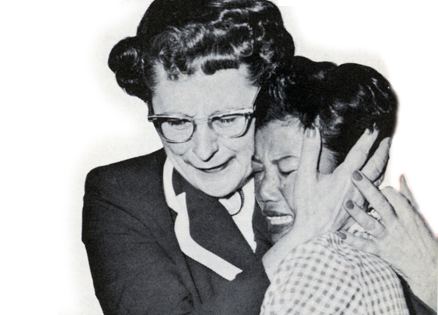
The last person off the plane was a girl so thin and small Edith thought at first it was a child. She did not come down the stairs, she only stood there, clutching the railing, and Edith knew that if she had been afraid, Aiko was near panic.

She called Aiko’s name and the girl rushed down the steps and into Edith’s arms. In that brief moment, as they held each other, Edith had an extraordinary thought. “Help me,” she said, her eyes tight shut. “Help me to love this girl, as if she were part of Karl come home. I prayed for him to come back. Now he has—in his two little daughters and in this gentle girl that he loved. Help me, God, to know that.”

Today, Edith and Aiko Taylor and the two little girls live together in the apartment in Waltham. Marie is the best student in her second-grade class; Helen’s kindergarten teacher adores her. And Aiko—she is studying to be a nurse. Someday, she and Edith would like a house of their own. At night they sit up late and make plans. Today Edith Taylor knows she is “the luckiest woman on the block.”

Did you enjoy this story? Subscribe to Guideposts magazine.

Clothed in Compassion

I’ve been the recipient of kindness, and I’ve also been the giver. And I’ve discovered something important: Kindness is a blessing no matter whether I’m giving or receiving.

The beautiful thing about kindness is that it doesn’t have to be something big or expensive to deliver a large impact. Sometimes it’s the little things that pack a wallop.

My husband Paul has delivered kindness to me on so many occasions. One of those moments arrived during a week when I was dealing with some difficult circumstances. I got up one morning and discovered a note on the kitchen counter that read, “I’m praying for you. Love you!” His simple note made me feel cherished, and lifted some of the burden from my shoulders.

Another time, when I was on a tight deadline and facing many long days of work, I woke up one morning and discovered that Paul had gotten up early and emptied the dishwasher, loaded it, wiped off the kitchen counters and had put all the laundry away. His kindness moved me to tears.

I teach quite often at writer’s conferences, and many of the conferees return year after year. I’m always so touched when they bring me gifts. Most of the items aren’t too expensive, but their kindness and the thought and love behind the gifts always melts my heart.

One of my friends brought me a gift for my birthday. She knows I’m frequently at conferences, and she bought me a beautiful lanyard that looks like a necklace. But it was what she said after I opened it that moved me to tears. She said, “I sat and prayed my way around all the beads on the lanyard, praying for you and all your projects.” Such precious kindness!

God says it best. In Colossians 3:12: “Therefore, as God’s chosen people, holy and dearly loved, clothe yourselves with compassion, kindness, humility, gentleness and patience.” I love the analogy of being “clothed” with compassion and kindness. Imagine how different our world might be if we got up each morning and wrapped ourselves in kindness before we left home.

Ephesians 4:32 tells us, “And be kind to one another, tenderhearted, forgiving one another, even as God in Christ forgave you.” Kindness is a package deal that includes having our hearts tender to others and even (gulp) forgiving others. That can be difficult at times, but it comes into perspective if we really stop to think about how God forgave us.

So that leads to an important question for each of us: What can we do to be kind to someone today? I can promise that we’ll make the recipient’s day better—and in the wonderful way that kindness always works, our day will become better as well.

Clap for a Sunset

Last night we ate dinner outside for the first time this summer. As we watched the sun sink towards the palisades across the river, the brightest tint of gold touching the bottoms of the clouds, Timothy said, “I think I saw some cartoon where everybody claps for a sunset.”

“Sort of like clapping for fireworks,” I said.

“But sunsets happen everyday,” Tim said.

We ate our fresh green bean salad and Carol’s risotto, staring at the sky. It was a subtler work of art than the Fourth of July fireworks but no less magnificent. Actually more so because it spread across the whole sky and everywhere we looked the colors kept changing. The fiery globe disappeared from view and like a star who has introduced a tune, the clouds took up the song and riffed on it in their own sky-hogging way. They went from bronze to copper to an impossible purple. By the time you noticed something in one corner there’d be something equally enchanting in another.

“Is this when we clap?” I wondered. It wasn’t like the fireworks. You knew when they were over.

“I guess so,” Timothy said and the three of us gave a quiet round of applause that didn’t sound like much in the patio beside the willow tree. But even then when the clouds turned gray and the color drained from the sky, the water in the river was a brilliant deep blue and the trees were silhouettes. What a beautiful night.

“I don’t think it matters when you clap,” I decided. God’s creation was a long-running show with thousands of new acts to applaud. Thankfulness would work any hour of the day. Still God must like it when we notice his especially florid numbers.

Ever clap for a sunset?

Rick Hamlin is the executive editor at GUIDEPOSTS.

Christmas Peace—Find It with Your Family and Others

Christmas—a time to celebrate our faith and love with family and friends. We gather to enjoy holiday meals and sing carols; celebrate Christmas tree lightings; watch the joy of children eagerly waiting to open their gifts. But for some of us, the holiday brings up continued conflicts and differences with others. In that case, how would you like to offer some Christmas peace this year?

New York Times columnist David Brooks notes that “at least 27 percent of Americans are estranged from a member of their own family, and research suggests that about 40 percent of Americans have experienced estrangement at some point.” (The most common form of estrangement is between adult children and their parents.)

Read David Brooks: “What’s Ripping American Families Apart?”

But making Christmas peace with others (and ourselves) is possible. Why wait?

Reconciliation is one of the best gifts to give and receive, making Christmas a great time to offer an olive branch and end a disagreement. Even the prophets of ancient time described the child to be born as the Prince of Peace. When the angels appeared to the Shepherds in the fields, they declared, ”peace on earth.” Even as we journey through Advent, we light a candle that symbolizes peace.

Read more about the 4 themes of Advent.

What can hold us back from offering Christmas peace? It could be stubbornness. Or pride. Someone once wrote, “Pride is concerned with who is right. Humility is concerned with what is right.” Our hurt can also get in the way—wounded people tend to lash out at others.

Granted, it takes spiritual strength along with humility and grace to extend the olive branch. Prayer also helps. “Lord, make me an instrument of your peace…” in the words of St. Francis.

Read the prayer of St. Francis.

This season, find the courage to make some Christmas peace with your son, daughter, sister, friend or colleague. Pick up the phone, send a text, write a letter. The relationship may be restored or not. But it might go better than you think. You’ll never know until you take a step of faith.

Remember that making peace with others also heals our own wounds. And we discover a priceless gift that makes our lives, relationships and world better.

Read more about the healing power of forgiveness.

Chef Lidia Bastianich Honors Her Heritage at Christmas

When I was a teen I worked at a German bakery in Astoria, Queens. We were always busy, particularly around the holidays. That was when I really missed the Christmas treats I’d had as a young girl in Istria.

Our Christmases were usually spent at my grandparents’ home in Pola on the Istrian peninsula. The town had only 30 houses, all along one road. Our Christmas tree was a juniper bush my brother, Franco, and I had chosen ourselves from the woods nearby. We’d tell our grandfather, and he would go back and get the exact one we picked out.

We put the tree in the kitchen. The warmth of the kitchen fire would carry a delicious scent through the house—juniper mixed with the scent of orange peels that my grandma, Nonna Rosa, left drying on the stove to make tea.

Our ornaments were homemade, most of them edible. We baked cookies from pignoli, pine nuts, and hung them on the ends of the tree branches. We strung together dried figs and bay leaves to make little wreaths. And we tied fresh fruit right onto the tree: tangerines, small apples and Seckel pears, all with the stems on. We put tiny candies all over the tree to mimic colored lights; the cellophane wrappers shone like little gems along the branches.

The cookie ornaments were always my favorite. For every one that hung from our tree, there was a missing cookie that found its way into my brother’s stomach or mine.

However, for all our idyllic Christmases, we were living under Communist rule. In 1947, the Italian region where my family lived was ceded to Communist Yugoslavia. Many ethnic Italians in Istria headed across the Adriatic Sea. We stayed put because my mother, Erminia, was eight months pregnant with me. Soon the border was closed. By the time I was nine, my parents had devised a plan to get us out. My mother convinced authorities she had to visit her gravely ill aunt in Trieste. Franco and I were allowed passports, but my father, Vittorio, was not. He escaped by foot weeks later.

In Trieste, we lived in a refugee camp. My courageous parents kept our spirits up. They assured us we’d have a good future in America one day. Finally, in 1958, we emigrated to the U.S.

It was a whole new world, exciting and unsettling all at once. My parents got jobs and we settled in a top-floor walk-up in Astoria. Sometimes my mother worked overtime and didn’t arrive home until well after 6:00 p.m. I was happy to start dinner. My mother would prepare the ingredients and leave things half-cooked, and write a note on how to finish the meal. Eventually I planned the menus. I even incorporated something quintessentially American: a Duncan Hines cake. Nearly every night, my parents came home to its delightful smell. On weekends, I was a typical teenager, dressed in bobby socks and a poodle skirt, listening to Elvis Presley and Frankie Avalon.

During the holidays we continued our old ways of life. On Christmas Eve we made the traditional baccalà, salted cod. And Mom and I whipped up the batter for frittelle, round yeast-risen fried pastries rolled in sugar, a warm sweet before midnight Mass. I knew our relatives in the Old Country were doing the same.

I worked my way through college, mostly waitressing at a pizzeria. With my husband, Felice, I opened my first Italian restaurant, Buonavia, in Forest Hills, Queens. Ten years and another restaurant later, we opened Felidia in Manhattan.

One day Julia Child dropped in for dinner and asked about my risotto, which later resulted in my being a guest on her PBS TV show. What an honor! That eventually led to my own PBS show called Lidia’s Italian Table and many cookbooks filled with the dishes, especially the sweets, I loved.

People are always talking desserts this time of year. “Who has the best recipe for tiramisu?” Or, “This cookie recipe belonged to my great aunt.” I think it’s because sweets—more than any other dish— celebrate an attachment to where we come from. La famiglia, family.

My mother, now 97, lives with me. When my family gathers on Christmas Eve and I heat the oil for the frittelle, I think back to how long we’ve been doing this. Our Old World faith and food traditions are such a big part of us.

Tutti a tavola a mangiare!” is how I close my cooking shows. “Everyone to the table to eat!”

On Christmas Eve when I serve dessert this request is all the more sweet.

Try Lidia’s recipe for Cappuccino Frozen Pie at home!

Checking In on Your New Year’s Resolutions

Remember the promises and resolutions we made? It’s been a month since the New Year’s celebration wound down, and in the life of a resolution, a month can be a very long time.

I always look at the turn of the January calendar as an opportunity to re-examine the intention set for the year ahead. Taking an open, positive attitude toward the potential the year still holds, try to assess your resolutions honestly. Here are some ideas on what to do if you’re rocking the resolutions, or if you feel like you’ve lost your footing a bit. Which category do you belong in?

“My Resolutions Are Going Great!”

If you are showing yourself to be a person of your word, there was never a better moment to practice healthy, uplifting self-congratulation techniques. Celebrate your accomplishments so far—and fuel your motivation to keep it up with self-care that is a propos to your achievement. If you’ve exercised three days a week for the whole month, maybe pick up a new workout top to freshen your resolve. If you have been successfully cutting down on sugar, seek out a healthy new dessert recipe to try this weekend. Or, if you are meeting a personal goal—more confidence at work, deeper conversations with family and friends, smarter spending and saving habits, more and better sleep—simply look yourself in the mirror, take several deep breaths and lovingly tell yourself, “You’re doing great. Keep it up!”

“My Resolutions Are Going Less-Than-Great.”

I am a firm believer that it’s never too late to make a resolution reset. If you struggle daily to meet your goal, it might be time to ask yourself—without judgment, please!—whether you were right to make that resolution in the first place. There is no shame at all in either adjusting a resolution (would exercising twice weekly be more accessible to you than three times?) or setting it aside altogether. It can also be helpful to dig deeper than the “doing” part of a resolution, into the reason you set your sights on it in the first place. If eating more vegetables isn’t working for you, for example, maybe you could step back to the larger goal of eating more healthy foods and approach that from a different perspective like fewer processed foods or more lean proteins like fish and tofu.

Regardless of where you are with your resolutions, remember that the year is young! This year could be your most positive one yet.

Carried Home by a Heavenly Horse

Ranching wasn’t for little kids. Luckily, I wasn’t a kid. I was 19, ready to handle any challenge that came my way. At least that’s what I thought two weeks before I arrived to spend the summer working on my Uncle Charlie’s ranch in southwest Idaho.

Now, as the sun set over miles of open country, I wasn’t so sure.

“C’mon, Okie,” I whispered to the horse I was riding through a maze of rim-rocked buttes and lonely valleys. Up ahead, Uncle Charlie sat ramrod straight on his own horse. At times like this he ignored everything I said. When I called his name, he didn’t seem to hear me.

We’re lost, I thought. We’ll never get out of here.

I looked around helplessly at the rocks and grass around us, desperate for something that pointed in the direction of the ranch. Even if I did see something familiar I probably wouldn’t know it. I was a greenhorn, pure and simple.

I’d tried to hide it. Back home in Oregon I could count the number of cows the family owned on one finger. But I was sure I could handle a whole herd of cattle just as well as the heroes in the Louis L’Amour books I loved.

I was old enough and tough enough to do any job all on my own. Without Uncle Charlie, without my parents–even without God. He’d watched over me close when I was growing up, but this summer I was determined to take the reins.

I kicked at Okie’s sides and sent him into a trot passed Uncle Charlie. Just look close, Erika, I told myself. Something will tell you which way is home. I squinted into the setting sun. Okie pulled at the reins, jerking his head to the right.

“Settle down, Knothead,” I told him, pulling him back into line. He needed to know who was boss.

Okie settled down and I scanned the horizon. I might look like I knew what I was doing, but inside I was still just as lost as ever. The other day, Uncle Charlie had handed me a strange device he called a wirestretcher and told me to repair a fence. “It shouldn’t take you too long to patch that break,” he said.

I stared blankly at the strange instrument. What break? I thought. The two of us had just spent the morning riding through the cattle on the range. I hadn’t noticed any breaks in the fence. I hadn’t even known I should be looking for one.

“About a half mile back, in the fence we were checking?” Uncle Charlie prompted. “Should I do it?”

“I’ll go!” I said. I leaned down in my saddle and snatched the tool out of his hands. It looked medieval.

“Do you know how to use that?” he asked, dubiously.

“Duh!” I said, hoping my teenaged bravado would be convincing enough.

“Well good luck,” he said.

It was dark by the time Okie and I got home, but the fence was fixed. Well, after a fashion. Maybe my repair didn’t look quite like the rest of the fence–I’d never figured out how to work that darn stretcher–but I’d done it all on my own without any help. That was the important thing.

Back in the empty valley, my horse veered sharply to the right again. “Cut it out, Okie!” I snapped, pulling him back to the direction I was headed.

The lonesome valley we were traveling through now was more confusing than any farm tool. The shadows were deepening, stretching out over the ground. Soon there would be no sun at all.

I’d been so confident when we set out at daybreak, bunching the heifers into a corner of the meadow.

“We’re twenty head short,” Uncle Charlie had announced when we finished counting.

“That’s what I got too,” I fibbed. I’d tried to count the heifers as they passed by in small groups, but it was harder than I thought.

“We’ll check Bennett’s first,” Charlie said, reining his horse to the east toward his neighbor’s land. “I saw some torn up fence when we were gathering the heifers.”

“Yeah, me too,” I said. I’d seen no such thing. Uncle Charlie seemed to see everything at once. I longed to ask him his secret–but that would be like admitting I couldn’t already do it myself.

Bennett’s allotment was roughly the size of Delaware, covered mostly in jumbled boulders rising to buttes, scattered junipers and miles of undulating sagebrush on scab rock. “No self-respecting cow would ever graze here,” I said.

“The feed here is only in the meadows,” Uncle Charlie explained. “Find the meadows and you’ll find the cows. If our heifers are mixed with Bennett’s cattle, that’s where they’ll be.”

“That’s what I thought,” I said, nodding wisely.

“Uh-huh,” Charlie said.

We’d found the meadow, but not the heifers. Uncle Charlie decided to head for home and ever since we’d been wandering through the sagebrush. Why doesn’t he at least talk to me? I thought, listening to the sound of Uncle Charlie’s horse behind me. Because you never listen when he does, I realized.

I’d been so eager to let Uncle Charlie know that I already knew everything I needed to know, I never thought to listen to things he’d tried to teach me. I hadn’t let him show me how to work the wirestretcher. I hadn’t let him teach me how to check for broken fences or how to count cattle.

I hadn’t learned a thing in the two weeks I’d been here, and it was all my own fault. I was nothing but a cocky, teenage greenhorn: all mouth and no muster.

I couldn’t do this alone. I needed help. God, I’m ready to listen now, I thought. Please show me where to go.

Underneath me, Okie gave another one of his hard jerks to the right. I started to wrestle him straight, when I heard someone say: “Trust your horse.”

I looked around the empty landscape. Uncle Charlie hadn’t spoken and there was no one else around for miles. Trust my horse? What could Okie the Knucklehead know?

Then I remembered all those Louis L’Amour novels I’d read. If the hero was injured he always tied his wrists to the saddle horn and let the horse take him home.

I looked down at Okie, still pulling to the right. If I followed his lead, I’d be giving up all pretense that I knew what I was doing. Giving Okie his head would be like admitting that this horse was smarter than the dumb kid holding the reins. It was humiliating– but I didn’t have any better ideas.

“God?” I whispered. “Please let this knothead be right.”

I relaxed my grip on the reins. Immediately Okie broke into a trot. Uncle Charlie’s horse followed behind us. Fifteen minutes later, with night closing in around us, we came to a fence with a grassy meadow beyond.

“That’s the East Field,” Uncle Charlie said, as if he’d been expecting it. “We’re about a mile from the ranch. We must have been walking just beside the place for miles now.”

I was so relieved to be home I couldn’t even feel embarrassed. I leaned down and hugged Okie around the neck. “You did it!” I said.

Uncle Charlie came up beside me.

“You’ll do, Erika,” he said softly.

“Not yet,” I replied. Someday I’d be ready to work on a ranch, as smart and tough as any cowboy. But not yet. I was still a greenhorn with a lot to learn. There was no shame in that. Okie snorted and pulled at the bit. I looked up at the big sky above, where stars were just beginning to appear.

“Thanks, Boss,” I said, “for giving me another chance.”

It wasn’t easy getting through to a stubborn teenager who knew everything, but I’d finally learned how to listen to Okie–and to God.

Download your FREE ebook, Rediscover the Power of Positive Thinking, with Norman Vincent Peale

Carmindy’s Inspiring Life

How did I know I was meant to be a makeup artist?

Well, sometimes the course of your life can be clarified in an instant, a single transcendent moment when you discover how your God-given gifts can make a difference for someone else. A light goes on, something clicks inside. Your path is clear.

That’s what happened to me at the Westminster Mall in southern California when I was 18.

I was working at Merle Norman Cosmetics, doing makeovers, showing women how they could look their best. A flattering shade of foundation, a little eyeliner, a different blush, a bit of reassurance, and they could see themselves with new eyes.

Of course, I was supposed to sell Merle Norman products too, but I ended up more interested in the women themselves.

Women of all different ages and backgrounds would walk in and take a seat at my counter. “How can I help you today?” I’d ask.

I could see their finest features—what made each of them beautiful in her own unique way—and I thought they’d want tips on how to play up that natural beauty.

But most of the time they’d gaze into the mirror and fixate on what they thought was wrong with their looks. “My eyes are too close together” or “I can’t stand my freckles” or “My lips aren’t full enough.”

I could tell how vulnerable these women felt sitting there scrutinizing their features, and I wanted to help. I wanted to tell them, I know how you feel. You see, for most of my childhood and teenage years, I thought I was awkward beyond hope.

I wrongly thought that my face was too pudgy, too big and too wide—my nose, my mouth, my cheeks, and don’t even get me started on my forehead. Every time I looked in the mirror, I saw every one of my flaws magnified.

It didn’t help that everybody in the beachside town where I grew up was a surfer…or looked like one. As a 10-year-old, I wanted nothing more than to join the junior lifeguards, but when I heard I’d have to put on a bathing suit and parade in front of the other kids, I quit before training even started.

Why? Because I’d been called “thunder thighs” one too many times.

The cruelty and teasing didn’t stop there. Once in art class in junior high we did a project where we cut out construction paper silhouettes of ourselves and posted them on the wall. “It’s easy to tell which one is Carmindy,” one classmate announced. “She’s the one with the double chin.”

In high school, I became convinced a trip to a luxe beauty salon would fix what was wrong with me. I saved up my babysitting money for months. I walked into the salon and sat down at a stylist’s station, feeling like a princess. Then the stylist pulled back my hair, peered at my face and clucked his tongue. “You should always wear bangs, dear,” he said. “Anything to cover up that forehead.”

Cover up. That’s what the women who came to my counter at the mall wanted me to do. Hide their so-called faults. Remake them into someone who didn’t look a thing like their natural selves. “That’s not always the best approach,” I gently tried to tell them.

I’d done it myself back in high school with disastrous results. I slathered on foundation to mask my freckles. Overdid bronzer in an attempt to contour that wide face of mine. Piled on layers and layers of eye shadow and mascara to draw attention away from my huge forehead.

My mother, an artist and a former model, could see I needed a new perspective. She took me to John Robert Powers School of Modeling, where I learned the principles of good makeup. I found out that less was often more and that tons of eye makeup made me look like a raccoon, not a movie star.

But there was something far more important that I got from my mom, something essential to who I am and what I believe. And that’s the idea that beauty comes not from how you look but how you feel about yourself.

We all carry around voices in our heads—usually echoes from childhood—telling us that we are too fat or too scrawny or have funny noses or thunder thighs. To counteract that, we need a positive voice, one that reminds us we all are made in God’s image and, therefore, inherently beautiful.

For me, that voice was my mother’s. When the taunts of my classmates brought me to tears, I found comfort in her arms. “Honey,” she said, holding me tight, “you are beautiful just as you are.”

Of course, it took me almost 18 years to understand what my mom meant, to truly believe it. If only I could help the women who came to the mall for makeovers see it for themselves. But what could I really do in the short time I had with them?

One day I was standing at the Merle Norman counter, my brushes at the ready, my favorite lipsticks lined up. A woman with deep creases etched in her forehead came in. “Do you think you could help me?” she asked hesitantly.

“I’d be glad to,” I said.

She sank into the chair opposite me. “I need a complete makeover,” she said. She had a pretty smile, but there was something so sad about her. She could hardly glance in the mirror before turning away, and I wondered what made her feel so unhappy with herself.

“Let’s start with some foundation,” I said. I went through several to find just the right shade that would bring out her skin’s glow. There’s something very intimate about putting makeup on someone. You’re leaning close to her, touching her face. It feels natural to start chatting.

And that’s what I did with her, as I did with all my clients. I wanted to know something about them—where they lived, what they liked to do, how many children they had. If I saw a spark, I’d get a better idea of what made them tick. But there didn’t seem to be anything this woman was passionate about.

I swirled some blush on, and all at once tears started rolling down her cheeks. “I’m so sorry,” I said, getting her a tissue. “Are you okay? Was it something I did?”

She shook her head. “It’s my husband,” she said. “Nothing I do ever pleases him. He criticizes everything—my cooking, my clothes, my looks…”

She talked some more and I listened while I worked, applying a sheer eye shadow, dabbing gloss on her lips. I didn’t feel qualified to give her advice about marriage—I was just a teenager, after all—but I wanted to show her how lovely she was. Her smile was warm and her eyes, even when she was so upset, were soft and kind.

For a while we were both silent, that silence of two people concentrating together. I did my best to make my work convey to her what my mother said to me, “You’re beautiful just as you are.”

When I was finished, I turned her chair to face the mirror. And in that moment, she saw it. “You’ve made me beautiful!” she exclaimed.

“No,” I said, “I didn’t do that. That’s how you were made.”

“Thank you so much.” She held my hand for the longest time. She might have even bought a product or two—that I don’t remember. What I will never forget is that wondrous feeling of knowing deep in my soul that this was what I was meant to do, help women see the beauty they were blessed with.

You know how I said I was more interested in the women themselves than in selling them Merle Norman products? Well, I got fired for not selling enough.

I promptly got a job doing makeovers at another place in the mall. I moved on from there, working with women all over the world (some models, some not), and eventually established myself as a top makeup artist.

Today, I’m the makeup artist for TLC’s hit TV show What Not to Wear. I write books on beauty (the latest is Crazy Busy Beautiful). I’ve cocreated a line of cosmetics.

Sure, makeup is about transformation—but not the kind of transformation that means becoming someone you’re not. It’s about bringing out your own unique and natural beauty, believing in your God-given gifts and letting them shine through.

How else would a teenager have discovered her calling doing makeovers at the mall?

Get some beauty tips from Carmindy here!

Can You Forgive A Murderer?

It’s hard to forgive, as Guideposts explored in detail with their “Power of Forgiveness” series last year. We know it’s something that our faith commands us to do. We know that forgiving someone is good for our spirit and health. Still, our anger, our sadness, our pain are powerful forces to overcome. Crimes committed against us and our loved ones stoke the fires of revenge, and sometimes a deluge of prayer is needed to snuff it out.

That’s what makes the story of Linda White and Gary Brown published on Slate this week so remarkable.

The story begins with a “Mysterious Ways,” a conversation Linda had with her daughter, Cathy. Linda discovered that Cathy’s fiancée was actually the son of the pediatrician the White family used to see before they moved from Houston to Colorado. Cathy’s soon-to-be father-in-law had actually treated her as a little girl. Linda and Cathy shared a laugh about the remarkable “coincidence.”

It was the last moment Linda and Cathy would share together. Days later, tragedy struck in the form of two 15-year-old boys who’d escaped from a nearby rehab center. The boys abducted Cathy, assaulted her, and killed her. They were arrested soon after. Each was sentenced to more than 50 years behind bars.

At a support group for crime victims, Linda didn’t find solace. “I didn’t feel like anyone was talking to me about healing, about moving forward. It was just about getting even,” she told Slate. “I didn’t want my life to be like that.”

Her faith guided her to take a different path. She found a booklet written by a United Church of Christ minister, Virginia Mackey, which preached something called “restorative justice,” which focuses on the rehabilitation of offenders through reconciliation with victims. In other words, meet and help heal the broken boys who perpetrated this horrific crime. One of those boys was Gary Brown.

It’s a stunning story, and one in which the role of faith in Linda’s healing process is crystal clear. An important read for anyone struggling to forgive someone for far lesser crimes.

Have you struggled to forgive? Did an unexpected encounter or sign open your heart? How did it change you? Share your true story with us.

Can Positive Thinking Keep Your Heart Healthy?

When we talk about positive thinking, we often use terms having to do with our hearts—open heart, pure heart, joyful heart. But new research from Duke University is making a more literal connection, finding that a positive outlook may be helpful to people who have chronic angina, a common heart condition.

Symptoms of this condition include chest pain or pressure because the heart is not receiving sufficient oxygen. Patients who displayed optimistic thought patterns, including having positive expectations about recovery, were 40 percent less likely to be hospitalized or require surgery than those who were not optimistic, according to the study.

The researchers collected data from 2,400 patients who had diagnoses of chronic angina and were preparing to undergo a procedure to open a blocked artery.

An interesting additional finding from the patients’ questionnaires was that the most optimistic patients were also the least likely to have histories of heart attack, heart failure, diabetes, or chronic heart disease.

The researchers did not declare a causal relationship between positive thinking and better heart disease outcomes, however. There are multiple possible reasons for the results of the study, including the idea that patients who are healthier to begin with are more likely to expect to recover and regain good health.

But the study does represent a new way of looking at the situation. Now, in addition to a body of research that examines the relationship between depression and heart health, there is a new avenue of inquiry that asks whether positive thinking could be deployed as a strategy to improve outcomes.

Lead researcher Alexander Fanaroff, a fellow in the department of cardiology at the Duke University Medical Center, told the Duke Chronicle that his next research question will explore ways to improve outlooks among heart patients.

Perhaps his subjects could reflect on the word of the writer Anthony J. D’Angelo: “Smile, it is the key that fits the lock of everybody’s heart.”