

Embrace God's truth with our new book, The Lies that Bind

The Faith Behind Nature Nate’s Raw & Unfiltered Honey

Content provided by Nature Nate’s Raw & Unfiltered ​Honey

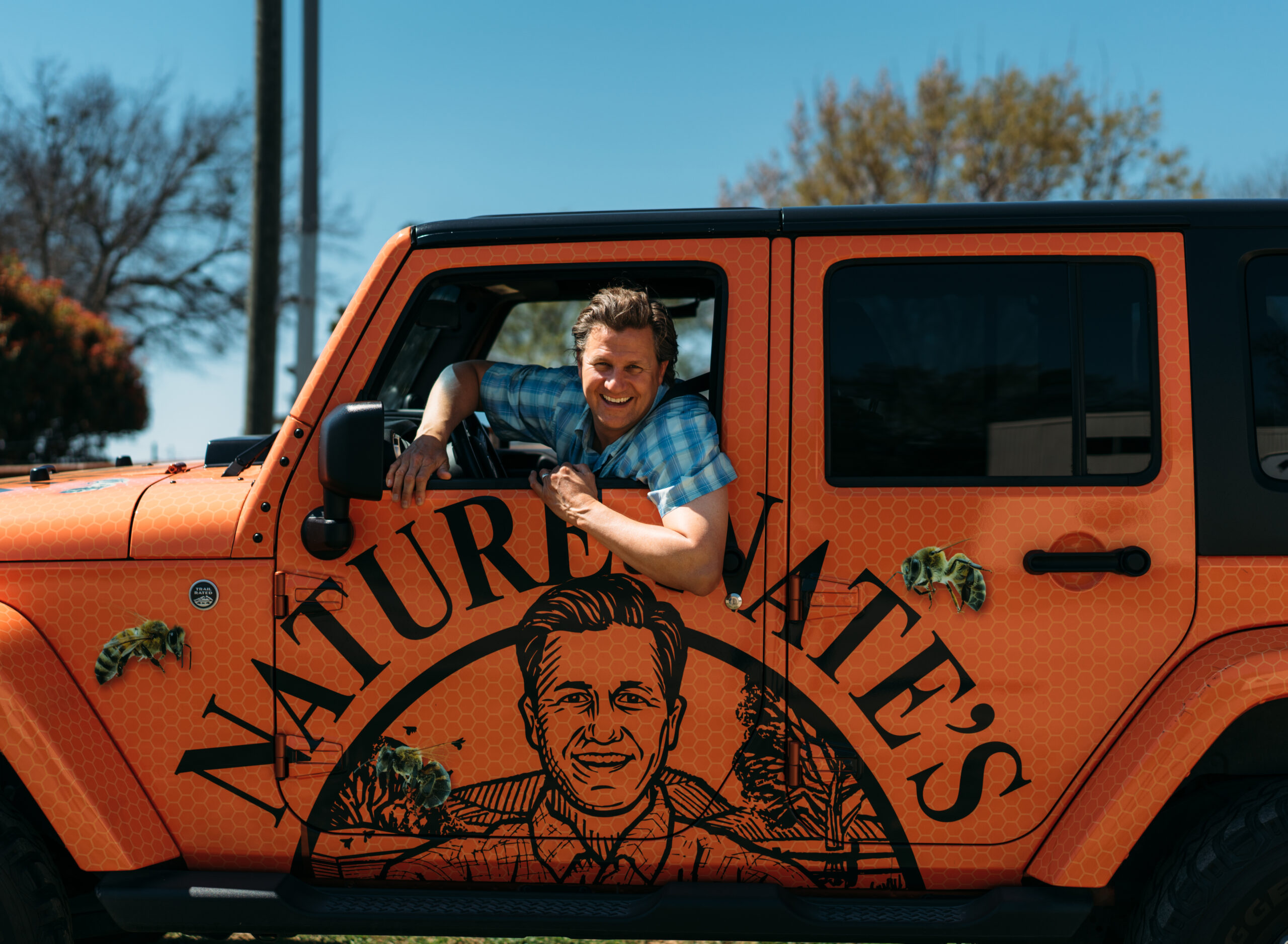
Nathan Sheets never dreamed one hive could turn into a business success story. Nature Nate’s Honey Company started as a post-honeymoon hobby for Nathan Sheets and his wife Patty. Twenty years after buying his first beehive, the hobby has flourished into a booming honey business with global sales and a commitment to betterment of communities and families across the US. But it wasn’t an easy start.

After losing his long-time advertising job, Sheets realized he couldn’t support his family with the part-time honey business he ran.

With encouragement from Patty, Sheets mustered the courage to bring his “no name” honey to Wal-Mart. Relying on his belief and his wife’s encouragement, Sheets approached Wal-Mart and within weeks, Sheets had a single sale that would cover the cost of living for an entire year.

Encouraged and energized by the sale, Sheets continued to grow his honey company. The past seven years have exceeded Sheets’ expectations, with new manufacturing facilities in Texas and Georgia and the company’s first retail store in Florida.

“Five years ago, we bought 200 pounds of honey. Only a short time later, we’re buying 25 million pounds of honey and we have become a top brand in honey. The only thing this can be attributed to is God and faith,” Sheets tells Guideposts.

Sheets points out that that God doesn’t shower believers with money or material reward. Instead, hard work and commitment is integral to the rewards they then turn back into helping as many people as possible.

Sheets says that the Nature Nate’s business is driven by more than a single bottom line: “We measure success not just by what we achieve, but also by what we contribute and how we work with others.”

Honeybees are by nature great at working with others: they are cooperative and build strength from team work. Sheets says that Nature Nate’s is nourished and grown because like honeybees, they work together well and share the many blessings granted to them.

Honeybees are an interesting metaphor for Sheets’ life. He never dreamed of a starting a honey business. But from an early age, he imagined how he could use his resources to sweeten the world and make it better for the people around him.

Sheets’ college nickname, “Nature Boy,” inspired by his love of the outdoors, fishing and exploring the beauty of nature developed into the company name, Nature Nate’s. Sheets’ affectionate nickname made sense for the company he leads with unwavering respect for nature and the people around him.

A devout Christian and former missionary in countries around the world, Sheets says that his experience doing mission work influenced his approach to the honey business. He continued this mission work well into the early years of Nature Nate’s. He traveled widely in Africa, sharing his faith and supporting ministries in Sudan, Kenya, Rwanda and Ethiopia.

Despite the everyday challenges of running a large organization and supporting so many, Sheets’ core of mission work remains central to how he runs his honey company today.

While his days of frequent mission trips are now replaced with leading Nature Nate’s, the company is committed in everything they do to the mission of serving others and to the betterment of families and communities across the US, and works actively toward that mission.

“God brought me on this journey of making a difference in people’s lives,” Sheets says. “When I started Nature Nate’s full-time, I had the same motivation that I had when I was doing ministry: wanting to make a difference for eternity, wanting to make a difference in people’s lives.”

Today, Sheets says, he runs Nature Nate’s in a way that aligns with Biblical principles, encouraging Nature Nate’s employees “to share a core belief and think of other people as more important than yourselves.”

Sheet’s team coined “Honey Makes It Better” and it is essence by which they live. For the people of Nature Nate’s, honey is a natural replacement for sweeteners containing high-fructose corn syrup or other fillers. At the same time, “Honey Makes It Better” means that Nature Nate’s can use its resources and profits to treat employees well and reinvest in the betterment of people across the US.

“We pay double the Texas minimum wage and we pay time off for employees to take mission trips and I’ll match whatever money they raise,” Sheets says of his business practices.

Sheets developed a national program under Nature Nate’s called “Honey Gives Hope” to fund important initiatives supporting women with breast cancer, impoverished families, educational advancement and more.

“Honey Gives Hope is more than just a corporate giving program. It’s a philosophy that we put into practice every day and a way of giving back — both locally and globally,” says Sheets.

This Mother’s Day, for example, in lieu of an expensive marketing campaign or other investments into the company, Sheets decided to instead have a direct, positive impact on women and mothers around the country. Program facilitators coordinated generous donations to ten shelters that serve and protect victims of domestic violence and work to prevent the abuse and neglect of women and children.

“Honey Gives Hope is the heart of Nature Nate’s and allows us to put a priority on taking care of families and helping those in need,” says Sheets. “We let the bees take care of making the honey. We take care of the community.”

This care for community stems from Sheets unwavering commitment to bring in staff that will lead the business and mission by treating others the way they want to be treated, pulling from the familiar Christian adage. It is the core value system on which he leads Nature Nate’s.

“The Lord has blessed us so we can be a blessing to others,” Sheets says. Nathan Sheets makes sure this goal is reached every day.

The Best Thing to Do for Spiritual Growth

There’s something that happens to me about once a month that always shakes me out of my spiritual torpor and makes me realize I’m meant to be doing a little better in the “Love your neighbor as yourself” department.

It’ll all start out innocently enough. I will have asked someone to do me a favor, maybe not even that big a favor, but big enough that it’s going to have cost them some time and energy. I won’t hear from the person for days or weeks and I’ll start fretting, wishing they could just do what I asked. How hard would it be? Don’t I deserve it?

Then just in the middle of my irritation, I’ll get a phone call or an email from someone asking me to do a big favor. The timing is never ideal, the request seems presumptuous if not outlandish. I’ll feel burdened and put upon and start thinking about all the ways I can say no. I delay, I procrastinate, I avoid the request that’s sitting in the inbox. Then it dawns on me: “Someone is asking me to do the kind of nice thing that I’m expecting for myself.”

This might seem small in the area of spiritual growth, but I think it’s HUGE. It must be something that makes the angels weep. If we want the heaven and earth from God, shouldn’t we be willing to offer a small piece of it to X or Y?

So here’s my suggestion—I’m making a mental note to myself. When you’re feeling a little blocked in your spiritual life, when you’re stymied, look at those good things that you can do for others. No good deed goes unpunished? I’m waiting for the moment when I can tally up more giving from me than I’ve ever been given.

Rick Hamlin is the executive editor at GUIDEPOSTS.

The Bad Good Friday and the Inspiring Easter That Followed

It began as such a happy day, Good Friday one year ago. The snow which had been coming down for two days let up which meant that my husband Lowell fly to Fairbanks, and get back in time for us to have all of Easter weekend together.

The children and I waved goodbye as he drove off to the airport, then shut the door quickly because it was still below freezing outside. About five o’clock, feeling lonesome for him, Anne, eight, David, six, and I went upstairs to watch TV. Anne and David were wearing blue jeans and cotton T-shirts; I had on a wool dress and nylon stockings. We took off our shoes so we could sit on the bed.

It was half an hour later that I heard a rumbling sound. Although we frequently hear a similar roaring—the firing of guns at a nearby Army base—I knew instantly that this was the sound of an impending earthquake.

I leaped up, called to the children to follow, and raced for the stairs. By the time we reached the front hall the whole house was beginning to shake. We ran outside into the snow, David crying, “Mommy, I’m in bare feet!”

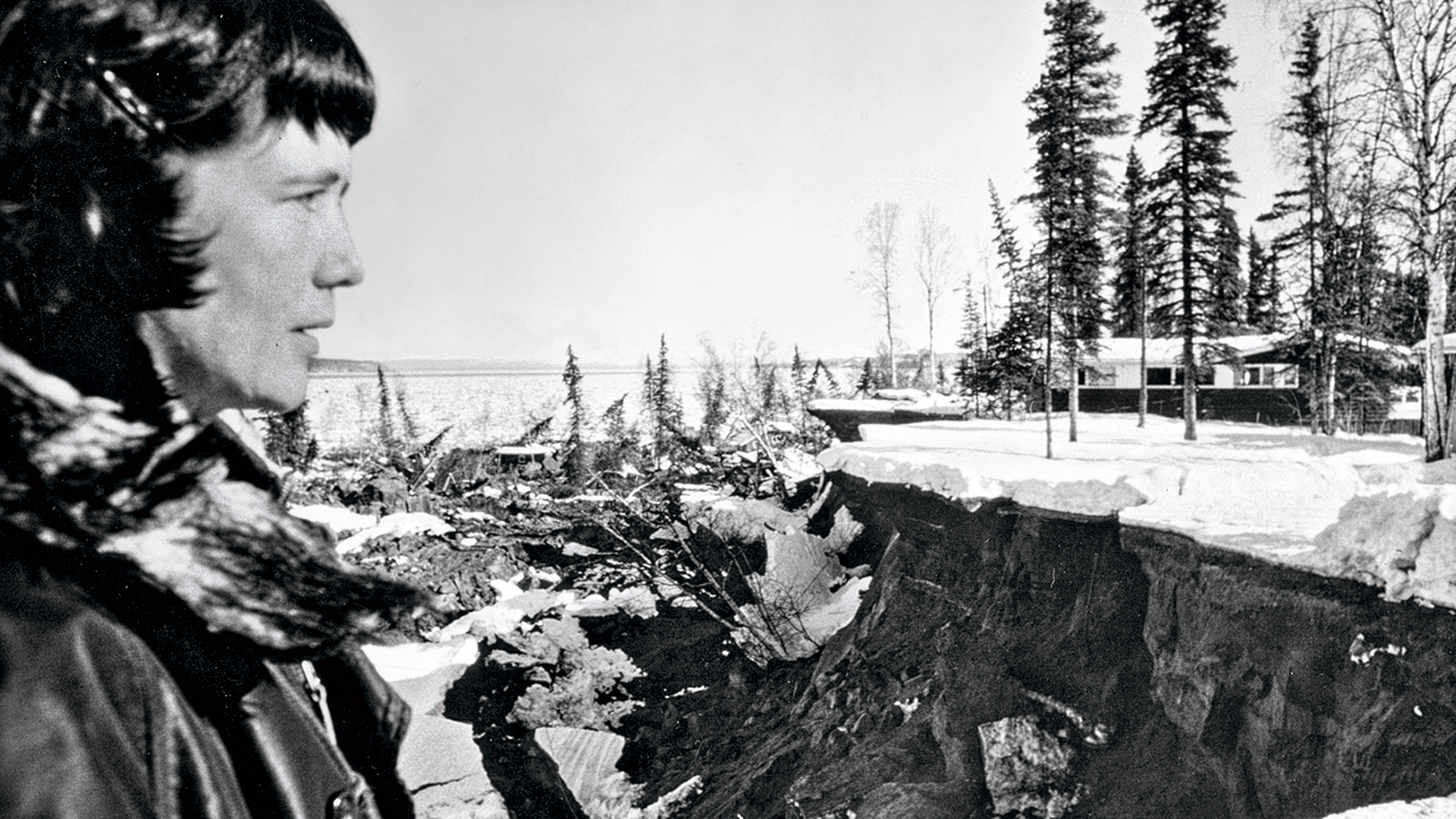
We were about 10 feet beyond the door when the world around us fell apart. We were flung violently to the ground which was jolting back and forth with unbelievable force.

The hallway through which we had just run split in two. We heard the crashing of glass, the ear-rending sound of splintering wood. In front of us a great tree crashed full length onto the ground. Our garage collapsed with a sharp report.

Now the earth began breaking up and buckling all about us. Suddenly between Anne and me a great crack opened in the snow. I stared in disbelief as the trench widened, apparently bottomless, separating me from my child. I seized the hand she stretched out to me in time to pull her across the chasm to my side.

By now the whole lawn was breaking up into chunks of dirt, rock, snow and ice. We were left on a wildly bucking slab; suddenly it tilted sharply, and we had to hang on to keep from slipping into a yawning crevasse. Though sobbing, Anne had the presence of mind to hang on by herself—thank God, for I was holding David with one hand, our bit of ground with the other.

Now the earth seemed to be rising just ahead of us. I had the weird feeling that we were riding backward on a monstrous Ferris wheel, going down, down toward the water (our house had stood on a high bluff overlooking Cook Inlet). When the worst of the rocking stopped, I looked around and saw that the entire face of the bluff had fallen to sea level. A few feet away, at the water’s edge, lay the roof of our house.

All I could think of was that the water would rise as earth tumbled into it and we would be trapped. The cliffs above us were sheer, with great sections of sand and clay still falling.

The children both were hysterical, crying and saying over and over, “We’ll die! We’ll die!” I realized we’d have to find a way up that cliff but the children were too frightened to walk.

I suggested that we say a prayer asking Jesus to take care of us and guide us. Both children stopped crying, closed their eyes and fervently pleaded with Him to come and help us. This had an extraordinary effect on them and on me, and we set out with the first real stirrings of hope.

The next 20 minutes were one great nightmare as we clambered up and down the great slabs of earth and snow, our bare feet aching and raw in the cold. I found a large tree leaning against the cliff and thought for a few moments that we might be able to shinny up it, but we gained only a few feet. We kept moving to the right, trying to avoid holes which opened at our feet and rubble still falling from the cliff.

Suddenly a man appeared above us. “Help!” we called to him. He shouted down that he would hunt for a rope, then disappeared. As we waited we were aware for the first time that we were soaked to the skin from lying in the snow; the children were shaking and their lips were blue.

At last six or eight men appeared at the top of the cliff. One of them, a stranger to us, started down toward us, finding one less steep spot. The children threw their arms around him as he reached us. He took off his black wool jacket, put it around Anne, then boosted David into his arms and led us all back up along the rope.

At the top there was a steep, sheer rim which I doubt I could have scaled by myself. But willing hands hauled us up and tucked us into a waiting car. When I turned to thank our rescuer, he had gone. But nearby I saw the strained, white face of our neighbor Wanda Mead. Someone told me that two of her five children were missing.

We were driven to the home of friends who lived well away from the devastated area. They wrapped us in blankets, but there was no heat in the house nor any way to make a hot drink.

The children were offered beds but refused to leave my side where I huddled with the others over the portable radio; they finally curled up in sleeping bags on the floor. Sleep for me was impossible until two questions were answered: had Fairbanks, where Lowell was, felt the quake, and how could we get word to him that we were all right?

The radio reported all the homes along our street destroyed, and that the two Mead children were still missing. I winced at the frequent pleas, “Urgent to Dr. Mead…needed immediately at Providence Hospital.”

Perry Mead, Alaska’s only neurosurgeon, spent the next 24 hours going from bed to bed at the hospital, tending to the needs of others while tears for his children streamed down his face.

The radio listed tremendous damage in the downtown area. We, living in Anchorage, watching it grow day by day, had felt personal pride in each new building that rose. Now the tally of damaged schools, stores and office buildings mounted by the hour.

There was a continuous stream of “Tell John his father and mother are at the Stewarts,” or “The Johnson family wants to know the whereabouts of daughter Ann.” It seemed an eternity to me before radio contact was reestablished with Fairbanks and we learned that it had felt merely a strong jolt. Planes were arriving from there with doctors and supplies, and I knew Lowell would be aboard one of them.

Then suddenly the announcer’s voice said, “If anyone knows the whereabouts of Mrs. Lowell Thomas and family, please contact us immediately.” I ran to the telephone and was so overwhelmed to find it working that I could hardly talk to the person who answered. But I got the essentials through, and just half an hour later Lowell walked through the door.

Words cannot describe our reunion. The kids and I were tremendously relieved, but Lowell’s emotions were those of a man who had not known for many hours whether his family was dead or alive.

Next morning, Easter Sunday, Lowell, Anne, David and I rose early. We put on the same clothes we had been wearing for two days: Anne the coat provided by our unknown rescuer, far more meaningful to her than any Easter bonnet; David a pair of pants too small to button, me some men’s corduroy trousers.

Many in the Easter congregation wore similar misfits, and the air in the heatless church was so cold that our breaths hung white above us as we sang “Hallelujah!” But it was an Easter service to remember.

At the rear of the church the minister had pinned two sheets of paper, one to be signed by the “haves”—those who had clothing and household goods to contribute—and one where the homeless could write down what they needed. At least 20 families there that morning had lost everything, yet as we left the church I saw that not one person had signed the “have not” list.

For what was there that we did not have? We had new gratitude for the gift of life and for the fact that, in one of history’s worst earthquakes, loss of life had been as small as it had. We had a state to rebuild with a new love for the word “Alaska” born the night we watched our neighbors rise to heroism. Above all we had the Easter message ringing in our hearts.

For the first Christians, too, lived through a sorrowful Friday, a Friday when their dreams collapsed, their hopes lay in ruins, when by every earthly standard they had lost everything. And then on Sunday morning they were the first to whisper the news that has transformed every loss from that day on, the news that love had won, that God had the final word, that death was overcome, that He had risen.

For more inspiring stories, subscribe to Guideposts magazine.

Thank God for Snow Days

I didn’t grow up with snow. At least not falling outside my window. In my Southern California childhood the only snow we saw was up in the mountains. Now whenever it comes, it still seems like a novelty.

Okay, I know it can be an annoyance. The mess it makes of the roads, the back-breaking work of shoveling it, the need to cancel flights or school.

And yet, and yet. A snow day feels like a message from God saying: Slow down. Savor my creation. You don’t have to rush, rush, rush. Watch what I can do to the sky. Look at how I can paint my world.

I was a freshman in college when I experienced my first snow storm. I was studying for finals, fearing that I would fail miserably, then I looked out and saw the snow swirling in the air, brushing the trees, adding highlights where there were none.

It was as though the Creator was telling me: You’ll be fine. I’m right here. Then we ran outside and had a snowball fight and slid up and down the hill outside my dorm room.

I still have that feeling when life is interrupted by a snow day. It seems like a heavenly reminder that all we can accomplish, all that we work hard for, is nothing compared to what the Lord can do with his own magnificent brush. A gray world turns white. Everything is transformed.

Spring is coming soon enough. The crocuses are there ready to burst into bloom. In the meanwhile, as the old song goes, let it snow, let it snow, let it snow.

Glorify the Lord, O chill and cold, drops of dew and flakes of snow. Frost and cold, ice and sleet, glorify the Lord, praise him and highly exalt him forever.

Telling My Story

I wrote a story for the April issue of GUIDEPOSTS magazine. When it came out, I showed it to a few people, then carefully filed my copies away and went back to work. I didn’t really tell many people, and I didn’t do much to celebrate. Hopefully, my story would inspire someone, and that would be celebration enough.

Then last week I got a frantic email from my mother: “WHY DIDN’T YOU TELL ME YOU HAD A STORY IN GUIDEPOSTS MAGAZINE?!” I could practically hear the hurt in the email.

My first reaction was frustration. Who had outed me? I demanded to know who told her about it. Apparently my mom’s friend Leta is a subscriber and had brought the magazine in to work and shown it around to all my mom’s co-workers. Argh. So now not only did my mom know, but all of my mom’s friends knew too.

I wrote back and told my mom something about how I just hadn’t quite gotten around to mentioning it yet, and promised I’d send her a copy of the magazine. Then I bent over and hit my head on my desk. I should have known that with 5 million readers, someone would have pointed the story out to my mom. I should have just told her about it.

So why didn’t I?

The truth is, my story, like all stories in GUIDEPOSTS, is very personal. It’s about a time when I was incredibly vulnerable and questioning everything I thought I knew. The life my parents had built for me and the faith my mom had passed down to me was a part of that.

Somehow, I was kind of embarrassed for her to know about that. I guess I didn’t really want her to see how badly I had struggled. For some reason, telling my story to the 5 million readers of GUIDEPOSTS didn’t seem like a big deal, but opening up to the people I love about what was really going on in one of the most difficult periods of my life felt a lot more scary.

Isn’t it funny how the people we love most are the hardest to be honest with?

After my mom’s reaction, I sent a copy to my grandfather, and he called me last night to tell me he’d shown it off at church as soon as it came in the mail. He also said he was proud of me, which I think is what my mom was trying to say too. So I guess opening myself up was worth it in the end—I know at least two people who the story helped.

Actually, counting me, I know three.

Beth Adams is the creator and editor of GUIDEPOSTS’ Home to Heather Creek fiction series.

Summer Inspiration

The NBA playoffs are over (LeBron finally got the championship for which he always seemed destined), which means summer is truly here on this first full day of the season.

It sure feels like summer here in the east. The heat has been a beast. We’ve taken refuge in the mountains for a few days, where at least it cools off a bit at night.

Last night Millie woke me up in the wee hours with a quiet little whine at the back door. This usually denotes an emergency, so I threw on a T-shirt, trotted downstairs and let her out. I went to the window and tracked her through the dark from the kitchen window. She briefly disappeared in the shadows from the woods, then reappeared in the middle of the yard. There she sat, very still, ghostly white in the luminosity of a crystal-clear night, head tilted up, staring at the sky.

What on earth was she doing? What was she seeing? It seemed to me she was looking at the stars, at the silvery heavens above, the Milky Way smeared across the horizons. I didn’t call her in. I let her stay that way for a while, just gazing up at the sky on the first night of summer.

Who knows what goes through a dog’s mind sometimes, what powers God has granted them that we can only imagine. What they see that we don’t see. What they feel.

After a while Millie rose and headed back toward the house. I heard a little scratch at the door and let her in. Her tail was swishing. She took a quick drink of water, trotted upstairs and put herself back to bed.

I almost followed but instead I wrote the foregoing. I didn’t want to wake up in the morning and think it was only a dream.

Happy summer, everyone.

Still Faithfully Serving God

My husband, Paul, and I attended the National Religious Broadcasters Convention (NRB) last week in Orlando. It’s a wonderful event with great sessions, keynote speakers, panelists and a large expo hall filled with interesting booths. One of the things I love most is that I always leave my time there with my spiritual batteries recharged. That’s priceless.

For me, NRB is like a big family reunion as I bump into friends and colleagues from the publishing, film, radio and television industries. It’s laughs over meals and short nights of sleep because I sit up late hanging out with dear friends.

On the afternoon of the third long day, we were so tired that we settled on a bench to rest for a while and to do a little people watching. We saw folks walk by, people whose names you’d recognize if I mentioned them.

Read More: How to ‘Win at Losing’

We noticed executives from radio networks, musicians, actors and leaders from large ministries. We watched folks dressed as Bible characters and historical figures, their colorful costumes giving us a peek into those long-ago days.

And then I noticed something that touched my heart. Heroes of the faith walked by—men and women who have been serving God for decades, some of them for 40, 50 and even 60 years. Men and women whose teaching, writing and radio and television programs have touched my life from the time I was a little girl.

The years have caught up with many of them, as evidenced by their halting footsteps as they walked the long hallways of the convention area and expo.

It hurt me to see how feeble some have become. One lady was there who’d recently buried her husband of 60+ years. Others had visible health issues. Some used a cane or a motorized scooter. But what I loved was that they were still there, and still faithfully serving God.

I want to be like them someday—a woman who has faithfully served God, who didn’t give up when the hardships of life arrived, who kept on keeping on for the tasks which God’s given me to do.

Dear Father, even when my steps are feeble and my health is failing, help me to be faithful to serve You. Help me to use every scrap of the talents You’ve given me and to fulfill every task that You’ve put on my heart. Help me to serve You for the long haul. Amen.

Spiritual Growth Through Writing for Daily Guideposts

Writing hasn’t always been my forte, so when I was asked to write a devotional for Daily Guideposts for the first time in 2005, I was honored and challenged by the task. Since then, it is something I look forward to doing each year.

Writing devotionals for Daily Guideposts allows me to share my story of faith, the struggles I’ve faced and the wisdom I’ve gained, with the hope that it helps others. I look at how the theme of each story will connect and resonate with readers. This process allows me to step back and re-live the experiences and lessons I’ve gained by looking through a writer’s lens. In doing so, I learn from these experiences and lessons all over again, sometimes gleaning new insights. Writing these devotionals is a lot like lifeyou never know what can happen.

Get your copy of Daily Guideposts here.

Each time I receive an email, greeting card or letter from a reader about how a particular devotional has touched their life, I feel blessed. And when a friend or family member sees that they have been mentioned, their expression fills me with joy. Helping others by encouraging them through my devotionals is a blessing. I don’t consider myself a writer, but someone who helps others grow in their faith as I grow in mine.

Lord, thank You for the gifts You give us; help us to bless others with them.

Society Without God? Nah.

Last weekend Kate, Frances and I rented a car and drove north to a farm run by nuns. Kate knows these nuns because she sometimes leads services at their house in New York, a few blocks from our church.

The farm is about an hour away in the semi-rural suburb of Putnam County. There several of the nuns raise chickens and ducks, grow all the food they eat and—this is why we rented the car—make maple syrup in early spring. Here’s something I didn’t know: Sap drips from trees with the consistency of water, tastes ever so slightly sweet and makes an astonishingly delicious cup of tea.

While we drove, for reasons that at first seemed random, Kate and I talked about an article we’d read in that day’s Times. The article discussed a book called Society Without God by Phil Zuckerman, a sociology professor at Pitzer College in California. The book is an extended study of religion—rather, lack of religion—in Scandinavia, which has one of the lowest church-attendance rates in the world.

Reviews touted the book as refutation of the idea that a faithless society would necessarily be morally unhinged. Presumably there are militantly religious people in the world who believe this. But I think most smart people understand that it’s a relatively dumb idea, given that even a cursory knowledge of history shows that both religious and non-religious societies are capable of great good and great evil (see: slavery in the United States; civil rights movement in same; quality of life in The Netherlands; discrimination against Muslims in same).

Still, regardless of whether the book flogs the wrong horse, Zuckerman said some interesting things when the Times’ Peter Steinfels called to interview him. This startled me: Most of his subjects, Zuckerman said, “balked at the label ‘atheist.’ An overwhelming majority had in fact been baptized, and many had been confirmed or married in church.”

Of course, most also disavowed Christian doctrine and displayed either total indifference or deep embarrassment when asked to state their thoughts on God and other religious questions.

Zuckerman took that as evidence of a society that had, in effect, moved beyond religion to a place where they could make moral decisions and live a happy life without reference to God—give or take a few purely ceremonial church weddings and baptisms.

I wonder. Could you not equally plausibly say that Scandinavians are reluctant to talk about God not because they don’t care or don’t know, but because their relationship with God—perhaps better to say, their way of living a godly life—is comprised of action, not statements and creeds?

A key element of American Protestantism is the idea that relationship with God begins with an affirmation of belief, then deepens with assent to a series of biblically-derived statements about God. The fruits of all that—abolishing slavery, say, or ensuring that no elderly person has to die alone in a nursing home—come later, if at all for some believers.

What if the Scandinavians do it in reverse? Or what if, having established a society that runs as much like the kingdom of God as imperfect human beings will ever achieve, they don’t need all those strenuous protestations of belief Americans cling to? What if such protestations are in fact sometimes a smokescreen, a way of avoiding engagement with the fruits of faith that God wants, indeed demands of us?

I thought about all of this when we got to the farm. There Frances emitted shrieks of delight as she fed the chickens (and even pet one that likes to be held, whom she christened “Mr. Cluck”), plucked eggs from the henhouse and watched Sister Catherine Grace prepare a great big bowl of sliced onions for that night’s meal.

The nuns drifted in and out of the kitchen on their way to various tasks—cleaning the house, sorting seeds for spring planting and, of course, prayer, study and worship. There was a groundedness to every one of those women, a settled ordinariness that transcended ordinariness into something almost unspeakably deep—the depth of relationship with God that comes when you let go your grasp on yourself and surrender to the often mundane (but no less beautiful for that) tasks that God sets for you.

The nuns were living the fruits of faith. Their talk about God would of course differ markedly from the average Scandinavian’s. But outwardly, minus their observance of the monastic hours, they run a pretty Scandinavian operation.

The language of doing, as opposed to the language of saying, or the language of believing. I think God speaks all of those languages, and God hears us when we speak them. Society Without God? That might be the one language God doesn’t speak.

Jim Hinch is a senior editor at GUIDEPOSTS. Reach him at jhinch@guideposts.org.

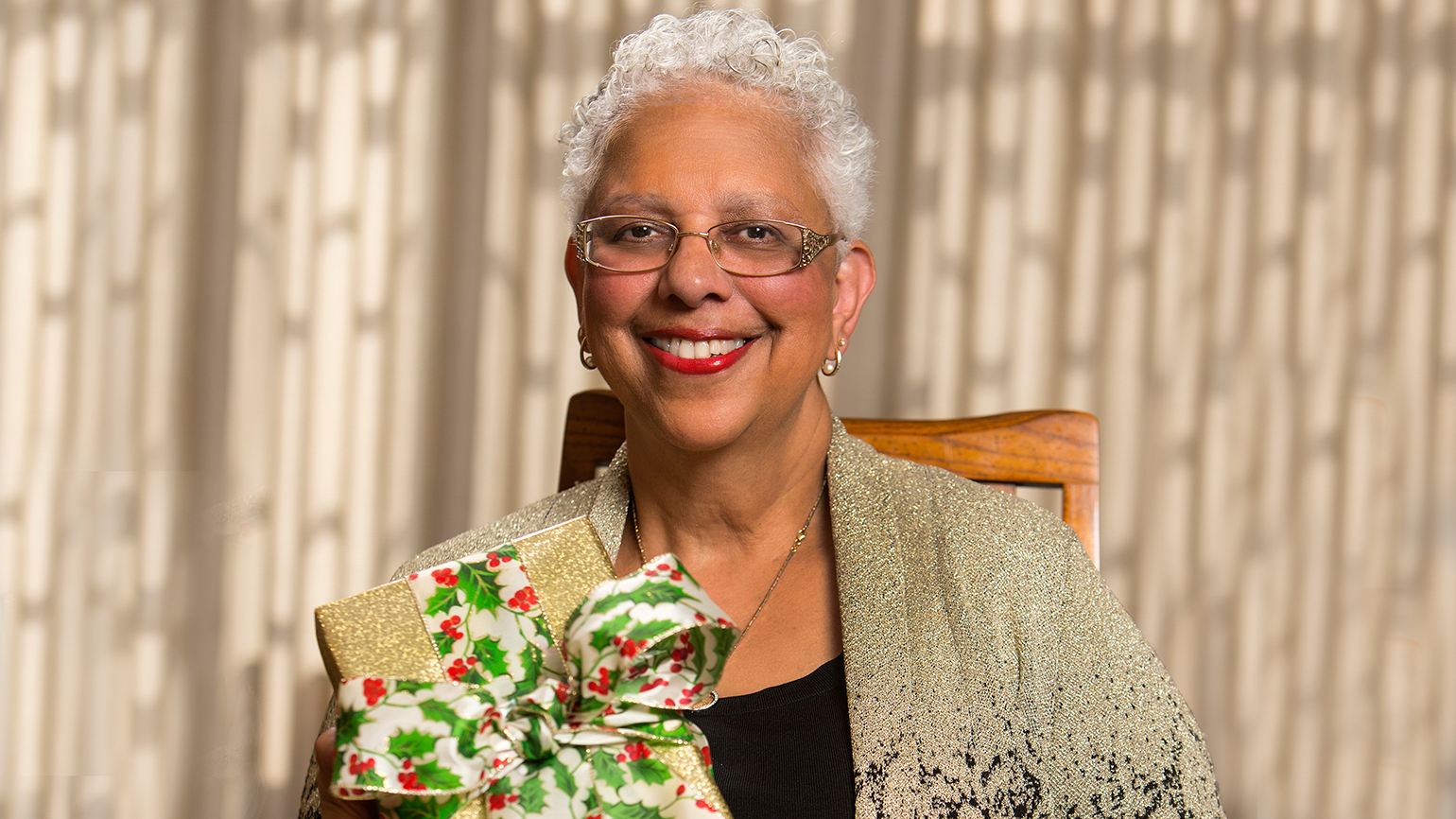
Should She Give a Present to a Difficult Church Member?

Have you ever been a part of something that made no sense to you at the time but turned out to be an unforgettable life lesson? That Christmas I didn’t understand what was happening. I didn’t really put it all together for some time, but what I learned about myself—and Mr. P—is a lesson I’ll never forget.

My Christmas to-do list that year was overwhelming. Nailing down last-minute details threatened to draw all the holiday spirit out of me. Still, the one thing that always made the mad rush bearable was my shoe boxes.

It was a tradition I’d started in memory of a dear cousin, the very first recipient of one of those boxes. Each year I’d look for 10 people, folks who were in nursing homes or had lost a loved one or just seemed lonely or in need. I’d fill a shoe box with little gifts—lotion, deodorant, toothpaste, socks, lip balm, soap and tissues. I’d tape 20 one-dollar bills end to end and roll them up tightly into a tube and for fun, I’d throw in a windup dollar-store toy.

After wrapping each of the gifts in leftover wrapping paper, I’d put them in the box and top it off with a handwritten note, “Always remember, God loves you.” I never signed my name. That was part of the satisfaction. The hidden joy.

By Christmas Eve that year, I had only five boxes left to hand out. I knew exactly who would get them—five older members of St. Margaret’s. I rushed to the parish hall just before the 7:30 p.m. service. The holiday reception was winding down. I spotted four of my intended gift recipients in the hall. The fifth was nowhere to be seen. Maybe that person would show up soon.

I needed someone to be Santa’s helper. Right then, I spotted my friend Jim, our church’s senior warden and a former college football player. At his size, he can seem intimidating at first, but he’s really a gentle giant. I sidled up to him. “Can you keep a secret?” I asked.

“Sure,” he said. I explained what I wanted him to do. We went to the hallway, where I slipped him the four shoe boxes. I stashed the last in a corner. Then I made small talk with some friends and watched out of the corner of my eye while Jim made his way around the room. Each time he stopped, there’d be a look of surprise. “What? For me? Who’s it from?” “Why, Santa, of course,” Jim would say with a chuckle. Soon everyone was laughing and enjoying themselves.

Everyone except Mr. P.

I hate to say it, but Mr. P was one of the most difficult people I have ever met. Ornery and persnickety were some of the nicer words people used to describe him. He was sitting by himself at the refreshment table, dressed in a red flannel shirt and tan slacks with suspenders.

He’d done quite well in business—he drove a hard bargain, folks said—but he was much less adept when it came to relating to others. In small groups at church, if the leader wasn’t assertive enough, Mr. P would hijack the discussion, stringing sentences together on whatever interested him without seeming to pause for breath. If someone wrestled the conversation back to the proposed topic, he would interrupt and continue trying everybody’s patience.

I had little tolerance for him and was only too glad when he started going to the earlier Sunday service. I went to the late one. I didn’t have to see him. And I hadn’t. Not until now. There he was, sipping eggnog. People were polite, pausing to say hello, but nobody wanted to sit next to him and get sucked into a conversation.

The service would start soon. I went to pick up the last shoe box. It looked as if the person I had intended to give it to wouldn’t be showing up. What would I do with it? A voice inside my head had a suggestion: Give the box to Mr. P.

There were a thousand reasons why Mr. P did not deserve this present. He wasn’t needy or in a nursing home. He didn’t seem lonely. Not at all. To hear him tell it, he was never lonely because he was such good company for himself.

Give…the…shoe box…to…Mr. P, my inner voice insisted. No way! I responded emphatically. Giving him the box would be absurd. Finally I put the box away in the cloakroom along with my coat and went into the sanctuary for the service.

Everything was beautiful, with the scent of fresh pine boughs, candles flickering, the altar transformed by a sea of poinsettias. I took a seat in a pew near the middle, just before the choir processed in, singing carols. The feeling of Christmas seemed so near! All of the stress of the season faded in the tidings of joy. But I couldn’t stop looking at Mr. P, who was sitting several pews ahead of me. Though people were sitting on either side of him, he seemed so isolated, so utterly alone. Maybe my inner voice knew something I did not.

All right, I told myself. I’ll do it.

We reached the portion of the service where we stood and greeted one another in peace. I slipped out of my pew and asked Jim if he would agree to play Santa’s elf one more time. “I’d like to give that last box to Mr. P,” I whispered.

“No problem,” Jim said. “His son is coming to pick him up. I’ll give the gift to him when I walk him to the car.”

“Don’t you dare tell him who it came from,” I said. “Just say it was Santa.” Back in the cloakroom, I fetched the shoe box and handed it to Jim. I enjoyed the rest of the service and didn’t give Mr. P another thought.

Later that winter, I heard some news about Mr. P. His health had declined, forcing him to move in with his son. Soon he was telling anyone who would listen how unhappy he was with the arrangement. Another Christmas came and went, and then Mr. P and his son seemed to disappear. That spring, I learned that Mr. P had died in Florida, where his son had moved for a job.

The next Sunday, Jim and I talked about Mr. P. “You know I had to tell him that you were the one who gave him that box,” he admitted, somewhat sheepishly. “He wouldn’t accept any other answer. You know how he was.”

It took me a second to remember what Jim was talking about. “Of course,” I finally said. “The shoe box.”

“Mr. P wanted to thank you in person,” he continued, “but he never ran into you. He said no one had ever given him something without expecting anything in return. That’s the way it was in business and life. He kept asking, ‘Why did she do that for me? I need to know why.’ I didn’t know what to tell him.”

I struggled to come up with an answer, recalling that Christmas Eve night, the ill will I’d felt toward Mr. P.

“I didn’t want to give him the shoe box at first,” I said. “I thought he didn’t deserve it. I thought there must be someone worthier.”

Then it dawned on me. I hadn’t given the shoe box to Mr. P at all. God had, over my initial objections. I’d finally complied because I had to give the box to somebody. It was God who gave the gift to Mr. P. I just delivered it.

Mr. P has been gone for several years now, and strange as it might seem, I miss him. I often think of him when I assemble my Christmas shoe boxes. I’m reminded of how people can be like gaily wrapped presents; what’s inside can’t always be deciphered. Their hearts, their minds, their needs can be a mystery to us. But sometimes we’re given a glimpse of just what God sees, what we are blinded to. Sometimes God uses us to help him love the people we think are unlovable. Like Mr. P, who needed a gift that Christmas more than anyone.

Read More: Five Benefits of Being a Cheerful Giver

For more inspiring stories, subscribe to Guideposts magazine.

She Found God’s Word in Religious Icons

I’d been driving for hours. From busy freeways near my home in Seattle suburbia, the thickly wooded landscape of mountain passes had given way to the vast fertile fields of the southeastern part of the state. With no tree in sight, there was a simple beauty to the open vista. Soon I would arrive in Pullman, a place I had never been. The city is home to farms, ranches and Washington State University. I hoped whoever attended my presentation would gain an appreciation of the religious icons I’d painted and carefully packed into tapestry suitcases for a symposium at the local Protestant church.

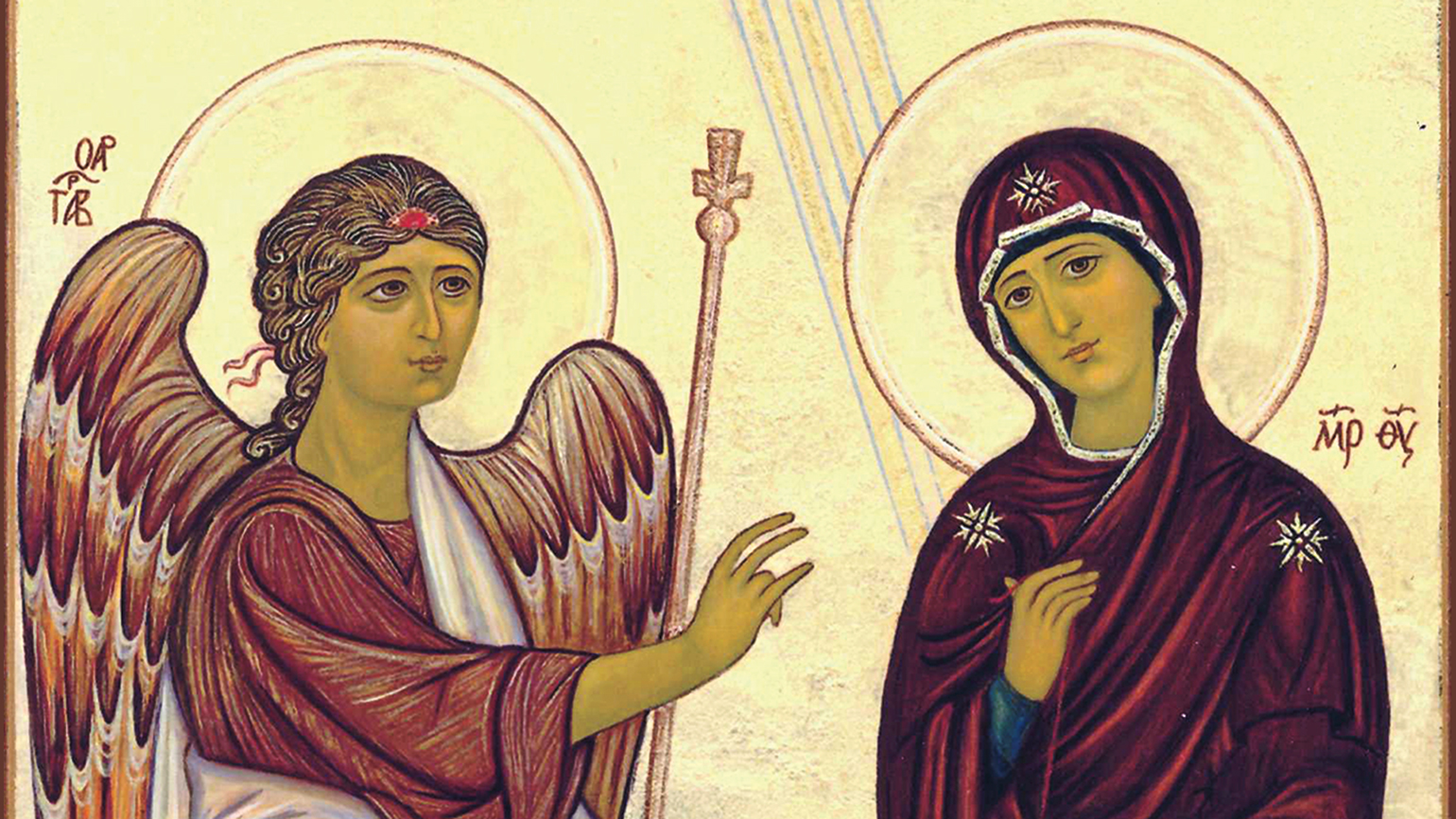
I was invited through a mutual friend of the church’s pastor to present my icons—my children, as I sometimes refer to the sacred images of saints and Christian historical events, such as the Annunciation and the Nativity. Icons are steeped in religious tradition and are often associated with the Orthodox Church.

As a Protestant with a convoluted spiritual history, I feel great joy sharing these windows into heaven with anyone who might be interested. This was the farthest I had ever traveled to present them, and I trusted that God was guiding me as I drove the open highways. Arriving at dusk, I pushed away anxiety and took a deep breath, praying the images would resonate. If even one person was touched by God’s story as portrayed in my icons, the six-hour trip would be worth it.

Iconography, which literally means “writing of images,” has existed in various traditions for centuries. That I’d devoted the past 20 years to sharing my faith through this art form is ironic, to say the least. I grew up in Ottawa, Canada, and while I had a stoic conservative Protestant father and an extroverted liberal Catholic mother, religion wasn’t openly valued in our family.

Church provided good child care when my father dropped me off to visit his mother, and I loved it, longing for a God who was bigger than denominations. But in my early teens I grew suspicious of religion. Deep down I remained a truth seeker, although I rejected the idea of a supernatural being who was interested in me personally. Instead I found a certain holiness in nature and sought solace there. When I married years later in a Unitarian church, I chose to omit God’s name from our vows.

I pulled up at my destination after hours of marveling at how God had brought me to this journey. The young, energetic pastor welcomed me warmly, and we got to work on my display. Mounted icon prints were hung on the walls, with accompanying prayers for meditation. I draped tables with maroon cloths and set my original icons on small stands, placing a candle in front of each one to enliven the gold leaf. We agreed to play music, some of my favorites from Valaam Monastery. At home while I paint, chant helps me enter into the spirit of the story I “write” into image.

I’d never forgotten the first icon I saw as a university student in Ottawa. I sat in my art history class, looking forward to learning more about some master of technique, like my favorite painter, Botticelli. Instead the professor put on the large screen an icon of Mary and the Christ Child from the Byzantine era.

Compared with Botticelli’s intriguing figures, such as those in his Birth of Venus, the icon looked like a child’s artwork, so simple, with nothing hidden or surprising. The image sunk into my subconscious, however, laying dormant for years. It took a move to Seattle many years later for that experience to bear fruit.

My spiritual rebirth as a Christian happened soon after I became a mother. My emotional shell seemed to crack open. I felt something in my spirit shift and reach out—no longer to the universe, but to a personal God that I now trusted was out there somewhere. I craved the scriptures— simple ones, like those I’d read in the illustrated Bible of my childhood. I joined a nondenominational “Bible church” and discovered an inclusive God who welcomes us home no matter how far we’ve wandered. Even me.

I was reintroduced to icons when I was invited to attend a weekly class at a Byzantine Catholic church in Seattle. Lonely and depressed after moving to a new city, I was drowning in home renovations, my aging mother’s decline back home in Canada, and frequent solo parenting when my husband traveled. I missed my old Bible church and the close friendships I’d developed there. I was hungry for spiritual energy. The class was a godsend.

I learned that iconography differs from other art in that it’s about the essence, not the form. Beauty is not its primary purpose. There are rules for painting icons—the work itself is considered a sacred calling rather than a platform for creative expression. Iconographers do not make up their own images; instead they use prototypes steeped in tradition; they do not sign the front of their paintings, but rather the back, beginning with the words by the hand of. Icons are conduits for sharing God’s love story with the world. Simply, God’s word in pictures.

Working on an icon of the Annunciation had been transformative for me. I prepared the plywood panel with layers of smoothly sanded gesso before tracing on the prototype. I wanted to capture that holy moment when Mary had a choice to make: to be God’s chosen vessel or not. As I worked on the image, the image worked on me; Mary’s eyes looked deeply into mine.

“What would you do?” she seemed to ask. Her story of love and loss as a human mother touched me deeply. I wanted to tell her to run away, that being highly favored wouldn’t equal a pain-free life. Hard times were ahead. Mary couldn’t see the big picture, but she trusted God, end of story. Or rather, the beginning.

Now, as I began to share the language of icons with the Protestant community in eastern Washington, I prayed exactly as I had on my drive over, to be effective and do my part. I hoped the icons would minister to others, as they had to me. Many people showed up, quietly considering the new images with gentle wonder.

Afterward a woman approached to speak with me, pausing to find her words. “I have Catholic relatives who I could never relate to,” she told me. “Now I feel like I finally understand them more.” Spiritual seekers of every stripe—the icons are “written” for us all.

For more angelic stories, subscribe to Angels on Earth magazine.

Seeing Herself Through God’s Eyes

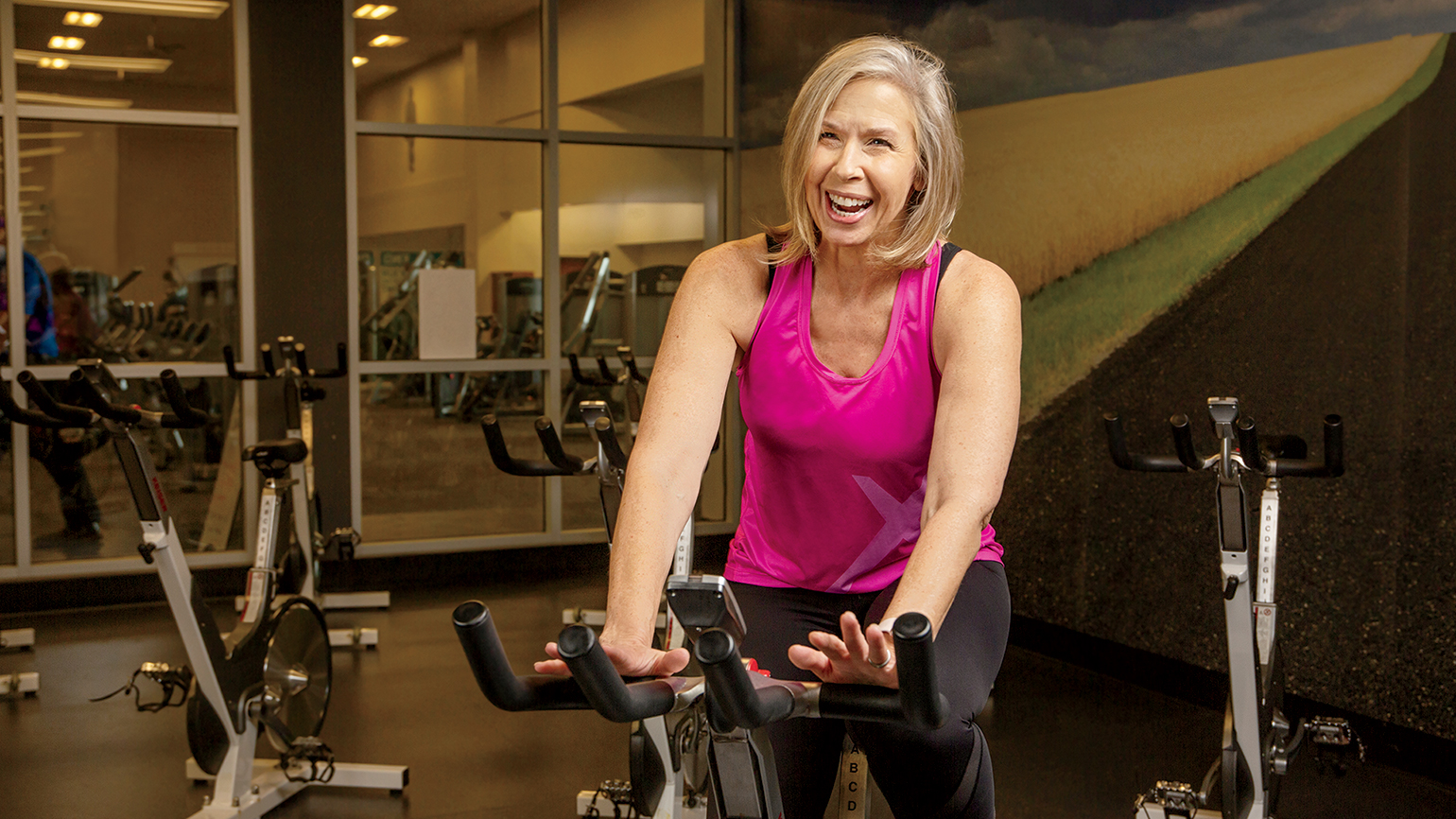
I pulled into the Gold’s Gym parking lot, but I didn’t get out of the car. Michelle, a mom from my daughter’s middle school, had invited me to spin class. “Come as my guest,” she said. “Grab a bike. See if you like it.”

No big deal, right? Except I hadn’t been to a gym in more than 15 years and was terribly out of shape. It wasn’t that I didn’t want to exercise and take better care of my body. But every time I thought about it, something kept me from taking that first step. Something I couldn’t quite put my finger on.

A perky gal in her thirties sashayed past my car, wearing fluorescent purple leggings with a matching print top. She looked as if she’d stepped off the cover of Shape magazine. I slunk down in my seat and pulled my ball cap over my eyes. Scowled at my baggy gray sweatpants. She’s everything I’m not, I thought. Slender. Beautiful. Confident. Not to mention 20 years younger.

Everything in me wanted to throw the car in reverse and return to the comfort of my home. But Michelle had texted that she was on her way.

I’d actually been thinking about going to the gym ever since last Thanksgiving, when someone posted a photo of me on Facebook. I stared in disbelief at my thick waist and thighs. The extra folds around my jawline. Dear God, is that really what I look like? I quickly untagged myself from the post.

The truth was, I’d hated my body ever since I hit puberty. I was curvy when the models in all the magazines were flat-chested and Twiggy-thin. It didn’t help that appearances were everything to my father. He worked out regularly and was proud that he cut a fine figure with his narrow hips and broad, muscular upper body. When I was little, back before he and Mom divorced, Daddy liked to flex his arms like a weight lifter and bid my younger sister and me to hang from his biceps.

As a sales rep for a clothing line, Daddy went to fashion shows and rubbed shoulders with gorgeous models. He made no secret of the fact that I didn’t measure up. When I went away to college, he sent me notes pushing me to lose weight, telling me how unattractive it was to be a size 12. Once he even offered me $500 (a lot of money in 1980) if I lost 40 pounds. His note explaining the bribe ended with “Size 8 bottoms are best.”

Those words had made my heart ache. Here I was about to become the first person in my family to graduate from college, but he’d made it clear that wasn’t what mattered. I longed to have the kind of father my friends had, someone who loved and accepted me for who I was.

After college, I landed a job as a television news reporter. I managed to lose the weight Dad had wanted by practically starving myself. (Because the camera adds 10 pounds, I even took up smoking after a colleague confided that it was her secret to staying thin.) Still, Dad never once said he was proud of me. When I was named weekend anchor, I sent him a tape of my first broadcast. “Who watches the news on the weekends?” he said.

In the mid-1980s, someone gave me a copy of Jane Fonda’s workout videotape. I was hooked. I put on leg warmers and a headband and felt the burn with Jane. Later I joined an aerobics studio. I spent a decade working out. No matter how slim and in shape I was, I didn’t feel good enough. I desperately wanted love, but deep down I didn’t feel as if I’d find it.

It’s no wonder I went through some bad relationships. Until I found Michael, the kindest man I’d ever met. He loved me the way I’d always yearned to be loved—unconditionally. We married, and when I got pregnant at age 40, it was a good excuse not to work out.

I visited Dad’s house when I was five months along. “You’re getting fat,” he said. I wasn’t even wearing maternity clothes yet. I expected him to be thrilled that I was giving him his first grandchild. That was the last time we saw each other. He died three days later.

As I got older, I came to understand that Dad was an alcoholic with a traumatic childhood who was desperately unhappy and unable to show me love because he’d never experienced the unconditional love of a parent. Now, 15 years after his death, I couldn’t have been happier about my life—a strong marriage, a wonderful daughter, a fulfilling freelance writing career, the centrality of my faith—yet I still couldn’t be happy about the woman I saw when I looked in the mirror.

I saw the woman Dad saw. Not pretty enough. Not skinny enough. Not good enough, period. In other words, me.

So here I was in the parking lot at Gold’s Gym, hiding in my car. My eyes followed the gal in purple as she strode through the gym doors. Was this the closest I’d come to working out in so many years because I feared I’d never measure up to women like her?

Now that I thought about it, that attitude wasn’t just about going to the gym. In almost every situation, I compared myself to the women around me. And I always came up short. Most women were younger, prettier, more successful, more active at church, better mothers, kinder, more patient—you name it.

Michelle tapped on my window. “Ready to ride?”

I smiled weakly and followed her into the gym’s cycling studio. Two rows of bikes formed a semicircle facing a mirrored wall. Great, now everyone can judge me.

I threw my leg over the bike next to Michelle’s and pedaled slowly to warm up. I peeked at the mirror, cringing at my ungainly self. The instructor dimmed the lights. Woohoo! At least no one would be able to see me struggling. Sweat poured down my forehead. My legs burned. Pride kept me pedaling. I didn’t want Michelle to know how out of shape I really was. An hour later—spent, breathless—I hobbled off the bike. My thighs felt like noodles.

The next morning, I lay in bed, moaning, my muscles too sore to move. My phone buzzed. A text from Michelle. “You’re gonna love Donnie’s class today. I’ll save your bike.”

My bike? I’d planned on spending the day recovering. But I couldn’t have Michelle thinking I was a wimp. I made it through the class. Barely.

Three weeks in, I was still just making it through class. I was constantly sore. I hadn’t lost any sort of weight. I wasn’t experiencing any exercise high. I was going through the motions, wishing I were home already. If I missed more than a day, Michelle texted me, asking where I was.

My M.O. was to hop on my bike, get the class over with and get out. As if the workout were a punishment.

One morning, after I’d wiped down my bike and left the spin studio, I spied a familiar silhouette on the weightlifting floor. Narrow hips, broad upper body. Biceps big enough for kids to hang from. My breath caught.

Daddy?

The man turned. I saw his face in the floor-to-ceiling mirrors. Of course, it wasn’t my father. Dad had been dead for 15 years. His death was tragic: He had died in a fire, and because so many of his problems were unresolved, he never found peace. His alcoholism, his self-hatred, his emptiness, his struggle to love and be loved.

But I still carried him with me, didn’t I? His expectations. His disapproval. Then I caught my own reflection in the mirrors. That’s what kept me from working out for so many years—my negative body image. Dad was gone. It was time I let all those damaging remarks—that I needed to look a certain way to be accepted and loved—go too.

I stared at my reflection and imagined how God saw me. How he saw every one of us in the gym. He wasn’t judging us by our appearance. Our fitness level. Our career success. Not even our kindness or generosity. He loved each of us perfectly in our imperfections, not because of who we were but because of who he is.

On my way out of the gym, I passed the woman I’d seen on my first day, who’d seemed so intimidating in her confidence and color-coordinated outfit. I caught her eye and smiled. She smiled back. Both of us were there to stay healthy. We weren’t so different after all.

I’ve been a regular at the gym for three years now. I’ve taken up strength training and kickboxing too. I try to work out four times a week. Sometimes I miss a day or gain a few pounds. I don’t beat myself up. What matters is that I’m getting fit physically, mentally and spiritually, and learning to love the body God blessed me with. And that’s good enough.

For more inspiring stories, subscribe to Guideposts magazine.