Embrace God's truth with our new book, The Lies that Bind

Loss and the Nearness of God

Loss. It can be tragic. It can be immediate. It can be prolonged. It can be anticipated. It can cause a small twist in life’s road or it can lead to a dramatic redirection. Loss. It is a part of living.

Grandpa Peale wrote, “There is no bright or easy philosophy that will shield a person from the necessity of meeting sorrow’s cold, hard weight at some point in life. So, we must be prepared to meet it when it comes” (from his booklet What to Do When….How to Handle Life’s Difficulties).

As I have mentioned, I work as a clinical social worker in the crisis intervention unit at a hospital. It is essentially an ER for mental health issues. We, as clinicians, also work with patients in the ER, ICU and other areas of the hospital in which people face the ultimate loss, the death of a loved one.

Whether the death comes after an extended illness or a tragic accident, pain, shock, sorrow and emotional confusion are present and will continue to rear their heads as time moves on. We have all experienced loss in one form or another and we have witnessed others experience loss. No path of mourning is the same.

The uniqueness of each of us as individuals makes the process of healing unique too, but what we do know is that similar emotions will be felt. I believe this is what Grandpa meant when he said, “We must be prepared to meet it when [sorrow’s cold, hard weight] comes” to us.

Loss does not always mean death. It can be the loss of a relationship–familial, intimate or friendship. The loss of a job, integrity, status, hope, financial security or mental or physical capability.

Loss is one of the heaviest crosses we must bear in this life and with each loss, we have the opportunity to grow in insight and fortitude in order to face the next one with a stronger foundation.

My fraternal grandfather died when my father was 11 years old. Grandfather Allen served in World War I and developed tuberculosis as a result of exposure to war gases.

My father spoke of his father as a hero. He told us how Grandfather Allen, despite his respiratory limitations, would play catch with him in their backyard in Scarsdale, New York. Simple, yet deeply meaningful father-son moments that my father carried with him throughout his life.

He lost his father, and a lifetime of memory making and relationship building with him. Painful beyond words, in my opinion. Yet, because of this great loss, my father always understood the preciousness of every day and the joy of being a parent to his six children. This was a gift to each of us Allen children.

Joy from loss? Well, I believe my father took the magnitude of his loss and put it into joyful living. Not easy, but possible.

Loss is a part of the human experience. Some of us are hit more harshly than others, but we all must face, at various points in our lives, the challenge of it.

Grandpa Peale, in his writings, went on to say, “In times of grief and sorrow, remember this: Your agony is not permanent.” God is with us in our grief, and his kindness and sympathy are always ours, he noted. “When you feel utterly crushed by the tragedy and sorrow of life, feel God’s kindly presence renewing you. God is near; be at peace.”

These words are helpful to me. Simple, real, and relevant. I am so grateful to the Guideposts Foundation for providing Grandpa’s writings to millions of people around the world who are facing every kind of loss life has to offer.

Thank you to all who support the distribution of these materials and booklets to every corner of the world. You are caring for people in ways for which my grandparents would be so grateful. Thank you.

Leymah Gbowee and the Hard Work of Faith

I was thrilled by today’s announcement that Leymah Gbowee has been made one of the winners of the Nobel Peace Prize.

In 2003 in Liberia she led thousands of women in protests against the war that killed 250,000 people. Dressed in white, as though “in sackcloth and ashes,” the women sat with placards at the fish market in Monrovia, praying for peace through sweltering heat and pouring rain. Sustained by faith, they did not give up.

Leymah’s just published memoir, Mighty Be Our Powers, reminds me of what hard work such faith can be. Unflinchingly honest, she is unafraid of acknowledging her failings. She writes frankly about the abusive relationships she had with men, the loneliness she suffered separated from her children while she was fighting for peace. Time and again she cries out to God. At a very low moment during negotiations with the warlords, when nothing was being accomplished, she prayed, “You fooled me, God!” Haven’t we all felt that way?

The whole idea of the campaign came from a dream she had. Gather the women to pray for peace, said a voice. Like Moses, she figured the job was for someone else. She didn’t feel worthy. After all, she was living with a man who was married to another woman. “If God was going to speak to someone in Liberia, it wouldn’t be to me!” she thought. God, she found, can use all kinds of people, even the most imperfect ones. Like us.

Even more compelling is to read about how her faith helped her when she was in an abusive relationship. At one moment, when working with refugees from Sierra Leone, she remembers a song she sang at church: Count your blessings, name them one by one, and it will surprise you what the Lord hath done.

“Compared with these women I had many blessings. Yes, I lived in an abusive relationship, but I had two healthy children, a warm bed, a roof over my head. The understanding put a boundary on my own pain,” she writes. Her healing was a long struggle, but when things were at their worst, she never stopped praying.

“Many years ago, I crouched in despair,” she writes, “dressed in a torn nightgown, in the bathroom of the apartment I shared, and opened my Bible. ‘God,’ I said, ‘give me a verse.’

“This is what I read: O thou afflicted, tossed with tempest and not comforted, behold, I will lay thy stones with fair colors, and lay thy foundations with sapphires…

“I saw it as a promise—and it was. It all came true.”

Leymah’s story is part of the PBS series Women, War & Peace, starting October 11. The segment about Liberia, “Pray the Devil Back to Hell” airs on October 18.

Read Leymah’s Guideposts story.

Learn to Accept Forgiveness

I’ve been reading a fascinating book lately, The Willpower Instinct: How Self-Control Works, Why it Matters, and What You Can Do to Get More of It, by Kelly McGonigal.

Whether you’re struggling with keeping your New Year’s resolutions or preparing to give up something for Lent, it’s worth a read. I found one detail especially fascinating: Research shows that when we berate ourselves for lapses in willpower, we make matters worse.

You see, one of the problems we face when we stumble is what psychologists call the what-the-hell effect. If I indulge in the large fries at lunch, I feel ashamed of myself and angry at my lack of self-control. Then, since I figure I’ve already blown my diet for the day, I might as well have dessert after dinner, right? McGonigal writes, “The what-the-hell effect is an attempt to escape the bad feelings that follow a setback.”

There’s a way out of this trap, and it’s an approach any Christian will recognize: forgiveness. When we acknowledge that we’ve stumbled, examine how we feel about it, notice our self-criticism but set the screeching aside, we can acknowledge our failure without wallowing in guilt. We can pick ourselves up and get back on track.

The truth is, God doesn’t ask us to beat ourselves up. He doesn’t demand that we rant at ourselves, raging that we’re stupid or losers or bad. He doesn’t say, “Yell at yourself in a way that would be un-Christian if you were talking to someone else.” He tells us simply that “If we confess our sins, he is faithful and just and will forgive us our sins” (1 John 1:9). He wants us to admit our failures. Admit that we feel bad about it. Accept his forgiveness. And move on.

Larry Ross Remembers His Time with Billy Graham

I have been privileged to serve as spokesman and media representative for evangelist Billy Graham for more than three decades, during which I have observed there is no difference between his public and private personality. Mr. Graham is the same individual one-on-one over dinner as he is preaching to thousands in the pulpit or millions from a TV studio.

Though he was a spiritual advisor and confidant to many top international leaders, he always makes anyone in his presence feel like he or she is the most important person in the world at that moment. Unlike many who have attended Mr. Graham’s crusades through the years, my first impression was not a memorable, life-changing experience.

When I was nine years old, my parents dragged my brothers and me to the closing ceremony of Mr. Graham’s Greater Chicago Crusade at Soldier Field. It was a hot, muggy Sunday afternoon in June with 94-degree temperatures and 97-percent humidity. I was sitting in the next-to-last row of the stadium—one of 100,000 people in the blistering sun—and Mr. Graham was just a speck far below.

Discover Billy Graham’s Wisdom on Aging Well in His Book, Nearing Home

All I can remember is how hot and thirsty I was. I didn’t meet Mr. Graham in-person until years later, shortly after graduating from Wheaton College when I was working as an intern for a company that helped organize large corporate conventions. I wasn’t quite sure what I would do with my life, but the idea of working in media appealed to me, even if I was just passing out flyers, fielding phone calls, making photocopies and hauling boxes.

I’d been working hard at a convention in Memphis for Holiday Inn franchise owners when my boss asked me, as a reward, if I wanted to meet any of the speakers. “Sure,” I said, “I’d love to shake hands with Mr. Graham,” who’d spoken at a prayer breakfast in the hotel that morning. “No problem,” my manager replied.

The next thing I knew, he escorted me across the hall and barged into a photo session Mr. Graham was doing that very minute. “Billy Graham, this young man went to your alma mater and wants to meet you.” I was mortified. What could I possibly say to the renowned evangelist and why would he want to greet a kid like me?

After all, he was in the midst of taking a group photograph with our client’s distinguished board of directors, and we’d just interrupted them. But Billy Graham did something I would see him do time and time again. He turned 100 percent of his focus on me as if I was the most important person in that room.

More significantly, he followed Jesus’ example of pivoting from an intrusion to create an opportunity; with distinguishing sincerity and authenticity, he leveraged our shared heritage as a platform to present a bold Gospel witness. It would be several years before I would meet Mr. Graham again.

Read More: How Billy Graham Changed My Life

After beginning my career with The General Motors Corporation, I soon landed at a large P.R. firm in New York, where one of my primary responsibilities was to shepherd baseball great Joe DiMaggio around to various media events. I was also tasked with assisting in media liaison for other clients, including a major whiskey distillery.

At times, I found myself conflicted with their business objectives, such as when it required securing product placement in “Seventeen” magazine – hardly the right audience for its message. As I began contemplating and praying about pursuing a new direction with my career, I was offered a life-changing opportunity from the agency-of-record for The Billy Graham Evangelistic Association.

They were looking to provide value-added professional public and media relations support for Mr. Graham, and needed someone with national experience and contacts for cross-over representation at the intersection of faith and culture. The mission and message was always very clear—it wasn’t about promoting Billy Graham around the world; it was about furthering his message of God’s love and forgiveness.

With his characteristic humility and dedication, Mr. Graham was simply the messenger, faithfully delivering that “good news.” There were big events, —stadium-filling crusades, network media interviews, photo opportunities and meetings with world leaders and hotel bellmen—but just as many encounters with airport skycaps and hotel bellmen.

And I was privileged to have a front row seat at the game, observing how Mr. Graham spread his message in the same way he had the first time we met, by being transparent and accessible in sharing God’s love through intentional one-on-one interactions behind the scenes with everyone he encountered.

I remember the first time I accompanied Billy Graham to do a sound check prior to a TV interview. I knew from experience that most people would just count to ten or say what they had for breakfast, but not him. As the soundman hooked-up his studio guest to a microphone and asked him to speak, there was no “Testing, testing, one, two, three” for Mr. Graham.

Read More: Prayer Tips with Billy Graham

Instead he launched into the transforming words of John 3:16, “For God so loved the world that He gave His one and only Son, that whoever believes in Him shall never perish, but have eternal life.” When I later asked him why, Mr. Graham replied, “In every interview, I try to share the Gospel whenever possible.

But if not, for whatever reason, at least I know that the cameraman heard it.” And over the years, God has honored his faithfulness in that regard. Other times Mr. Graham demonstrated the Gospel by his actions. Once I was with him in Los Angeles for a black tie gala dinner at The Beverly Hilton hotel that was taped for broadcast as a prime-time television special.

He worked hard to get his part right, shooting his interaction with the host several times until the producer was satisfied. It was a glittery star-studded event, with one celebrity after another parading down the red carpet and mingling with other guests in-between takes. At one moment a prominent actor came over to our table, greeted Mr. Graham warmly and then launched into a raunchy joke, creating a tense, awkward moment for him and the mixed company within earshot.

I could tell, I’m sorry to say, exactly where the story was going, but Mr. Graham listened with his customary courtesy and attention. When the comedian shamelessly came to the punch line, there were a few awkward laughs followed by a stunned silence as other guests waited to see how Mr. Graham would respond.

But he just matter-of-factly gave the comic a big bear hug, turned to the table and said—without a hint of judgment or condemnation, “This man has always been one of my best friends in Hollywood.” The universality of Mr. Graham’s message was powerfully impressed upon me in 1989, when he preached a stirring sermon to the Queen of England at a lavish dinner attended by the Lords and Ladies of London.

Read More: Faith in the Graham Household

Two days later I accompanied him to a park in London’s East End, where his audience was a decidedly down-market crowd of 5,000 immigrants. I asked him what message he planed to give them. “The same one I gave to the Royal Family two nights ago,” he said. Mr. Graham’s humility was clearly evident in another behind-the-scenes moment in the greenroom before an interview on NBC “Today.”

He was just beginning to exhibit Parkinsonian symptoms, making it difficult to write. While we were waiting, a producer—it could have been me that first time I met him—asked him to sign her personal copy of his just-released Memoirs, Just as I Am. “Of course,” he said. The producer stood by as Mr. Graham gripped the pen and slowly wrote his name.

Obviously moved, having come to faith at one of his crusades, the woman did something that I had never seen anyone else do in all my prior years with him. Though people were constantly asking Billy Graham to pray for them, she asked if she could pray for him. “Of course,” he said again. Then she knelt down and gave as moving a prayer as any he had offered on others’ behalf.

Afterward I took that as my practice, which I have continued ever since. At the end of a meeting with Mr. Graham, either over the phone or in-person, after I had asked about his health and family and we had covered all the necessary business, I was intentional about praying with and for him.

Though my responsibilities involved serving as spokesperson, making contact with the media on his behalf and ushering him in and out of greenrooms and studios, I made it a point to lift him up before the Lord he so faithfully served. After all, God had been a partner in his work from the beginning.

Read More: Billy Graham’s Decisions for God

Though countless people over the years have asked Mr. Graham to sign things, after that producer left he was sincerely puzzled by the attention. “I have never understood why in the world anyone would want my signature,” he said. At heart he considered himself “just a country boy, called to preach.”

But he surprised me when he said matter-of-factly, “I have only asked for one autograph in my whole life.” I spent several minutes pondering who that individual could possibly be. At first I thought it was Babe Ruth, whom I knew he had greeted after a ballgame when he was 12; or perhaps it was President Truman, whom he met on the first of many visits to the White House.

Or it could even have been Winston Churchill, who summoned the evangelist to his private chambers after his successful crusade at Wembley Stadium back in 1954. I sheepishly offered my guesses. “No,” Mr. Graham said. “It was John Glenn,” telling me they had sat together at a Time magazine 75th-anniversary gala at Radio City honoring all living cover subjects in 1998.

“As we got up to leave, John asked me for my autograph. I responded, ‘I’ve never asked anyone to sign something in my whole life. Could I have yours?’ And so we swapped autographs.” Billy Graham faithfully preached a timeless message in a timely way for more than six decades. He put the green grass of the Gospel down low where “even the goats could get it.”

I have been honored to get to know him as a colleague, mentor and friend. But the way he was with me was the way he was with everybody. Anyone who met this humble messenger of God’s love.

Larry Ross is president of A. Larry Ross Communications, a Dallas-based media/public relations agency founded in 1994 to provide cross-over media liaison at the intersection of faith and culture. For more than 33 years, he served as personal media spokesperson for evangelist Billy Graham, and is responsible for the website, http://www.billygrahamlegacy.info and curator of the video streaming channel, http://bit.ly/BillyGrahamLegacyYouTube.

Did you enjoy this story? Subscribe to Guideposts magazine.

Keep Those Spiritual Batteries Charged!

Several years ago, I headed to the cell phone store to update our family plan. The young guy behind the counter said, “Let me look at your usage and see how the current plan is working for everyone.”

He tapped on the computer keys, and in a few minutes, he said, “Somebody keeps going over their text messaging limit.” And then in a tone of awe, he uttered, “It’s you. Wow, we’ve never had anybody your age go over their limit before.” As I told my husband later that evening, “I’m old, but evidently I’m cool.”

Yes, I use my technology a lot. Take my laptop and cell phone away from me for a few days, and I’ll go into withdrawal. I experienced that a little bit last year when we were in Canada, and my phone wouldn’t work throughout most of the area where we were staying. I felt crippled. I’d take my phone out to look up directions, do some research, jot down notes or to check out the menu of a restaurant, and then remember again that my phone/internet wouldn’t work.

So you can imagine my consternation last week when I headed out for a long busy day and realized that my phone battery hadn’t charged the night before and only had 4% power. I knew I’d plugged it up to charge—in fact, it was still hooked up to the charger cord—so I couldn’t figure out what happened.

But then as I walked back through our family room a bit later, I realized why it hadn’t charged. Yes, I’d plugged the phone into the charger, but the other end of the cord had come unplugged from the outlet. I wasn’t plugged into the power source.

Friends, it’s the same way for us spiritually. If we don’t stay firmly plugged into God, our souls won’t be charged for the journey each day, and we won’t be ready for all the things we’ll encounter.

When we’re plugged into Him, we can hear God’s directions, and anytime we need Him, we can just call out to Him. In Colossians 1:11, it says, “Strengthened with all might, according to his glorious power, unto all patience and longsuffering with joyfulness.” No matter what comes into our lives, we’ll never be powerless as long as we’re connected to God, our power source.

Keep the Faith: The Joy of Giving at Christmas

I was eight years old that Christmas, and I wanted to get something special for my mom and my older sister, Tanya. We were living in an apartment in Spanish Harlem, in Manhattan, close enough to school that I could walk there with my friends—Tanya keeping an eye out for me—while Mom went to work.

Every year, I couldn’t wait for the holidays to arrive. We’d make a big batch of Orville Redenbacher popcorn and take out Mom’s sewing kit. We’d push needle and thread through each popped kernel, making a long string to loop around our Christmas tree. Whatever we didn’t hang on the tree branches, we popped into our mouths. Soon there would be a pile of presents under those branches, many of them for me.

Mom had confirmed my suspicions about Santa Claus long before, but now that I was getting older, I wanted to be able to give something back to her and Tanya. I didn’t have any money, of course. I couldn’t buy any of the nice things that I wished I could, but I wanted to give them a taste of what it felt like for me to open a present from them. After all, didn’t the Bible say it was better to give than receive?

One day, I came up with a plan. I snuck into Tanya’s closet and grabbed her favorite leather boots. When Mom wasn’t looking, I took a brandnew box of light bulbs out of the kitchen closet. I wrapped both presents in our prettiest Christmas paper, taping a card on top—just like Mom always did—by folding a square of leftover paper and signing it, “Love, Ty’Ann.” I carefully put the gifts under the tree.

Did I hope that Tanya and Mom would be surprised when they opened my presents to them on Christmas Eve? I wasn’t sure what they would think, but their smiles and laughter and heartfelt thanks were more than I could have imagined.

We all love to retell the story of that long-ago Christmas when I gave my mom and my sister things they already had. What they gave me in return was even more precious. The sheer joy of giving.

For more inspiring stories, subscribe to Guideposts magazine.
Keeping the Faith: Wandering the Desert

One of my favorite summer pastimes is going to the beach. The vastness of the ocean puts my problems in perspective and reminds me of God’s awesome power. One day a few years ago, I left my friends on the sand and went for a walk. Deep in thought, I headed down the beach. All of a sudden, it hit me that I was thirsty and needed shelter from the sun. But amid the sea of people and beach umbrellas, I couldn’t find my friends. With no cell phone or water, I continued to wander, increasingly desperate.

That incident reminded me of the Israelites wandering the desert for 40 years. Freed after centuries of brutal slavery in Egypt, they believe they’ll soon reach the Promised Land. But somewhere along the way, they turn from God and worship false idols. Hence they stay in the desert for decades.

I can’t imagine wandering for 40 years. A couple hours was more than enough for me. But we learn that while God’s time line often differs from our own, he will lead us out of the des­ert—if we trust him. That desert can be a hot beach, a long personal struggle, a pandemic. You might lose your way or even your faith.

But if you turn to God, he will provide—maybe not what you want but what you need. He rained manna from the sky when the Israelites were hungry; he made water gush from a rock when they were parched. Keep the faith—you’ll see God’s miracles in your life too.

For more inspiring stories, subscribe to Guideposts magazine.

Keeping the Faith: Navigating a Spiritual Winter

I’m not a fan of winter. There are things I appreciate: the holidays, cozying up with a mug of hot tea, the beauty of a blanket of snow covering the ground. Still, I get sad when the days get shorter and the darkness of the season sets in.

We will experience more than one spiritual winter in our lives, when we feel we are stumbling around in the dark, alone, disconnected from God. It’s inevitable. Maybe you’ve lost a job or a loved one. Maybe a blizzard of bad feelings has enveloped you.

This is a painful spot to be in. But remember the childhood game of Hot and Cold, in which someone hides an item and you have to find it? When you got really close, the other person would say “hot.” If you were somewhere in the vicinity, you were “lukewarm.” And when you were nowhere near? “Cold.”

I felt bewildered whenever I was “cold.” The clues didn’t add up; nothing made sense. Then I’d realize that if I kept searching and listening, I’d find what I was looking for. Same with finding your way back to God. No matter how lost you feel right now, keep listening for him. Your faith will flourish again.

These bleak seasons are not only inevitable but neces­sary. The flowers of spring would not blossom without what goes on underground, unseen, all winter. For my faith to grow stronger, I too need these periods of reflection.

I read a lot in the winter. This verse from the Gospel of John always jumps out at me: “The light shines in the darkness, and the darkness did not overcome it.” Shine on this winter!

For more inspiring stories, subscribe to Guideposts magazine.

Keeping the Faith: As Bold as Fireworks

July 4. It’s the most American of holidays and a rite of summer for so many of us. Barbecues, carnivals and—of course—fireworks.

I grew up in New York City, in a building that overlooked the East River. Every year my family and I would go to the rooftop so that we could get as close as possible to those famous Macy’s Fireworks. They seemed so beautiful, so magical—almost heaven-sent. I would gaze at the sky in awe.

As an adult, I wasn’t that impressed by fireworks anymore. But one year, I was visiting Mom on July 4 and she called me to the window. Watching the sky light up and hearing her oohs and aahs, I got caught up in the excitement too.

That’s when I started thinking about what fireworks could teach us about faith. Sure, it would be great if we all maintained faith as big and as bold as those fireworks displays all the time. But that doesn’t always happen. We have doubts; we turn away from God at times.

But fireworks can remind us to pause—and look upward. To look toward God—and toward the beauty he can bring to our lives—if only we pay attention. As Matthew 5:16 says, “Let your light so shine before men, that they may see your good works, and glorify your Father which is in heaven.”

I hope you catch a beautiful fireworks display this Fourth of July. More important, I hope you let your life, and your faith, sparkle all summer and all year long.

For more inspiring stories, subscribe to Guideposts magazine.

Keeping Faith Going in Summer

Summer can be a time where we relax our spiritual routines a little and let things go. Maybe you attend church regularly during the year, but now you’re missing more days than you think you should. Perhaps you aren’t as involved in a volunteer activity that motivates and sustains you. Or possibly you’ve let your exercise routine go.

But summer is the ultimate Sabbath time. So in a way, it can be a chance to turn things down a notch, stop performing so much for others or God, and sit in the shadows (or the sun) a bit. It’s actually a very good time to reconnect with what you might be missing, discover your blind spots, and in ways you might not normally do so.

One of things many of us like to do during the summer is read, and read with a sense of leisure. Few things compare to sitting down and simply reading an absorbing book. There’s a certain quiet that settles on you. Your mind opens up with anticipation; it’s stimulating, and even brings with it a sense of possibility.

So here’s a list of three good spiritual memoirs I’d recommend to feed your spirit this summer. They’re nothing formal or difficult to get through. Nothing too ponderous, though certainly they have their profound moments. Just do some of this “spiritual reading,” and let it gracefully take the place of some of the activities you think you should be doing. Here they are:

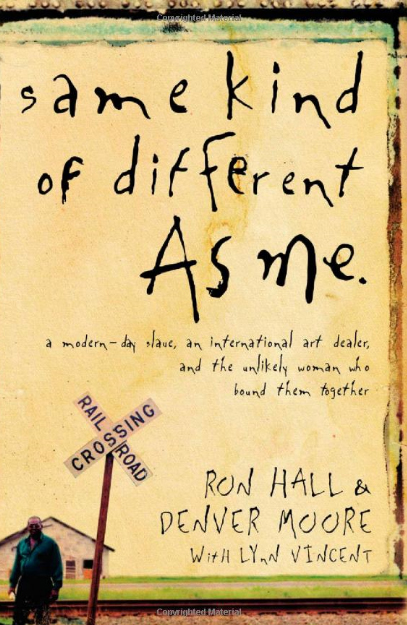
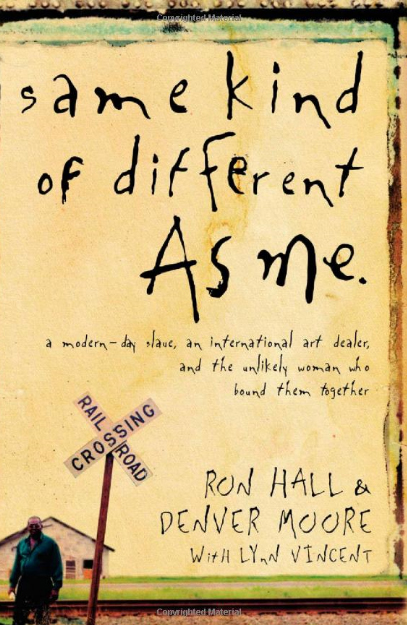
Same Kind of Different As Me

Joy to the World: The Inspiring Journey of the 2019 Rockefeller Tree

I looked out my living room window at the proud little Norway spruce, still safe in its pail, standing out there in our front yard, where it would ultimately make its new home. “You’re gonna be a beauty,” I said. It was January 1960, and I was looking forward to planting our tabletop Christmas tree in the ground come spring. “That’s the one,” I’d said at the gardening store, pointing to a nicely shaped live evergreen, its roots wrapped in burlap. “You’re destined for greatness.” We’d decorated the tree and surrounded it with presents for our two young sons, Mitchell and Thomas. Now I felt almost as if I had three babies to watch grow up.

That spring the tree took root—and grew along with our family. Two more sons came along, Floyd and Kenneth. They loved the tree, climbing its sturdy branches and chasing the squirrels who had settled in it. “Four boys and a tree” pretty much described our family entertainment. As the years passed we craned our necks to see the regal point up top—10, 20, 30 feet in the air.

Each December we used a ladder to hang big multicolored outdoor lights from the branches as best we could. Then we would go inside to warm up and watch the New York City Rockefeller Center Christmas Tree Lighting Ceremony on TV. I always marked the event on my calendar and tried to coordinate decorating our own front yard prizewinner on the very same day. I loved seeing all the people press in around the tree that was chosen from thousands to be the most famous Christmas tree in the world.

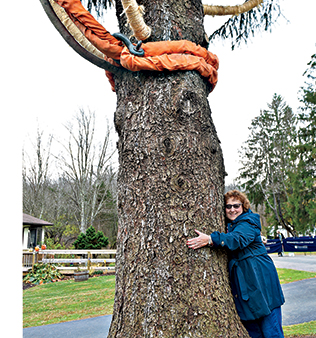
Carol Schultz hugs her Norway spruce prior to its trip to NYC
       Carol Schultz hugs her Norway spruce
prior to its journey to NYC

From our TV room we clapped and cheered along with the live audience when the tree lights were switched on. It was a joy that never dimmed.

One year, while watching the credits roll, I thought of my own tree. If only that could be our tree up there on the plaza stage, a throng of people from around the world celebrating its glory, golden angels lining the entryway to the breathtaking vision. In 2000, I found out how to nominate a tree for consideration. I wrote to the committee and enclosed a photo that hardly did our tree justice. Maybe someday, I thought when I put the letter in the mail.

I almost forgot my Christmas wish until a neighbor came over last summer.

“A guy from Rockefeller Center stopped by. You weren’t home, so he left his card for you. Says he likes your tree.”

The next day I got a knock on my door from the guy. It was Erik Pauze, the master gardener. “Can we talk about your Norway spruce?”he asked.

We strolled under the shade of the tree.

“My crew and I would like to come visit once a week and fertilize the tree, keep an eye on it,” he said. And so they did, until my Christmas wish was a sealed deal. My tree, my little Norway spruce, now 77 feet tall by expert measurement, was chosen to be the Rockefeller Center Christmas tree of 2019!

In October the workers placed a sprinkler on top of the tree to soften the branches so they could bend. Then they wrapped the branches one by one with rope to make the tree easier to bundle.

In November the crew came back to cut the tree down. It was a big to-do in our little town—our neighbors and all the elementary school kids gathered around to watch. Once the crew sawed through the spruce’s mighty trunk, a crane lifted it onto a flatbed truck for its journey to New York City. My family and I all stood on its huge stump for a photo.

Instead of watching the tree lighting ceremony on TV last year, there I was in Rockefeller Plaza as a bona fide VIP.

“You made it!” I cried to my tree.

It was cold and rainy, but when the switch was flipped, all of New York City seemed to light up with me. The crowd roared, and I felt connected by Christmas to millions of people all over the world.

Our tree left Rockefeller Plaza on January 7, but her work was not done. The wood from it was milled, treated and turned into lumber used to build homes for Habitat for Humanity. Joy spread from my home to so many others.

And now it’s time for me to run out to the gardening store and pick this year’s tree. I know she will be a beauty.

Read more: The Man Who Picks Out the Rockefeller Center Tree

Inspirational Books Every Christian Should Read

When I was in college I took a course in religion that changed my life. It was an introductory survey of some of the most heralded Christian theologians both ancient and modern: Augustine, Aquinas and Luther on to Buber (actually Jewish), Barth and Tillich.

Not your everyday household names, but people whose thoughts about faith and belief were to me less about argumentative treatises and more about beauty, poetry, honesty and the courage to simply just “be” in the presence of God.

My professor, Bill Thomas, purchased copies of a volume of Karl Barth’s Church Dogmatics out of his own pocket and distributed them free of charge to his class of students, who were puzzled by his unique generosity. I knew there was something special there and I was hooked.

Yet my life headed out in many different directions after that course, and I didn’t keep up as much with those specific thinkers. Still, most of these extraordinary books have stuck with me after all these years, both in spirit and in print. When Dr. Thomas said, “The more you invest in these books, the more they will pay off,” he was right.

Now I’m excited to recommend something that can help just about anyone make their way into some of the most important books to read in conjunction with the Bible. 25 Books Every Christian Should Read: A Guide to the Essential Spiritual Classics offers work that shapes our faith, including Reflections of Divine Love (Showings) by Julian of Norwich, The Imitation of Christ by Thomas á Kempis, Institutes of the Christian Religion by John Calvin, The Pilgrim’s Progress by John Bunyan, Orthodoxy by G.K. Chesterton and Mere Christianity by C.S. Lewis. Each chapter highlights one book, offering historical background, an explanation of the book’s significance, and a brief reading to get you started.

I would encourage you to get a copy, sample a few of these writings, go find one of them as a whole, and dig in. Happy reading.