

Embrace God's truth with our new book, The Lies that Bind

A Tornado Taught Her the True Meaning of a Perfect Christmas

Our house looked like the holiday spread in a decorating magazine, with garland framing the front door, stockings on the mantelpiece and bowls of cinnamon spice potpourri scattered about. But was it possible for a wife and mother ever to be completely ready for Christmas? Nine days, that’s what I had—and a million things to do. How would I get our Christmas cards done when I couldn’t even take a decent picture of the kids to put in it?

“Boys!” I snapped, on edge. “Picture time.” Jackson, four, and 19-month-old Clay came running. I’d taken 72 shots of them and wasn’t happy with a one. This warm Saturday morning I was determined to get it right, even if the boys would be hot in the outfits I’d chosen. I fussed with the presents and rearranged the porcelain Nativity with Baby Jesus front and center, animals in a neat semicircle around him. Everything had to be perfect.

I popped a roll of 36 into the camera and looked through the viewfinder. Jackson was holding his favorite stuffed animal. “Honey, we’re not gonna put Rabbit in this picture, okay?” Jackson handed him over, grudgingly. He loved Rabbit. He slept with that old thing every single night, and it showed. Rabbit’s neck flopped to one side and his button eyes were off center. He was so threadbare I had to wash him in the gentle cycle inside a pillowcase. When Rabbit was in Jackson’s arms, all was well with the world. But that didn’t mean he belonged in our Christmas card picture.

“Okay, boys, heads together. Say cheese.” Click. “Clay! Sit still.” Click. “Smile. No funny faces, Jackson.” I took the last shot as my husband, Richey, came into the living room.

“Hey, Jackson,” he said, “let’s hit the mall for some last-minute shopping.”

“Good idea,” I said. “Clay and I will get the film developed at that one-hour place by Mama and Daddy’s. Mama and I still have to settle on the Christmas menu.”

I went to my room and put on something cooler. The weather wasn’t exactly cooperating in the perfect Christmas department. Temperatures in the seventies! In December! I saw my Bible lying open on the nightstand and closed it. That book stayed as close to me nights as Jackson’s Rabbit did to him. Lord, I prayed, help me prepare for your day.

My big guys drove off. Clay and I went in the opposite direction. We dropped off the film, and I looked up to see an eerie gray bank of clouds approaching. Tornado weather. I flicked on the car radio. “Warnings are in effect for the following counties,” the announcer said. Thank heavens, South Tuscaloosa County, where we live, was in the clear.

By the time we got to Mama and Daddy’s, the wind was howling. “Carla!” Daddy said. “Where are Richey and Jackson? That tornado’s a real threat.” I prayed they were safe and rushed to the TV. The forecast had changed. “If you are in South Tuscaloosa County,” the meteorologist said, “get to your safe place immediately.”

“Let’s get to the Jaggerses’ basement,” Daddy said. I swept Clay up in my arms. Halfway there, Daddy turned and looked behind him. His eyes said fear. I had to see for myself. I looked—

A black, undulating mass, huge as a building, bore down on us. “Run!” I screamed. Mr. Jaggers met us at the door. “Everybody’s downstairs!” he shouted. We scrambled into the basement and bolted the door. What about Richey and Jackson? Lord, keep them safe. Keep us all safe. That’s all I ask.

Finally the wind died down. It was okay to go outside. That first step into daylight was always the worst. You never knew what would be waiting out there. A yard strewn with tree branches—or an empty hole where a house once stood. We came out of the basement to find the neighborhood unscathed. Mama and Daddy were lucky. What about my house?

“I have to get home,” I said. Richey was probably already there with Jackson.

“Daddy will go with you,” Mama said. “I’ll keep Clay here. Just in case….”

All the way home traffic lights were out, water spewed from hydrants, big oaks lay uprooted. We turned into our neighborhood. Folks stood outside their houses—some with sections of roof missing. Furniture, paper, clothes, appliances and lumber lay everywhere. “Just drive, Baby,” Daddy said. We reached our street. My heart pounded. Houses untouched by the storm stood next to others that had been destroyed. I turned the corner. And then I saw our house—the picture-perfect house with the garland around the door. The home I had readied for Christmas.

The garage and front porch were demolished. The second story was ripped clean off. The first floor’s interior walls stood bare and exposed. A stray garland dangled from a pipe. Richey and Jackson walked up. I got out of the car and fell into my husband’s arms. Daddy took Jackson. “I’m sorry,” Richey said. “I’m so sorry.”

Hand in hand, we stepped over the threshold of what had been our house and picked our way through the debris to the spot where the Christmas tree had been. We’ve lost everything, I thought. Everything.

I made my way to our bedroom and wiped the tears and dust from my eyes. Then I saw it—my Bible, lying on the bed-side table, exactly as I had left it that morning. I opened the cover. The inside was wet and gritty. The acrid, fishy smell of the storm permeated each page. But it was there, still there, unmoved even by a tornado. Yes, Lord, you kept me and my family safe. Thank you.

Friends showed up. They took our linens home to wash, boxed up what was salvageable, carted off furniture to storage. Somebody we didn’t know delivered sandwiches and coffee. Darkness and rain stopped our work. We camped out at Mama and Daddy’s for the night. Clay was young enough to think this was an adventure. Jackson kept up a brave front.

“There’s so much to do,” I moaned to Richey when we finally lay down to rest. “Where do we start?”

“With a good night’s sleep, Carla. Close your eyes,” he said.

The next day, December 17, dawned clear and cold. We were back at the house by 8 a.m., sifting through the wreckage. Jackson had begged to come with us. I watched him out in the backyard, hands clasped behind his back, head down, moving through the debris one step at a time. I knew what he was looking for. Rabbit. We’ve lost everything we own, and all Jackson can think about is Rabbit.

Just a day before I was worried about the packages under the tree, our Christmas cards, the dinner menu. Now there were no presents. There was no tree. No house to celebrate in. There was no Christmas. But Jackson didn’t comprehend the totality of our loss. For him, there was simply no Rabbit. And that sting distracted him from the real pain of realizing we had been completely wiped out. Maybe, in a strange way, that would be Rabbit’s final comfort for my son.

I wondered about all the people surrounding us, friends and strangers alike. Their Christmases hadn’t been ruined. What about their last-minute preparations? What were they doing here with us? Nobody talked much while we worked, but word got around about what Jackson was looking for so hard.

A coworker of Richey’s found a framed photograph of Richey and me in his yard, five miles away. I had always cherished that picture. It was taken in the early days of our marriage when we used to talk a lot about what was most important to us and what we wanted out of life. To love and be loved, we agreed, first by God and each other and the family we hoped to start. I stooped down and pulled a soaked baby sock from a pile of bricks. A lady crouched next to me. “We all put a few Santa gifts in the backseat of your car for the boys,” she whispered. The woman patted my shoulder and went back to sifting through the wreckage.

I looked up at the sky. To love and be loved, I thought. We did, and we were. The worst had happened: The tornado had blown apart my perfect Christmas. But Christmas didn’t need me to make it perfect. Wasn’t it perfect already? Made perfect by the love God sent the world 2,000 years ago. That’s where Richey and I would start to rebuild our lives: We’d start with Christmas. I never thought I’d say it, but I was truly ready for it.

“Hey, everybody!” my brother-in-law shouted. “Look over here! Look what I found!” He held something high above his head. Jackson scrambled over the rubble. “Rabbit! You’re alive!” Jackson grabbed him and danced around. Everyone cheered. All was well with the world. It was Christmas, all right.

I had a hard time choosing a photograph of the boys from that last roll of 36. Tree out of focus, the boys engaged in high jinks…every shot was a winner. Not perfect, maybe, but real.

Last night in our new house, three years after the tornado, Jackson slept soundly in his room with Rabbit. I sat in my room with my Bible open in my lap. I’ve grown accustomed to the smell, but I’m still cleaning the pages. I take my time. I slide my hand down, wiping off the grit slowly, clearing verses before I read the truth of their words. The grit in my Bible kept me real while I prepared this past Christmas. I left the perfect for the One who is.
A Sandy Hook Mother Learns to Give Her Grief to God

Our family loved Easter. We loved the beautiful church service, the pretty new dresses for our girls. I always woke up excited to celebrate God’s promise of new life.

This year, I woke up with a knot in my stomach.

It had been three months since I’d watched Emilie, my six-year-old daughter, board the yellow school bus that would take her to first grade at Sandy Hook Elementary School in Newtown, Connecticut.

Three months since my phone had rung with a message that there’d been a school shooting in Newtown.

Celebrating Guideposts' 75th AnniversaryThree months since an ashen-faced governor of Connecticut had walked into a classroom crowded with terrified parents and told us our worst fears had come true.

Emilie had been a shining light in our family—a precociously empathetic child, keenly aware of other people’s feelings. She’d doted on her younger sisters, Madeline and Samantha. She would draw pictures for me and my husband, Robbie, always with sweet messages, especially when we needed cheering up. The first word she’d ever said was “happy.”

She was murdered by a troubled young man, who had walked into her school and fatally shot 20 children and six adult staff with two semiautomatic pistols and a semiautomatic rifle before taking his own life.

And now it was Easter, one of Emilie’s favorite holidays. I didn’t know how I would make it through the day. Much less heal from the grief that still consumed me.

The three months since Emilie died had tested my heart, mind, soul and marriage. Robbie and I had struggled with anger and overwhelming loss. Working with a counselor, we had managed to remain emotional anchors for each other. We had done our best to keep life going for Madeline and Samantha. Our family had not fallen apart.

Yet the void that Emilie left behind remained. It was as much an abyss as a void for me.

I knew Emilie was with God. I knew she was safe in her Heavenly Father’s arms. But those were words in my head. In my heart was a void, as if Emilie had simply vanished from existence. Churning around the edges of that void, that abyss, was pure loathing for her killer.

I hated that loathing, and I hated that void. I felt helpless about both.

For three months, I prayed for those feelings to be healed. God had given me various answers to those prayers. But I didn’t understand any of them. And the answers didn’t make the feelings go away.

The first answer—and I admit, this made me jealous—came not to me but to Robbie.

Less than a month after Emilie died, Robbie emerged from tucking in her little sisters one night with a look of awe on his face.

“You’ll never guess the conversation I just had with Madeline,” he said. He told me that Madeline had asked if we’d ever see Emilie again.

“Where do you think she is?” Robbie said.

“Heaven,” said Madeline.

“That’s right,” Robbie said. “So the best way to see her again is to love God and make good choices.”

Then Madeline said something surprising: “But what about the boy who shot her?”

Robbie searched for words. “How do you feel about that boy?” he said.

“I think he was a good boy but he made some really bad choices,” she replied.

“And how do you think God feels about him?” Robbie asked her. “I think he loves him but he is not happy with the choices he made,” Madeline said.

Robbie and I sat in the living room as he recounted this conversation. He began to cry. “Alissa,” he said, “I could feel Emilie there! I could feel her with Madeline and me.”

I stared at him in shock. That sense of Emilie’s presence was exactly what I wanted! Some sign from God to fill the void. Why had it happened for Madeline and Robbie but not for me?

I racked my brain for something I could do to receive a similar gift. Then it came to me. I needed to pray as intensely and transparently as Madeline had prayed in her childlike directness. The best place to do that would be at the Mormon Temple in New York City. In Mormonism, the temple is a sacred place that’s reserved for weddings, baptisms and intense prayer and meditation, especially during times of trouble. The closest temple to our house was in New York.

A few days later, Robbie and I drove down to the city. We sat in the room set aside for prayer, and I began praying harder than I ever had before. Take away this void, God. Let me know Emilie is not gone.

I listened intently, certain that I was at last doing what I needed to do to get through to God. And then an answer came. You need to talk to the shooter’s father.

What? That wasn’t what I was praying about! I tried to bring my focus back to Emilie. The words persisted. At last I gave up, disappointed. On the car ride home, I told Robbie what had happened. He looked bewildered too. But the words were so clear, we felt we had to act on them.

We reached out to Peter Lanza through intermediaries. To our surprise, he responded immediately. I was a nervous wreck driving to the Connecticut office building where we agreed to meet.

That nervousness evaporated as soon as I saw Peter. He was as much of a wreck as I was. His hands shook. His face was flushed.

We sat at a conference table, and I told Peter about how I’d felt moved by God to meet with him. Then suddenly the question I most wanted to ask became obvious: “Why did your son do what he did that day?”

For some reason, I felt prompted to add: “I’m sorry you lost him.”

Peter’s eyes widened at my words. He must have expected me to hurl invective. His hands stopped shaking, and the words poured out of him. He told us how his son had struggled socially at school, especially after Peter and his wife separated when his son was nine and later divorced. Diagnosed with Asperger’s syndrome as a teenager, his son gradually cut himself off from Peter and then from the rest of the world.

As Peter talked, I began to realize that the effects of his son’s evil actions spread far beyond my family and the families of other victims. In the aftermath of the shooting, Robbie and I had been showered with gifts and kindnesses from strangers in Newtown and far away.

Peter Lanza was reviled. A horrified world recoiled from him at the moment of his greatest loss and confusion. I felt sorry for him.

“Meeting you is like a glimmer of light through a dark agony,” Peter said before we parted that day. I wondered if it could be a glimmer for me too.

Two months later, lying in bed on that Easter morning, I still wondered. What was the thread connecting these messages from God? What was God trying to tell me? Whatever it was, it hadn’t gotten through. The thought of Easter without Emilie was more than I could bear.

But I had to bear it. Madeline and Samantha were up. I could hear them tiptoeing around in search of Easter baskets. Soon they would want help putting on their new dresses. I forced myself out of bed and summoned up my best coping smile.

Once the girls were dressed and tearing around the house in excitement, I returned to the bedroom to get ready for the service.

“Would you girls like some music to dance to?” I heard Robbie ask. One of Robbie’s favorite hymns, “Come Thou Fount of Every Blessing,” started on the stereo, accompanied by giggling and the patter of little feet. At first, I nearly burst into tears, thinking about how much Emilie would have loved being there with her sisters.

Then something moved me to dress quickly and go watch. I opened the door, stepped into the hall, and there were Madeline and Samantha, twirling and laughing to the music. I grinned in spite of myself. All of a sudden, a feeling of warmth and peace descended on me. It filled my body and radiated out to the hall and the rest of the house.

With crystal clarity, I knew in my heart—it was as if I had always known—Emilie had not vanished. Yes, she had died. But she was alive in a new way with God. I could almost feel her right there with us. Every memory I had of her arose in my mind and became solid and real. I breathed in the blessed sense of her.

Tears rolled down my cheeks. Robbie appeared beside me and put his arm around my waist.

Why was this happening? I had no idea. Only at church, later that morning, did I begin to understand. Listening to the wonderful Easter story, I thought again of that insight I’d had meeting with Peter Lanza—that Emilie’s death was part of something larger. Now I knew just how much larger.

Madeline had sensed that larger meaning when she asked Robbie about the man who took Emilie’s life. God had pointed me toward it when he counseled me to meet with Peter.

Death, God wanted me to understand, did not extinguish Emilie’s light. My grief was not the end. When I looked beyond myself, reached out to others, trusted God to make something good from the horror of Emilie’s death—that was my healing.

How could I believe this? Because God had lost a child too.

Long before Emilie died, Jesus died. Then Jesus arose. Out of the darkness and grief of his death came new life.

Emilie was now part of that new life. There was no void where she had been. With God, there is never a void. I did not have to hate the shooter for taking Emilie away. No one could take Emilie from God. Indeed, I could give even the shooter to God. I could give all of it to God. Then I could begin healing.

Those thoughts came to me as glimmers on Easter morning. Over the next several months, they became more real. I stopped hating the shooter and later forgave him in my heart. More important, I understood that ultimately it was God’s job to judge and forgive. As grief and hatred left my heart, there was more room to remember Emilie and treasure what she meant to our family.

Eventually we left Connecticut, moving to a rural area on the West Coast, where Robbie got an excellent job at a hospital and Madeline and Samantha could grow up without the pressure of the shooting’s aftermath.

Five years after the horror of that day, I still miss Emilie intensely. But that only strengthens my resolve to be the best mother I can be for Madeline and Samantha. My grief, still crushing at times, no longer defines me. I am defined by my relationship with a Heavenly Father who embraces—and gives new life to—all of his children.

For more inspiring stories, subscribe to Guideposts magazine.

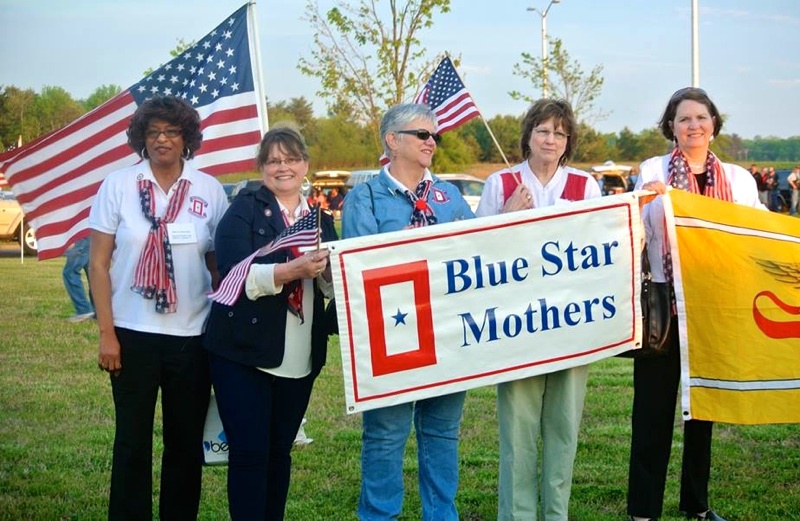
Are You a Blue Star Mother?

I remember the first time I heard the term Blue Star Mother.

After our oldest announced his decision to enlist, I became hypersensitive to all things patriotic. Everywhere I turned, someone had ties to the military. It could be anything from bumper stickers announcing someone in the car ahead of me loved a soldier to tiny lapel pins in red, white and blue. My entire perspective was centered on those who served and the ones who loved them.

It was this sensitivity that led me to approach a woman at a conference I was attending. On the collar of her blouse was a small pin, a blue star within a field of white, banded by red. After our class, I asked her what it stood for.

“It means I’m a Blue Star Mother.” At my blank look she continued, “I have a son serving in the military.”

She had just described me, and I wanted to know more. I told her about my son’s upcoming enlistment, and she introduced me to the organization that would be my lifeline during my son’s time in the service.

Blue Star Mothers of America is a 501(c)(3) Veterans Service Organization (VSO). They were incorporated by Congress in 1942. They are nonpartisan, nonsectarian, nondiscriminatory and nonprofit. Their mission is simple:

  • Support fellow members.
  • Support our sons, daughters and other family members who are currently serving in the U.S. Armed Forces.
  • Support our country’s veterans.
  • Support the families of our fallen heroes.

There are Blue Star Mothers chapters throughout the United States, with more than 10,000 members. It’s easy to get connected. When I joined, the women in our local group welcomed me with open arms. They shared valuable information, support and prayers. Their friendship was one of the things that helped me through our son’s time in the military. I remain active to help support those women who are just beginning the journey with a child in the military.

If you have a son or daughter serving, or know someone who does, I encourage you to contact a local chapter. Get plugged into a group that understands what you’re facing. Not only will you have the support you need, but you’ll also be able to support others in similar situations.

What about you? Do you know about Blue Star Mothers of America? Share your stories in the comments below.

Appreciating God’s Incredible Creation

This morning I opened the blinds to let in the sunshine and noticed something new outside one of our windows. Overnight, a large spider had woven a web that stretched across the window. The intricate design captured my attention and brought home a reminder that I don’t have to look far to see the creative genius of an incredible God.

Nothing shows that more beautifully than the perfection of an infant. Whenever I’ve held one of my brand-new grandbabies, I’ve been struck by the thought that this long-awaited little one came fresh from God’s hands to ours. I’ve sat and counted 10 tiny toes and fingers. I’ve stroked my hand across baby-soft skin and downy hair. I’m in awe of a God who could design all of that, who knit that child together while he or she was still in the womb.

I see His craftsmanship in the bright colors of flowers, every blossom different and unique. I enjoy His love of texture in the rough bark of trees, and in the soft fur of a kitten or dog. And I soak in the sheer beauty of an orange sky as the sun sets over the ocean, casting shadows on the surface of the water. Nobody paints the sky better than God.

I’m reminded of His faithfulness every night when I see that He’s—once again—hung the moon and the stars in the sky. I see His majesty in the mountains that rise high above me, and His attention to detail in the velvety blades of grass that tickle my feet when I walk barefoot through the yard. What an amazing God—and how even more amazing that He cares about me…and you.

That makes me think of those verses in Psalm 8:3-4:

When I consider Your heavens, the work of Your fingers, the moon and the stars, which You have ordained, what is man that You are mindful of him, and the son of man that You visit him?

I’m so grateful for a God who—in the midst of creating all this perfection—still has us on His mind. That, sweet friends, is what’s truly incredible.

An Easter Like the Very First One

Easter wasn’t really the same this year, was it? Having to worship remotely, not singing together in a church that smelled of fresh-cut flowers. No big Easter egg hunt in the yard afterwards.

But maybe the way we feel right now is similar to how those first followers of Jesus felt when they were confronted with the miracle of Easter. Fear, bewilderment, awe. When I look at the Bible stories of the Resurrection they help me find hope in the moment that is now. These are a few of the lessons I’m learning:

Fear is only natural.

At the end of the Gospel of Mark, we see this reaction to the empty tomb: “So they went out and fled from the tomb, for terror and amazement had seized them; and they said nothing to anyone, for they were afraid.”

They were afraid. Unwilling to share the good news with anyone. Jesus had to appear to His disciples more than once for them to take it in. Even if it was what He had been telling them all along.

It’s hard to recognize the power of the Resurrection.

One of my favorite stories, from the gospel of Luke, is about Jesus’s appearance to the two disciples on the road to Emmaus.

They don’t recognize Him. They seem amazed that He is unaware of the events that have just happened, the Crucifixion. He goes on to describe the sense of it, but still, they can’t take it in.

It was only when Jesus sits at the table with them and breaks bread that they know Him. He had been with them that whole way. Like He is with us the whole way. Even now.

The proof is deep inside us.

I’ll admit, sometimes I’m a bit like Doubting Thomas. I want to see proof. I want some evidence. Thomas knew the other disciples had seen this Risen Lord. Why hadn’t he?

“Unless I see the mark of the nails in his hands and put my finger in the mark of the nails and my hand in his side,” Thomas says, “I will not believe.” A miracle? Show me, we say.

But when Jesus does appear to the disciples and says to them, “Peace be with you,” Thomas gets it in an instant. No proof necessary. Jesus’s presence is enough.

That presence has never left. Easter is here. Right now. Always has been. Always will be. Despite our fears. Despite our doubts. God didn’t leave us then, and He certainly hasn’t left us now.

An Angelic Reunion Between Two Courageous Women

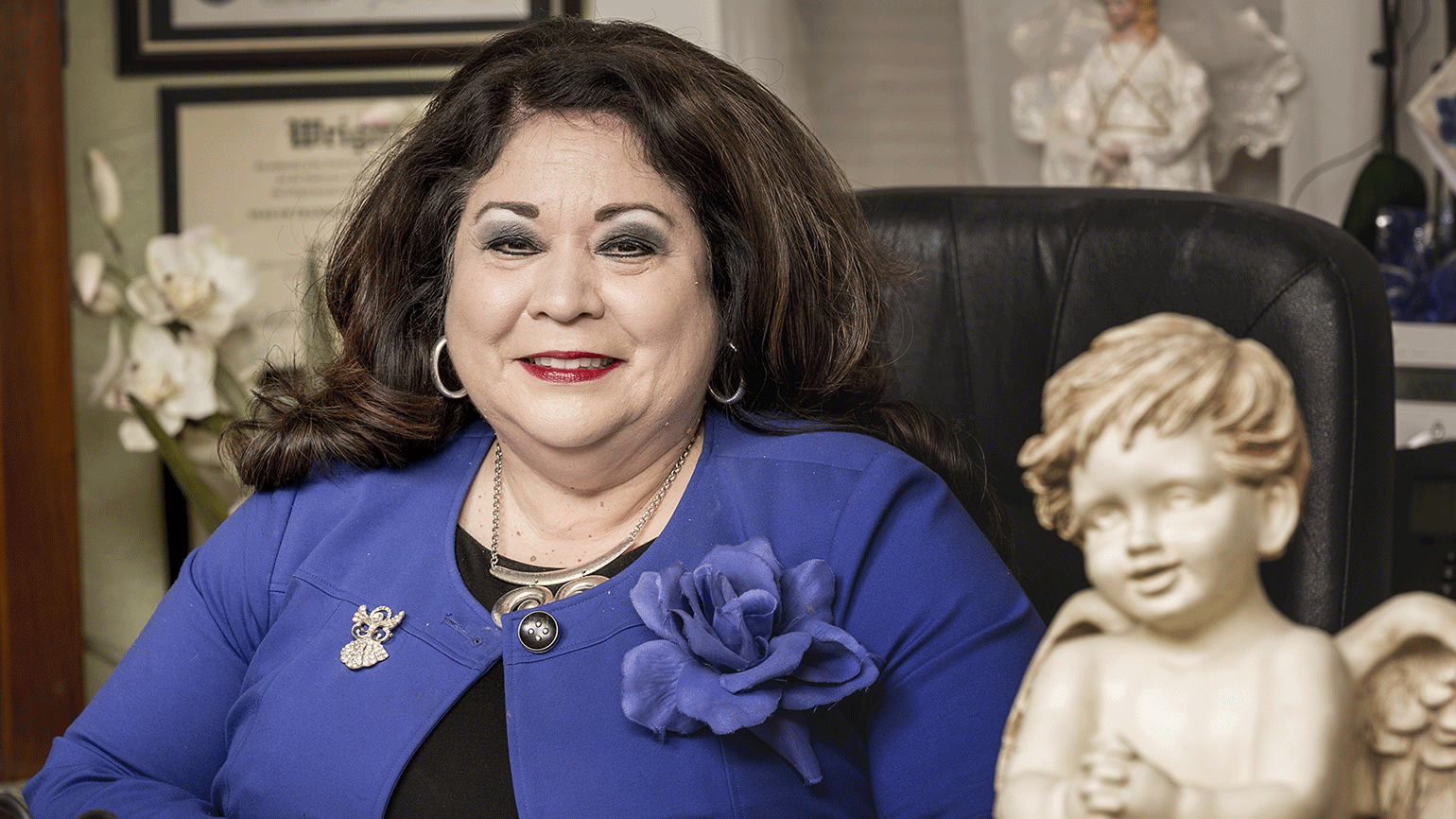
Angels of Grace. That’s what I called the foster family agency that I founded in 2000. Then, 14 years later, in 2014, we caught the attention of the local Rotary Club and I was invited to speak. I was a bit nervous but happy to talk about our work.

Angels of Grace took children out of dangerous environments and found them safe, nurturing places to grow up. We prioritized keeping siblings together and reuniting children with their families or placing kids into permanent homes.

I was up next to speak, after the policeman finished telling his story. As I waited to be called to the podium, my mind went back to a night many years before. That night, it was me who desperately needed to find a safe place.

I sat alone in the busy ER at the county hospital. My body was sore. Broken ribs made it hard to breathe. A split lip made my mouth taste like blood. My face was swollen and bruised. When I caught sight of my reflection, I saw the handprints. The handprints of my husband, the man who’d put me here.

I looked around at the others in the ER. Two sailors in uniform injured in a bar fight. A kid on a bike, hit by a car. An asthma attack. Chest pains. Overdoses. The staff was stretched to the limit. One nurse in particular seemed to be everywhere at once, checking on each person and reassuring them.

“Hi,” she said, coming over to me. “Your name’s Lisa, right? I’m Jena. You’re going to be okay. I’ll be with you as soon as I can.”

I nodded. She’s so smart, competent and strong, I thought. Everything I wasn’t. Everything I could never be. I had people depending on me too: a four-year-old son and two-year-old daughter. And another baby on the way. How was I going to take care of them on my own?

Now here I was at the Rotary Club. It seemed almost like a miracle. The police officer spoke of fulfilling his boyhood dream, leading a life of service.

From an early age, I knew I wasn’t allowed to have dreams. I followed the plan laid out for me by my parents, my church. God’s plan, 6they said. I got married right after high school, everyone anxious for me to start a family. Almost immediately, my husband became abusive. It was my duty to make it work, I was taught. That was what God wanted.

I stuck it out. For my family, for my God. And then, while I was pregnant with my third child, a friend of mine was killed by her abusive husband, her children left motherless. I held my own children’s hands at the funeral. That can’t be what God wanted for her, I thought. It can’t be what a loving God wants for me.

The next time my husband attacked me, I gathered up the kids and left the house in a bathrobe. At three in the morning, I found a pay phone on a deserted street and called a women’s shelter.

They took care of my kids and sent me to the hospital. That’s how I ended up in the ER, watching Jena care for all those patients. Even now, all these years later, safe and waiting to speak at the Rotary Club, I remembered how scared I’d been. I’d thought leaving home would be the hardest thing I’d ever done, but facing the future had seemed even more impossible.

All night long, Jena checked on me. One by one, the other patients were cleared out. Eventually I was moved to a room. After I was settled, Jena came to find me. “Just wanted to make sure you were okay,” she said.

She cupped her hands around my face and looked right into my eyes, as if she had something important to say. “You’re beautiful,” she said. “You’re smart. You’re courageous. This is just a bump in the road. We’re going to get you to the other side.”

I had to be those things. It was the only way my kids and I would survive. But I wasn’t Jena. I wasn’t strong or courageous. Before I could stop myself, I grabbed her hand in mine. “Pray for me,” I whispered.

Jena didn’t miss a beat. “Dear Lord, I ask you to take care of Lisa. Send your angels to watch over her. Wrap your arms around her. Protect her. Give her wisdom and insight. Help her to know how beautiful she is.”

The memory of Jena’s prayer came just as the officer was finishing up his talk. Any nervousness I had slipped away. I felt strong and hopeful, just as I had that night Jena had prayed for me. As if I could face anything. After all, I had angels watching over me.

With my notes in order, I stood and took my place before the crowd at the Rotary Club and told them about the work we did at Angels of Grace. How I was on call 24 hours a day, ready to go get a child whenever I was needed.

“The first thing I tell every child I meet is that they are beautiful and they are safe,” I said. “I make sure they know this is a bump in the road and promise we’re going to get them to the other side.”

I talked about some of the children I’d met, the families we’d created, about our annual fundraiser coming up. The audience seemed enthusiastic about our mission. Several people approached me after I finished to ask more questions. One woman looked familiar, but I couldn’t place her.

“My husband was the police officer who spoke before you,” she said. “That’s why I’m here tonight. But I want to help you with your fundraiser any way I can.”

Her voice was familiar. I realized where I’d heard it before. In a busy ER on the scariest night of my life. “What’s your name?” I asked.

“Jena Farmer.”

“Were you ever a nurse?”

“I was,” she said. “A trauma nurse at the old county hospital.”

“Jena, do you remember a little Mexican girl who came to the ER? Her husband had beaten her….”

“I prayed for her,” she said. “I mean… for you!”

All these years I’d thanked God for the nurse whose kind words had given me the courage to face the future. The same words I’d passed on to hundreds of children since then. Now God had brought Jena and me together again so she could see herself what angels can do.

Learn more about Lisa’s organization, Angels of Grace

For more inspiring stories, subscribe to Guideposts magazine.

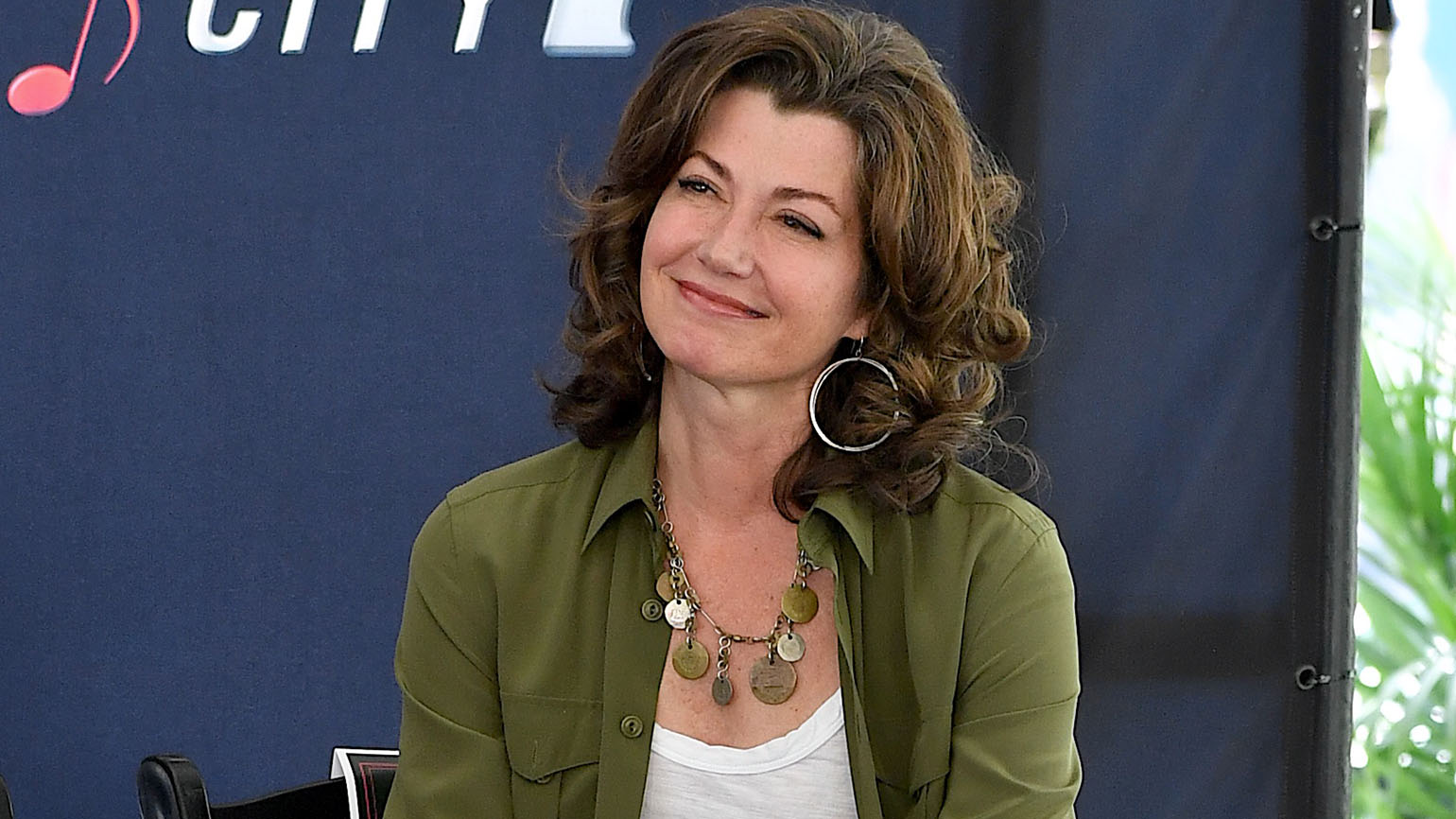
Amy Grant on Her ‘Miraculous’ Recovery from Open-Heart Surgery

Singer-songwriter Amy Grant expressed her gratitude to loved ones for their prayers after undergoing open-heart surgery in early June. The 59-year-old Christian pop artist took to Instagram to thank her fans, friends and family for the outpouring of support, while also sharing photos of her post-surgery scars.

The operation was required to correct a partial anomalous pulmonary venous return (PAPVR), a congenital heart condition in which one or two of the pulmonary veins returns blood to the right atrium instead of the left atrium.

Grant first announced her diagnosis in February, in honor of Heart Health Awareness Month, via Twitter, where she thanked her doctor for encouraging her to have a heart check-up due to a family history of heart disease. Tests revealed the rare but “fixable” condition.

“Instead of concerts and camping trips this summer, I am going to take care of my heart,” she wrote, before encouraging her followers to do the same.

The six-time Grammy winner, who has been married to country singer Vince Gill since 2000, compared her experience to being “a non-runner who was signed up for a marathon,” but added that the well wishes she’s received were “just pushing me through.”

“Thankfully the doctor said it could not have gone better,” Grant’s rep told PEOPLE. “We’re praying for a full and easy recovery over the next days, weeks and months to come.”

“My recovery has honestly felt miraculous,” the music star assured her followers. “I want to say thank you to each person who said a prayer for me. Prayer changes everything.”

While crediting the power of prayer for her smooth recovery, the singer also urged her fans to continue praying for the country during this “crazy, broken, yet beautiful time.”

“Let’s turn all the brokenness into love and seeing each other,” she added. “I love you.”

A Mountaintop Rescue Came Together with God’s Help

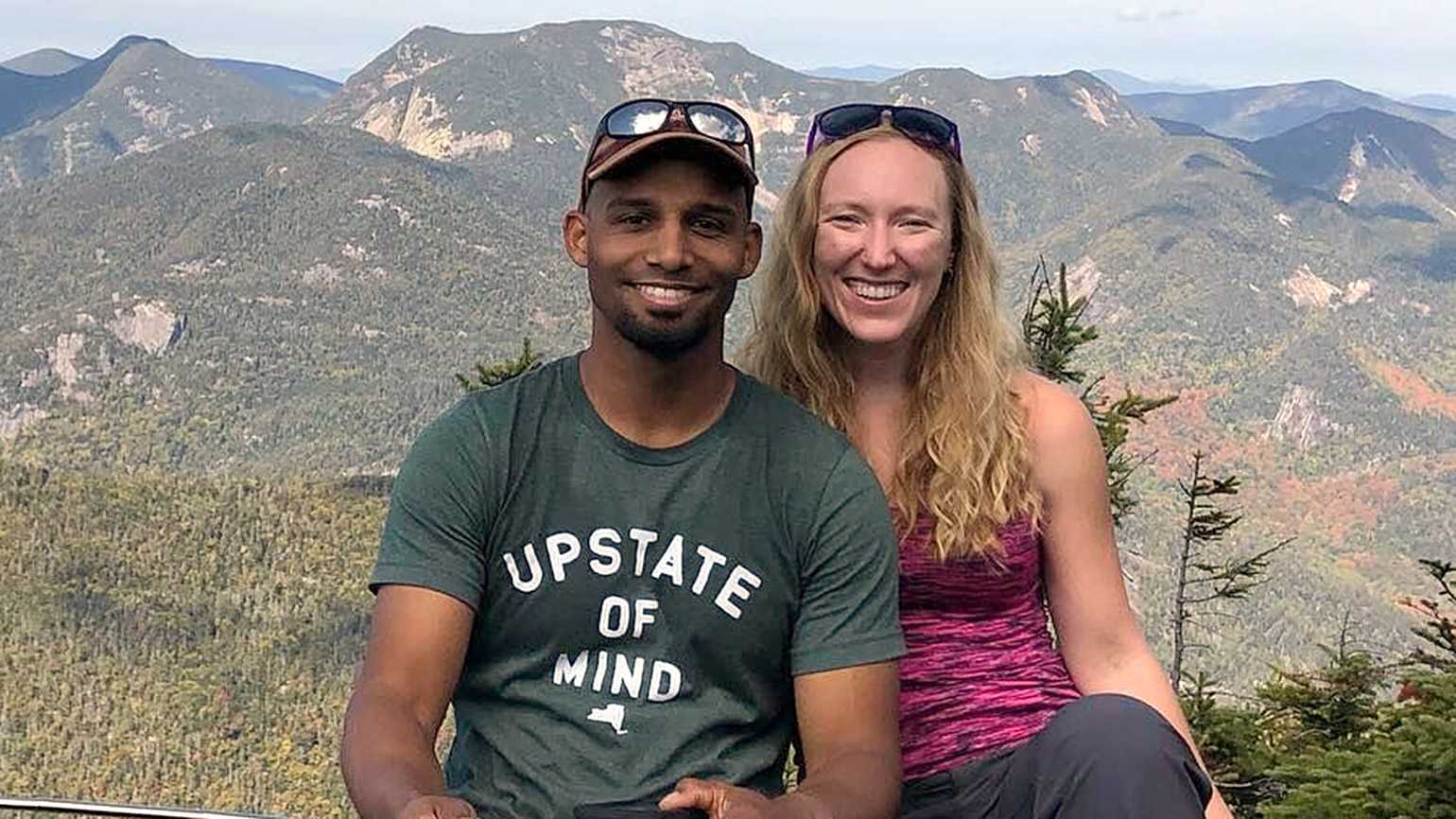
I did it! Last November, I stood at the top of my forty-sixth Ad­irondack peak in less than four months, the breathtaking beau­ty of New York State’s Keene Valley spread before me. I raised my arms in triumph and took a deep breath of crisp mountain air. It doesn’t get much better than this.

Over the years, I’d summitted every peak taller than 4,000 feet in the Ad­irondacks, joining a group known as the 46ers. What made today special was that I’d set a goal to do all 46 again in less than a year. Then nailed it with­in just a few months. A personal best!

I’m big on focus and commitment. I’m a full-time literacy teacher, a Ph.D. student in education and a church or­ganist. In my free time, I tackle hiking challenges. I like to push myself, to accomplish things. It’s how I feed my­self, physically, mentally, spiritually.

I looked over at my husband, Mike, and friends Emily and Katie-Jean, who’d joined me on this climb to the top of Dial and Nippletop Mountains. They were all fit, experienced hikers, though not as gung-ho about it as me, Mike especially. He’s more of a tech guy.

We’d set off in the morning, dressed in layers to ward off the chill. It took us just less than five hours to cover the five miles to the 4,620-foot summit of Nippletop, with more snow and ice on the rocky trail the closer we got to the top. It was almost 1:30 p.m. now. We’d have to head down soon, while it was still light out.

A friendly young hiker waved to us. “Hey, want me to take your picture?”

“Absolutely!” I said. I put my arm around Mike. Emily and Katie-Jean squeezed in next to us.

“Thanks for doing this for me,” I whispered to Mike.

“I’m so proud of you,” he said.

I gazed out over the sweeping vista. The purple mountains in the distance. The crystal blue sky that seemed to stretch on forever. This was the best part. I felt such gratitude for being able to experience the beauty of God’s creation, a blessing for all the work I’d put into this. Thank you, Lord, for being with me in this challenge.

Mike gave the hiker his phone, which had a better camera than mine. The other guy snapped a few pics.

“Okay, let’s get going,” I said. “I want to take a different trail so we can get down before dark. It’s steeper but shorter.” It would still be a good four hours before we got to our car, which was in a parking lot three miles from the base of the mountain.

We spaced ourselves apart so we wouldn’t fall on each other if one of us stumbled. I led the way, setting a fast pace. I wanted to scout out the terrain.

The descent grew steeper. I’d caught a glimpse of this trail on the way up, but what had appeared to be snow was more like a river of ice.

I stopped to attach microspikes—steel teeth that clamp onto my boots for extra traction. I’d reminded Mike to pack his microspikes. I hoped he’d remembered. Had I told our friends to bring theirs?

Carefully I sidestepped down the slope. A quarter mile down, I stopped and looked up the trail for the others. I couldn’t see them.

Then an anguished scream pierced the quiet. Mike! In the 10 years we’d been married, I’d never heard him cry out like that. He must have fallen.

I scrambled up the frozen slope. Why hadn’t I hung back to guide him?

Finally I saw him, maybe 100 feet ahead of me. Sprawled on a steep, narrow, wooded part of the trail. Ice everywhere. His hands were clutching his right leg. It felt as if I flew the rest of the way to him. My eyes went to his foot. It hung gro­tesquely, pointing the wrong way. I gasped. “What happened?”

“I slipped on the ice,” he said. “Then I heard this crack. It hurts bad!”

“Don’t worry,” I said, my heart rac­ing. “I’ve got this.” I dug through my daypack—map, blanket, water bottle, headlamp, snacks, space blanket, hy­dration pack, first aid kit. All this stuff but nothing for a broken bone. Out in nature, I always felt on top of things. Now there was nothing I could do for my husband. Poor Mike! What had I gotten him into?

Moments later, Emily and Katie-Jean came cautiously down the slope. Katie-Jean was a physical therapist. “What should we do?” I asked.

Katie-Jean checked Mike’s ankle. “We need to splint it,” she said.

“Here, try this,” I said, handing over my hiking poles. I peeled off one of my shirts. Katie-Jean fixed a pole to Mike’s leg, using my shirt and several bandanas. What now? There was no way the three of us could carry him down this mountain.

I pulled out my cell phone and punched 911. Nothing. No signal.

“Can I help?” It was the guy who’d taken our picture at the summit.

“My husband fell. He’s hurt, and I don’t have service here.” The words came out in a rush.

“Take mine,” he said. “I got service near the top.”

I’d have to leave Mike and climb higher to get service.

“We’ve got him,” Emily said. I nod­ded and squeezed Mike’s arm. “Hang on, hon,” I said. I wished I’d never organized this hike. Mike was only here—and hurt—because of me.

I hurried up the slope. He’s depend­ing on you, I told myself. I kept trying 911, hitting redial even as I picked up speed, breaking into a jog.

Just above the tree line, the call fi­nally went through. “We’re hiking Nippletop, and my husband fell,” I told the 911 dispatcher. “I think he broke his leg.”

“Is he conscious?” he asked.

“Yes, but his leg is bent sideways at the ankle. He’s in a lot of pain. We won’t be able to get out by ourselves. We need help.”

“A forest ranger will hike up,” the dispatcher said. “We’re trying to get your location from your phone. Can you describe where you are?”

I did my best to explain, then rushed back to Mike. “Help’s coming,” I said. He nodded, grimacing.

I returned the phone to its owner, but he stayed in case he could help. I tucked my space blanket around Mike. We talked and joked around to keep his spirits up. The rest of us kept mov­ing to stay warm.

An hour went by. Then another. The sun was sinking in the sky. What if Mike went into shock? But there was nothing I could do except wait and pray. Lord, my husband is so much more important than some personal milestone. I’d trade all those summits just so Mike could be okay.

At last, a ranger in a navy jacket appeared, shouldering a bulky green backpack. She took charge immedi­ately. “We’re going to airlift him out,” she said. “We have to hurry. It can’t happen after dark.”

The ranger pulled a saw from her backpack. “You need to cut down trees so your husband doesn’t hit them as he’s being raised,” she said. “Be care­ful—the saw is sharp.”

Was she serious? The trees around us were 20-foot-tall birches, not spin­dly little saplings. Still, we worked frantically and managed to fell six trees in a half hour.

By now, the chopper was overhead, its propellers whipping up a fierce wind. The ranger radioed the pilot, and he dropped a rope. The ranger fashioned a half harness and slipped it around Mike. He rose slowly in the air.

Soon Mike would be at the hospi­tal, getting the care he needed. An extraordinary rescue, made possible only through the efforts of an entire team. Our friends Emily and Katie-Jean, the hiker who’d lent me his phone, the ranger, the helicopter crew, the dispatcher and other rangers who had been in constant communication with everyone. And God, who’d coor­dinated it all.

Relief and gratitude washed over me as the crew lifted Mike into the helicopter. I waved and watched until the helicopter was barely a speck in the sky.

It would be a long hike back down for the rest of us. I strapped on Mike’s backpack in addition to my own. I felt myself sag under the weight.

Katie-Jean put her hand on my shoulder. “How are you doing?” she asked. “I’d be freaking out.”

“I’m okay,” I said. Exhausted and a little shaky but okay. And that was because of everyone around me. Reaching the mountaintop, even my forty-sixth of the highest peaks in the Adirondacks, wasn’t how I felt closest to God. It was knowing that he’d sup­ported me when I really needed him, bringing the people who were able to help, every step of the way.

I couldn’t wait to reunite with Mike at the hospital. I started down the mountain with my friends, the packs I carried already feeling lighter.

For more inspiring stories, subscribe to Guideposts magazine.

A Mother’s Amazing Answered Prayer

The waiting was the worst. Waiting in an exam room at the Wright-Patterson Air Force Base hospital in Ohio, where I’d finished chemotherapy for Stage 4 Hodgkin’s lymphoma a year earlier. Waiting for the oncologist to come in with my lab results. Waiting to see if the little bumps by my collarbone were just residual scar tissue.

Waiting, holding my wife Gretchen’s hand, praying we would be given the all clear to live our lives. I was 24 and Gretchen was 23. We’d been married for five years. We had so much ahead of us, didn’t we? Filling the home we’d just built in Michigan with children, making a lifetime of memories together.

But one glance at the oncologist’s face as he walked into the room told me that we’d have to put our dreams on hold again.“Your biopsy came back positive for Hodgkin’s lymphoma,” he said. “I’m very sorry.”

Gretchen squeezed my hand so hard, I could tell she was struggling to keep it together. I couldn’t look at her or I would break down. I had to be strong. Her mother had died of lung cancer not long after our wedding. Gretchen wouldn’t be able to bear losing someone else she loved. Not now. Not to cancer again.

Sign up for Guideposts Free e-newsletters and Get Inspiration Delivered to Your Inbox

The oncologist explained that since my cancer was resistant to the chemotherapy I’d already had, I would need a bone-marrow transplant. But the procedure had such a high risk of complications that I would have only a 20-percent chance of surviving it.

“When can we start?” I asked. The oncologist thought I didn’t realize how grave my situation was. I knew. But I didn’t believe in percentages. I believed in God. I would do my best to fight the cancer. The rest was in the Lord’s hands.

Gretchen and I went back to our room at the base hotel. It was hard calling our family and friends to break the news. My mother burst into tears when I told her. The stress of the day took its toll. Gretchen and I went to bed exhausted. I fell asleep almost immediately.

Something woke me in the middle of the night. A touch. A hand gently brushing my cheek. Gretchen? Was she getting up for some water? I opened my eyes. It wasn’t my wife leaning over me. She was sound asleep. It was Jesus, gazing at me with such love in his eyes—more love than I had ever felt before, than I had even thought was possible.

“I am with you.” His lips didn’t move, but I heard him as clearly as if he had spoken. And in a way, he had, through his touch. Then he lifted his hand from my cheek and left, and it seemed as if my worries and my cancer were lifted from me too. I went back to sleep confident that I had a lot more life to live.

First thing in the morning, I told Gretchen all about my encounter. “I saw Jesus!” I said excitedly. “He actually touched my face!” I showed her the exact spot on my right cheekbone where I’d felt the brush of his hand.

She thought I’d simply had an awesome dream. We went to a Bob Evans restaurant for breakfast. I asked Gretchen to grab us a table. I couldn’t keep what had happened to myself. I ran to the pay phones to call my mom.

The perfect Mother’s Day Gift: Women’s Devotional Bible

“Chris?” Mom sounded frightened, and no wonder, considering the last news she’d heard from me. “You’ll never believe what happened last night!” I said. I told her about Jesus coming to me in the night. His caress. His parting words.

Silence. Then Mom started sobbing. “Why are you crying?” I asked. “I’m going to be fine.”

Finally she composed herself. “Chris, you don’t understand,” she said.“Last night, after you called, I asked God over and over for one specific thing. I asked him to be with you.” Jesus didn’t just come to comfort me, he came to answer my mother’s prayer.

There was one more thing I didn’t understand at the time—not until Gretchen and I had the first of our three sons. Late one night he woke up with a fever. I held my baby and tried to comfort him. If only I could transfer his sickness to me and suffer for him, I thought, stroking his cheek with my fingers.

Suddenly I was brought back to the night that Jesus had touched me. At last I recognized the love I’d seen in his eyes. It was the love a parent has for his children. A love that healed me.

A Miraculous Rescue from a Raging Inferno

On the plains of northwest Oklahoma, you can see for miles: nothing but prairie grass, clumps of cedar trees and rugged red-rock canyons. But even with my binoculars, I could barely make out the helicopters, one after the other, dumping water on a wildfire at the horizon. I wasn’t concerned by the small plume of smoke snaking skyward. It had to be at least 50 miles away, across the South Canadian River even.

That afternoon, my uncle Larry and cousin Tony and I had driven to this 4,000-acre ranch for a planned three days of turkey hunting. Larry had brought three horses for us to use, moseying about the ranch like real cowpokes. At age 57, I was semiretired from a career in retail management. It felt great to get away for some male bonding.

Community Newsletter

Get More Inspiration Delivered to Your Inbox


I snapped a few pictures of the bushy cedars, the canyon rims—nothing but blue skies above—and texted them to my wife, Ande, two hours away. “Nothing to worry about,” I typed. “Having a great time.” She’d seen the fire on the news and called a few minutes earlier to warn me, but we’d lost the cell connection. I didn’t want her fretting. I knew she’d be praying regardless. All that talking-to-God stuff came harder for me. It was hard to imagine him actually listening to anything I’d have to say.

The wind had picked up, blowing hard from the southwest. We left the horses in the stable by the ranch house and climbed into a Gator utility vehicle, Larry driving, to scout for places to draw out the gobblers the next day. We headed north on a small gravel road that hugged the ranch perimeter. We stopped here and there to look for signs of turkeys.

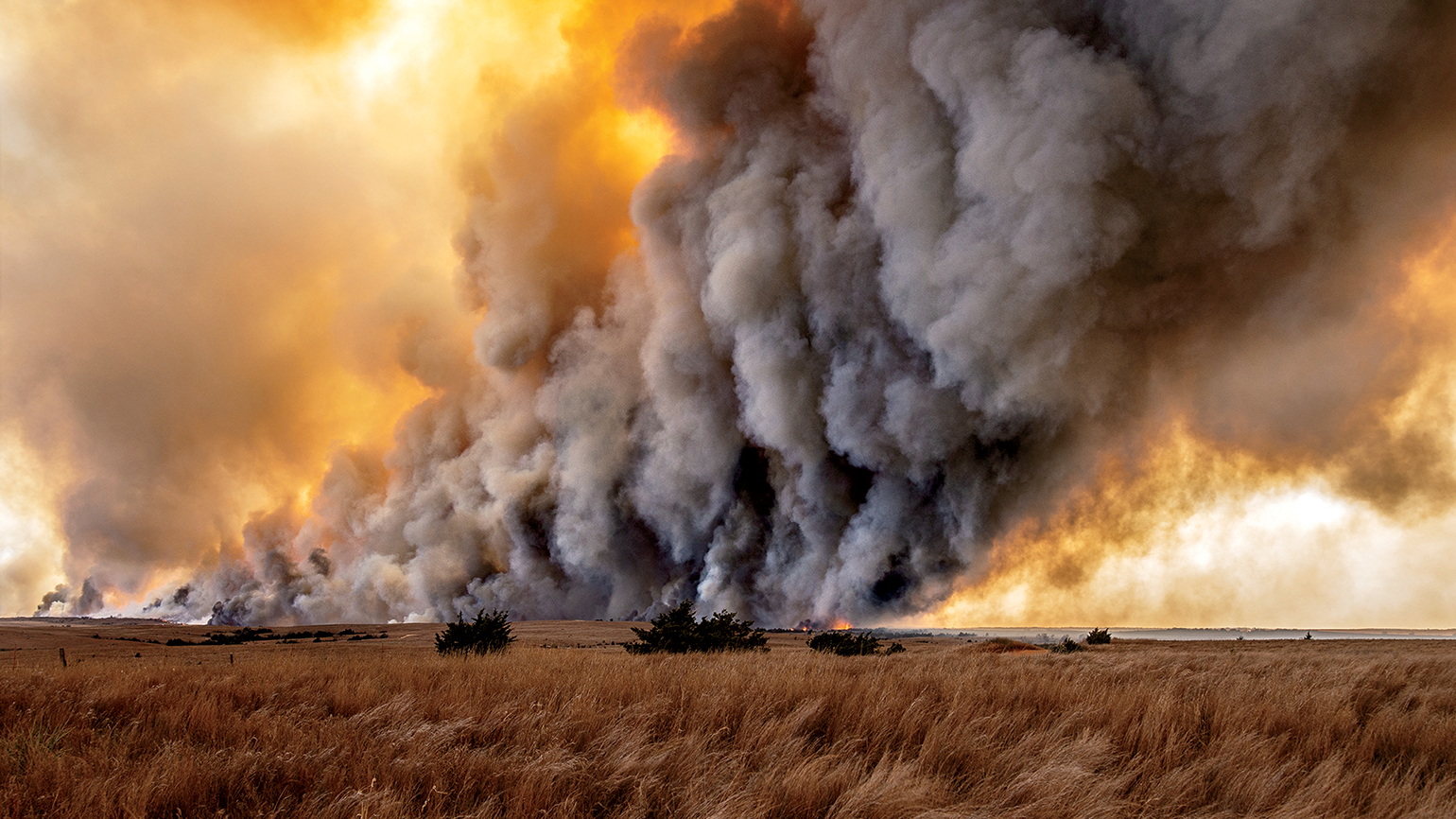
We drove for about a mile before Larry turned to head back south, toward the ranch house. As we did, my eyes went wide. A wall of flames was racing toward us, maybe three quarters of a mile away. “Get us out of here!” I screamed. Larry whipped around, bouncing hard over the gravel road. How had the fire jumped the river? To cover that kind of ground so fast would have taken tornado-like speed. The flames would be on us in no time.

“What about the horses?”

“What about our trucks?”

“How can we save ourselves?”

We weren’t expecting answers. We were just trying to keep from totally losing it. I looked back. Amazingly, we were gaining on the fire.

Until we ran out of road.

A heavy-duty barbed-wire fence blocked the way. There was no way to get the Gator past it. Larry, Tony and I jumped off and scrambled to the other side. But it hardly mattered. On foot, we were goners. I called Ande.

“We’re surrounded by fire,” I shouted over the howling wind. “Call 911! We need a helicopter to get us out of here.” The connection went dead.

I looked around. Where were Larry and Tony? The smoke was so thick, I couldn’t see more than a few feet around me. I yelled for the other guys. All I could hear were the cedars exploding. The dry grass crackling like popcorn. It was terrifying. I reached in my pocket for my cell phone again. Gone. I must have dropped it. That phone was my only contact with the outside world. But there was no time to look further.

I stumbled blindly, choking from the smoke. Flames reached out and tagged me, burning my clothes. If I didn’t get some fresh air, I was going to die of smoke inhalation. I knelt down, my face near the ground, gasping for breath.

I’d never needed God as I did now. But I never felt as if I’d done anything to deserve his help or his love. Ande was up every morning at 5:30, praying and reading the Bible. Me? I’d put nearly everything else in my life first—work, family, chores. The only times God had felt real to me were Sunday mornings. For years I’d driven two hours every other weekend to look after my mother, mow her property. Driving home, I’d turn the radio to a station out of Tulsa that played old-time gospel music, those wide-open Oklahoma skies spreading out before me. I felt as if I was in the arms of the Creator. I never got that feeling anywhere else.

I was on my own here. Through the smoke, the flames biting me every step of the way, I made it to the top of a canyon. Momentarily I was above the fire. To the west, maybe a quarter mile away, I saw a flat area the fire hadn’t reached, a place clear of cedars.

I half-ran, half-staggered there, then collapsed on the ground. I took deep breaths. After a few minutes, I tried to stand. Smoke filled my lungs. I fell back to the ground. Behind me came a roar like a freight train. I looked back. All I could see were towering flames.

I pulled myself to my feet. I went one way, then another, the blaze chasing me. Somehow I ended up in an area that had already been burned, the ground charred black. How I’d gotten there I had no idea. It was as if I’d been carried. I lay on the embers—my scalp, my back burning, blistering. I didn’t even have the strength to lift my head.

“God, please let me live,” I cried out in desperation. It was the first prayer I’d said in years. I knew I was too late to expect any favors from God. I only hoped he’d be there for Ande. “Let her know I love her,” I whispered.

Hot wind whipped dirt and ash against me. The fire would be right behind it, burning over me. I dug into my pocket and found a handkerchief; I put it over my nose and mouth. Closed my eyes tight. A peace came over me. I was ready to die. I just hoped I’d lose consciousness before the flames reached me.

A minute passed. Then two. I opened my eyes as much as I dared. The flames had burned a kind of firebreak into the ground just yards away from me. Now it was blowing away from me. A miracle.

I stood and started walking, no idea of the direction I was going. It looked like a war zone, blackened cedars littering the countryside. Was anybody searching for me? I hadn’t seen a single helicopter. In the distance I saw a windmill and a large, round stock tank on a concrete slab, a place where I could lie down, away from burning embers. It took every bit of strength I had left, but I got there just as darkness fell.

I dipped my handkerchief in the cool water I found, washing soot and ash off my face and wetting my lips. Water, even though it wasn’t the cleanest, had never tasted so good.

I collapsed onto the concrete. The air was still smoky. How much more could I breathe in before it killed me? Would I even live till morning? I wished I’d been able to tell Ande and my kids how much I loved them. In the distance, I watched as cedars burst like fireworks, the fire ravaging everything in its path. The flames had surrounded me—by any logic, the fire should have consumed me too. And yet, as if a shield protected me, I’d been spared its full fury.

I looked up. Helicopter lights zipped across the sky. But there was no second pass. No one had seen me. I stared up at the majestic starry heavens. The view went on forever, beyond what my eyes could possibly take in. The only thing I could compare it to were those drives back from my mom’s. That overwhelming sense of God’s presence. He’d been with me then. He’d shielded me from the flames today. He would be with me always. I didn’t have to do anything to earn his love. I thought of Ande’s prayers, the prayers of folks at church she had no doubt asked for. I felt their love too. There on the hard concrete, without another soul around, I felt watched over, a feeling I’d never known before.

“Thank you, Lord,” I prayed. “For never giving up on me. Thank you for Ande and the kids, for the life you’ve given me.” The words came freely, easily, as if I were talking to an old friend. I talked to him all night, about everything I could think of, making up for lost time.

At sunup, I started walking. Before long, I saw a pickup. Two men got out.

“Have you been out here all night?” one asked. “We were just going to work at the oil rig, but we’ll make sure you get help. You’re one lucky dude.”

“Do you have any water?” I was downing my third bottle when a silver SUV pulled up. My son, Jordan, and sons-in-law, Mark and Sean, and my good friend Don got out. “He’s alive!” they shouted. One of them held a phone to my ear. “Everything’s going to be okay,” Ande said. “I love you.”

The boys explained that Larry and Tony were safe. The horses had survived as well. A helicopter took me to the burn unit in Oklahoma City. As it lifted off, I took one last look at the charred landscape below. Total devastation. More than 280,000 acres would burn. But in the blackness I saw hope, the promise of a new day dawning, new growth.

I was alive because the fire had miraculously changed direction. And so had I.

For more inspiring stories, subscribe to Guideposts

A Look Inside the Misfit Ranch

“This dog is not normal,” my friend and fellow veterinary technician Shannon said, studying a tiny bulldog mix puppy who’d been born at the clinic where we worked. We watched Rosalie try to find her balance. As soon as we put her on her feet, she would flip onto her back.

“Something’s definitely off,” I said. “But I’m going to figure out how to help her.”

Rosalie’s breeder thought the kindest thing would be euthanasia. No way, I thought. This eager puppy, with her white fur and brown spots, just needed someone to give her a chance.

And that someone was me. I knew what it was like to feel broken. Scared. Hopeless.

The vet confirmed that Rosalie had cerebellar hypoplasia, a neurological condition that affected her motor movements, and she wouldn’t ever be able to stand up on her own. The diagnosis didn’t scare me, though. “We just need to get creative,” I told Shannon. She smiled. This wasn’t the first time she’d seen the wheels turning in my head.

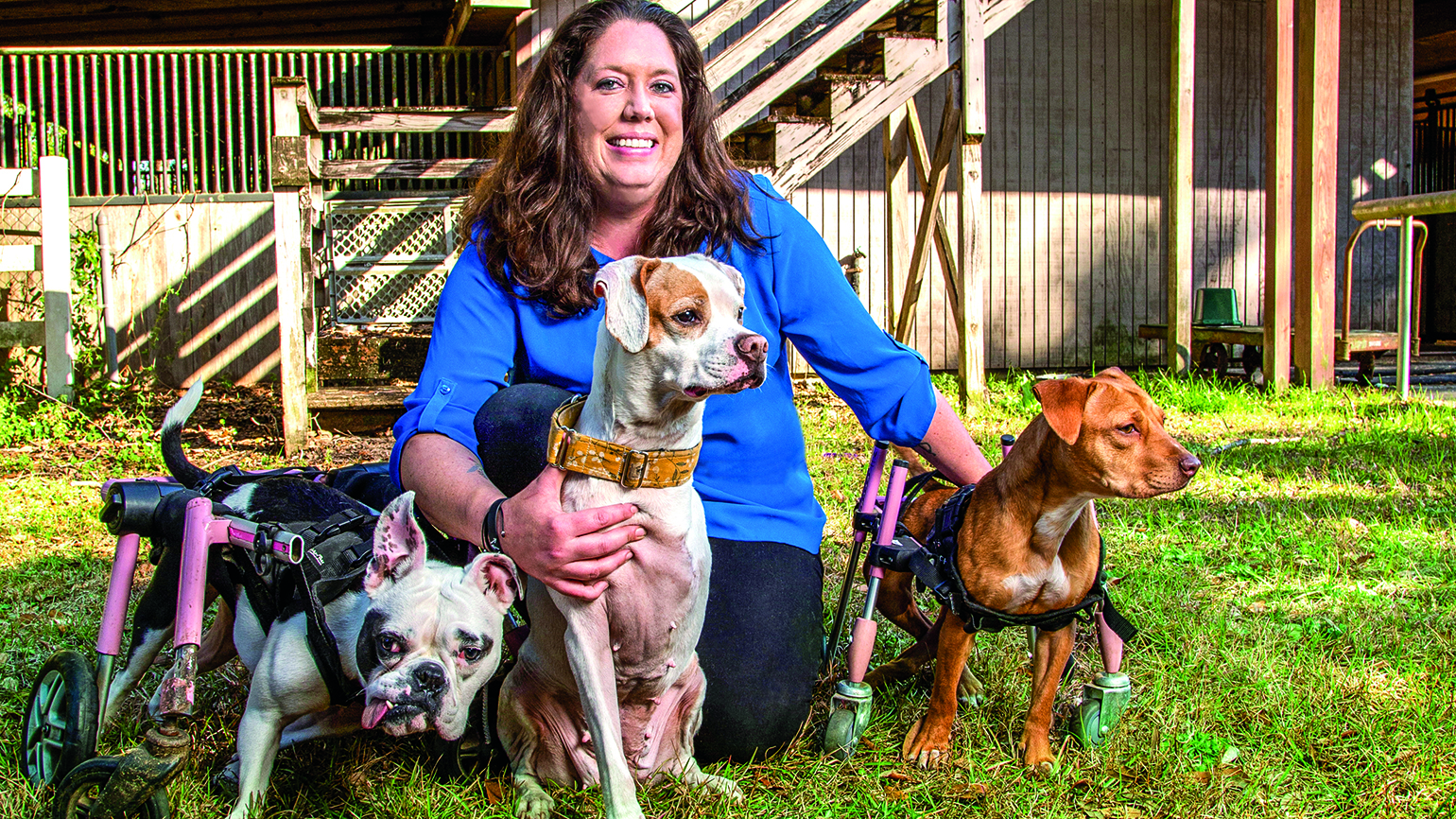
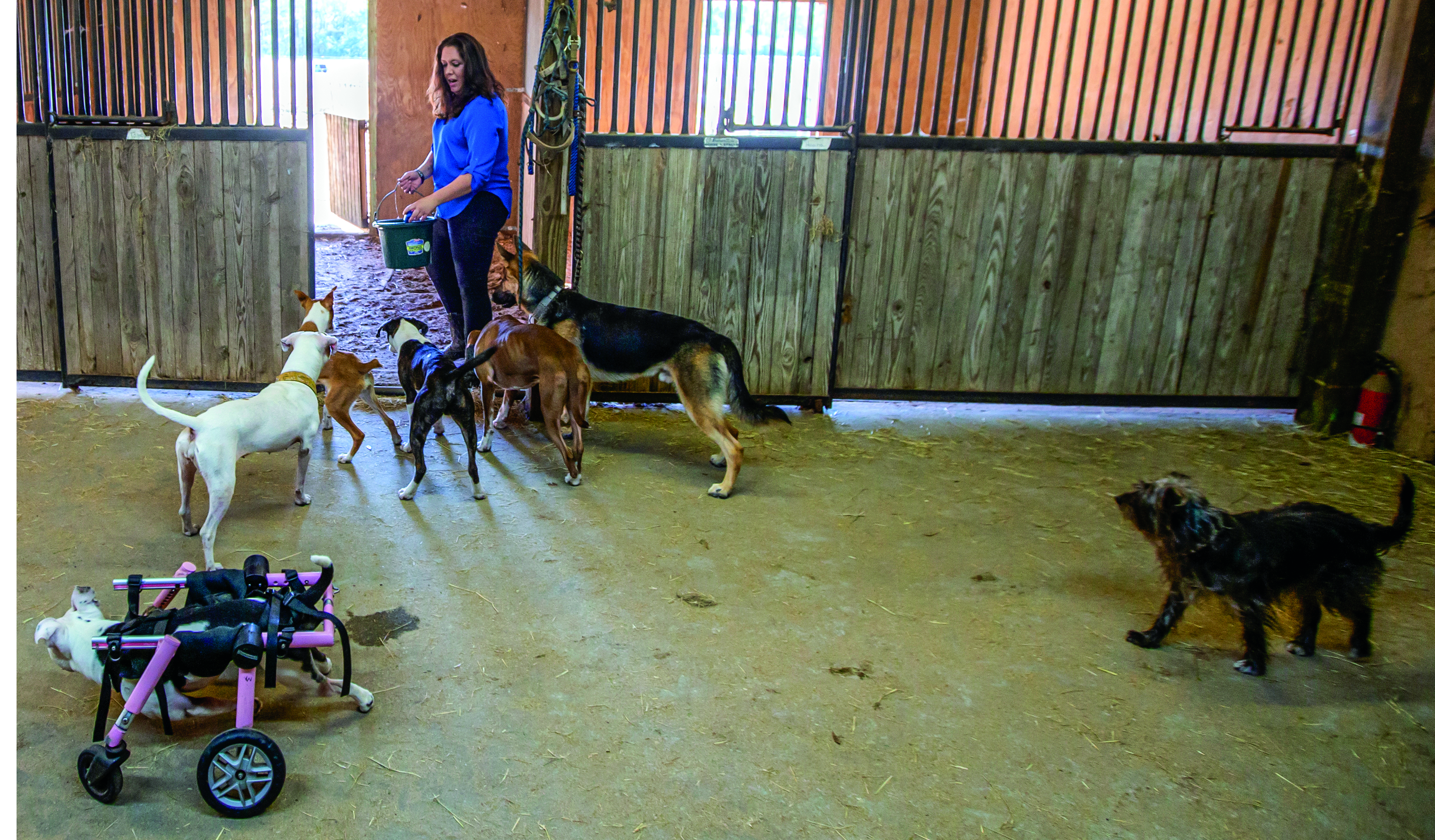
Not only do I work at the clinic but also on a private farmstead in Pensacola, Florida—a place our team of volunteers lovingly refers to as the Misfit Ranch, where we take in and rehabilitate dogs that have been abused or have special needs.

It all went back to late 2009, when I’d been the one in need of healing. I’d felt so trapped then. Trapped in an unfulfilling job, where I was just going through the motions to get through each day and pay the bills. And worse, trapped in an abusive relationship that I couldn’t find a way out of, no matter how hard I prayed.
“Everything happens for a reason,” my grandfather used to tell me when I was little. But I couldn’t understand the reason for my misery. Why was I living a life I didn’t belong in? Nothing about it felt right—not my job, my house or my relationship.

One day I got a call from a friend who was looking for a helper to move to her ranch nearby. “I need someone I can trust to take care of the horses part-time,” she said. Something in me sparked to life at that. A part of me that had lain dormant for so long I’d almost forgotten it.

Animals were a huge part of my growing-up years. My parents and I were constantly bringing home sick or injured little creatures, mangy dogs, stray cats, birds that had crashed into our windows. We’d nurse them back to health and release them or find them homes. I always thought I’d work with animals, but I didn’t even have a pet as an adult—no one to greet me when I came home from work or comfort me when I felt lonely.

Taking care of horses…Something in me told me that I needed to do this. I picked up and moved to the ranch. My boyfriend came with me. I thought the new setting would change him. It didn’t. But what had begun to change, without my consciously realizing it, was me. One night, I finally stood up to him and sent him packing. It was terrifying. I could barely sleep that night, still shaky from the whole ordeal.

It was the horses that helped restore me. Their presence calmed me. Caring for them every day reminded me of nursing animals with my parents. Even though I was just a kid, I’d felt such joy and purpose then. Little by little, the fear that had its hold on me for so long faded. I knew God had led me here to the ranch, to this place where I could heal. He would help me find that sense of joy and purpose again.

I started volunteering with dog rescue groups in the area. I felt drawn to the dogs for whom it was hardest to find homes. The old ones. The ones with medical conditions. The ones on hospice. There was plenty of room on the ranch to foster them. And plenty of room in my heart to love them, even if it was just for the short time they had left on this earth.

I was in and out of clinics often with my foster dogs. I want to be able to do more for these dogs, I thought. What if I learn more about veterinary medicine? I took a leap of faith and began training to become a vet tech. It was difficult balancing the physical work of caring for the horses and the mental stamina needed to learn. I started treating animals as a vet tech in 2017 and got a job at one of the clinics I’d taken my fosters to.

Sometimes I would take stray dogs home with me from the clinic to give them one-on-one care overnight. I always had a soft spot for the tough cases—the broken ones who, to others, seemed hopeless. Word spread and I became the go-to for abused or differently abled dogs in North Florida. Vets would give out my number or people would contact me through social media, asking me to take in a dog that was blind or aggressive, had mange or an amputated leg. The Misfit Ranch grew to a point where I needed help caring for these animals that had no place to call home—especially because I never turned any of them away.

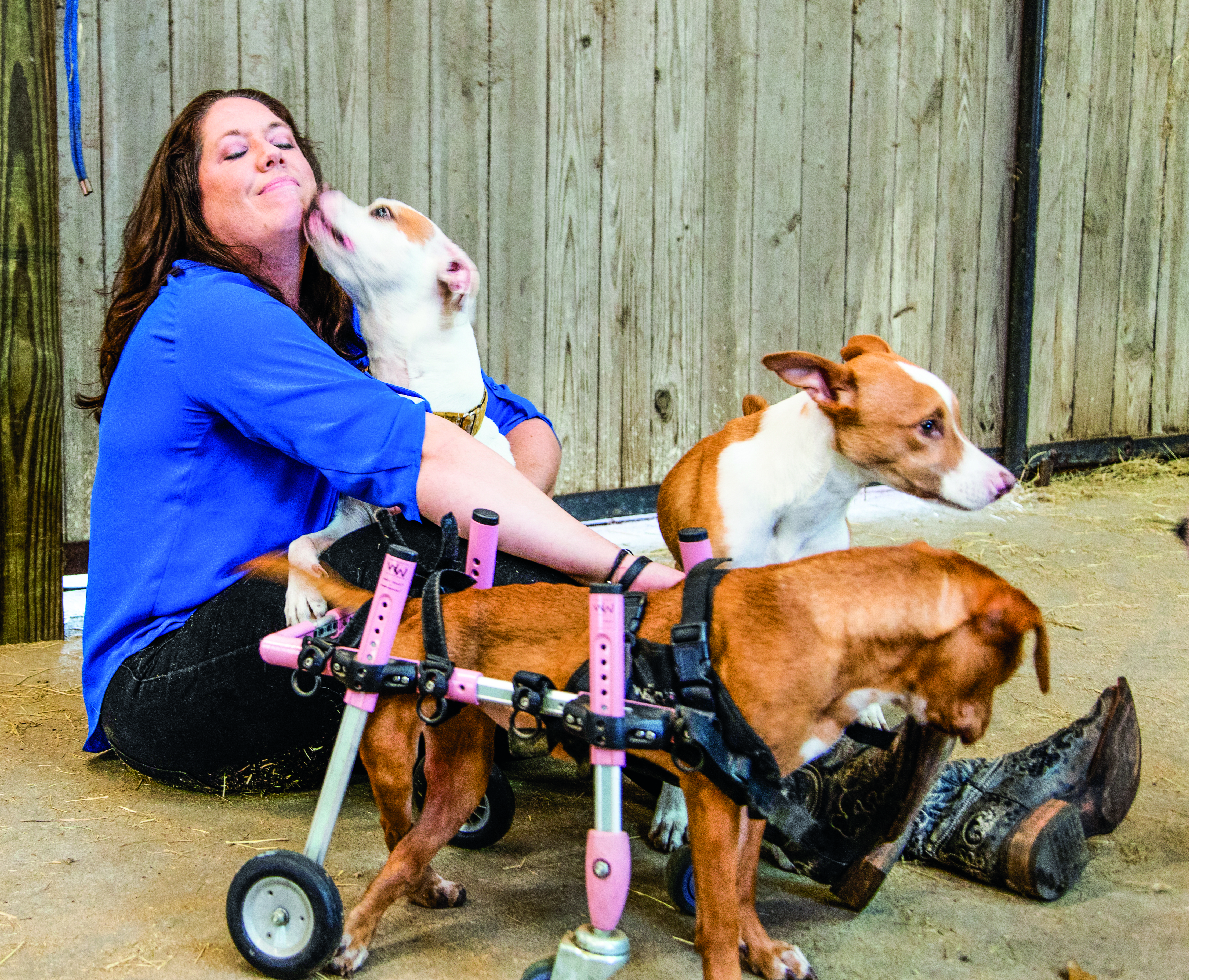
Like Rosalie, the little bulldog mix with the neurological condition. The breeder let me take her. I jerry-rigged contraptions to help her walk. A few months later, a local pet equipment provider offered to make her a custom wheelchair. With her new ride, Rosalie Turtle—a nickname I gave her because of her tendency to flip over—was finally able to stay upright. Now she’s independent and living life to the fullest.
Every dog that comes to the ranch has a story. Tipsy came into the clinic one night after being shot in the leg. The terrified pit bull mix cowered, refusing treats. She seemed to have lost all trust in humans. Understandable. So I took her home. “No one is ever going to hurt you again,” I promised.

It took time—and a lot of howling out of fear—but Tipsy learned she was safe and, most importantly, loved. She’s turned into one of my most outgoing dogs, racing around the ranch on her three legs.

There’s a fair share of heartache at the Misfit Ranch. Sometimes, no matter how well we care for these animals, no matter how hard I pray over their ailing bodies, they just can’t go on. I’ll never forget Hugh, a feisty, spotted bulldog who came along after Rosalie. When the paralysis in his hind legs worsened, he also received a wheelchair to cruise around in.

Hugh and Rosalie became fast friends—they understood each other—but their fun didn’t last. Hugh’s pain remedies stopped working and he became aggressive. He wanted to be left alone. I spent long nights worrying about him. One morning, Hugh crossed the rainbow bridge. So many people had been following his journey on my Facebook page (@rosalieturtleandfriends), praying along with me. “If only love could be enough,” I wrote. “Fly high, my boy.”

Every time I meet an animal that’s broken and scared, I think back to the time when I thought I was beyond repair. There’s something to be said for being a misfit. It might take you a while to find where you belong in God’s world, but when you do, you’ll see your hardest struggles are what led you there. Like my grandfather said, everything happens for a reason.

For more inspiring animal stories, subscribe to All Creatures magazine.

A Heaven-Sent Text Message Gave Her a Second Wind

I was at a Native American reservation in California, two hours from the nearest big city. A desert landscape of scrub brush and rocky slopes extended in all directions.

I was here to run. And I was pretty intimidated.

It was November 2019, and I had just arrived at the Ragnar Los Coyotes trail relay race. The annual race is a grueling multiday relay through the rugged beauty of Los Coyotes Indian Reservation in San Diego County.

More than 200 runners were here, camped out in a small city of tents. I knew no one. Everyone looked way younger—and fitter—than I was.

My husband, Tom, thought I was nuts when I signed up.

“Let me get this straight,” he said. “You’re going to fly from North Carolina to California, meet up with total strangers, drive two hours into the mountains where cell phones don’t work and there’s no running water. Then you’re going to camp with those strangers while competing in a multiday relay race?”

Now I was asking myself the same question. I gazed at the sleek, toned athletes setting up their tents and chatting about past trail races they’d run.

I was 58, a former teacher and stay-at-home mom of two grown kids. I’d been a recreational runner for years; I’d even competed in races. But I’d never run a trail race in my life. Nothing like this. Some runners travel around the world to compete in big-name marathons or off-road races in spectacular locations. Not me. Family came first.

The previous year, Kate, our younger daughter, had gone off to college. Suddenly I was free to try a bigger adventure. When an online moms’ running group advertised this rugged race on the other side of the country, I jumped at it.

My training would be considered a joke by the elite runners here. There are no big hills in my North Carolina town. If I wanted to run up a hill, I’d have to go to a parking garage.

Neighbors watched and wondered as I slogged through two runs a day in the August heat. One pulled up beside me in her car and asked if I wanted to sign up for a text message group she hosted that sent daily Bible verses to members’ phones.

“Sure!” I said. I needed all the encouragement I could get.

Like right now. I felt alone in this remote landscape. I couldn’t even call Tom or the girls. No cell service.

I joined my relay team. We were eight women from around the United States selected by the moms’ running group. I was the oldest by far. We gathered around the tent where we’d sleep during the race. We talked about the course, three loops of increasing difficulty with a total elevation change of nearly 4,000 feet.

Each member of the team had to take turns running each loop. It would take more than 24 hours for everyone to complete the entire course.

Ping!We looked around. The sound came from my cell phone.

“Did you just get a text?” one of my teammates asked.

“I did,” I said, puzzled.

I was even more puzzled when I read the message. It was a Bible verse. From Isaiah, chapter 41: “So do not fear, for I am with you; do not be dismayed, for I am your God. I will strengthen you and help you; I will uphold you with my righteous right hand.

”It was my neighbor’s Bible verse group text. How did it show up on my phone? It was evening; she usually sent the texts in the morning. And there was no reception here.

“It’s a Bible verse,” I said.

“Let’s hear it,” someone said.

I read the words aloud.

“Now that is something to think about,” another teammate said.

“Five minutes to start!” our team leader cried. The discussion ended, and we scrambled to gather our things and head to the starting line.

I was runner number five on the team. It was getting dark when I began laboring up the rocky trails of the first loop. I had to walk and grab tree branches to haul myself up the steepest slopes. What if I fell? My headlamp slipped. I kept running.

First loop.

Second loop.

I tried to nap in the tent until the final, toughest loop. Day was breaking as I set out. Oh boy, the first two loops had been a warm-up by comparison. Almost immediately I had to walk, too discouraged to run up trails that seemed almost vertical.

Runners passed on either side. My lungs burned. I wanted to stop.

“Left foot, right foot,” a runner chanted as he zipped by.

I stopped and caught my breath. The verse from Isaiah sounded in my head: I will strengthen you and help you.I wasn’t alone; God was with me. I can do this, I told myself. All I had to do was move my left foot, then my right foot.

I got going again and picked up speed. I pushed onward. All of a sudden, I heard cheering ahead. My teammates were hooting and clapping as I crossed the finish line.

We waited for three more runners on our team to finish. As the last one approached, we ran onto the course and joined her across the finish line. We hugged each other, our dusty faces streaked with tears. We took photos with our medals, packed up our campsite and headed for San Diego.

As soon as my team members and I got back in cell range, all of our phones started buzzing. Mine lit up with multiple texts from Tom and the girls, asking how the race was going and sending me encouragement.

None of those texts had made it through.

Only one did. The one I’d needed the most.

For more inspiring stories, subscribe to Guideposts magazine.