Embrace God's truth with our new book, The Lies that Bind

In His Image

So all of us who have had that veil removed can see and reflect the glory of the Lord. And the Lord—who is the Spirit—makes us more and more like him as we are changed into his glorious image. 2 Corinthians 3:18 (NLT)

Most of us have looked in the mirror at one time or another, asking the familiar fairy-tale question: Mirror, mirror on the wall…? As a young teen, I’d look at my peers and complain, “Mirror, mirror on the wall, why’d you make me so tall?”

The thing about mirrors is, they never lie. What you see is what everyone else sees, at least physically. And sometimes, all our best efforts to accentuate the positive and downplay the negative still leave us discontented with our looks.

But Jesus never lies either. It’s just that He sees things differently than we do. He gauges our “looks” by a different mirror. We’re not too short, too tall, too big, or too small. He doesn’t measure us by a wooden yard- stick, or compare us to our peers. He knows we are uniquely made, one of a kind, a creatively designed child of His. And He looks at our hearts, not at our outward characteristics (1 Samuel 16:7).

Unfortunately, we see ourselves through a veil. Jesus wants to remove that veil so we can view His mirror, not ours. As His followers, what He wants us to see is His reflection daily. And the more we look into His mirror and what He says about us, the more we’ll come to believe—and reflect—His image. When we look into His mirror, we’ll see what Jesus sees: “beautiful,” “loved,” “redeemed,” “Mine.”

Faith Step: The next time you look into your mirror and are tempted to complain, remember how Jesus sees you. Thank Him, not only for making you unique, but for creating you in His image.

Infuse Your Life with Purpose and Meaning

Watch what God does, and then you do it, like children who learn proper behavior from their parents. Mostly what God does is love you. Keep company with him and learn a life of love. Observe how Christ loved us. His love was not cautious but extravagant. He didn’t love in order to get something from us but to give everything of himself to us. Love like that. Ephesians 5:1–2 (MSG)

I love this paraphrase of Ephesians. The idea that we watch what God does and then do it. That’s our assignment. And when we watch, we find that mostly what God does is love us. Through Jesus, we see His extravagant love giving us everything of Himself, all of the time. Our job is to love like that. How different would my life be if I made loving my job? And yet that’s what the Bible tells us to do.

Mother Teresa said, “Many people mistake our work for our vocation. Our vocation is the love of Jesus.” That’s interesting to me, coming from someone who spent her life serving the poorest of the poor. But what she’s saying is that the work, no matter what it is, is secondary. Our vocation—what we do—our fundamental focus and calling—is the love of Jesus.

This applies to me as I teach at the university. My work may be reading and writing. But my vocation is love. My doctor friend cares for the sick; my cosmetologist friend styles hair. My auto-tech friend changes oil and tires, and my brother administrates the school. But our vocations are all the same: love. Jesus’s love informs whatever daily tasks there are to perform and infuses them with purpose and meaning.

FAITH STEP: What is your work? And how does it serve the purpose of your vocation, which is the love of Jesus? Evaluate your daily tasks in light of your true vocation, looking for ways to share the love of Jesus through the work He has given you to do.

How to Change When Change Is Hard

But Lot’s wife looked back, and she became a pillar of salt. Genesis 19:26

Letting go of the familiar is tough. Changing careers or colleges or moving to a new city can take an emotional toll on us. It’s even more difficult to leave behind old habits, attitudes and behaviors.

Lot’s wife wasn’t able to let go of her home in Sodom, even though God sent angels to warn her family to run for their lives because judgment was coming. In fact, the angels’ warnings included such grave commands as “Don’t look back” and “Don’t stop.”

Why in the world did this woman choose to stop and look back? Could it be that she loved the life she was leaving too much? Though Sodom was full to overflowing with sin and vice, apparently the dark and oppressive city was comfortably familiar to Lot’s wife.

It is difficult to leave the familiar behind. That fact is as true today as it was in the days of Sodom and Gomorrah’s destruction–even when God himself is saying, “It’s time to move on.”

If you’ve ever struggled with a destructive habit, you’ve felt the pull of the familiar–even as you’ve sensed God’s nudge, “Move on now.” You’ve experienced the temptation to turn back just one more time, for one last look, one last taste, one last “fix”–even as God has whispered, “Don’t look back.”

Maybe you’ve agonized over a loved one’s downward spiral, desperately attempting to rescue them time and time again–until finally God impressed upon you, “Stop. Let go.”

Unlike Lot’s wife, none of us has ever become a pillar of salt by turning back for one last peek. Yet we all struggle with the difficulties of letting go of the old in order to grasp the new.

Take heart. God understands that letting go of the familiar is hard. Yet he has called us to move on to new life in Jesus Christ by letting go of our old worldly lives, our old habits, our old dreams–to boldly move forward without looking back.

When you feel God’s call to move, allow him to guide you. He will give you the grace to do whatever he has asked.

Reflection
What does the this passage teach you about letting go in order to move forward?

Why is it so difficult sometimes to let go of the past?

What is one thing you think God may be asking you to let go of right now? Spend some time praying that God will help you let go of whatever is hindering you from moving forward in your spiritual journey.

Hitting the Wall

I hit a wall on Sunday. Not literally, of course. I’ve faced a long, long run of problems that have required huge self-sacrifice, deep prayer, and immense self-control.

Last Sunday I was beyond tired. I had nothing left to give, no reserves of patience or energy. Then, naturally, the attack began. Feelings of wanting to give up trying, of rank exhaustion swirled in my head, and I had nothing left with which to fight them.

I walked away. Actually, what I did was walk to church instead of taking the bus. It was a full two miles in the snow and cold. One foot after the other, hands in pockets, thinking only of taking the next step.

Instinctively I knew that even if only 10% of my stuckness was a physical manifestation of stress, at least I could work off 10% of the problem.

When I got to church the service had already started. My head was a bit clearer, and I could pray. Lord, I’ve done everything I know how to do, and then some, I began, There’s nothing left of me to give. I’m weary and burdened, and I need some of that rest You promised. And no, not just a day or two.

Not much happened. But then the sermon started, and the pastor spoke about how during Lent we give up little things out of love for God.

It was a simple thought, and not a new one–to do things out of love for God–but suddenly a whole new reserve of energy opened up for me.

You see, it occurred to me that doing hard things out of love for Him is different than just doing hard things. It’s even different than doing hard things with prayer and faith. It takes the problems I face out of the center of my heart, and puts God there, instead. It switches the order from:

God, I need Your help with this problem

to

Father, I will face this problem out of love for You.

There are many, many things I am certain I can’t deal with in life, but is there anything I’m unwilling to face out of love for God? No. No, there is not.

For like Paul, I am convinced that neither death nor life, neither angels nor demons, neither the present nor the future, nor any powers, neither height nor depth, nor anything else in all creation, will be able to separate us from the love of God that is in Christ Jesus our Lord. (Romans 8:38-39)

He Changed Baseball Forever

Record my lament;
list my tears on your scroll—
are they not in your record?
Then my enemies will turn back
when I call for help.
By this I will know that God is for me.

—Psalm 56:8–9

It’s not the honor you take with you,
but the heritage you leave behind.

—Branch Rickey, Dodgers general manager who signed Jackie Robinson

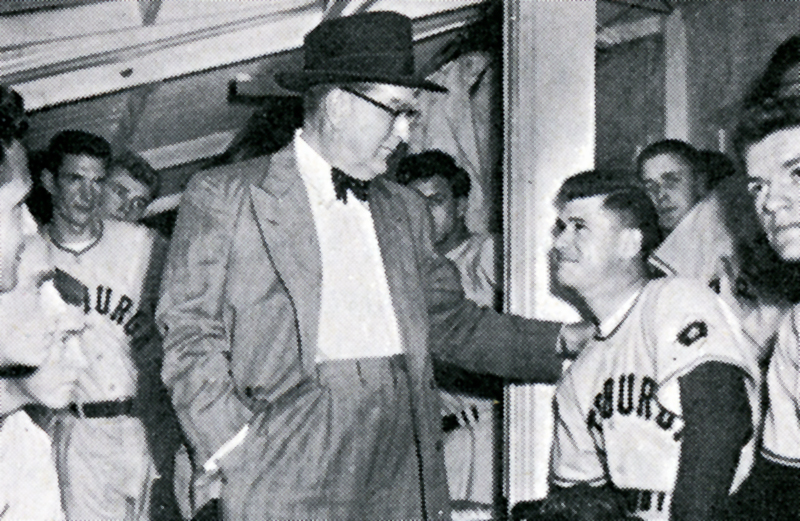
As a player, Branch Rickey had a very forgettable major league career. In fact, he probably wished that more people would forget about the one major league record he set that still stands today: as a no-hit, no-field catcher with the New York Highlanders in 1907 (they became the Yankees in 1913), he once allowed 13 stolen bases in a single game.

But as a general manager in the front office, Rickey changed the face of the game in many ways. He was the first to develop the minor league clubs as a “farm system” for his major league club (at the time, the Cardinals). He developed the first full-time spring training facility (for the Dodgers) and was instrumental in making everyday use of things such as batting helmets and pitching machines. He helped found and fund the Fellowship of Christian Athletes in the 1950s. He put together the components of three different teams that went on to win the World Series (Cardinals, Dodgers and Pirates). And then, of course, he changed the face of baseball forever when he signed Jackie Robinson to a contract.

Some have suggested that Rickey was simply trying to find a way to attract even more fans to Dodger games, that his breaking of the so-called gentleman’s agreement to ban African Americans from major league baseball was simply a financial issue and not a noble cause. But Rickey was a man of outspoken faith, guided by his Christian upbringing and Methodist roots. His heart had been deeply moved by an episode in his life when he was a much younger man, coaching the Ohio Wesleyan University baseball team.

The team had taken a road trip to play Notre Dame in South Bend, Indiana. When they arrived to check into their rooms, the hotel manager said to Rickey, “I have rooms for all of you—except for him,” pointing to the team’s black catcher, Charley Thomas.

“Why don’t you have a room for him?” Rickey asked.

“Because our policy is whites only,” said the hotel manager.

After much discussion between the adamant innkeeper and the persistent Rickey, it was agreed that Charley Thomas could stay in Rickey’s room on a cot. After assigning the other players to their rooms, Rickey went up to his room to find Thomas sitting in a chair, weeping and pulling at the skin on his hands, crying out, “It’s my skin. If I could just tear it off, I’d be like everybody else. It’s my skin; it’s my skin, Mr. Rickey!”

That moment seared its way into Rickey’s conscience. He was so moved by the young man’s despondency and the injustice of his plight that he later said, “For 41 years I have heard that young man crying. Now, I am going to do something about it.” And he did. American historians often mark the day that Robinson signed a contract with Rickey and the Dodgers as a major date that helped galvanize the coming Civil Rights movement.

God hears our cries too, and does something about it. Our tears move God. In fact, Psalm 56 indicates that God writes it down when we cry. God has compassion on us, longs for justice for us, and remembers our plight.

Another translation of the Hebrew word behind “scroll” in Psalm 56:8 is “wineskin,” or in our vernacular, “bottle.” If you were to go inside a Middle Eastern tomb from biblical times, you would probably see collections of bottles that were used to collect the tears of mourners at funerals. These vials were then entombed with the loved one as symbols of honor and affection.

Someday, in heaven, God will wipe every tear from our eyes (Revelation 21:4), but until then, it’s a great comfort to know that God doesn’t view our pain and sorrow with indifference. Jesus himself wept (John 11:35), so he knows grief and sorrow up close. God is the heavenly statistician who records the tears that fall from your eyes and stores them in bottles. God misses no point of pain, forgets no moment of loneliness or depression, and records every teardrop caused by happiness or joy. When injustice has happened to you, you can be assured that God knows, cares and is for you.

Those hands that had attempted in vain to peel off skin of a different color later became the hands of a highly skilled dentist. Just as Branch Rickey remembered that young man’s great sorrow, Dr. Charles Thomas never forgot what Branch Rickey did for him. Years later, at Rickey’s funeral, the officiating minister said, “Branch Rickey has been called the master mind of baseball. His vision made him that. But, he was also the master heart of baseball…He made goodness attractive to others.” Isn’t that true of all heroes? Wouldn’t it be great if people could say that about you?

Intentional walk: God, sometimes I hold back my tears, thinking that it’s undignified or a sign of weakness to cry. But I remember today that Jesus cried, and he possessed more dignity and strength of character than any other human being. I know that you are for me, and that my prayers are marked “Special Delivery” when they arrive, bathed in tears, at your throne room. And as I cry out to you, remind me, “Those who sow in tears will reap with songs of joy” (Psalm 126:5).

Have Faith, Rain or Shine

I got up this morning and the sun was shining peacefully over the Hudson River. Oh good! I thought, It’s going to be a great day! My heart is easily influenced by external factors.

On the good side of this are the things that urge my heart toward God: gorgeous weather, small acts of kindness, having a day when life runs smoothly. On the bad side are the things that should urge my heart toward God, but don’t: a cranky kid who needs prayer, logistical glitches that make it clear the world isn’t designed for my convenience, inconsiderate people whose hearts could use an infusion of heavenly grace.

What I need to remember is this: My faith should influence the circumstances of the day rather than be influenced by them. Rain or shine, good day or bad, I’m called to bring Christ’s light into all situations, to all people.

Harvest Devotion

I was having a “sunset moment” one Sunday night, a discouraged feeling I get sometimes after a long week at work.

Standing on my patio, gazing up at the sky as the sun went down, I wondered if my being here made any difference at all. God had so much to worry about. How could he find time for me?

Later I heard an odd knocking on my door. A neighbor I’d nodded to in passing stood there, holding something carefully. “I had to knock with my elbow,” she said. “Have some cherry tomatoes? I have plenty to share.”

“Thank you!” Surprised, I opened my hands to receive the bounty: six golf-ball-sized red pearls. “How big a crop did you have?”

“I got twelve.”

“Twelve?” I said. “Twelve plants?”

“Twelve tomatoes.”

“You can’t give me half your crop! Come inside, please.

We sat in my kitchen. She said softly, “After my husband passed away, I began to wonder if God cared about me. To keep myself busy, I started some tomato plants on the patio. Bugs got about a dozen and I killed a few more by overwatering them…Then I realized it didn’t matter if I had only one plant left. I tended that plant and watered it carefully. It dawned on me then that no matter how small and alone I felt, God was always there, nurturing me.”

My jaw must’ve dropped, for my neighbor said, “I know that sounds strange…but I just wanted you to have them. A gift from me.”

Thank you, God, for the times you make yourself known in my loneliness and for the gift of your care.

Get Inspired by Life’s Mysteries

It is God’s privilege to conceal things. Proverbs 25:2 (TLB)

My first contribution to Daily Guideposts was in 1988, 28 years ago. There were only 31 writers that year. Ronald Reagan was president, and America was singing Bobby McFerrin’s hit song “Don’t Worry, Be Happy.”

The first letter I ever received from a reader was from a middle-aged woman whose husband had just died. She was going back to college to learn some new skills. She wrote, “I feel like I am getting ready for something, but what I am getting ready for is a mystery.”

She was not disturbed by the mystery. In fact, she seemed excited about it, as if the future was a series of Christmas presents to be slowly unwrapped with joy. I had never thought of mystery as a pleasure, but after reading her letter I began to see how mystery could be a gift from God, something to add a bit of zing to life.

READ MORE: DOODLE YOUR WAY CLOSER TO GOD

After all, would I even want to go to a ball game if I already knew who would win? Would I enjoy a movie very much if I had seen the ending before? If I knew I would someday inherit a million dollars, would I become unhappy in my job?

Not knowing the future frees me to pay attention to the present, and maybe that’s the best way to be ready for the future. There may be trouble ahead, but if I manage my money well now, I should be ready for it. If I make the people I love happy now, there should be a harvest of joy someday.

Bobby McFerrin was right. “In every life we have some trouble, when you worry you make it double. Don’t worry, be happy.”

About my future, Lord, surprise me.

Digging Deeper: Deuteronomy 29:29, Ecclesiastes 3

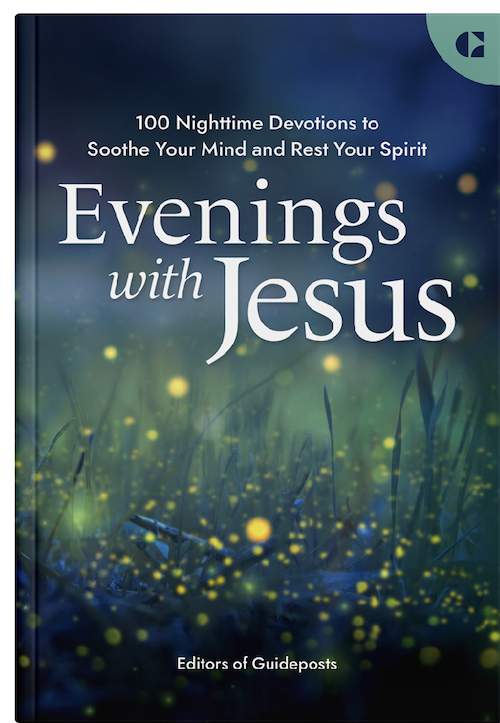
Free Excerpt from a New Guideposts Devotional: ‘Evenings with Jesus’

Maybe it’s been a long time since anyone tucked you under the covers at night and blessed you with a gentle kiss. But you can revive such sweet bedtime moments with a new Guideposts devotional, Evenings with Jesus: 100 Nighttime Devotions to Soothe Your Mind and Rest Your Spirit. I was delighted to be among the writers who were asked to contribute to this collection that identifies and categorizes entries into seven elements that are integral to spiritual well being: Connection, Gratitude, Forgiveness, Positivity, Purpose, Rest, and Values. Here’s one of my contributions called “My Charging Station”:

Evenings with JesusCome to me, all you who are weary and burdened, and I will give you rest.

MATTHEW 11:28 (NIV)

Throughout my adult life I’ve had trouble falling asleep at night. Sometimes I can attribute this problem to external circumstances. A neighbor’s barking dog. The pop and bang of fireworks. Or, when I’m traveling, unfamiliar beds, pillows, and heating or air-conditioning units throw off my ability to settle down to sleep. Sometimes, however, the source of my sleeplessness is internal. Maybe I’m anticipating an early morning flight or important appointment the next day. Or perhaps I’ve got leftover adrenaline after watching a late-night baseball game.

I’ve tried many things to improve my sleep habits. I’ve reduced my caffeine intake, added a cup of hot chamomile tea to my evening routine, and refrained from using my computer, or any screen for that matter, after dinner. Those may have had some impact, but one part of my going-to-bed routine has been much more beneficial.

I started my bedtime preparations one night in much the same way as I always did, walking to my nightstand and plugging in all my devices so they’d charge overnight. But, in that perfectly ordinary moment, I had an epiphany. Whether I’m in my own bedroom, a hotel room, or somewhere else, I connect my devices to the power source that will enable them to begin the next day fully recharged. But what I’d lost sight of is that my mind and heart require something similar every night. A connection. Not to electricity, but to something—or, rather, to Someone.

When Jesus says, “Come to me, all you who are weary and burdened, and I will give you rest” (Matthew 11:28, NIV), He invites us to become His followers and to learn from Him. He continues: “Take my yoke upon you and learn from me, for I am gentle and humble in heart, and you will find rest for your souls. For my yoke is easy and my burden is light” (Matthew 11:29-30, NIV).

But what if that invitation applies also to those of us who have already become His followers? What if He’s extending a daily offer to us to keep us charged? What if I understood my personal connection with Jesus to be like a recharging station—a nightly habit that is indispensable if I want to get the rest I need?

I’ve long made Bible reading and prayer a regular part of my evening routine, but I must admit at times it’s been, well, routine. Yet I’ve come to understand that it’s not my effort that fosters rest; it’s the coming, the connection, the spark, the flow of mercy, love, and grace from Jesus to me that quiets my mind, calms my heart, and soothes my soul.

Since that realization, I do my best to make sure that, first and foremost, my evening routine includes connecting with Jesus. It may happen through singing a hymn or from a Gospel reading. It may spring from a tender poem or devotional essay. It’s sometimes unplanned and unexpected, but it never fails to bring rest, fulfilling the promise, “I will refresh the weary and satisfy the faint” (Jeremiah 31:25 NIV).

Jesus, night after night, You promise to release me from the weights and burdens of the day. Tonight, I come to You with gratitude, trusting that You recharge my heart, mind, and soul through this night, as I repose in Your embrace.

Similar in format and tone to Guideposts’ popular Mornings with Jesus devotionals, Evenings with Jesus is designed to send you to sleep, reposing and recharging in God’s embrace.

Find Your Calling in Life

“As a prisoner for the Lord, then, I urge you to live a life worthy of the calling you have received.” Ephesians 4:1 (NIV)

One of the greatest gifts my parents gave me was permission to listen to the voice of my own gladness. My father told me that I could do anything with my life; his only hope was that I would enjoy my work as much as he enjoyed his.

My father was not called to be a missionary or a pastor, a teacher or some other vocation that people label as noble. He ran a small company that sold sandblasting and spray-painting equipment. But he ran it well, and ethically. He demanded hard work from his employees, but never asked them to do more than he was willing to do as well. In Wishful Thinking: A Seeker’s ABC, Frederick Buechner writes: “The place God calls you to is the place where your deep gladness and the world’s deep hunger meet.”

Christians have two callings. The first we must heed is the call to follow Jesus. (See Romans 1:6–7.) We share that with all our brothers and sisters in Christ; it is a general calling. But each of us also has a specific calling, whether it is to run a company or write books or to be a mom, or an orthodontist, or whatever.

Romans 1:1 says that Paul was “called to be an apostle.” That was his specific calling. The voice of my own gladness (and the world’s need) called me to be a writer. And I think I enjoy my work as much as, maybe more than, my dad enjoyed his.

What is God calling you to do? If you don’t know, the question to start with is what brings you joy? And then, how will you respond to that call?

Faith Step: If you followed your “deep gladness” where would it lead you? Have you given some time in prayer to asking God about your specific calling?

Finding Faith in Insomnia

I reflect at night on who you are, O Lord, and I obey your law because of this. Psalm 119:55 (NLT)

Have you ever stayed awake at night when your brain wouldn’t slow down despite your body feeling exhausted? I have.

I often lie awake for hours on the night before an early morning flight too. A nagging doubt says I’ll sleep through my alarm, so my subconscious reacts as though I’ve injected it with caffeine.

Insomnia wracked my body for nearly four months following leg injuries. That period provided opportunity to pray during the night. It also tested my ability to control my thoughts when I couldn’t sleep. This was critical, for allowing dark thoughts to run amuck would have meant drowning in a pool of self-pity, fear, or even anger.

Hour after hour, night after night, I had to reel my thoughts into a positive place–focused on the Lord. I meditated on Scripture verses, stopping to ponder key words and visualizing what they meant.

I prayed for my husband, kids, grandkids, and extended family members. I prayed for friends far and near, for the Church, for our country, and for missionaries.

Conversing with the Lord during those sleepless nights deepened and sweetened my faith. So did fixing my mind on the character of Christ. Thinking about His attributes, such as holiness, compassion, boldness, and wisdom, caused me to realize afresh how marvelous He is, and that He deserves all my affection and praise.

The next time sleep evades you, embrace it as an opportunity to focus your undistracted thoughts on Christ. Meditate on Who He is and trust Him to deepen your faith as a result.

Faith Step: What character quality do you admire most about Christ? Find a Scripture that extols this quality. Write it on a recipe card (for spiritual nourishment) and then put it on your nightstand so you will have easy access to it the next time you can’t sleep at night.

Faith to Endure Life’s Storms

The people were amazed and said, “What kind of person is this? Even the winds and the lake obey him!” Matthew 8:27 (CEB)

Which are the scenes from the Bible you’d time travel to if you could? Near the top of my list would be when Jesus stilled the storm.

One of the accounts of that event is recorded in Matthew 8:24–26: “A huge storm arose on the lake so that waves were sloshing over the boat. But Jesus was asleep. They came and woke him, saying, ‘Lord, rescue us! We’re going to drown!’

He said to them, ‘Why are you afraid, you people of weak faith?’ Then he got up and gave orders to the winds and the lake, and there was a great calm” (CEB).

The disciples woke him, begging Him to rescue them, which suggests that they hoped He could. Jesus called them people of weak faith because they weren’t sure He could.

When storms rage around us and every wave leaves us gasping for air, what do we believe about Jesus? That He’s sleeping, inattentive, disinterested? Or does our faith thin out, leaving us wondering if He has the power to change things?

READ MORE: SCRIPTURE AND TIPS TO HANDLE LIFE’S CHALLENGES

Jesus gave orders to the tumult, and there was great calm. The wind and the waves were more obedient and responsive than His followers. The storm recognized His voice and His authority. The wind understood His power. And the lake and gusts didn’t just quiet down a little. They grew impressively calm. Subdued. “You win, Jesus. You always win.” Oh, to hear His voice and obey Him as quickly as the wind!

Faith Step: To what storm in your life is Jesus speaking, “Peace. Be still”? When anxious thoughts rise, beat them back with the declaration, “Every storm in my life must bow to the Name and the authority of Jesus Christ.”


Awake each day to the wonders of Jesus!

Mornings with Jesus 2018 focuses on Jesus’ words and teachings. By spending five minutes a day in His comforting presence, you’ll walk each day with renewed confidence and your spirit will be refreshed. Order Now