Embrace God's truth with our new book, The Lies that Bind

Message in a Dream

Today’s guest blogger is assistant editor Daniel Kessel.

If you’re a Mysterious Ways subscriber, you’ve probably received your copy of the December/January 2015 issue. Did you catch the news Edward Grinnan shared in the Editor’s Note?

Starting next issue, we’re launching a new section called “Dreams & Premonitions,” devoted to the stories you send about these mind-boggling, sometimes prophetic phenomena. I’ll be the section’s editor, and I’m extremely excited.

That’s why I couldn’t believe it when my brother Mark recently told me the story of a mysterious dream that impacted one of his favorite radio personalities, Don Geronimo. Mark, a big-time radio fan, followed the popular “Don & Mike Show” up until its final episode in 2008.

Freda Wright-SorceThe show ended in part because Don had so much going on behind the scenes. His wife, Freda, was killed in a car accident in July 2005.

She’d been a frequent guest on the “Don & Mike Show” and had started calling in even before they were together. Their on-air relationship was a hallmark of the show.

After his wife’s death, Don took a short hiatus from work. He returned three weeks later and recorded what my brother described as one of the most memorable, heart-felt episodes in the show’s run, dedicating the whole 75 minutes to Freda’s memory.

Don discussed the poignant letter his wife had written him months earlier, which he discovered locked away in the family safe. According to the Washington Post, Freda’s letter begins with a dream:

“I dreamed last night I died. . . . I wasn’t afraid and I felt no pain. . . . Don’t be sad for me. My only sadness is my family will be sad for me. Just know that all is right and is as it should be. I am happy.”

Freda wrote she looked forward to being reunited with her loved ones someday. At the end, she signed simply, “Freda, 10/16/04.”

Penned just 9 months before her fatal accident, inspired by a dream, the reassuring letter was exactly what Don needed to make it through the difficult days ahead.

Have you ever had a mysterious dream or an inexplicable premonition? What did you do about it? Contribute to our new section and share your story with us!

Mastin Kipp on Embracing Life’s Divine Storms

Why does God send a storm when a rain shower will do? That’s a question we asked Mastin Kipp, Functional Life Coach and author of the bestselling book The Daily Love: Growing Into Grace and the recently released Claim Your Power. In 2004, Mastin was 22, a Kansas native living the dream in Hollywood. Until it became a nightmare. A “divine storm” uprooted Mastin’s life and sent him down a remarkable path of self-discovery. We recently Skyped him to get some answers on why everything had to go wrong for things to go right….

Mastin Kipp as seen on the cover of the Oct-Nov 2017 issue of Mysterious WaysWhat exactly is a divine storm? A divine storm is basically when everything in your life seems to go crazy. It’s a crisis you didn’t see coming. It could last a day, a week, a year, even longer. And it can be hugely painful. Maybe money is running away from you. You can’t seem to get a job. A close friend passes away. And you sort of feel like, Is God against me? Is someone following me around and purposely sabotaging my life?

I call it a divine storm because, from a spiritual perspective, it really is God trying to get your attention. If you’re in a divine storm, you’ll know. You’ll definitely know. The set of circumstances is too bizarre for it not to be from God.

Why is he trying so hard to get our attention? You can think of it like driving on the highway. When you start going off the road, there are these divots. Some of us have to go over the cliff before we say, “Hey, I should’ve paid attention to those divots back there.”

The purpose of a divine storm is to help you find your calling or get back on track. The crisis reveals patterns that need to be healed or addressed so you can live out your purpose, whatever that might be. It’s sort of a wakeup call to how you’re spending your life. A lot of times, you realize, I actually have some past trauma that I haven’t worked through. It’s not just a bunch of random stuff happening to you because you’re a bad person. I like to say that the universe has shaken you to awaken you.

Is that what happened to you? Absolutely. The first giant storm came when I was 22 years old. I’d just gotten fired from my dream job as a vice president for a record label. I honestly felt like Hollywood had chewed me up and spit me out. I’d moved to Los Angeles when I was 19 to pursue my dreams in the music business, and my life very quickly became an episode of E! True Hollywood Story. I was partying a lot, doing drugs, spending money like crazy. In addition to losing my job, I was going through a huge breakup and was deeply depressed. The relationship had been based on drugs.

One Sunday, around four o’clock in the morning, I was driving home to Santa Monica after a massive fight with my ex. I was high as a kite. I made a turn onto Ventura Boulevard and cut off a police officer, the only other driver on the road. I was screwed. In that moment, I decided to pray. Where that thought came from, I have no idea. I just said, “Dear God, if you help me get through this, I’ll quit.”

The cop pulled me over, and I explained my situation. I didn’t lie. I said I was tired and had been fighting with my ex. He let me go. I knew that moment was a handout from God. As if he was telling me, “Hey, kid, wake up.” On the drive home, I felt this presence in the car with me. I didn’t know what it was at the time, but it convinced me that I had to change. That the next time I wouldn’t be so lucky.

Did you change? That’s the thing about addiction—all logic, all promises go out the door. Days later, I was in my apartment at 3 a.m. and felt the urge to use again. I’d spent the whole night drinking. I went to cut up a line of cocaine, but I physically couldn’t do it. Something wouldn’t let me consume any more drugs. It was as if a force had taken up residence inside my body and was preventing me from doing it. Like I wasn’t in control of myself. It was the same presence I felt in the car on Ventura Boulevard. Along with a deep knowing that if I did use again, I would die.

I couldn’t prove it, but I didn’t want to find out. I flushed the drugs down the toilet. I’m not a person who has these visceral, very visual spiritual experiences. But in this instance, it was obvious to me that there was a higher presence there in that room. To me, it was very clearly Christ.

​How did you go from there to becoming an inspirational guru? I wanted to figure out how to feel as good off the drugs as I felt on them. I’ve come to find that addicts are really people looking for God in all the wrong places. I threw myself into spiritual study and asked God to show me my purpose. Eventually I started an inspirational T-shirt company to share all the spiritual truths I’d uncovered.

It did really well at first. Then, within a week, everything went bust. My business partner left. The new girl I was dating left. The business crumbled. My roommate moved out. I got gout in my left toe. My lower back went out. All of that happened over maybe six days! I kept thinking to myself, I’m not dumb or smart enough to do all this to myself. There has to be something else going on here. That’s when I heard the voice of author Caroline Myss, whose work I’d been studying during my recovery, saying that this is happening for you, not to you.

My first reaction was, “Easy for you to say—you’re not the one with all these problems!” But then I thought about what I’d really want to do with my life if that was in fact true. I created @TheDailyLove on Twitter. I began tweeting messages of love to encourage others. It ended up being an answer to my prayers. Sometimes things going wrong can actually be them going right.

Is it only during a divine storm that we’re really able to sense God’s presence the way you did? If you’re distracted, addicted or in some unhealthy behavior pattern, you’re definitely not paying attention to the divine. You’re checking Facebook likes or doing drugs or in an endless cycle of worry. But when someone is in the middle of a storm, they’re vulnerable, and there’s an opportunity to make a choice. Either you’re going to keep going or you’re not. When you’re brought to your knees like that, it’s an encounter with the divine.

Can’t God just send a light gust of wind, though? For some people, sure. But I’m the guy who hit rock bottom and asked for a sledgehammer and a drill! My storm was in direct proportion to how stubborn I was. It doesn’t always have to be that dramatic. For the stubborn ones, though, it sometimes does. Sometimes you won’t make a move until you’re in too much pain not to make a move. Storms really stress the importance of intuition. If you don’t pay attention to what your heart is telling you, then you get a divine rain shower or a divine lightning bolt and eventually a divine storm.

God is trying to bring us to a surrender point, when we say, “The way I’m doing things is not working. Show me a better way.” Whether or not you’re stubborn, there’s a part of everyone’s story where all seems lost. You can call it a divine storm or a “dark night of the soul” or just an ordeal. At the end of the day, it’s archetypal in nature and everyone will go through it at some point in their life.

What determines whether or not you survive the storm? Part of it is understanding that these storms are normal. Whatever the crisis is—whether it’s the death of someone you love, a business that’s not working out, a relationship that’s failed—it’s just part of what happens in life. Millions have gone through it; millions will go through it again. So instead of focusing on the why of what’s happening, focus on finding the message, the miracle in it all.

Does a miracle always come out of a divine storm? I think the mere fact that something is going wrong is the miracle. Because it’s getting your attention. Everything that happens to you can be used to help you find your purpose, which ultimately brings you closer to God. We have to start viewing not just the good stuff as the miracle, but also the bad stuff that gets you to the miracle. The whole thing is a gift.

Do you still have storms? I have a divine storm every five seconds! There’s always something going on. I’ve come to believe that the whole purpose of life is to weather the storm. It’s not about preventing it. It’s about understanding why it’s there. And then having the strength to face it and use the opportunity to grow.

Louie Zamperini: The Power of Forgiveness

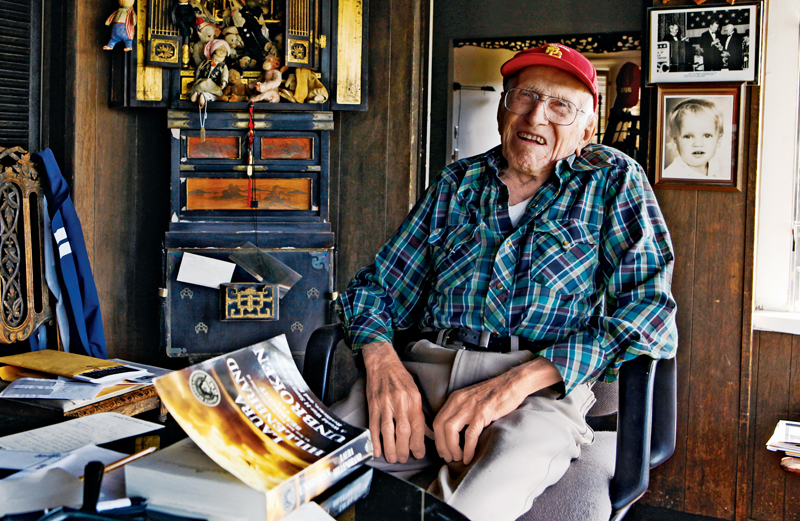
My journey into forgiveness began with a phone call, a breathtaking story and a question.

It was 2002. I’d spent the previous year in a whirlwind of promotion for my first book, Seabiscuit, and was taking some time off. One day, I found myself thinking about a man named Louie Zamperini.

Researching my book, I’d stumbled upon references to an odyssey that he’d survived in World War II. Though I’d only heard bits of his story, I was intrigued, and jotted his name in my notebook. When I finish this book, I thought, I’ll try to find him.

That day in 2002, I did a search online for Louie and discovered that he was alive, in his mid-eighties, living in California. I wrote him a letter. He sent a warm reply, so I called him.

Over the next hour, he told me the most amazing survival story I’d ever heard, a tale that included a plane crash, shark attacks, and capture and torture by the enemy. But what fascinated me even more than his story was the way Louie told it.

He was infectiously cheerful, speaking of his captors’ cruelty without a trace of bitterness. I asked how he could speak so easily of such vicious men. His answer was simple: “I’ve forgiven them.”

I was hooked. My mind began turning on a question: How does a man forgive what is seemingly unforgivable? In search of the answer, I began a seven-year journey through his life, a journey that culminated in my book Unbroken: A World War II Story of Survival, Resilience, and Redemption.

The more deeply I understood what Louie had endured, the more wondrous his forgiveness seemed.

As a boy in California in the 1920s and early 1930s, Louie was an incorrigible delinquent. Then he discovered that he had an extraordinary talent for running. He became a world-famous track phenomenon, competing in the 1936 Berlin Olympics when he was still a teenager.

World War II began, and Louie set aside athletics and joined the Army Air Corps. He was stationed in Hawaii as a bombardier, fighting harrowing air battles against the Japanese.

On May 27, 1943, Louie and his crew took off to search for a missing bomber. Far out over the Pacific, engine failure sent their plane plunging into the ocean. Trapped by wires in the wreckage, Louie passed out.

When he came to, the wires were gone. He swam to the surface and climbed onto a raft, joining two other survivors. They’d sent no distress call, and no one knew where they were.

For weeks the men floated, followed by sharks, surviving on rainwater and the few fish and birds they could catch. On the twenty-seventh day, a plane appeared. Louie fired flares, and the plane turned toward them.

But it turned out to be a Japanese bomber, and its crewmen fired machine guns at the castaways. Louie leaped overboard.

He had to kick and punch the circling sharks to keep them away until the firing stopped and he could climb back up onto the raft. Over and over the bomber returned to strafe the men, sending Louie back into the shark-infested water.

By the time the bomber flew off the raft was riddled with bullet holes and was starting to sink. Amazingly, none of the men had been hit, but the sharks tried to drag them away. Beating them off with oars, the men frantically patched the raft and pumped air into it. Finally the sharks left.

On they drifted, starving. One man died; Louie and the other crewman hung on. On the forty-sixth day, they saw a distant island. They rowed toward it. When they were only yards from shore, a Japanese boat intercepted them.

For the next two and a quarter years, Louie was a captive of the Japanese military. First he was held in a filthy cell, subjected to medical experiments, starved, beaten and interrogated.

Then he was shipped to prison camp in Japan, where he was forced to race against Japanese runners, winning even though he knew he’d be clubbed as punishment. He joined a daring POW underground, stealing food and circulating information to other captives.

It was in prison camp that Louie encountered a monstrous guard known as the Bird. Fixated on breaking the famous Olympian, the Bird beat Louie relentlessly and forced him to do slave labor.

Louie reached the end of his endurance. With his dignity destroyed and his will fading, he prayed for rescue.

When the atomic bombs ended the war, the Bird fled to escape war-crimes trials, and Louie was saved from almost certain death.

He went home a deeply haunted man. He had nightmares of being bludgeoned by the Bird. Trying to rebuild his life, he married a beautiful debutante named Cynthia, but even her love couldn’t blot the Bird from his mind.

He sought solace in running, but an ankle injury, incurred in POW camp and exacerbated by the Bird’s beatings, hampered him. Just as he was reaching Olympic form again, his ankle failed. His athletic career was finished.

Devastated, he started drinking. He had flashbacks: The raft or the prison camp would appear around him, and he’d relive terrifying memories. He simmered with rage, provoking fistfights with strangers and confrontations with Cynthia.

He couldn’t shake the sense of shame that had been beaten into him by the Bird.

Louie thought God was toying with him. When he heard preachers on the radio, he turned it off. He forbade Cynthia to go to church. He drank more and more heavily. In time, Louie’s rage hardened into a twisted ambition: He would return to Japan, hunt down the Bird and strangle him.

It was the only way he could restore his dignity. He became obsessed, trying to raise money for the trip, but his financial ventures kept failing.

One night in 1948, Louie dreamed he was locked in a death battle with the Bird. A scream startled him awake. He was straddling his pregnant wife, hands clenched around her neck. His daughter was born a few months later.

One day, Cynthia found him shaking the baby, trying to stop her from crying. She snatched the baby away, then packed her bags and walked out.

In the fall of 1949, Cynthia made a last effort to save her husband. She asked Louie to come to a tent meeting in Los Angeles, where a young minister named Billy Graham was preaching.

For two nights, Louie sat in that tent, feeling guilty and angry as Graham spoke of sin and its consequences, and God bringing miracles to the stricken.

On the second night, Graham asked people to step forward to declare their faith. Louie stood up and stormed toward the exit. But at the aisle, he stopped short.

Suddenly he was in a flashback, adrift on the raft. It hadn’t rained in days, and he was dying of thirst. In anguish, he whispered a prayer: If you will save me, I will serve you forever. Over the raft, rain began falling. Standing in Graham’s tent, lost in his flashback, Louie felt the rain on his face.

At that moment Louie began to see his whole ordeal differently. When he’d been trapped in the wreckage of his plane, somehow he’d been freed. When the Japanese bomber had shot the raft full of holes, somehow none of the men had been hit.

When the Bird had driven him to the breaking point, and he’d prayed for help, somehow he’d found the strength to keep breathing. And that day on the raft, he had prayed for rain, and rain had come.

Louie’s conviction that he was forsaken was gone, replaced by a belief that divine love had been all around him, even at his darkest moments. That night in Graham’s tent, the bitterness and pain that had haunted him vanished.

A year later, Louie went to Japan. He was a joyful man, his marriage restored, his nightmares and flashbacks gone, his alcoholism overcome. He went to a Tokyo prison where war criminals were serving their sentences.

He hoped to find the Bird, to know for sure if the peace he’d found was resilient. But the Bird wasn’t there. Louie was told that the guard had killed himself.

Louie was struck with emotion. He was surprised by what he felt. It was not hatred. Not relief. It was compassion. Louie had found forgiveness.

Louie Zamperini’s life is a journey of outrageous fortune, ferocious will and astonishing redemption. For me, what gives his story lasting resonance is the light it sheds on the cost of victimization and the mystery of forgiveness.

What the Bird took from Louie was his dignity; what he left behind was a pervasive sense of helplessness and worthlessness.

As I researched Louie’s life, interviewing his fellow POWs and studying their memoirs and diaries, I discovered that this loss of dignity was nearly ubiquitous, leaving the men feeling defenseless and frightened in a world that had become menacing.

The postwar nightmares, flashbacks, alcoholism and anxiety that were endemic among them spoke of souls in desperate fear.

Watching these men struggle to overcome their trauma, I came to believe that a loss of self-worth is central to the experience of being victimized, and may be what makes its pain particularly devastating.

Anger is a justifiable and understandable reaction to being wronged, and as the soul’s first effort to reassert its worth and power, it may initially be healing. But in time, anger becomes corrosive.

To live in bitterness is to be chained to the person who wounded you, your emotions and actions arising not independently, but in reaction to your abuser. Louie became so obsessed with vengeance that his life was consumed by the quest for it.

In bitterness, he was as much a captive as he’d been when barbed wire had surrounded him.

This is why forgiveness is so liberating. But how is it found? For Louie, it lay in resurrecting his dignity, seeing himself not as the wretched creature that the Bird had striven to make of him, but as the object of God’s infinite love.

His self-respect and sense of power reborn, he finally had the strength to let go of his hatred.

I talked to other former POWs who forgave their captors, and for each, forgiveness seemed to follow a return of dignity. Each man found it in his own way, guided by his history and his pain. Louie’s story doesn’t represent the only way out of bitterness. There is no one right path to peace.

Forgiveness is a complex, elusive mystery, and one man’s story can only begin to unravel its secrets. But I take from Louie’s life one beautiful, undeniable truth.

Even when a man suffers the most soul-shattering of abuses, even when he seems hopelessly bound by resentment, forgiveness can still find him and set him free.


Lost on the Night Before Christmas

The Christmas party had been wonderful. It was great to be among friends on Christmas Eve, sipping eggnog and singing carols. I was sorry it had to end. Finally, at a little past one in the morning, I headed home. I was almost at the freeway exit when I saw the sign: CLOSED FOR NIGHT CONSTRUCTION/PLEASE TAKE ALTERNATE ROUTE.

Alternate route? What alternate route? The 55 Freeway was the only way I knew back home, and there weren’t any detour signs. The next exit was coming up fast. Maybe this will put me on the right road, I thought, turning off.

Big mistake. Now I was in the parking lot of a shopping mall. I drove in circles around the deserted lot, trying to get my bearings. I didn’t have a GPS, didn’t have a cell phone. At this hour, on Christmas Eve, there wasn’t anybody to ask for directions.

I glanced at my gas gauge and groaned. Almost empty. Pulling into a spot, I shut off the engine. I leaned my head against the steering wheel. I hoped what I heard about miracles on Christmas was true. I needed one right now.

All of a sudden, I felt a bright light shine on me. The star of Bethlehem? No, just a streetlight on top of a pole that seemed to be sticking up from one of the used car dealerships that lined the street. I couldn’t take my eyes off it. Maybe the lot has a night watchman, I thought.

I drove slowly, staring at the light. There was something comforting about it . . . even if I didn’t know what I’d find when I got there.

I passed some buildings and trees and the full lot came into view. The building next to it was dark. No night watchman. But there was something that made me believe in Christmas miracles.

Attached to the light pole was a sign. 55 FREEWAY: STRAIGHT AHEAD. The way back home.

READ MORE: IS THAT YOU, SANTA

Lost at Sea

KEISA: Not a cloud in the sky, sunlight kissing Charleston, South Carolina’s downtown market. This was the perfect way to spend the Saturday before Labor Day, shopping with my mother, sister-in-law Paula and our three girls, while the guys were off deep-sea fishing.

It was all my husband, Rex, had talked about for weeks, from the moment he got the new boat—a 38-foot cabin cruiser. He’d had it out only a few times before. I checked the time on my cell, a little after 10 a.m. They’re probably baiting their hooks about now. It felt great to get away.

We were spending the weekend at my brother Rodney’s and his wife Paula’s place in Charleston, a four-hour drive from our home. “I hope the fish are biting,” I said to Mom. “Rex promised to take me out to dinner tonight.”

Mom shook her head. “You know how those boys are,” she said. “Dad said not to expect them before dark.”

REX: I eased off the throttle, bringing the boat to rest over a man-made reef. “Here’s the spot,” I called out to my crew, three guys and three boys. The sun was already blistering hot. I snagged a Dr Pepper from the cooler.

“Okay, let’s…” The words never got out of my mouth. An ear-piercing alarm screamed. My eyes flew to the gauges. Check. I threw open the doors to the engines. Saltwater filled half the compartment and was rising fast. I grabbed the radio mic. “Mayday! Mayday!” I gave our compass reading. “Heading 108. Twenty-one miles off the coast. Express Cruiser taking on water.” Dead silence.

Before I could try the radio again my 15-year-old son, Tyler, yelled from below deck. “Dad! Water’s pouring in the hold!”

I looked to the stern. The diving platform was already underwater. “Everyone get in your life jackets and get to the front of the boat,” I ordered. I pulled on my preserver and counted heads. Tyler. Rodney and his 14-year-old son, Kaleb. Another brother-in-law Jody and his little guy, Xander. He was only five! Finally my father-in-law, Roger, the kids’ grandpa. There was no choice but to abandon ship. We needed some way to stay together. I searched the boat…there was plenty of rope, emergency flares lying under the windshield. We had the bait—squid, shiners—in a back compartment, our rods and the…

“Grab the cooler,” I yelled. It was a big one filled with brats, chicken salad and soda. We’d be able to hold onto it and stay afloat. “Get the rope from the bumpers and tie up together. Hurry!” Cool water lapped at my feet. We’d have a few hours at least before hypothermia set in.

The guys scrambled, tying the rope around their waists and then to each other. They pushed off from the boat with the cooler. I pulled my cell phone out of my pocket. Typed in a text to Keisa: “Mayday. Heading 108. 21 miles.” Hit send. No service, the screen flashed back. Grabbed the radio mic again and turned to see a massive wave crashing over the stern. It slammed me against the windshield and swept our flares out to sea. Now how were we going to get help?

I swam over to the rest of the group. Only the bow remained above the surface. Oil and gasoline pooled around us. It burned our skin. “We’ve got to get out of here,” I said, my eyes watering from the fumes.

We kicked about 50 feet away. Searing pain shot through my leg. Tyler screamed. I reached into the water and pulled something slimy from his leg. “Jellyfish!” I said. They were everywhere. Xander was sobbing. “Am I going to die?” he wailed.

“No,” Roger answered firmly. “God is watching over us. We just need to pray.”

KEISA: I was looking at dresses when my cell went off. “God Bless the Broken Road,” Rex’s ringtone. I pulled it out of my purse, but there was no message. “That’s odd,” I said. “Rex just tried to call me.” I checked the time. 11 a.m.

“Don’t worry about it,” Paula said. “I’m sure they’re having a ball out there.”

REX: The waves pushed us farther out to sea. We strained to keep them from flipping the cooler. I looked back. I could barely see the boat. “We’re going to end up in the middle of the ocean with this current,” I said to Rodney. I tied a length of rope around my waist and then to the cooler. “Everyone kick,” I said. “I’m going to tow us back to the boat.”

I turned and reached my arm into the water, pulling with all my strength. A wave swept over me, pushing me backward. I can’t give up, I thought. The guys are depending on me. I paddled harder, stretching as far as I could with each stroke. But it was like I was swimming in place. My chest and leg muscles ached, my heart pounded. Ever so slowly the boat drew closer. I pulled up about 50 feet away. In the distance I saw a tanker. This could be it!

“Look over there,” I said, pointing to the ship. “Rodney, swim with me to our boat. If we can get up high enough maybe they’ll see us.”

We untied ourselves from the cooler, swam to the bow and climbed to the top. Hanging on with my right arm, I waved my left arm frantically. But it was no use. No one saw us. We lowered ourselves back into the water. I cut the anchor loose so I could tie the rope to the cooler to keep us from drifting away. Something hit my leg…hard. “Sharks!” Rodney said. “They smell the bait.”

KEISA: The dishes had long been cleared away. Spaghetti—not the nice dinner Rex had promised me. It wasn’t like him to blow off a date. They should have been back by now. It was 10 p.m., more than two hours after dark. My mind kept going back to that call. What if there’d been a problem?

Mom, Paula and I lingered at the table. I had my cell phone open, pretending to play a game while I looked up the number for the Coast Guard.

I went to a bedroom to make the call. “Coast Guard,” a voice on the other end answered. “Lt. Rhodes speaking.”

“My husband was out deep-sea fishing with my brothers and dad. They’re overdue,” I said. “I’m worried they might have engine trouble or something.”

“Let me check the log,” he said calmly. “Let’s see…Mayday call about ten this morning. Says there was interference. We didn’t get any details. We sent out a chopper and didn’t see anything. We’ll get back out there and I’ll stay in touch.”

I tried to tell myself that they’d be all right, stranded somewhere on the boat. At least they had enough food in that cooler to feed an army. I didn’t say anything to the others yet.

REX: The sharks were out there somewhere, waiting. But I had a more pressing concern. I couldn’t stop shivering. I could feel Tyler next to me shaking as well. Hypothermia coming on. It was all I could do to hold on to the cooler, my body exhausted. I opened the cooler lid and pulled out a Dr Pepper, took a sip and handed the bottle to Tyler. “We’ve got to stay hydrated,” I said.

We’d been out here for 12 hours. “The Coast Guard’s looking for us by now,” I said to reassure the guys. “The girls would have called when we didn’t come in.” But would there be enough time? Would I ever hold Keisa again? God, tell me this isn’t how it’s going to end, I prayed.

I hooked my legs around Tyler’s and Roger’s to try and keep us warm. I could hear Xander crying again. It was a miracle the little guy was even still alive. I felt so helpless.

Someone was singing. Roger. “Amazing grace, how sweet the sound…” I couldn’t help but join in. “I once was lost…” The others did too, Xander loudest of all. I looked up to the heavens. The sky was awash with stars, brighter than I’d ever seen. Lord, we’ve done all we can, I prayed. The rest is up to you. My body still quivering from the cold, our fate as bleak as ever, I sang along, “Twas grace that brought us safe thus far…and grace will lead us home.”

KEISA: My cell phone rang. I lunged for it. What time was it anyway? The clock read 3:30 a.m. “Hello.”

“Mrs. Willimon, Lt. Rhodes here. I’m sorry to report we haven’t seen any sign of your family. We’ve got two choppers in the air and a C-130 transport plane, plus a cutter in the water, but…it’s a big ocean. I was hoping you might have a photo of the boat that you could e-mail us.”

“I think so,” I said. I remembered Rex posting some pictures on Facebook.

I went to Paula’s bedroom, woke her up and explained the situation. “I need to get on your computer.” I sent Lt. Rhodes a picture of the boat. Mom and Paula sat down at the table, their faces etched with worry.

“All we can do is put it in God’s hands,” Mom said. “We need people praying.”

Mom got on the phone to our pastor back home. Paula called Jody’s wife, Crystal, in North Carolina, who hadn’t made the trip, then her minister. I woke up Rex’s mother and my sister Alisa in North Carolina. “I’ll ask for prayers on Facebook,” Alisa said.

I clicked over to the Bible on my cell phone. What was that verse I’d read in my morning devotional? James 1:6. But let him ask in faith, nothing wavering. For he that wavereth is like a wave of the sea driven with the wind and tossed.

I could only imagine what the guys were going through out there, tossed by the waves, clinging to survival. But I wasn’t going to let my faith waver. God knew where they were in that big ocean. He was our only hope.

The three of us bent our heads. “Dear God,” Mom prayed, “send your angels to bring them home safely.”

REX: The sun was just peeking out over the horizon. There was a noise in the distance. Whup-whup-whup. “They’re coming!” I shouted. We waved and yelled until I thought my arms would fall off.

But the helicopter flew past us. My heart sank. How could they have not seen us? Then it stopped…and turned back, hovering directly above us. The wind from the rotor blades sprayed saltwater over us. All I could feel was the joy of being alive. I popped the cooler, grabbed a Dr Pepper, opened it and handed it to Roger. “Pass it around,” I said. “This is a moment to celebrate.”

“Look, a frogman,” Xander hollered. We watched as a rope lowered a man in a wetsuit down to the water. He swam over to us. “Everybody okay?” he said. “We’re gonna get you out of here.”

He escorted Xander and Jody to the hoist first. It lifted them skyward. Then Kaleb and Tyler and finally Roger. “That’s all this bird can hold,” the rescue swimmer told Rodney and me. “But we’ve got another one on the way.” I thought about all the ways I’d tried to get help. The radio call that hadn’t gone through, my cell phone out of service, flares washed away. But God had never failed us. He’d heard our Mayday call loud and clear.

KEISA: I held Rex tight in the emergency room, tears flooding my cheeks. I didn’t think I’d ever let him go. “The boat sank?” I murmured again, in wonder. What a miracle they’d all survived! Rex started to speak, but I covered his lips with my finger. “Shhh,” I said. “Not yet. You need to rest. You can tell me all about it when you take me out to dinner.”

Download your FREE ebook, True Inspirational Stories: 9 Real Life Stories of Hope & Faith

Lost… and Found, With a Little Bit of Help

I can’t tell you how many objects I’ve lost over the years—favorite sweatshirts, car keys, gloves, hats, one half of a pair of socks, sunglasses, my cell phone, my digital camera. Most times, those things were gone for good (I hope someone in the Dominican Republic is enjoying my vacation photos at least). But the story of Michael Amberson, in the Gadsden Times this week, gives me hope that I may still find the more meaningful things I’ve lost.

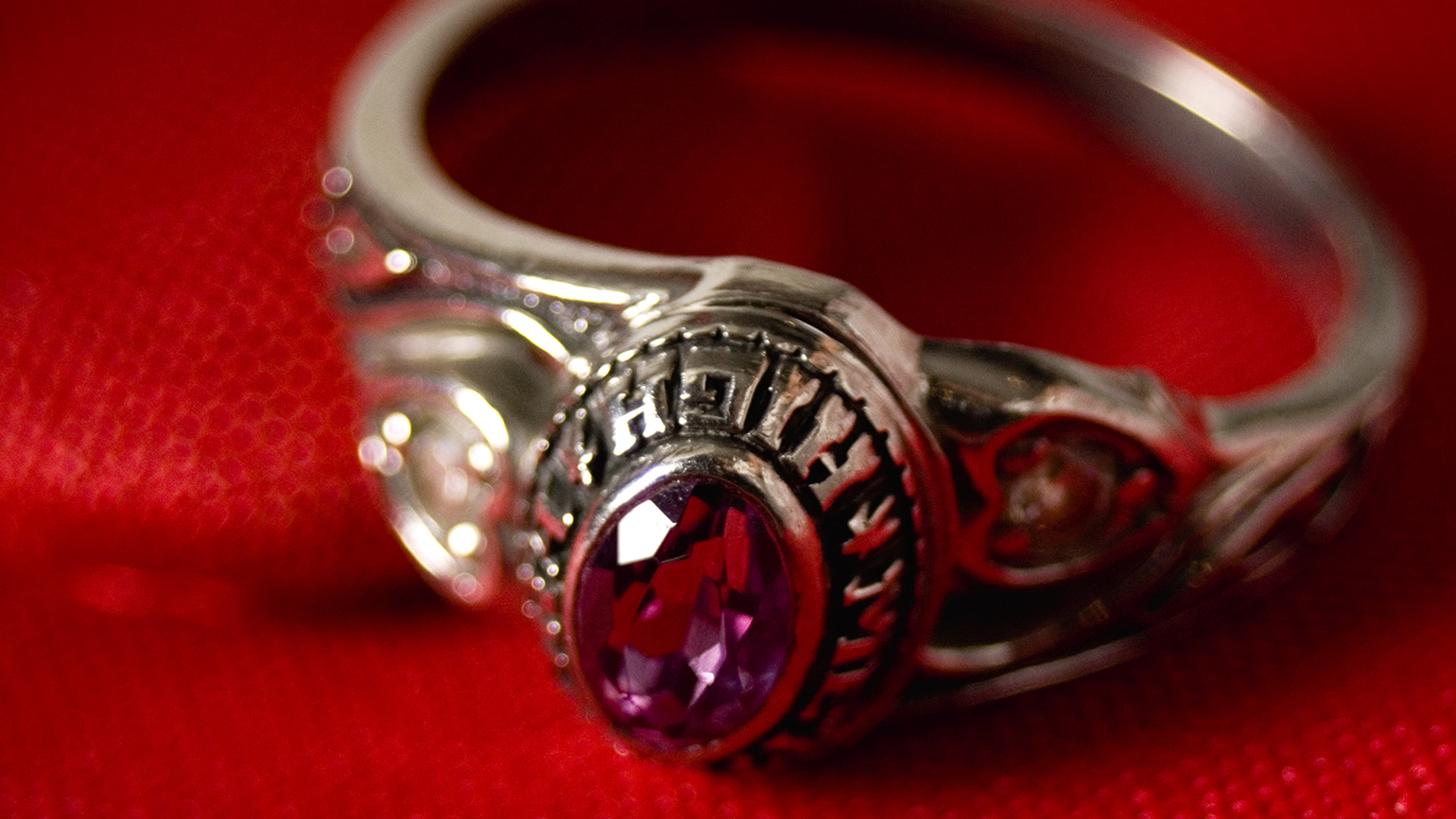
Less than a year ago, Michael’s grandfather passed away. Grandpa Charles had taught Michael a lot about the things he’d need to get ahead in life. Like when Michael graduated Gadsden High School in 1996. Grandpa Charles paid the down payment for Michael’s class ring and helped his grandson set up a payment plan at the jewelry store to teach him how to establish good credit. That gift, and the lesson that came with it was just one of many memories that Michael recalled after his grandfather died. It was just too bad that Michael had lost the ring somewhere in his dorm his freshman year at Jacksonville State University.

Then, two weeks ago, a man named Chad West was mowing the lawn for a friend in Gadsden when he spotted a glint of metal at the foot of a dogwood tree. He bent down and picked the object up. It was a ring, a class ring—with the name Michael Amberson engraved inside.

Michael’s number wasn’t listed in the phone book. Chad was unsure how to ever find the owner—did he even live in Gadsden anymore? Then the answer fell into his lap… literally. See, Chad was a mailman, and as he sorted through his stack of mail to deliver one day, he spotted an envelope with Michael Amberson’s name on it. Last Friday, the ring that meant so much to Michael came back to him.

Jacksonville State University and Gadsden are more than 22 miles from one another. It had been 14 years since the ring was lost. And yet, in Michael’s time of grief, the ring that was tied so closely to memories of his Grandpa Charles ended up right where it would be found… by a mailman, one person who could definitely deliver it.

None of this means my camera will ever make its way back to me (or that my lost socks will rejoin the ones they’ve abandoned). But it’s good to know that there’s something reuniting people with the beloved things they thought had been lost forever.

Has something meaningful to you been lost, and found, in a surprising and mysterious way? Let us know at mw@guideposts.org.

Look to the Heavens: A Conversation with Father Kurzynski

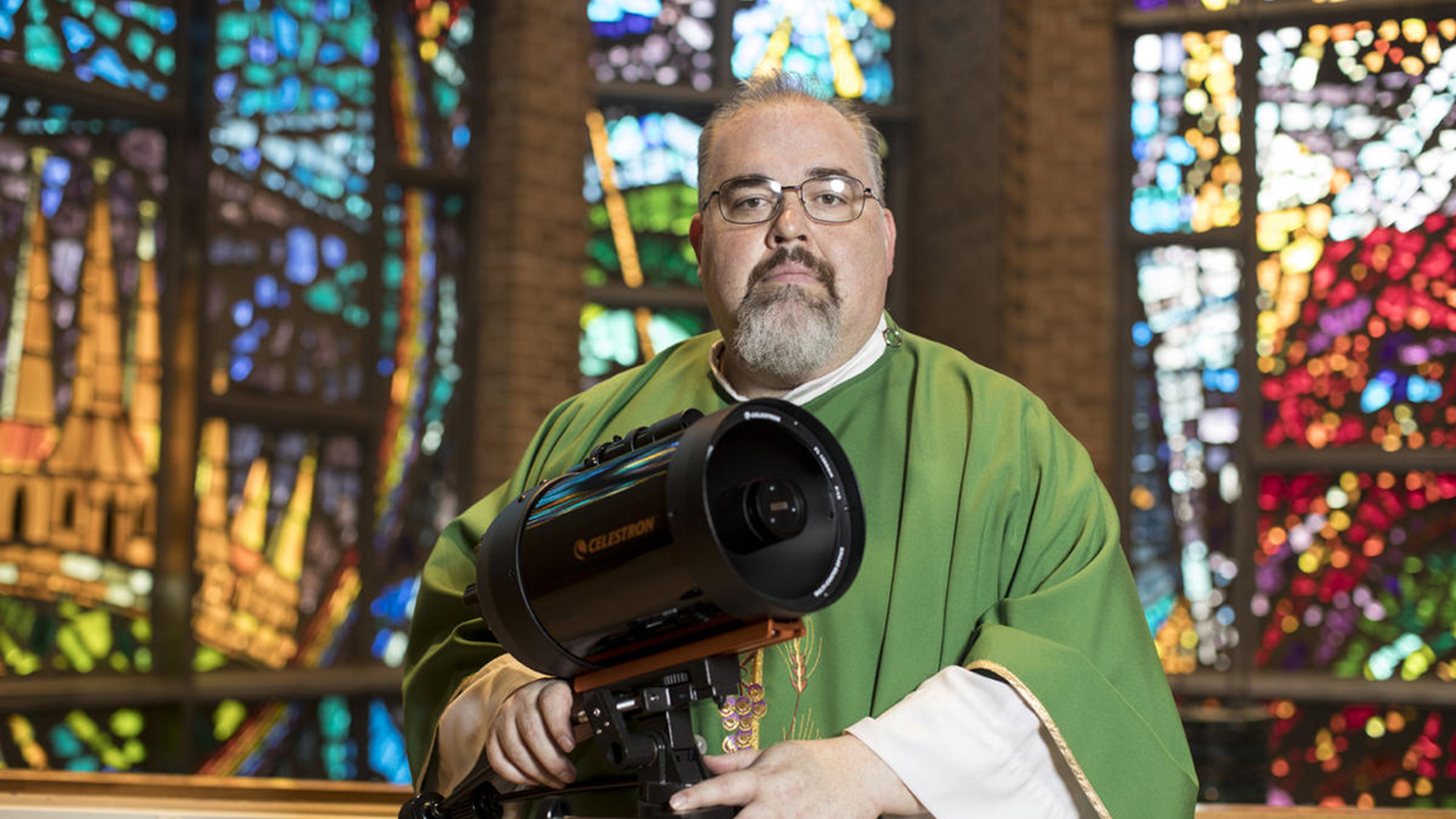
Why does looking at the night sky inspire in us such wonder and awe? That’s a question Father James Kurzynski has been fascinated with his whole life. A hobby astronomer and priest in the Diocese of La Crosse, Wisconsin, Father Kurzynski was instrumental in the creation of the Vatican Observatory’s first “Faith and Astronomy Workshop,” designed for parish educators interested in learning more about astronomy and the science behind our universe. Father Kurzynski is also the author of the book God’s Canvas: An Exploration of Faith & Science. He recently talked to Mysterious Ways to shed some light on the mysteries of faith and the universe…

How did your interest in astronomy and faith begin?

It started as a kid. I grew up in rural Wisconsin on our family farm. I was really blessed to be born in a very dark part of the state with clear skies where I could see the stars. I was a daydreamer who loved to lie in the backyard and marvel at the beauty of the night sky. I would look at the heavens and be amazed with God’s love for me. The deep connection we share with creation and with God was very self-evident to me as a child when I saw the stars at night. It sparked a lot of questions for me, so I began to grow up on faith and science.

I went on to minor in astronomy in college. When I entered seminary, I wanted to explore some of the classic questions of faith and science, but my seminary didn’t have any classes on that. That’s when I reached out to the Vatican Observatory, and ended up working with them to help create the “Faith and Astronomy Workshop.”

There are many stunning sights in this world that elicit awe and wonder, and make us think of our faith and of God, but it seems that the night sky holds a particularly powerful experience for many. Why do you think that is?

When you look at a night sky and see what seem to be just pinpricks of light in exception to the moon, the honest question you always ask is: What else is out there?

When you begin to look into that, you start to understand the immense distances between our earth and everything else. You start talking about things like billions of light years and the size of our solar system. So it can be a very normal tendency to see ourselves as incredibly small. For some, this leads to a crisis of faith, because unfortunately, a modern presumption is that we need to be significant in proportion to creation to be important in God’s eyes. But Scripture doesn’t support this idea. In fact, it supports the opposite idea. Scripture says that it is in smallness that we find our meaning. It is when we are small that God can lift us up.

The philosopher G.K. Cheserton wrote a sketch in his book Tremendous Trifles that illustrates this well. In it, two friends are each granted a wish. One wishes to become a giant, while one wishes to be made very small. The giant is underwhelmed by the world, which seems tiny from his perspective, and unimpressive. The small man, on the other hand, remains in a constant state of awe and wonder.

What can we make of the tumultuous relationship between science—like astronomy—and religion?

Actually, the original history was that astronomy and faith were very closely connected. It wasn’t until recent day that the fight dimension has taken hold. When you look at the nature of science and faith, they’re not at odds with each other. Science examines the physical world and remains neutral about God and faith. Science doesn’t have the ability to explain everything. The proper relationship between science and faith is as dialogue partners.

It’s one thing to ask, as science does, “How are we here?” But it’s another to ask, “Why do I exist? Why do I feel the need to search for purpose? Why does my life seem to be meaningful?” The calling that we have to ask these questions, to improve ourselves, points us to something beyond ourselves. It shows us that something is calling to us as we’re calling to it.

Are there places in the Bible, or early in Judeo-Christian history, where we can see this close connection?

There’s a clear tradition in scripture of the heavenly bodies being symbolic for people. When we look at the stars we think of God’s promise to Abraham, “Look at the sky and count the stars…that’s how numerous your descendants will be.” Here, the stars represent people. Or we think of the dreaming of Joseph and how these eleven stars and the sun and moon bowed down before him. The eleven stars, the sun, and the moon in Joseph’s story are his brothers and his mother and father.

There is a distinction between this and astrology, whereby people look to the stars to purportedly predict the future. Sometimes people will question me on this and ask, “What about the star of Bethlehem, and the wise men?” At that time, the wise men weren’t part of what we would now consider a Judeo-Christian approach to an understanding of the heavens. They were following to the best of their ability what truth was. They were practicing to the best of their abilities their faith. And at the time of Jesus’ birth, everything, even the natural world, was pointing people to his arrival regardless of what faith or tradition he would have represented.

Why do we think of the sky as the location of heaven?

We can definitely see a logical history of connecting the night sky with the heavens. In our modern context, we don’t hold that. There’s been an evolution in our understanding of heaven. We don’t want to limit heaven to that physical space alone. That would be like limiting God to a physical being in the universe.

Looking at the night sky, though, inspires us to dream of heaven as something far greater than what we perceive. It helps us realize that as magnificent and wondrous as our universe is, God is as mystical and unknown.

How does admiring and exploring our universe point us to God?

The way we know that we have a God who wants us to know him is that we live in a universe that wants to be known. Therefore, the universe has a Creator who also wants to be known. The universe doesn’t have to be comprehensible. It could be made in a way that we couldn’t understand. But it’s so understandable, even in the unknown, that we know that with time and patience, we’ll discover how the universe exists and why it is here.

And so, the universe itself becomes a very strong argument that there has to be something else. It points to something beyond us. This should give us hope and consolation.

Do you think there are other forms of intelligent life in the universe?

To say that we are the only life forms in the universe puts a limit on God’s creative act. I can’t limit him and say that he only created us. There are possibly other created beings out there that could be different from us, and we as people of faith should not be afraid of that.

Can God play the same role in other galaxies?

Yes. Because we are human, our tendency is to reduce God to human traits. We are limited beings and limited in what we can perceive. Our problem is that we also limit God in thinking that he has to have the same limitations that we have as humans. Instead we have to realize that God is not made, but simply is. He exists in such a way that he can be present at everything in the universe simultaneously, and everything—even the smallest particles, planets, dwarf planets, asteroids, and dust—are part of God and essential to God.

Look for the Rainbow

I have placed My rainbow in the clouds. It is the sign of My covenant with you and with all the earth.” (Genesis 9:13, NLT)

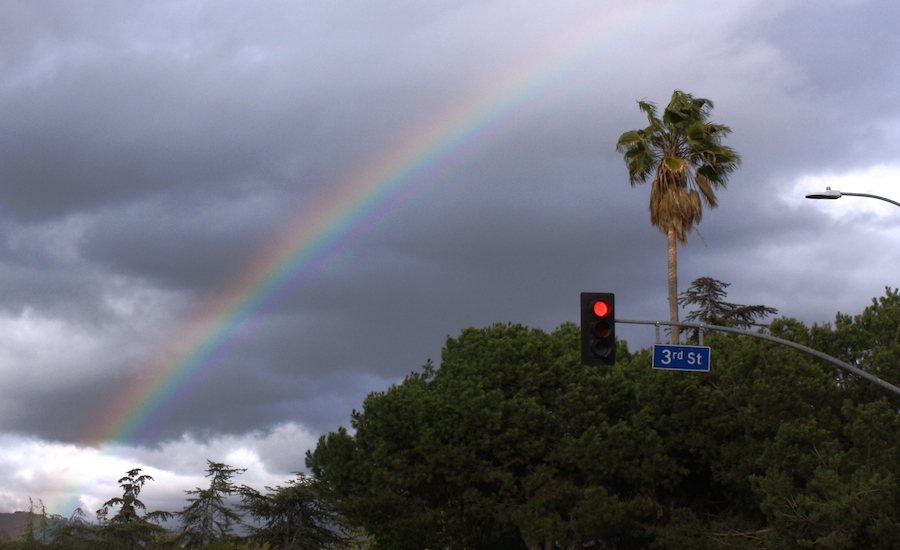
Rainbows have always meant a lot to our family. On the day that my sweet father went to heaven, we left the rehabilitation center where Daddy had died, and as we headed home, a double rainbow stretched over the highway between Decatur and Fort Worth, Texas.

It was as if God was saying, “I’ve got your Daddy, and this is your promise that you’ll see him again someday.”

Just as I was processing the beautiful display of God’s promise to me, Allyson, who was only 9 at the time, said, “God put two rainbows in the sky just for us–one for me and one for Abby because He knew how much we would miss Papaw.”

Precious.

Both girls had also grabbed onto that promise, giving them the same comfort I was experiencing from gazing at the wash of color across the morning sky.

Since then, it seems that any time I have a big decision to make or a situation where I really need the love of my Heavenly Father, a rainbow will appear out of nowhere. And each time, I feel that same comfort.

As I prepare to travel to Los Angeles next month to celebrate Allyson’s completion of her degree from the Fashion Institute of Design & Merchandising, I can’t help but remember another rainbow moment–on the day we first moved Ally to LA several years ago.

I was one distressed mama.

While I was thrilled that Ally was following her dream and pursuing a career in fashion, I couldn’t believe I was going to have to leave my baby girl in Los Angeles all by herself–2,000 miles from home.

We had prayed over her move, and God had shown us great favor at every turn; still, I was nervous and upset.

She is only 18! I thought. How is she going to survive in this huge city?

And what if we’ve chosen the wrong apartment complex for her…What if it’s unsafe? Maybe we should move her closer to school…And, will she be able to navigate the public transportation system? It’s so confusing…

The LA weather seemed to match my mood that afternoon–rainy and dreary. I was lost in worry when all of sudden, my eyes focused on the sky directly above Allyson and her boyfriend, Wesley, who had accompanied us to help with the move.

Painted across the grey sky was an absolutely beautiful rainbow.

Overcome with emotion, I couldn’t speak so I just pointed. We all took a moment to gaze at God’s goodness, His promise that everything was going to be OK.

Ally and I locked eyes and exchanged knowing smiles.

It was a rainbow of reassurance, and exactly what I needed before I could leave my baby girl and head back home.

Time after time, God has shown me His love in such a personal way. Sometimes it’s by way of rainbows in the sky; other times, through a scripture that jumps off the page; still other times through a kind word from a stranger. He is so faithful! God knows just what we need, exactly when we need it.

All we have to do is trust in Him, and look up.

Pray this with me today:

Father, thank You for loving me the way You do and for comforting me when I need it most. I trust You, God, with every part of my life. And, I am so grateful for the rainbows of reassurance You send my way, reminding me of Your faithfulness. You are a good God. In the Mighty Name of Your Son, Jesus, Amen.

Look for Daily Miracles

Today’s guest blogger is my work buddy Tarice Gray. She’s a Guideposts Books editor and loyal member of our Guideposts Prayer Fellowship crew. On Monday, she popped up at my desk to report a small “mysterious ways” she experienced on Sunday. Her tale left me smiling, so I just had to share it with you.

Here’s her “little miracle” story:

On Sunday morning, my pastor began his sermon by reminiscing a bit about a friend he once worked with. The man was kind and loved Jesus, but would overuse, in my pastor’s opinion, the phrase “Would you look at God!”

Pastor preached that most people used the saying to glorify Him after something significant or unexpected happened in their lives, like a good report from the doctor or an out-of-the-blue financial blessing.

But my pastor’s friend used it to celebrate “little things” like discovering a great parking space in a crowded lot or finding an item he wanted on sale. His friend said repeatedly in these times, “Would you look at God!”

Pastor’s response in those moments was that God didn’t care about such minor things. I had to agree. It seemed silly to say “Would you look at God!” because of a good parking space!

“But in hindsight,” Pastor said, “maybe He does care.”

Read more amazing stories! Click here to subscribe to Mysterious Ways

Later that Sunday, my 7-year-old daughter, Marin, and I went to BJ’s Wholesale Club. The chain is known for two things: never having bags to pack up your purchases and not letting you leave without an employee verifying your receipt. As a result, you can’t just tuck the receipt in your bag or pocket.

We had our receipt punched at the door. Marin held it while I balanced our items in my arms. I asked her to hand the receipt to me so we didn’t lose it, just in case I needed to return something. I’d purchased a pajamas set for Marin and her doll she just had to have, but wasn’t sure if it’d fit.

Just as Marin was about to hand me the receipt, a huge gust of wind blew it out of her hand and across the enormous parking lot into a cluster of debris. It was gone. “Ugh!”

I took a moment to rearrange our items, and we walked to the car. Suddenly, unexpectedly, the wind shifted. Like a small, gentle breath of air. One rectangle piece of paper escaped the cluster of debris, blew in our direction and landed at our feet. I reached down and checked it. I couldn’t believe it–our receipt! What were the chances?

I smiled at my little one and couldn’t help myself as I said to her, “Would you look at God!”

When was the last time you said, “Would you look at God!” Share your story below!

Listening to the Quiet

Today’s guest blogger is assistant editor Daniel Kessel.

One of my favorite stories in the April/May 2015 issue of Mysterious Ways comes from Senior Editor Rick Hamlin, an account of 17th-century philosopher Blaise Pascal’s spiritual epiphany. So when Rick posted a web-exclusive video about Pascal, I couldn’t wait to watch.

One line in particular stood out: “All of humanity’s problems stem from man’s inability to sit quietly in a room,” Pascal once said.

Maybe it’s just because I tend toward shyness around the office, but that advice really resonated with me. Imagine–what if we were content all the time, even during life’s quieter moments?

Pascal’s wisdom echoed in my head one recent afternoon while I washed my coffee mug in the office kitchen. I didn’t feel much like talking. I just wanted to get another caffeine-filled cup of coffee and go back to writing. A quiet room sounded great to me.

“Hey, Daniel,” a cheerful voice said. Rick, one of the few people in the office who calls me “Daniel” instead of my nickname, “Dan.” He walked into the kitchen and switched on the electric kettle for his tea.

“How are you?” I replied. Rick said he was doing great and opened the cupboard for a tea bag. I finished cleaning my mug and pressed the button on the coffee machine. For a moment, we stood in silence. Golden silence, exactly the kind Pascal would have praised.

But then a thought popped into my head. Ask about Europe. Huh? Where’d that come from? To my knowledge, Rick didn’t have any vacations coming up. But as much as I wanted to grab my coffee and go, the urge wouldn’t disappear. Ask about Europe! Rick poured hot water into his mug–in a second he’d leave the kitchen. I blurted it out before I could stop myself.

“So, uh, do you have any trips to Europe coming up?” I asked.

Rick’s eyes lit up. “Well, yes,” he said. “My wife and I are flying to Italy this weekend!” An old colleague had contacted him at the last minute, he explained, and asked for consulting help on a writing project in Rome. “How did you know?” he asked.

Until that moment, I didn’t. We stood in the kitchen for a while longer and discussed Rick’s unexpected trip abroad. Inside, I was amazed. My question about Europe seemed to come from nowhere. Like someone had wormed his way into my brain, forced me to break the silence and speak.

I still agree with Pascal’s advice that silence is key for inner peace. Sometimes, though, a quiet voice speaks to us in that silence, and spurs us to connect with others. I know I won’t ignore it in the future.

Has a casual conversation ever led you to something or someone unexpected? A much-needed friend, or even a life-saving connection? Don’t be shy–tell us your stories!

Let It Snowflake!

Have you ever taken the time to examine a snowflake? I mean really, really study it?

I haven’t, at least not since I was a kid. When it snows in New York City, I’m more focused on getting to work without falling face first into a mound of slightly off-color sidewalk snow!

But, the next time it snows, I think I’ll take a closer look. According to Smithsonian.com, there are 39 categories of solid precipitation that can be broken down further into 121 subcategories. Isn’t that kind of amazing?

Take a look at this eye-opening graphic from chemistry teacher Andy Brunning that classifies all the snowflake varieties:

Caltech Physics professor Kenneth G. Libbrecht explains on his snow crystals website, “since snow crystals all follow slightly different paths through the clouds, individual crystals all tend to look different.” So, as the saying goes, no two snowflakes are alike.

That’s even more astounding when you consider that, according to the Library of Congress, “Each winter there are about 1 septillion (1, 000, 000, 000, 000, 000, 000, 000, 000 or a trillion trillion) snow crystals that drop from the sky!” Man alive!

All of this got me wondering. If God put that much care into crafting snowflakes–each with a unique path–can you just imagine how much thought he put into us and our own individual paths? His designs are complex and inexplicable and completely marvelous when you think about it.

I’m almost looking forward to the next snowfall in New York. Until then, take a look at these photos of snowflakes up close–prepare to be dazzled!

Have you ever been floored by God’s designs in nature or beyond? Share your story below!

John Corbett: The Importance of Saying Yes

Most of my career I’ve played the nice guy, the romantic interest with a heart of gold. I’m really comfortable in those supporting roles. So my role in the new movie All Saints, as an Episcopal priest who’s assigned to a small church in Smyrna, Tennessee, was a definite challenge. Not that Michael Spurlock, who’s a real person—the movie is inspired by a true story—isn’t a good guy. But I’d never played the lead, a character who’s on every page of the script, and it scared me. Yet something made me say yes to it.

Actor John Corbett on the cover of the August 2017 issue of Guideposts magazine​Michael arrives at All Saints with orders to close the church down. The congregation has only a dozen members and can’t make the mortgage payments anymore. No reason to keep the place open, right?

Not quite. Refugees from Burma show up. There are 70 of them, members of the Karen ethnic group and observant Anglicans. They want to be part of the church. But their needs go beyond the spiritual. They need jobs, food, places to live.

Michael reaches out to them, even though he’s not going to be around long enough to make much difference. As soon as he sells the church’s acreage, he’ll be gone. But then God gives him an idea. The Karen people were farmers back in Burma. What if they farmed the land the church owned? They could grow their own food, sell the extra produce and maybe even help raise money to pay off the church’s debt.

That’s exactly what happened. It’s not what Michael Spurlock expected; it’s not what his superiors had asked for; it’s not at all what he’d been assigned to do. Except it’s exactly what God wanted.

That really spoke to me because there have been times in my own life I’ve ended up doing something I totally didn’t expect, something I couldn’t even have imagined. Flash back to the first half of my life. Not long after I was born in Wheeling, West Virginia, my parents moved our little family to California. They split up when I was two, and my mom and I took the train back to Wheeling to live with her mother. It was a great place to grow up. I went to a small Catholic school with the same 13 kids from first through eighth grade, then the Catholic high school on the same block. Everybody knew everybody.

Weekdays and Sundays I served as an altar boy at St. Joseph’s Cathedral, a big beautiful place with a dome, mosaics, a massive pipe organ and an immense circular stained-glass window. I got up at 5 a.m. to do my paper route, then rushed to church. Altar boys had to be on their toes, putting on vestments, stacking hymnals, arranging the wafers, filling the water and wine cruets, lining up the bells. No sleeping on your feet. By the time I was 15, I’d worked so many funerals that an open casket hardly fazed me (being slipped a fiver as a tip wasn’t so bad either).

I learned self-discipline as an altar boy. It was good training for a guy who would end up making movies—not that I had the slightest inkling of my path back then.

I figured I’d just stick around Wheeling after high school and get a job. I wasn’t cut out for college; I was a C or D student at best. My dad drove out from Southern California for my high school graduation. He asked me what I planned to do with my life. I shrugged. I didn’t know.

“If you ever want to work in the steel industry,” Dad said, “I can help you find a job.” He was a welder. “Just let me know.”

“Sure,” I said, never thinking I’d take him up on it. I’d grown up all the way across the country, so I didn’t really know him well.

A couple of months later, making only $2.65 an hour as a delivery boy, I found the offer more tempting. Maybe I should try California. Maybe a job like Dad’s would be just the ticket. I drove out there with some buddies. I didn’t even tell my dad I was coming. In fact, I didn’t even know where he lived, just the name of the town. Bellflower.

I took a bus to Bellflower. I went to a phone booth outside a Laundromat, looked up “John M. Corbett” in the book and found his address. There was a guy putting laundry into his hatchback. I told him the address and asked, “Can you tell me where this is?”

“About a mile from here.” He started to give me directions, but he must have seen how clueless I was. “Let me take you there,” he said.

I got in his hatchback, and he drove to a small two-bedroom house. I knocked on the door. My dad and his wife welcomed me in, and I stayed for a year. True to his word, Dad got me a job at Kaiser Steel in Fontana. Soon I was earning more money than I’d ever dreamed, clocking 60-hour weeks. I had a nice apartment, nice clothes and plenty of money to go out with my buddies. The work, though, was grueling.

John and the cast of All Saints filmed at the Smyrna, Tennessee,
church where the actual story took placeI was a hydrotester. Kaiser made huge pipes headed for the Texas oil fields, and my job was to make sure the welds were tight. We pumped thousands of pounds of water through them to see if there were any cracks. We couldn’t do it without getting drenched ourselves. We worked 10-hour shifts, testing a pipe a minute. Which meant getting soaked 60 times an hour.

I wanted to believe there was something else out there for me, something I was meant to do, but I had no idea what it was. Year in, year out, I stuck it out in that open-ended factory, freezing in the winter, when the wind howled down the San Bernardino Mountains, sweltering in the summer.

Then one day some pipes came off the assembly line and hit me in the back. Next thing I knew, I was on disability, walking with a cane, popping painkillers.

Manual labor was out of the question. What was I going to do with myself now? “Why don’t you go to community college?” Dad said. “Take some classes. Get a degree.” I’d been such a lousy student. What purpose would college serve? Then again, it wasn’t as if anything else was jumping out at me.

The first week at Cerritos College went okay. The second week, the assignments came. Read eight chapters by tomorrow. Write a five-page paper. I was completely lost. One afternoon I stayed in the cafeteria long after everybody else left, totally disheartened. College was a dead end for me. Twenty-four years old and I had no future.

I finished my chicken burger and was picking at some French fries when a few guys came in and sat at the other end of the long table, 18-year-olds just out of high school. They were joking around. I made some jokes back. They laughed and scooted over to me. I asked what classes they were taking. “Acting,” they said. Who knew there were acting classes at Cerritos?

“We’ve got an improv class next,” they said. “Wanna come?”

“Your teacher won’t mind?”

“No. Come on.”

I grabbed my cane and hobbled after them. They took me to a theater that was like a black box: black bleachers, black floor, black floor-to-ceiling curtains and a small performing area. It had a mysterious, almost mystical feel. The instructor walked in. Georgia Well was her name. My new friends introduced me. “This is John. Okay if he stays?”

“Sure,” she said. I watched one improv after another. I’d never been around anything like this! It was as if a whole new world opened up to me, a world I longed to be a part of, a world where I sensed I belonged. It was as clear as anything I’d ever gleaned from those hours on my feet at St. Joseph’s, listening to the priest.

To my surprise, Georgia Well asked if I wanted to do an improv. I knew enough to know I had to say yes, yes to a new purpose for me, a new understanding of myself. I wanted to be here, take acting classes, learn to do all the things my new friends did, perform in plays (not that I’d ever seen one).

I dropped my other classes and signed up for all the acting classes at Cerritos. Within a month, I’d landed a role in the campus production of Hair. My dad’s jaw just about dropped to the floor when he saw me on stage singing. Everything on his face said, I didn’t know you could do this. I didn’t know I could do it either!

That’s what happens when you follow God’s lead and do what brings you joy. I didn’t need the cane or the painkillers anymore. Healing came from the work I was doing, the friends, the new passion I’d discovered. I’m the least likely guy to end up in several hit TV series, let alone star in a Hollywood movie. Me, a blue-collar kid from West Virginia. But when I look back, I can see how the altar boy duties, the paper route, Dad’s finding me a job at a steel mill, even the debilitating back injury brought me to where I am now.

Still, I can’t help asking myself, What if I hadn’t been sitting in the cafeteria that day? What if I hadn’t gone with those guys to that improv class?

I’ve learned, like the priest I play in All Saints, that when God sends a suggestion our way, the best thing we can do for ourselves is say yes.

For more inspiring stories, subscribe to Guideposts magazine.