Embrace God's truth with our new book, The Lies that Bind

An Inspiring Message in the Sand

Walking the beach alone wasn’t how I wanted to spend that Saturday. I worked hard all week, and I looked forward to the weekends with my family. Unfortunately my grown kids didn’t always want to sit at home with me. I’d hoped by this time in my life I’d have grandkids to visit, but it wasn’t to be.

I strolled slowly up and down, digging my toes into the wet sand. The smell of the salty air and the roar of the surf soothed me. What a delight it would be to have a little companion on my beach visits. I just have to be patient, I told myself. I’ll have grandchildren if and when it’s meant to be.

I sat down on a sand dune. As I stared at the sea I suddenly felt blessed to have the healthy family I did have. Two sons, 16 and 22, and a daughter, 14, and my oldest son, Mike, who’d been married three years.

I got up to continue my walk, but I only made it 20 yards before I stopped in my tracks. Someone had written the word “grandma” in the sand. It felt like a sign. When I got home Mike called. He usually called once a week to check in. It was always good to hear his voice.

“Hi, Mom!” he said cheerfully.

I couldn’t resist asking. “Do you have any news to share?” I said, remembering the writing in the sand.

“No, Mom,” he said, laughing. “No babies. You’ll be the first to know. I promise.” Mike and his wife were good-natured about my prodding.

Oh, well, I thought. I guess the sign was meant for someone else. Some lucky lady, that was for sure. “You’re all I need to be happy,” I said. It was true.

“Thanks, Mom,” he said. “We’ll see you later in the week.”

We were all getting together to celebrate my middle son Mark’s birthday. By the time he blew out the candles on his cake, I was so caught up in celebrating the family I already had I’d forgotten all about my walk on the beach and the writing in the sand.

Mark opened his presents, and last, a card from Mike and his wife. “Am I the first to know?” Mark asked after reading the note inside.

Mike and his wife looked at each other. “No,” Mike said. “Mom was!”

Yes, Mark was going to be an uncle, and Mike was going to be a father after all. He’d found out just after he’d called. Thirteen years later I still walk the beach, only now I have not one but half a dozen grandkids on the journey with me. Some lucky lady for sure.

Download your FREE ebook, The Power of Hope: 7 Inspirational Stories of People Rediscovering Faith, Hope and Love

An Inexplicable Nudge Led Her to a Long-Lost Family Recipe

I sorted through some cookbooks on the kitchen counter. My husband, Steve, worked next to me in silence. We were going through his parents’ farmhouse near Rock Port, Missouri, trying to decide what to do with everything in it. We were overwhelmed by the 60 years of stuff that had accumulated.

I knew this undertaking was hard on Steve. He’d grown up in this house. His parents had built it themselves. After his mother, Velma, had passed away 20 years earlier, his dad, Lyle, had left everything untouched. He’d instead focused his energy on keeping the farm going. Now Lyle was in his late eighties and could no longer work. Lyle resisted leaving the farm, but it was clear his health was deteriorating. Steve and his brothers decided to move him into a nursing home.

The brothers knew that they were making the best choice, but it was tough for Steve to see his dad frail and diminished. As we emptied out his parents’ kitchen now, I knew Steve was thinking about all the good times the family had shared here and the good meals his mom had cooked.

Velma was the best mother-in-law you could ask for. When Steve and I got married, it was my second marriage and I had two young daughters. I could have so easily felt like an outsider. Not with Velma. She welcomed us warmly and treated my daughters and me like family right away. She and I had very different backgrounds. She was a born-and-raised farm girl. I’d grown up in the suburbs, the child of New Yorkers. But Velma was easy to bond with. And cooking had really brought the two of us together.

I had gone to the Culinary Institute of America and was the author of four cookbooks. Cooking was my passion. Velma was a skilled home cook who had expertly fed four hungry boys. Steve and his brothers still spoke fondly of their mother’s delicious comfort foods. Velma had shared recipes with me for a few of Steve’s favorites, but, sadly, she didn’t get a chance to show me all of them. Just four years after Steve and I got married, Velma died of melanoma.

As I stacked the cookbooks on the counter, I couldn’t help but think about the one dish I never could get right: Velma’s famous apple crisp. It was one of Steve’s all-time favorites, but it was also one that I didn’t have the recipe for. I’d searched through all his mother’s cookbooks but couldn’t find it anywhere. Perhaps she had committed it to memory and just never written it down.

Over the years, I’d tried to recreate the apple crisp, but I could never get it exactly like Velma’s. I tried different recipes, some with cranberries, some with walnuts, one with oatmeal streusel. Steve would take a bite and say, “It’s good, but it’s not Mom’s.”

It had become a kind of running joke between us. Still, I felt frustrated. I was an accomplished cook! How could I not get this apple crisp right? After years of trying, I’d finally given up.

I was making another stack of cookbooks when a kitchen drawer caught my eye. I’d never looked inside it before. Yet I felt drawn to it now. We still had so much work to do, but something was telling me to stop what I was doing and check out that drawer. I walked up to it. I opened it and found some old recipe cards scattered inside. I gathered them up and started thumbing through them.

You don’t have time for this right now, I reminded myself. Just set them aside for later.

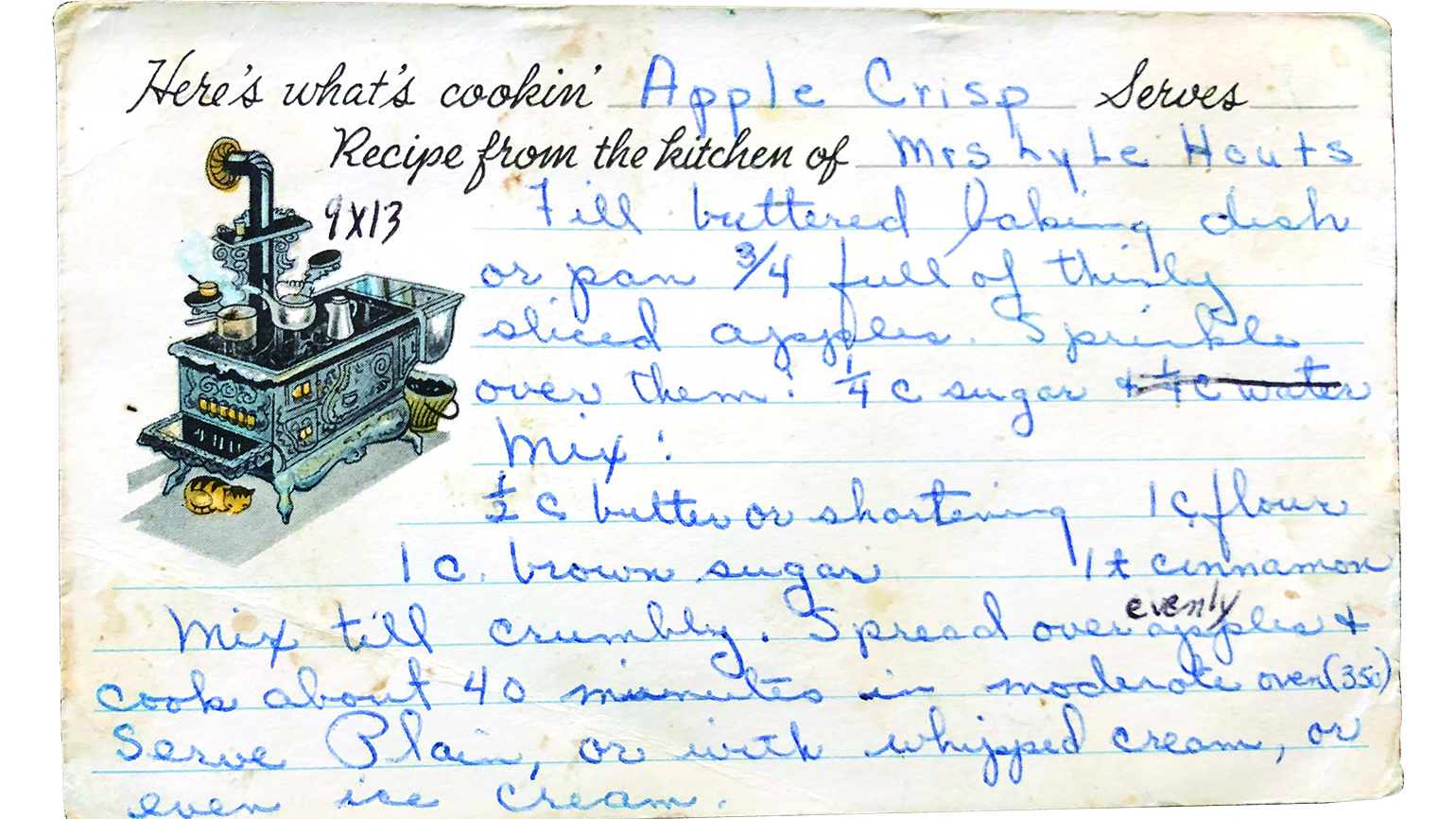
As I moved to set them down, the pile of cards flipped to the center. I stared in disbelief. There, in Velma’s handwriting, was a card for apple crisp. I’d finally found her recipe! It had been hidden away in this drawer the whole time. But how had I known exactly where to look?

The next week, when things were quieter, I gave the dessert a shot. I’d never gotten it right before, but then again, I’d never had the recipe. Following the instructions step by step, I made a pan of apple crisp. I waited nervously as Steve took a bite. For the first time in weeks, his eyes lit up and a smile spread across his face. “This is it!” he said.

Though I can’t explain it, I’m grateful for the powerful nudge that guided me to the long-lost, long-coveted recipe. It allowed me to bring Steve some much needed comfort—a perfectly made slice of Velma’s apple crisp.

Did you enjoy this story? Subscribe to Mysterious Ways magazine.

An Incredibly Fabulous Pink Dolphin

Here’s a little bit of wonder for you today. Something you may have seen floating around the Internet. A pink dolphin. That’s right…pink!

The pretty-in-pink bottlenose dolphin was first seen in the Calcasieu River, Louisiana, by charter boat captain Erik Rue in 2007. Fittingly, her nickname is Pinky. She’s thought to be a rare albino dolphin and is now believed to be pregnant!

Take a look at footage of the fabulous Pinky from Captain Rue.

I don’t know about you, but the idea of living in a world with pink dolphins just brings me joy. Kind of makes you feel like anything is possible, like horses that tap dance and vegetables that taste like doughnuts.

Who knows what else is out there?

An Important Lesson from an Italian Renaissance Painting

Florence, Italy. I’d been there before on one of those scruffy five dollar-a-day youth-hostel jaunts through Europe, but now, just graduated from college, I was wondering what to do with my life. Could I live in Florence for a while, practice my Italian, write a little, grow up?

It seemed a crazy dream—not enough money or sense to manage it. Still, that fall, I bought a one-way plane ticket and checked into a cheap pensione near Florence’s railroad station. On a luminous October day, with the sharp aroma of espresso and cappuccino wafting from cafés, I crossed the Arno to the church of Santa Maria del Carmine. My goal: to gaze at a fresco I’d studied in art history.

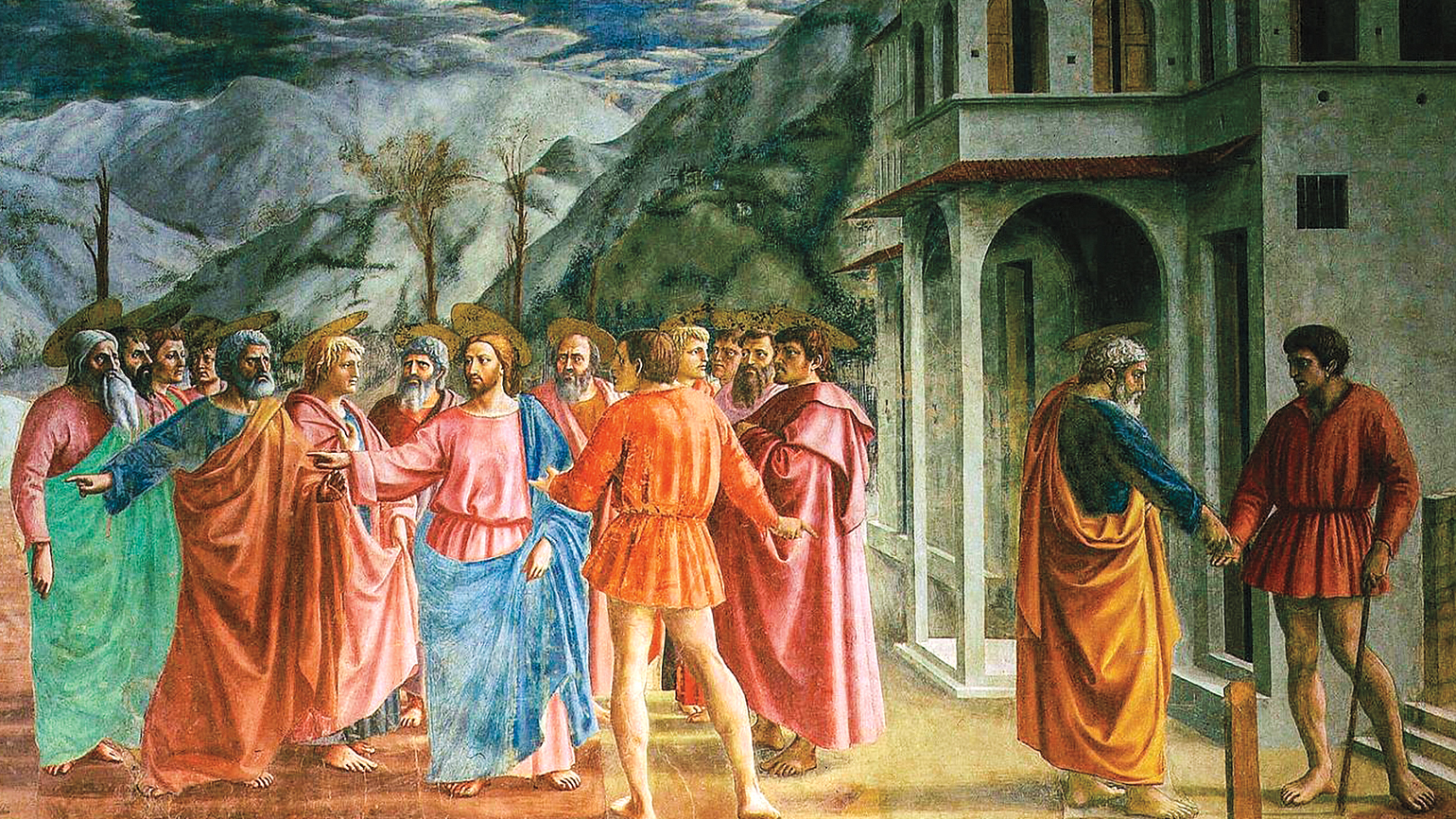
It was The Tribute Money, painted by Renaissance master Masaccio in the 1420s. It exemplifies a turning point in Western art, when things became more realistic through the use of linear perspective.

The scene shows a miraculous event from the Gospel of Matthew. The disciples are in Capernaum, and Peter is challenged by a tax collector: Does Jesus pay the temple tax? Yes, Peter says, then goes back to Jesus, who knows all about the conversation without ever having overheard it. (There’s one miracle.)

In his usual fashion, Jesus turns the question back on Peter: “From whom do kings of the earth take their toll or tribute? From their children or from others?”

“From others,” Peter correctly replies. In other words, the rich and powerful look for every way to avoid paying their full weight of taxes.

“Then the children are free,” Jesus says, a line that makes me smile. The children, that’s us, Jesus’s followers. We’re free. Still, wishing not to offend the tax collector—after all, Matthew was a tax collector—Jesus tells Peter to go to the sea, cast his hook and take the first fish that comes up. Open its mouth. There will be a coin inside. “Take that and give it to them for you and me,” Jesus says.

In Masaccio’s fresco, you see everything happening at once. The tax collector accosts Peter, who goes back and talks to Jesus—the central focus of the painting—before extracting the coin from the fish’s mouth.

I started thinking about my own financial situation. I still had a bit of money left from painting my sister’s house and waiting tables over the summer. It was enough to stick around Florence for a month or two, guarding every cent. But I wanted to stay longer, make friends, study singing if I could, visit this fresco many times. I would have to find some source of income. But how? I didn’t know anybody. What could I do? It was nice enough for Peter to get something from the fish’s mouth in Capernaum. Miracles like that were the stuff of biblical times, not the 1970s, not for a wandering college grad husbanding a dwindling supply of travelers’ cheques.

I walked out and gazed up at the Duomo across the river. Churches abounded in this beautiful town. There was even an American church founded by expatriates. A professor of mine who had been here on sabbatical recommended it as a networking tool of sorts. “You might meet some nice people there,” he said. Maybe so, but I didn’t see how that was going to help my wallet.

Nevertheless, that first Sunday I went to the American church for worship and lingered at the coffee hour afterward—American coffee, alas, not espresso. The conversation was American too: frank, unapologetic, full of “Where are you from?” and “What are you doing here?” I introduced myself to a tall woman in her fifties and mentioned that I’d just graduated from college. “What was your major?” she asked.

“English,” I replied—a sure conversation stopper.

“Would you be interested in teaching English at my language school?” she said. Would I ever! Pennies from heaven—if not from a fish’s mouth.

That was my first job. Others miraculously followed: tutoring, babysitting, substitute teaching at the American school. I moved out of the pensione and rented a room on the outskirts of town. I joined the choir at the American Church and the choir at the Italian Duomo. I studied voice and began palazzo-sitting for an Italian contessa, walking her corpulent dachshund in the piazza twice a day. I was making a life and a living for myself in a foreign city where I’d arrived not knowing a soul.

Whenever I had a chance, between gigs, I would go back to the Masaccio and stare at it in that musty church. I was beginning to see its deeper meaning. God’s bounty could be found in the places you least expected. You simply had to trust and not be too greedy. You’d find the coin you needed. Enough to satisfy the moment. You did what you were called to do, like Peter the fisherman or Rick the English major, who’d discovered the joy of teaching.

By year’s end, I had enough money to fly home for the summer, but I was determined to come back. A friend suggested that I take over the one-bedroom apartment he’d be vacating. He took me to meet the landlord, an elderly Englishwoman who liked the rent delivered to her—with tea and biscuits and lots of chitchat. I left humming, “See you in September….”

How exactly was I going to make enough money to pay for the first month’s rent at the apartment remained a mystery. Nobody I knew back at home in Southern California needed a paint job, and I wouldn’t be there long enough to go back to waiting tables. The small amount of money I’d managed to save from my teaching and tutoring over the past few months was barely enough to pay for a week’s worth of food upon my return. Trust God’s provision, and be open to what anyone suggests, I reminded myself. Even if it seemed outlandish.

The suggestion from a friend that summer really did seem outrageous: “Rick,” she said, “you’re good at trivia. You should audition for this TV game show they’ve just revived, Tic Tac Dough.” This was 1978. I called up, was booked for an interview, drove the family station wagon to a studio. Long story short: As a contestant, I won a dining room set (which I managed to sell), a free trip to Europe for two (which I gave to Mom and Dad to come visit me) and $1,500. More than enough to cover initial costs back in Florence, where I happily lived another year.

Much has changed in the world since then. But I still hold on to the message I learned from that fresco. Trust in God’s providence. Don’t be greedy. There will be enough for the day. Take it from the fish’s mouth.

Animals That Save Their Owners’ Lives

Over the years, we’ve shared some pretty remarkable stories about animals that rescued their owners and other human beings. Pudding, the cat that saved a diabetic woman from a low-blood-sugar episode. A horse named Amber that stepped between her caretaker and a wild, violent mare. The mysterious stray that came to stay with a minister’s family while he was out of town—keeping them safe in a dangerous neighborhood.

These stories make us wonder… where do these protective instincts come from? They seem to hold no evolutionary purpose. Are they a sign of higher intelligence in these creatures than we seldom give them credit for? Or is there a greater force at work, using these furry friends to reach us at times when others cannot?

Today my attention was caught by an incredible story on the link-sharing site Reddit. Debra Lowery of Lake Ronkonkoma, New York, was taking a shower in her family’s split-level ranch house when she suffered a seizure. As she fell, she hit the hot water knob, turning it all the way up. Unbeknownst to the family, the hot water boiler was broken and unable to regulate the water temperature. As Debra lay unconscious in the tub, increasingly scalding water rained down on her.

Debra’s sister, Denise, was in her bedroom on the opposite end of the house and a level down from the bathroom where her sister lay in mortal danger. Denise didn’t know anything was wrong. Until a furry black creature poked its head through her door, barking repeatedly.

“Gangsta? What are you doing here?”Gangsta the Hero Dog

It was odd to see the family’s Pomeranian on that level of the house. Gangsta, a small dog, was absolutely terrified of walking down the home’s steep stairs. Someone always had to carry her from level to level. She had been in their father’s room on the top level of the house, but now had dashed down the stairs with an extreme sense of urgency. She would not stop barking.

Denise knew something was wrong. Following Gangsta, she rushed up the stairs and ran to the bathroom, where steam billowed from around the door. She burst in to find her sister badly burned. Denise quickly turned off the water, preventing her sister from drowning or sustaining further burns.

Even after significant reconstructive surgeries and skin grafts, Debra still bears scars from the accident. But she is thankful to be alive, and she celebrates her recovery. Today, according to her friend who posted her story to Reddit, Debra is an advocate for burn victims and donates what little she can to burn centers in her area.

She wouldn’t be alive without Gangsta’s help. A little dog who’d never run downstairs before—driven to do so by some force beyond logical understanding.

What do you think, readers? Do animals have an instinct to protect us? If so, where does it come from? Tell us in the comments below.

Has a pet you’ve owned ever acted in an odd, unnatural way, alerting you to danger? Send us your story. We might share it in our magazine!

Angels Abound

Back in Biblical times, angels abounded, and when they spoke, they had something important to say! They are evident a lot in the story of Christ’s birth.

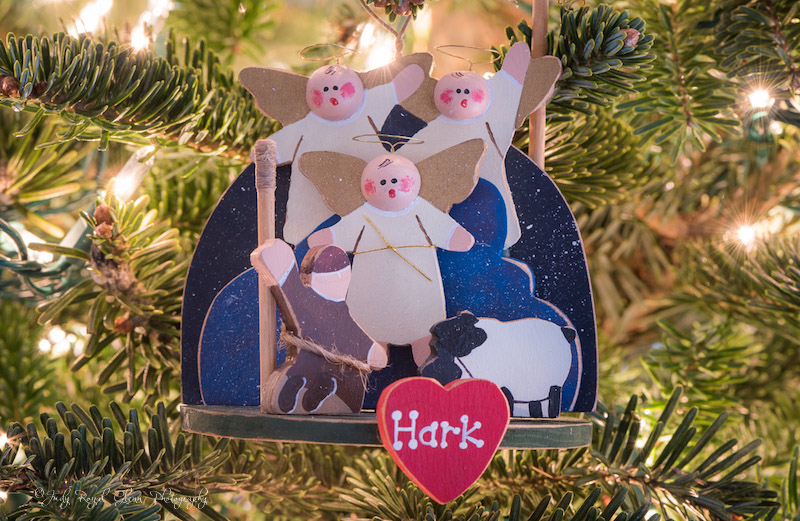
Christmas wooden ornaments. Photo by Judy Royal Glenn.

I wrote in my last post how an angel of the Lord spoke to Joseph in a dream and visited Mary. We find the presence of angels once again in Luke, chapter 2. The scriptures read:

And in the same region there were shepherds out in the field, keeping watch over their flock by night. And an angel of the Lord appeared to them, and the glory of the Lord shone around them, and they were filled with fear.

And the angel said to them, Fear not, for behold, I bring you good news of great joy that will be for all the people. For unto you is born this day in the city of David a Savior, who is Christ the Lord. And this will be a sign for you: you will find a baby wrapped in swaddling cloths and lying in a manger.

And suddenly there was with the angel a multitude of the heavenly host praising God and saying, Glory to God in the highest, and on earth peace among those with whom he is pleased!” (Luke 2:8-14, ESV)

I would have loved to be present both at Jesus’ birth and when the angels brought their proclamation to the shepherds. What incredible sights to see!

We may not physically have the opportunity to see angels all around us as the shepherds did, but we know they are here among us helping the Lord carry out His work on the earth.

Don't forget to show hospitality to strangers, for some who have done this have entertained angels without realizing it!(Hebrews 13:2, NLT)

Angelic Mouse in the House

Spring cleaning doesn’t have to happen in the spring.

That’s what I told myself as I looked around my workroom one chilly afternoon. It was looking pretty cluttered. My desk was covered with papers and bits of my many craft projects: yarn, crochet needles, straw, fabric, thread. It needed tidying up, but I could think of a dozen other things I’d rather spend the day doing. It can wait, I told myself.

But as I turned to go, I spotted something on the floor. I looked closer: mice. The evidence was unmistakable. The Dominican Monastery where I live is in the city, but the grounds attract all sorts of animals from outside. Mice were the very worst of them all. They got into everything, were hard to catch and made a mess wherever they went. I sighed in frustration, feeling like that cartoon cat who used to shout, “I hate those meeses to pieces!” whenever one outsmarted him.

Looks like I’ll be doing that spring cleaning after all, I thought. I went to the closet and pulled out the vacuum to pick up the “evidence” of my tiny intruder.

When I leaned down to plug the vacuum into the usually empty wall socket, I was confused to see something else already plugged in. The desk lamp isn’t powered from this socket, I thought. And it’s not the digital clock. But what other electrical appliances did I run in this room?

Taking the cord in my fingers, I followed it from the socket up to my desk where it disappeared through some papers, then under a plastic bag of lace. I’d been using the lace to make angels a week before. I must have gotten distracted and left the lace out, right on top of—

“My glue gun!” I cried, lifting up the lace. It was still plugged in, still turned on, still very hot! “How long has this been smoldering?” I wondered to one of the lacy angels I’d created.

I turned the bag over in my hand. The lace was untouched but the plastic was scorched. Even a single day more and the smoldering glue gun would have started a fire for sure.

Thanking God there hadn’t been more damage, I unplugged the glue gun. As I did my eye fell on those mouse droppings again. If I hadn’t seen them, I would have put off my cleaning. I wouldn’t have turned off the gun. That merry little mouse might have saved the whole convent!

I gave my workroom a cleaning like it had never seen before. A few days later I caught my merry mouse—in a humane trap that would not injure or kill her. I released her into the garden where she scampered off to find a new home.

Now I tell everyone how much I love meeses because they kept me from going all to pieces.

Did you enjoy this story? Subscribe to Angels on Earth magazine.

Download your FREE ebook, Angel Sightings: 7 Inspirational Stories About Heavenly Angels and Everyday Angels on Earth

Angelic Mementos at Christmastime

Each Christmas my husband, Walter, and I are surrounded by familiar faces from all over. They aren’t exactly friends who’ve traveled near and far. They’re more than that—they’re angels. Really.

It started in 1958 when we made a pact to travel as much as we could with our two young daughters. Don’t get me wrong, money was tight! I was an aide in the high school cafeteria and Walt worked in a factory. But we scrimped and saved and put aside money from each and every paycheck.

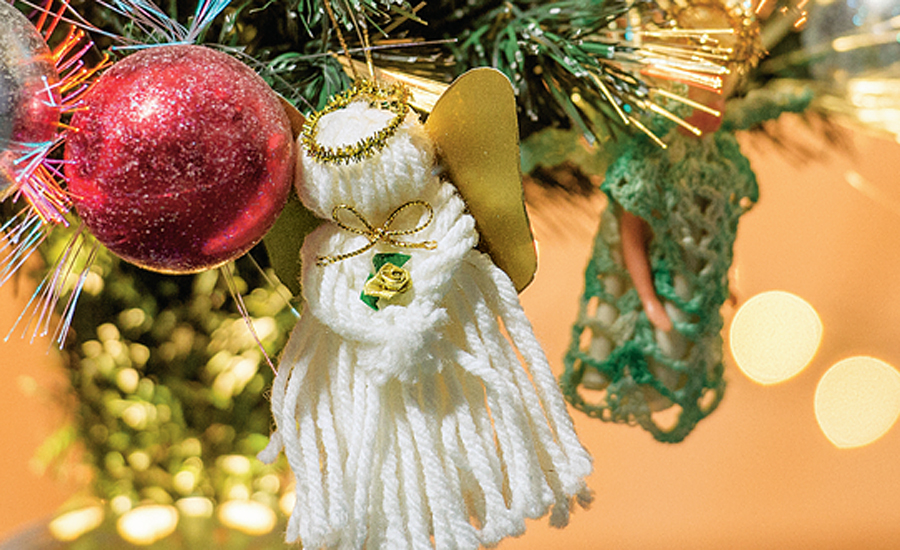
After a road trip to the Pennsylvania countryside, Walter surprised me with a gift: an angel ornament crafted from white yarn. She was beautiful—with impressive gold wings and a glittering crown. “I wanted you to have a reminder of our vacation,” he said. “And she just jumped out at me.”

That’s when I got a vision: “What about a whole tree of angels? One from every place we visit!”

Over the years, our angel tree grew: a ceramic cherub from the Blue Ridge Mountains, a seashell angel from Hawaii, lace beauties from Washington State. Walt often teased me for piling them all toward the front of the tree. But I didn’t want any angels to be missed!

A few years ago Walt came home with a smaller tree—one that wasn’t so difficult for us to manage now that we’re in our golden years. After we decorated it he flipped a switch. “Surprise!” he said.

Just like that, the tree rotated—displaying our entire collection of angels! And the best Christmas gift of all are the memories we have shared along the way

Download your FREE ebook, Angel Sightings: 7 Inspirational Stories About Heavenly Angels and Everyday Angels on Earth.

An Extraordinary Meeting, in a Babies R’ Us

I read a great story from City View Magazine in Knoxville, Tennessee.

It was supposed to be a quick errand: run in to Babies R’ Us, pick up a child’s travel container and get home. But there was a long line at the checkout. Meghan Dempster looked at the people directly in front of her. A blonde Caucasian woman, with a chubby, smiling baby, seemingly of African descent.

That woman could easily be Meghan herself soon. She and her husband Michael had felt led to adopt, even though they already had three biological children. A few years ago, they adopted a girl from Guatemala. And now, they were about to give a home to another child, this time from Africa.

The first child that the adoption agency brought to their attention was a boy named Mitku, who’d been abandoned in the African bush, and who had contracted neonatal tetanus, most likely from a rusty implement used to cut his umbilical cord. Meghan and Michael were told the child could have severe brain damage.

Meghan and Michael didn’t know what to do. With four kids, they didn’t think they could handle a child with special needs. But could they really turn down a child that needed a family so badly?

Meghan had struggled with the decision. If she didn’t care for Mitku, who would?

Then they flew to Ethiopia and met Terefe. His name, the boy’s birth mother had told them, means “he saves.” The Dempsters decided that he was the one for them. But the other child never left Meghan’s mind. Even now, buying a child’s travel container for Terefe, who she and her husband would soon fly to pick up.

“Your baby is beautiful,” Meghan told the woman in line in front of her.

The woman, Mandy Watson, replied that she had just adopted Silas from Ethiopia. She was buying his first solid food. They kept talking as the line slowly moved. Turned out they had both used the same adoption agency. Mandy began to tell about Silas’s history back in Africa. “He had neonatal tetanus. They didn’t think he would make it.”

“Wait a second,” Meghan interrupted. “What’s his name, what’s his Ethiopian name?’”

“Mitku,” Mandy said.

Meghan didn’t have to wonder any more about the fate of that other child. He was healthy and happy, being raised by a family in the same town as her.

“In my mind, it was God-ordained, because had I gotten out the door when I wanted to, I would have never met [Mandy],” Meghan told City View Magazine. “To see her and see this baby, to see that here he is, in this perfect family, right here in Knoxville, and he’s thriving…what are the chances of that happening?”

Mandy told the magazine that her family and Meghan’s are now bonded for life. They plan on bringing the boys together to Africa when they’re older to reconnect with their roots. “Suddenly, our eyes were open to something that’s so much bigger than us.”

An Exchange of Christmas Miracles

I grew up believing that Christmas was a time when strange and wonderful things happened, when wise and royal visitors came riding, when at midnight the barnyard animals talked to one another, and in the light of a fabulous star God came down to us as a little Child.

Christmas to me has always been a time of enchantment, and never more so than the year that my son Marty was eight.

That was the year that my children and I moved into a cozy trailer home in a forested area just outside of Redmond, Washington. As the holiday approached, our spirits were light, not to be dampened even by the winter rains that swept down Puget Sound to douse our home and make our floors muddy.

READ MORE: THE FIREHOUSE CHRISTMAS MIRACLE

Throughout that December Marty had been the most spirited, and busiest, of us all. He was my youngest, a cheerful boy. blond-haired and playful, with a quaint habit of looking up at you and cocking his head like a puppy when you talked to him. Actually the reason for this was that Marty was deaf in his left ear. but it was a condition that he never complained about.

For weeks I’d been watching Marty. I knew that something was going on with him that he was not telling me about. I saw how eagerly he made his bed, took out the trash, and carefully set the table and helped Rick and Pare prepare dinner before I got home from work. I saw how he silently collected his tiny allowance and tucked it away, spending not a cent of it.

I had no idea what all this quiet activity, was about, but I suspected that somehow it had something to do with Kenny.

Kenny was Marty’s friend, and ever since they’d found each other in the springtime, they were seldom apart. If you called to one, you got them both. Their world was in the meadow, a horse pasture broken by a small winding stream, where the boys caught frogs and snakes, where they’d search for arrowheads or hidden treasure; or where they’d spend an afternoon feeding peanuts to the squirrels.

Times were hard for our little family, and we had to do some scrimping to get by. With my job as a meat wrapper and with a lot of ingenuity around the trailer, we managed to have elegance on a shoestring. But not Kenny’s family. They were desperately poor, and his mother was having a real struggle to feed and clothe her two children.

They were a good. solid family; but Kenny’s mom was a proud woman, very proud, and she had strict rules.

READ MORE: A MIRACULOUS CHRISTMAS GIFT FROM BEYOND

How we worked, as we did each year, to make our home festive for the holiday! Ours was a handcrafted Christmas of gifts hidden away and ornaments strung about the place.

Marry and Kenny would sometimes sit still at the table long enough to help make cornucopias or weave little baskets for the tree; but then, in a flash, one would whisper to the other, and they would be out the door and sliding cautiously under the electric fence into the horse pasture that separated our home from Kenny’s.

One night shortly before Christmas, when my hands were deep in peppernöder dough, shaping tiny nutlike Danish cookies heavily spiced with cinnamon, Marty came to me and said in a tone mixed with pleasure and pride, “Mom, I’ve bought Kenny a Christmas present. Want to see it?” So that’s what he’s been up to, I said to myself. “It’s something he’s wanted for a long, long time, Mom.”

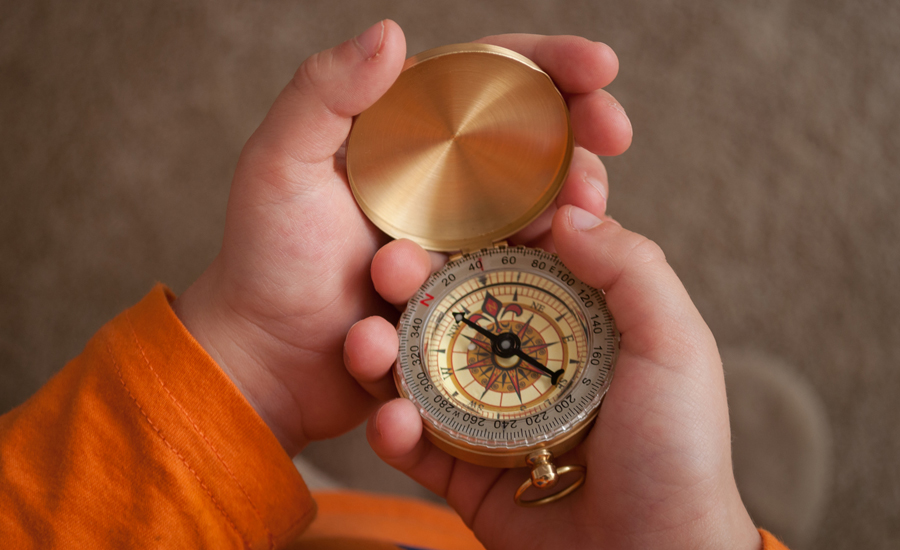
After carefully wiping his hands on a dish towel, he pulled from his pocket a small box. Lifting the lid, I gazed at the pocket compass that my son had been saving all those allowances to buy. A little compass to point an eight-year-old adventurer through the woods.

“It’s a lovely gift, Martin,” I said, but even as I spoke, a disturbing thought came to mind. I knew how Kenny’s mother felt about their poverty. They could barely afford to exchange gifts among themselves, and giving presents to others was out of the question. I was sure that Kenny’s proud mother would not permit her son to receive something he could not return in kind.

Gently, carefully. I talked over the problem with Marty. He understood what I was saying.

“I know, Mom, I know…but what if it was a secret? What if they never found out who gave it?”

I didn’t know how to answer him. I just didn’t know.

The day before Christmas was rainy and cold and gray. The three kids and I all but fell over one another as we elbowed our way about our little home putting finishing touches on Christmas secrets and preparing for family and friends who would be dropping by.

Night settled in. The rain continued. I looked out the window over the sink and felt an odd sadness. How mundane the rain seemed for a Christmas Eve. Would wise and royal men come riding on such a night? I doubted it. It seemed to me that strange and wonderful things happened only on clear nights, nights when one could at least see a star in the heavens.

I turned from the window, and as I checked on the ham and lefse bread warming in the oven, I saw Marty slip out the door. He wore his coat over his pajamas, and he clutched a tiny, colorfully wrapped box in his pocket.

Down through the soggy pasture he went, then a quick slide under the electric fence and across the yard to Kenny’s house. Up the steps on tiptoes, shoes squishing; open the screen door just a crack; the gift placed on the doorstep; then a deep breath, a reach for the doorbell and a press on it hard.

Quickly Marty turned, ran down the steps and across the yard in a wild race to get away unnoticed. Then, suddenly, he banged into the electric fence.

The shock sent him reeling. He lay stunned on the wet ground. His body tingled and he gasped for breath. Then slowly, weakly, confused and frightened, he began the grueling trip back home.

“Marty,” we cried as he stumbled through the door, “what happened?” His lower lip quivered, his eyes brimmed.

“I forgot about the fence, and it knocked me down!”

I hugged his muddy little body to me. He was still dazed, and there was a red mark beginning to blister on his face from his mouth to his ear. Quickly I treated the blister and, with a warm cup of cocoa soothing him, Marty’s bright spirits returned. I tucked him into bed and just before he fell asleep he looked up at me and said, “Mom. Kenny didn’t see me. I’m sure he didn’t see me.”

That Christmas Eve I went to bed unhappy and puzzled. It seemed such a cruel thing to happen to a little boy while on the purest kind of Christmas mission. doing what the Lord wants us all to do, giving to others, and giving in secret at that.

I did not sleep well that night. Somewhere deep inside I think I must have been feeling the disappointment that the night of Christmas had come and it had been just an ordinary, problem-filled night, no mysterious enchantment at all.

But I was wrong.

By morning the rain had stopped and the sun shone. The streak on Marty’s face was very red, but I could tell that the burn was not serious. We opened our presents, and soon, not unexpectedly, Kenny was knocking on the door, eager to show Marty his new compass and tell about the mystery of its arrival.

It was plain that Kenny didn’t suspect Marty at all, and while the two of them talked, Marty just smiled and smiled.

Then I noticed that while the two boys were comparing their Christmases, nodding and gesturing and chattering away, Marty was not cocking his head. When Kenny was talking, Marty seemed to be listening with his deaf ear.

Weeks later a report came from the school nurse, verifying what Marty and I already knew: “Marty now has complete hearing in both ears.”

The mystery, of how Marty regained his hearing, and still has it, remains just that—a mystery. Doctors suspect, of course, that the shock from the electric fence was somehow responsible. Perhaps so. Whatever the reason, I just remain thankful to God for the good exchange of gifts that was made that night.

So you see, strange and wonderful things still happen on the night of our Lord’s birth. And one does not have to have a clear night, either, to follow a fabulous star.

Did you enjoy this story? Subscribe to Guideposts magazine.

An Earthquake Survivor’s Lessons on Life and Loss

It was January 2001. Viral Dalal (pronounced “We-rull” “D-lal”) had just returned home to Bhuj, India from the U.S., where he was attending graduate school part-time and working full-time as a computer scientist. He was in his bedroom, getting some sleep while his family ate breakfast down the hall, when the unthinkable happened. A 7.7 magnitude earthquake shook Bhuj for two minutes, causing the condominium Viral and his family were in to collapse like a stack of cards.

In the aftermath of the earthquake, Dalal found himself trapped in a small, dark, concrete casket, beneath six stories of rubble. No food or water. He spent five days buried underground before rescuers heard his raspy cry for help. After Viral emerged from the rubble, he discovered he was the lone survivor of the building collapse. His parents, brother, sister-in-law and nephew had died.

Viral spent many years working through his grief, making a conscious effort to move from darkness into light. Here are some of the lessons he learned along the way, condensed and edited from his book, Choosing Light.—Desiree Cole

Give Life a Hug
In this day and age, when a traffic light that doesn’t turn green fast enough can ruin someone’s day, I cannot help but think: why are people so unhappy with their perfect lives? What is everyone really upset about? Where is the problem?

After what I went through in Bhuj, the definition of “problem” changed for me. I know what a real problem looks like. When I was inside the concrete enclosure, trapped for days without any certainty of living another day, a single drop of water or a tiny bit of light would have given me the amount of happiness that one cannot even fathom.

All I can say is that if you are alive and well, you are very lucky. If you have a loving family around you, you are living what some people can only dream of. Life in itself is a beautiful thing. Give it a hug. Every day.

Choose Happiness
Photograph courtesy Viral DalalAfter the earthquake, I had to work to make happiness a way of life, and not an end goal. How did I become happy? One step at a time. Every time I thought about happiness, I thought about my mother first. She was such a happy being. These thoughts made me focus on positives, and on the things that pulled me up. I tried to look at the past with a smile.

I also observed that when I wanted to be unhappy, I could be, and nothing could stop me from being unhappy. I used the same “formula” to stay happy. No one was going to stop me from being happy either.

So even though I wasn’t stuck inside a concrete box anymore, I continued to work hard on opening up these blocked pathways inside my brain, one scratch at a time. I did not realize at the time that it was an inner engineering feat.

“Consistent drops of water falling in the same spot can make a hole in the toughest rock known to man,” I remembered my father saying.

With persistence and determination I was eventually able to clear these blocked pathways of happiness.

Listen to Your Gut
Before the earthquake, I was attending school part-time and working full-time as a computer scientist. For some reason, I felt compelled to leave that job so I could visit my family in India. It seemed like a crazy move at the time. But now I cannot express how grateful I am to have been able to spend the last days with my dear ones. I fail to imagine what I would have gone through if I had lost my family while I was in the U.S.

I was able to see them and be with them because I listened to my gut. I left my career—my first job in the U.S.—to be with them.

Today, I continue to make decisions that are driven by my gut, knowing now how important that is. So much “light” for living comes from this instinctual level of our being.

Live in the Present Moment
I knew that life was unpredictable, but I also happened to think that such a thing as the earthquake could never happen to my family or to me. Only after going through these personal losses, I realized that anything could happen to anyone, at any time. There were no guarantees.

That’s why the present is much more important than the past or future. The present moment is real. Present life is real.

Value Your Life
You are invincible when the higher power, or the universe, or good luck is by your side. No one knows how much or what it takes for these powers to be by your side, every single time.

Don’t test these powers.

Life is extremely, extremely precious. It only takes a split second to throw a very precious life away. I learned not to take life for granted. I learned to value it, much more. And once again I learned that my life and the power to make the right choices will always be in my own hands.

Viral Dalal is the author of ​Choosing Light (GJ Press LLC.).

An Audition Arranged by God

Wanted: one soprano for summer position. This notice appeared in the church bulletin on a Sunday morning in 1945. I was new in Washington, D.C., and I wanted to be chosen for that job. I lost no time in presenting myself to the choir director, who set up an audition for me on the following Sunday.

After a lot of thought and prayer I selected Geoffrey O’Hara’s “I Walked Today Where Jesus Walked” for my audition piece. All week long I practiced. But back at the church on Sunday I made the dreadful discovery that I’d left the music on the bus. And then, to add to my disappointment, the choir director whom I thought I’d be singing for was not there. He had been called out of town, and the decision about my hiring was now up to someone else. As it turned out, the substitute organist and choir director was a friendly sixtyish gentleman who put me at ease immediately.

Even so I hesitated. Finally I had to tell him that I’d lost my music. “What piece were you planning to sing?” he asked.

“’I Walked Today Where Jesus Walked,’” I told him. Assuring me he could play it from memory, he launched into the accompaniment.

“You sang that exactly as it should be sung,” my accompanist told me after I’d finished. “Welcome to the choir.”

I was overjoyed. Only when I was leaving did I think to ask his name. With a mischievous grin, the organist—and noted composer—replied, “Geoffrey O’Hara.”