


Embrace God's truth with our new book, The Lies that Bind

A Desperate Woman Gets Faith for One More Day

Roberta Messner is a beloved contributor to Daily Guideposts and has written devotions for over 20 years. With the publication of Daily Guideposts 2018, we reflect on the amazing spiritual connection between devotional writers and readers. This powerful story is a reminder of the way God speaks to us and through us in beautiful and surprising ways.

Sunday evening, 7:30 p.m. That’s when I would do it.

I sat on the edge of my bed and twisted the cap off my prescription pain medication. Normally one tiny white pill would help ease the pain. Not this time. I emptied the entire bottle into my palm and counted. Thirty-two pills. If I took them all at once, I’d stop breathing, go into cardiac arrest.

I wouldn’t need to write a note for those I left behind. Everyone would know why.

It was a cruel irony, being a registered nurse with an incurable disease. Tonight I would finally cure it for good.

Thirty-two pills. One for each surgery I’d had in my 60 years on earth.

READ MORE: A POEM FOR THE PAIN

I suffered from an invasive form of neurofibromatosis: noncancerous tumors that grow from nerve cells. Large masses formed in my brain and nasal cavities. The only way to treat them was to cut them out, and they kept growing back. I lived with unrelenting pain.

Two things had always gotten me through: faith and writing. Over the years I wrote many stories about my condition for Guideposts—both devotionals and magazine articles. I tried to show how my trust in God lifted me up when all seemed hopeless. I always concluded with a positive message, hoping to encourage and inspire others.

This was why I suffered, I believed. So I could help others who were also suffering. It was why, even with the pain, I still worked all week at a hospital, tending to the needs of my patients.

After my thirty-second surgery, I wrote a prayer that became something I said to God daily—“Thank you, Lord, for taking care of your own…always.” For that surgery, my doctor had prepared a platelet gel using my own blood cells and injected it into the place the tumor had been—a procedure that he believed would prevent the mass from growing back. He would never have to operate on me again!

The joy I felt was overwhelming…and dangerous. I took a vacation with my sister—the first one I’d been able to take in years—and banged my head in a clumsy fall. The swelling didn’t subside. An MRI showed tumor number 33 in my eye socket.

A large hematoma disfigured the left side of my face. I looked like Frankenstein’s monster. The symptoms got worse—pounding headaches around the clock, the constant tingling and occasional sharp spike of dying nerves. All signs pointing to the fact that the tumor was growing. I begged the doctor to remove it, but he said that it was too risky—I could die on the operating table. I had to live like this for the rest of my life.

Calls from my sister barely registered. I rarely went out anymore. I was too self-conscious about my appearance. When I had to go to work, I hid my face behind my hair and makeup, wore huge glasses and avoided looking anyone in the eye. I sat in the back of the church so I wouldn’t have to lie about being okay. I was tired of faking it.

Those words I’d written, about God taking care of his own…did I even believe them anymore? How could they be true?

READ MORE: NO GREATER PAIN

I woke up early Sunday morning with a throbbing skull. I could barely make it through church. The hymns I loved were like a chorus of jackhammers. Even here, Lord? Even here I can’t escape?

All the prayer meetings, the anointing sessions and healing services I’d attended over the years in hopes of a miracle—none of them had worked. That’s when I decided. There was nothing left to live for.

Seven-thirty on the dot. I shifted the mound of pain pills in my palm and cupped my hand to my mouth, ready to throw my head back and swallow. Out of the corner of my eye, I saw the edge of my nightstand, and on top, the journal and pen I used for drafting my Daily Guideposts devotionals. You told your favorite patient you’d read a devotional to her on Monday….

Why should that matter? What did anything matter now? But I lowered my hand. I’d made it through Friday without thinking it was my last day among my friends and patients. Should I go through one more day? To say goodbye? No one had to know what I was planning. The pills would be waiting for me when I came home from work.

One more day. Then it’s over.

I took my usual dose and made sure to get every last pill back in the bottle. I screwed the top on tight and put the bottle away. I massaged my temples. Maybe this tumor will take me out in the middle of the night….

I dragged myself to my desk early Monday morning—eyes burning, head in a vise.

One of my coworkers poked her head in my door. “The director wants to see you,” she said.

I hauled myself out of my chair and walked down the hall. In the office was the director, along with the hospital’s chief of staff and two women I didn’t recognize.

What was going on? Who were they? Former patients with a complaint? Had I been so distracted by my pain that I’d done something wrong? “Roberta, I’d like you to meet Linda Hudson and her daughter, Beth Rucker,” the chief of staff said as I went in. “I’ll let them tell you why they’re here.”

Linda stepped toward me and grabbed my hands. “We’re from New Martinsville. It’s a five-hour drive from here. Beth and I headed out just before sunrise this morning. We wanted to make the trip here to meet you.”

“Meet me?”

“You’re the woman who writes the Daily Guideposts devotionals we love to read.”

What? I’d had readers send letters and e-mails…but I’d never had any show up in person. “You came all this way….” I said. I couldn’t tell her the truth—that she’d almost come here for nothing.

“Well, it’s the strangest thing,” Linda said. “Beth and I had been putting the trip off for weeks. Then yesterday evening, around seven-thirty, you fell so heavy on my mind. I started praying for you. I knew I had to see you. Not tomorrow, not next week, but today. I couldn’t wait one more day.”

Editor’s Note: Roberta Messner is feeling much better and you can find her writing in the latest edition of Daily Guideposts.

Read a collection of Roberta’s devotionals!

Did you enjoy this story? Subscribe to Mysterious Ways magazine.
A Couple’s Love, Lost and Recovered

It was them. I was sure. I caught my breath.

My husband and I were out to dinner, and when I looked up from my menu I saw them, intensely familiar and yet different. They were older now, the strain of years showing, but those faces had burned themselves into my memory. “That’s them,” I said. “The happy couple.”

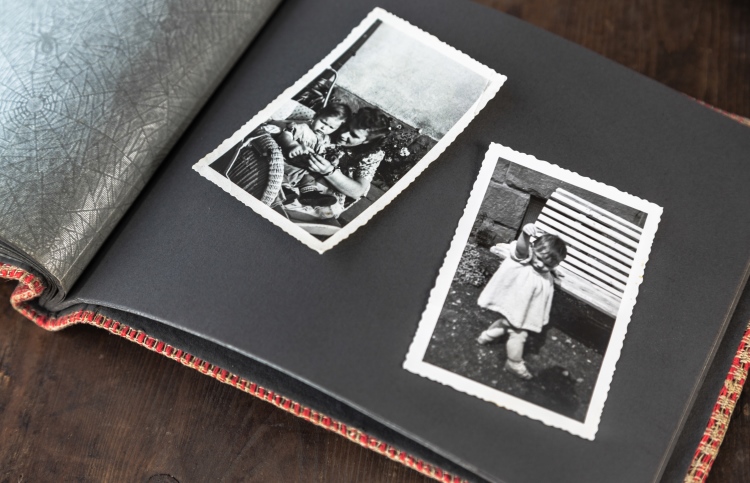
My husband looked at me, nonplussed. For about half a year I’d stared at pieces of this couple’s life, photos in an old album. We’d found it in the gutter on a street by our house. A handsome young man at his high school graduation. A dark-haired, exotic beauty winking at the camera. Their backyard wedding. Babies growing into toddlers, playing with grandparents. It was the story of a happy family. No one could have meant to throw away these precious moments.

If only I could find these people, I thought. And yet where to start? I had no idea. So I kept the album, thumbed through it from time to time, wondering.

Now, improbably, here they were. There was something so different about them, though. As if they were strangers to each other. They picked at their food. I couldn’t contain myself. I shot up from my seat and approached them. “I have something that belongs to you,” I said.

Immediately, I felt like I was intruding. Yes, they said, they’d lost the album, among other items looted from a storage locker. Storage locker? Maybe these photos hadn’t been missed. I jotted down my address, unsure if they even wanted the album returned.

The next day, the man showed up at our house. “We were caught off guard,” he explained apologetically. Then he took the album from me and flipped through it, smiling wistfully.

“You see, this was back when I was sober. Before my drug addiction destroyed our marriage. I’m getting my life together, and hoped my wife and I could be a family again. If we could remember what connected us. That dinner last night was the first step,” he said.

He held the album to his chest. “Then you ran up, offering us this.”

Maybe, I hoped, because it was meant to be the next step.

A Conversation with Charlie Goldsmith, Star of TLC’s ‘The Healer’

Are some of us born with unique spiritual gifts? At 18, Charlie Goldsmith says, he discovered he could inexplicably ease the pain and ailments of people he barely knew, a realization that led him to become a healer. Now the 37-year-old Australian is starring in TLC’s The Healer. He works full time as an entrepreneur and doesn’t charge for healings. Instead, he wants to be studied by science to determine how healers—who have a long tradition in the faith community—can assist traditional medicine. He recently spoke to Mysterious Ways about his gift and what science has to say about it.

How did your gift first make itself known?
I was always a sensitive and intuitive kid. In 1999, I graduated high school and my father sent me to work at a health retreat camp for the summer. I was sitting in the locker room one day and a man limped by, clearly in pain. I asked him what was wrong and, at that moment, felt a searing pain shoot up my leg. It was a bizarre experience. The next morning, I was eating breakfast and felt my hands forcibly pulled together in a kind of clap. I thought I was losing it.

People around me asked if I was okay. I said, “No, I can feel something between my hands.” They put their hands on mine to feel it. One of the women who did had nothing visibly wrong with her hands, yet I felt what seemed like a lump in the air above one of her fingers. I moved my hand in the air above the lump as if smoothing it out. The woman started to cry. She was able to bend her fin­ger, something she hadn’t been able to do in years. After that, I kept practicing. If someone had a prob­lem, I would try to help.

Where does the gift come from?
I don’t know. I was never taught how to heal—I just instinctively know how to do it. The rest is a mystery. One of the things all this has taught me is that there’s much more to the world than what we can see. My gift is part of me and it’s always there, so I can control what to do with it. But there’s an intelligence in it that’s not all me. Some say it comes from God or that it has to do with energy. Recently I found out from my grandmother that her own grandmother had a similar ability. So I can’t say for sure. Perhaps it has to do with empathy. Or a consciousness that connects us all. Or maybe I’m us­ing a different part of my brain. I don’t dwell on the how and why. What mat­ters is that gifts like this exist.

Why you?
I have no idea. Other than that a gift isn’t much good without the willing­ness to use it and I’m willing. I consid­er myself to be a bit of a bridge. I can speak to people who aren’t so com­fortable with this area of medicine. I didn’t come from a background where this is in any way normal. My family is in business and the enter­tainment industry. I never even knew what “spiritual” was until my gift came. So I really do understand how this might appear to some people. My own family was half accepting, half reluctant. I only recently started talking about it publicly because my goal is to work with doctors and researchers. To do that, I need to change how the medical community perceives these types of things, so that healers can work in environ­ments like hospitals.

How exactly does your gift work?
I don’t have the ability to diagnose people. So I start by asking someone what’s wrong. After that, I specifically think about the issue. When I work on someone, I try to move my focus to that problem area. I don’t touch the person, but I’ll often hover my hands over the problem spot. I work very fast—sometimes less than a minute. People describe the experience in different ways. They say they feel tin­gling or heat or coolness. If you’re in a lot of pain, you might feel the pain leave your body. In the early days, I actually felt the pain that I was reliev­ing in other people. Now it just tires me out. It’s hard on the mind.

What ailments can you treat?
Things considered medically incurable seem to be the easiest for me. That makes sense because there’s a gap in the medical field where healers fit. I’ve worked with people who’ve had viruses or infections and who aren’t responding to antibiotics. People who’ve had chronic pain not helped by medicine. People with anxiety, de­pression, allergies, skin diseases or illnesses for which the source can’t be pinpointed. I worked on a two-year-old boy born with congenital ad­renal hyperplasia. His body doesn’t produce cortisol, and he had a lot of pain and trouble sleeping. I didn’t think I’d be able to help him because it was a genetic condition. But after I finished, he fell asleep on the floor at my feet. Six months later, his parents told me he was pain-free and sleep­ing through the night. Sometimes the gift surprises me.

Can you heal yourself?
I definitely can’t do for myself what I do for other people! I call it a gift be­cause it’s something I give, not some­thing I necessarily benefit from. There are also some people I can’t heal—I’d say two out of every 10 people. I worked on someone with the flu the other day and seemed able to lessen the time the person would be sick, re­duce the fever and clear the sinuses. But I couldn’t get rid of the flu com­pletely. It can be frustrating because I don’t always know why I can’t help.

What does science have to say about your gift?
After years of trying to get scientists to analyze it, I participated in a study at New York University’s Lutheran Hospital that was published in The Journal of Alternative and Comple­mentary Medicine in 2015. Basically I worked alongside hospital staff to provide supplementary care for pa­tients. Out of 50 people with chronic pain, 76 percent of them reported marked improvement. I worked with another 29 people with health prob­lems unrelated to pain. In that group, 79 percent measurably improved. Over 77 percent of all people I treat­ed reported or experienced results immediately. The study wasn’t enough to turn the tide on the medi­cal credibility of healers, but it did help build the case that similar stud­ies need to be done.

Critics would argue that the only evidence for your healing is anecdotal….
They’re not wrong. Empirical evidence is what I’m working toward. Regard­less, I’m able to heal things that tradi­tional treatments simply can’t. And I’ve been able to do it for 20 years. I’m hoping that medical institutions will start to take it a lot more seriously. Un­til that happens, healing is going to remain a fringy, misunderstood area. The big question is, how many people are out there like me? How do you find them? Without science opening the door, it will be difficult to ascertain.

If you could give the gift back, would you?
No, I wouldn’t give it back. I’m not going to pretend it hasn’t been tough. But what an incredible experience I’ve had. I am filled to the brim with one of the basic human needs: purpose. I wouldn’t want to give that away. If I died tomorrow, I’d feel as if I’d done some good in the world.

A Conversation with an Epiphany Expert

Elise Ballard was an actress and filmmaker living in Austin, Texas, when she had an epiphany that changed her life. Her experience sparked her own research into these kinds of revelations. Interviewing people from all walks of life—from celebrities like Barry Manilow, Dr. Oz and Maya Angelou to her own friends and family—she asked, “What has been your greatest epiphany?” She collected their responses in her book, Epiphany: True Stories of Sudden Insight to Inspire, Encourage and Transform. Mysterious Ways asked Elise about what she’s discovered.

What is an epiphany?

An epiphany, by definition, is a moment of great revelation that usually changes your life. What makes epiphanies different from an everyday realization is their divinely inspired quality. They feel like something deep within. Something greater than yourself.

I believe that epiphanies are a deep, deep calling. It’s your soul calling to you, guiding you to use your gifts and talents to accomplish your purpose. Every person experiences epiphanies differently, but generally an epiphany feels as if it’s something different and more important than an average thought. It’s ephemeral, and it feels like truth.

And what got you so interested in epiphanies?

I had an epiphany of my own. I was an actress in Austin in a play. I was playing a woman who was madly in love with her husband—a Texas politician—and desperately wanted to have a baby. But she couldn’t. I kept noticing parallels to my own life. I was married to a politician too. But I had been unhappy in my marriage for years. We both were. But I was stuck. I couldn’t bring myself to end the relationship.

In preparing for the role, I did a lot of research into adoption and fertility. One day, before dress rehearsal, I was printing out a brochure about adoption to use as a prop. Suddenly I had this thought. I could do that. And instantly it felt as if everything just shifted.

I realized that what was really keeping me in my marriage was the deep-seated fear that I’d never have a biological child. But through all the research I had done for this role, I now knew there was a myriad of ways to be a parent. It wasn’t reason enough to stay in a broken marriage, to deny myself happiness. By the time that brochure was done printing, I felt physically different. Everything had changed. I started taking action. Within a few months, I’d rented an apartment and moved out.

It was only later that I’d realized—I’d had an epiphany. The kind of experience that people talk about.

And that’s when you decided to write the book?

No, not then. At work, shooting behind-the-scenes footage for other productions, I started asking people, “Have you ever had an epiphany?” People’s eyes would light up. It was engrossing, watching them describe these moments. Plus, I was having more of my own epiphanies from hearing theirs! Their stories were enhancing my life. I wanted to share that with others.

The whole process leading to my writing the book was serendipitous, which is one of the classic hallmarks of an epiphany.

What are the other defining characteristics of an epiphany?

There are four elements: listening, belief, action and serendipity.

Listening is about being open. It’s about the desire to change. It’s hard to hear a message if you aren’t actively listening for one. You can open yourself up to experiencing one through practicing prayer, meditation and mindfulness. Also, pay attention to what the people around you are saying, to your own inner voice, to the things you read and to experiences you feel drawn to. You’ll know it when you hear it. When people have a true epiphany, it stands out and feels special. They believe it. That’s why belief is another hallmark. All the people I’ve spoken with have never doubted their epiphany and what it meant to them.

Of course, epiphanies aren’t truly transformative without the third step, action. Every person who had a life-changing epiphany had to take action to set everything in motion. Even if you don’t know where you’re going, you have to take that first step.

And finally there’s serendipity. That’s when the second step is revealed. And the third step. And the fourth. It’s a miraculous and fun process. Circumstances just fall into place, and it means, “Yes, this is right for you. Keep going.”

In hearing hundreds of epiphany stories, were there any similarities you noticed?

I realized that we all have these moments. No matter who you are, no matter where you live, no matter how old you are or what you believe—this is part of being human. Each story was so very different. And yet, when you boiled them down—asking what is learned—they were universal truths: belief in yourself, faith, everyday wisdom, love, growth and healing. Things that connect us all.

In your book, you say that epiphanies often have a “ripple effect.” What do you mean by that?

We don’t realize the effect we’re having. Your actions and ways of being are affecting everyone around you. As G.W. Bailey said in his interview with me, “When one life changes, many lives are changed.” Epiphanies are transformative and compel us to take positive action, and we’re interconnected beings.

Is there a difference between a miracle and an epiphany?

By definition, a miracle is an occurrence that’s inexplicable by natural law. Epiphanies don’t often go against natural law. Sometimes people have miraculous, Paul-on-the-road-to-Damascus-style epiphanies, but oftentimes, it’s the subtle ones that cause the most dramatic changes. The similarity between epiphanies and miracles is that both usually happen in moments of crisis when we need them most. And, like miracles, epiphanies are wondrous. This is because they set off such a profound shift in thinking. For so long, we don’t have clarity, and then everything changes in a moment. That’s why people often describe epiphanies as miracles.

Are epiphanies always a positive experience?

I’ve never heard of one that had a negative outcome. I think of epiphanies as fundamental truths. Even if they are painful, they lead you to your best self. If you act on them, that is. Some people don’t. I’ve spoken with people who had epiphanies but didn’t act on them. Maybe they were scared or felt it wasn’t the right time. Whatever the reason, they let these moments pass them by. But in those cases, the message often taps them on the shoulder again. And then it might hit them over the head.

Some people have asked me if it’s too late to act. Never. We can always change, grow and take action, no matter what. Our greater potential is always there, waiting for us.

What most surprised you about your research?

When you open yourself up to epiphanies, you have more of them. And what I’ve found with people who have had multiple, life-altering epiphanies is that there seems to be a theme. I interviewed one person who had multiple epiphanies about responsibility. In his case, it was about realizing he was an adult and needed to act like one and “step up” at different stages in his life.

In my own life, I’ve noticed that when I’m frightened of something, I’m often in denial. Now when I feel stuck in life, I’m like, “Elise, what are you scared of? What are you in denial about?”

I’m a spiritual person. But in doing this project, I interviewed people who had such unshakable faith that it made me question the depth of my own belief.

I knew there had been moments in my life when God was there. But that deep, everyday faith? I didn’t really have it. So I started working on it.

I realized that in order to deepen your faith, you have to first believe in yourself. Divine love—God’s love—is unconditional. Our goal is to be able to love like that. But you aren’t able to do that unless you have learned to love yourself unconditionally, which I really didn’t understand. Now I do.

I haven’t gotten there yet. I’m still working on it, but I’m closer now than I used to be. Thanks in no small part to an epiphany of my own and the series of good events it set into motion.

A Conversation with a Miracle Investigator

When a senior pastor he’d worked with and respected told Elijah Stephens he was seriously questioning his faith, it hit Elijah hard. “I’ve probably prayed 500 times for a church member to be healed,” the pastor told Elijah. “Not once have my prayers been answered.” Their talks raised a lot of questions for Elijah. Does God still heal the sick? Do miracles still happen? Does prayer matter? Where was the evidence? Elijah felt driven to find answers. Over the course of five years, he traveled across the country, interviewing people who believe they’ve experienced miraculous healings. He also talked with doctors, scientists, theologians and skeptics. Elijah’s findings have recently been released in a documentary called Send Proof. He spoke with Mysterious Ways about his quest.

Why did your senior pastor’s doubts affect you so strongly?

We were best friends. We did ministry on the streets that was miracle-focused. We prayed for people together. He was pretty much the last person I would have ever expected to question the reality of miracles. If he, a man who’d devoted his life to his faith, didn’t believe in miracle healings, then were miracles real? I had to know.

So you went looking for evidence of miracles. But isn’t that the opposite of faith?

There is a feeling that wanting proof or being too intellectual separates us from the Holy Spirit working within us. I totally reject that. Church history is full of people who were fully engaged with their intellect and had powerful encounters with God.

We’re called to worship God with not only our hearts but also our minds. In my opinion, deeply researching and identifying true healing miracles glorifies God because it further encourages people to pray, no matter how hopeless a situation seems. It reminds us that nothing is impossible with God. That’s something we all need to be reminded of, even longtime ministers.

For the purposes of your research, how did you define what a healing miracle was?

I was looking for stories of people who were healed in a way that medical science couldn’t explain, as well as people who were healed soon after they were prayed for. Prayer was important to my research because it served as evidence that God was asked to intervene. I relied on an organization called Global Medical Research Institute (GMRI), which researches people’s claims of miracles for the possibility that the healings could have a natural explanation. The ones I looked into had none.

What can healing miracles teach us about other miracles?

The reason I chose to study healing miracles is that they are quantifiable. You can see that a patient had a medical problem that was resolved without any explanation. This provided evidence that it wasn’t just good fortune, which you can’t really show in other miracle cases; for example, when someone gets a heaven-sent new job. For someone who might be skeptical about the validity of miracles, healing miracles offer trackable evidence of God at work. They can give us assurance that God is working in other parts of our lives as well.

What was the most remarkable miracle healing you learned about in your research?

Chris Gunderson’s healing. He could only eat through a feeding tube because of an incurable stomach disorder. In 2011, when he was 16, he went to a worship service and was prayed over by a man named Bruce Van Natta. Chris felt a feeling like an electric shock move through his body. That evening, he ate an entire meal for the first time with no issues. Doctors had no explanation. He hasn’t used a feeding tube since. But here’s what’s even more interesting. Bruce Van Natta had experienced his own miracle healing four years earlier, when a semitruck he was working on fell on him, crushing his entire body. During surgery, doctors were forced to remove so much of his small intestine that it was thought he wouldn’t survive long post-op. But soon after someone prayed for his healing, he experienced a rejuvenation of his small intestine, which left his doctors dumbfounded. Bruce quit his mechanic job to become an evangelist. He’s been quoted as saying his miracle is small compared to the miracles he’s witnessed as a result of sharing his testimony. It’s possible to attribute an individual case of healing to a natural but unexplainable event. But to see the way God used Bruce’s healing to continue to reach others, through sharing his story and through participating in prayers that led to more healings—to me that’s incredibly powerful.

What would you say to people who think that a lack of a medical explanation still isn’t conclusive proof of God’s involvement in someone’s healing?

It’s important to remember that for this project, I specifically looked at cases where prayers were said not long before the miracles happened. They didn’t just happen on their own. It’s difficult to deny that there’s a connection to prayer, a divine response.

Some people you spoke with said they would be convinced of miracle healings only if there was a way to scientifically study the outcomes of prayers, as in a double-blind study. Is that reliable proof?

I don’t think that’s a great way to study miracles at all. You can’t expect to replicate God’s actions in any kind of study. We should consider studying miracles the same way we look for proof in legal cases. We look at the data, we interview witnesses and we decide what is most believable.

Anecdotes are powerful, but did you find any evidence for healing miracles that did involve more controlled observation?

Candy Brown, professor of religious studies at Indiana University and co-founder of GMRI, went to Mozambique in 2009 with the missionary Heidi Baker, who was hosting a faith healing service. Many of the people in attendance had visual and hearing impairments. Candy administered vision and hearing tests for people as they were entering Baker’s services and then tested them again after Baker prayed for them. Candy found dramatic improvement in participants’ eyesight and hearing. One participant who couldn’t read the eye chart at all before could read part of it after being prayed over. These are findings that have been published in a peer-reviewed medical journal.

What do you tell people who feel as if their prayers didn’t get answered?

I tell people it’s always God’s desire to heal in this life or in heaven. I remind people that they might not receive physical relief when they pray for healing, but that doesn’t mean God isn’t answering their prayer. God sometimes answers our prayers with a spiritual or emotional healing that helps us better address the challenges we are going through—both physical and otherwise. I’ve heard of God doing incredible things with people’s lives when they say, “God, I’m not trying to treat you like one of those jackpot machines and get something out of you. I’m giving my whole self to you, and I’m trusting Christ to use my life.”

Can you give us an example of someone like that?

Yes, Marolyn Ford. I found her experience incredibly inspiring. At age 18, she was diagnosed with juvenile macular degeneration, an eye disease that causes progressive vision loss. The doctors told her there was nothing to be done. No surgery or medication or glasses could restore her sight. She was devastated and prayed for a miracle, but her prayers, it seemed, were unanswered. She trusted that God had a plan for her life whether or not her vision returned. She never lost faith in God’s ability to heal, and kept praying for her sight to return if it was God’s will. In the meantime, she continued to live a full life. She learned to read braille and walk with a cane. She graduated from college, and it was there she met her future husband. Her husband joined Marolyn in her continued prayers for healing, with still no change. Marolyn went on to earn a doctorate degree. One night, after she’d been blind for 13 years, Marolyn’s husband prayed again for God to restore her sight. While he was still praying, Marolyn’s sight was restored. She clearly saw her husband kneeling before her. Today, almost 50 years later, her vision remains intact. GMRI examined her medical records and consulted with experts. There’s no question that her sight was restored and no medical explanation for how it happened. Marolyn went on to become an evangelist, and her testimony brought many people to Christ. I can’t answer why she had to wait 13 years for her healing, but there’s no doubt that God was at work in her life.

There’s a belief that miracles are rare occurrences. Did your research bear that out?

While miracles aren’t necessarily common, data shows that they do happen more often than we might think. A CBS News poll found that 35 percent of Americans say they have personally seen a miracle. That’s some 100 million people. Another survey found 73 percent of U.S. medical doctors believe miracles can occur today. So I think we’re often simply not aware of all the miracles that are happening.

How did your research affect your own faith?

In the documentary, I talk about how I was abused as a child. As an adult, I suffered from severe PTSD. Hearing these testimonies of God at work helps me trust God in my own life. In a way, the research helped me find my own healing.

For more inspiring stories, subscribe to Mysterious Ways magazine.

A Conversation on the Power of Hope

Dr. Steven Sandage worked as a Dr. chaplain in prisons, geriatric facilities, group homes for boys and mental health facilities. During that time, he was drawn to the work of helping people who were struggling to find hope. Now a professor of psychology of religion and theology with Boston University, Dr. Sandage studies the intersection of spirituality and mental health. His books and research explore how we can use both psychology and theology to cultivate hope through prayer, connection and healing. We spoke with him about what science can tell us about hope and prayer, and what we still have to learn about the role God can play.

What made you want to study the connections between spirituality and mental health, specifically the concept of hope?

I had a powerful experience during my doctoral studies in psychology that made me really interested in the connection between faith, psychology and hope.

I was in my mid-twenties, and I’d always thought I had a strong commitment to my faith. But after several stressful years working with people in correctional facilities and mental health centers, I felt the foundations of my faith destabilizing. It was a time of spiritual turbulence for me. It all came to a head when my mother had a prolonged health crisis. I got a call late one night about yet another trip to the emergency room and an uncertain prognosis. When I got off the phone, I felt nothing but despair.

I felt compelled to leave my apartment and head outside into the night to take a walk. I started talking very honestly with God about my feelings of mistrust through a kind of spontaneous lament. The dark night was suddenly incredibly quiet and spacious around me, and a stillness came over me. My feet literally felt secure on the ground, and deep inside I felt a new and intense sense of hopefulness.

What did you make of this profound experience?

I knew this was a new kind of hope for me, one I felt amid ambiguity and doubt. It was a hope of active surrender beyond all the possible outcomes of my situation, and I was intrigued by it.

I was reminded of John Wesley, the founder of Methodism, who had a similar spiritual experience. He was struggling with his faith when, one night, he went to a religious meeting in London. Wesley later recounted in his journal that at the meeting, he felt his heart “strangely warmed” and that he truly trusted Christ for his ultimate salvation. It’s a wonderful description of a deep and powerful spiritual experience that signaled a shift in his ultimate source of hope, from striving for achievement to trusting in grace. He did not just consciously decide to hope differently; it was a deeper spiritual and psychological process involving a transformed relationship with the ultimate source of meaning.

Looking back, I feel similarly about that moment of hopefulness I had on that walk that night—the spiritual difficulty I faced and the quiet, grounded hope that came when I authentically met with God. I became more interested in hope when I read theories about hope as a crucial ingredient for change. My exposure to the suffering that people experience in prisons and mental health settings led me to wrestle with my knowledge of hope and to reach for a deeper understanding.

Speaking as both a psychologist and a theologian, how would you define hope?

Hope is an active anticipation in the ability to reach desired goals. It requires a willingness to put energy toward those goals.

What’s interesting to me is that hope is most helpful for goals that are extremely challenging. We don’t always need hope for something that’s easy to do. It becomes crucial when that goal is not necessarily within our grasp, and we don’t have total control over the whole process. Our ultimate source of hope involves beliefs that are often theological.

Why is hope such an important part of psychological health?

There are numerous virtues that offer “windows” into the intersection of spirituality and psychology—such as forgiveness, justice, humility and gratitude—but hope is an important one, because without some belief in the possibility of getting toward a desired end, it’s hard to make progress in life. Students who are more hopeful do better academically. People who are in rehabilitation for physical injuries or psychotherapies tend to have better outcomes if they have a strong degree of hope. Years ago, the psychiatrist Jerome Frank argued that hope was vital in most forms of healing around the world.

In what ways have you seen psychology and hope converge in your own professional practice?

As a psychologist who works with people who are suffering, I’ve noticed a benevolent force sometimes renewing hope in the face of difficult circumstances. This happens in addition to the conscious, psychological work the patient and I are doing. From my own Christian tradition, I believe this force is God working through the unconscious to generate change and transformation.

One particular case comes to mind. I was working with the mother of a young man who was struggling with severe mental and behavioral problems. Though she cared for her son tremendously, this mother was having a hard time getting herself together to be an effective parent. She had struggled with substance abuse problems in the past. Even though she had been sober for a while, she still felt a lot of guilt and shame. We’d worked out some things through family therapy, but she told me she still didn’t feel confident to do what it took to be a good parent.

Then one day she came into a session, and she was palpably different. She was filled with so much hope. When I asked her what had changed, she said she’d had a dream. In it, she said that God had come to her and told her, “Greater is he that is in you, than he that is in the world” (1 John 4:4). It was as if this dream had gotten ahold of her, and she felt a new kind of strength. As I worked with her after that, she was very different in her outlook. This was such a rich example of psychology and belief coming together. She’d been going to therapy and AA for several years and had started going back to church. And then this message in a dream from God transformed her perception of herself and her life. All the while, hope had been brewing.

That’s remarkable! What did you learn from that experience as a psychologist?

I loved the mystery of it. It showed me there are certain steps I can take to go deeper with someone, but there could be things happening beyond my awareness that might make a real difference as well. I could unpack my patient’s issues with the psychology of hope, but none of us can arrange for a dream from God. The experience reminded me that hope can be developing before we even fully know it—and I think that’s very hopeful in and of itself. I personally believe there is a benevolent force that is trying to help, and I think it’s necessary for me as a psychologist to cooperate with that force.

What role does prayer play in fostering hopefulness?

Hope requires a kind of spiritual stretching. If I am trying to move toward something I want that is particularly challenging, I am going to need to add a spiritual practice, such as prayer or meditation, to help restore a balanced mindset in which hope can grow.

I’ve done empirical studies on hope and prayer, and I’ve found some interesting things. For example, one study showed that petitionary forms of prayer, or prayers that directly ask for things, are a little complicated when it comes to hope. These prayers were helpful some of the time, but they could also have a negative effect on hopefulness, particularly for folks who were in a very difficult place. They can cause people dealing with shame, anxiety or depression to get into a negative spiral of asking for something specific over and over. In fact, some people I’ve seen who engage in only very specific petitions of prayer can become more discouraged.

On the other hand, I discovered that contemplative prayer—or prayer that is more meditative—was more conducive to hopefulness. These prayers are less about a wish list and more of a spiritually embodied practice. Contemplative prayer can regulate the body and mind, by slowing our breathing and getting us to focus on the positive experience of prayer with God. To remain hopeful, it can help to have a grounding spiritual relationship with the divine, and contemplative prayer lends itself to that.

Are there any best practices for cultivating hope in addition to contemplative prayer?

Yes. You can reflect on times you felt hopeful in the past, when you worked toward a goal that you weren’t sure you could achieve and did. You can connect with people who have cared for you in the past and expressed some hopefulness for you. That could be anyone, including a teacher, a spiritual leader, a coach or a family member. Even if those people are not in your life anymore, you can reflect on that relationship and the encouragement it provided.

Another important strategy can be to break down a large, difficult goal into smaller, more manageable goals. People can then titrate their hopefulness throughout the process. And if someone is having a really hard time cultivating any hope at all, it’s important to see if they can find their way into a therapy relationship and a relationship with a wise mentor who can hold their hope for them during a period of despair.

A Contest Winner’s Mysterious Ways

Our staff is in Rye, New York, this week for our writers workshop, where we invite a chosen few to the lovely Wainwright House on the Long Island Sound. One of our new workshoppers, Christie Hughes, recently wrote on her blog about the "mysterious ways" that led her to winning the contest:

"My head’s been in the clouds, and I feel like I’m standing as tall as the Statue of Liberty. I should. Because I’m going to NEW YORK CITY! Yep, I said that just like the old Pace Picante commercial, complete with southern drawl and all.

Christie Hughes who won a spot at the Guideposts writing workshop."I owe the woman who delivered the good news a brand new pair of ear drums after I let out a shrill squeal.

"Turns out I won a slot at the Guideposts Magazine Writers Workshop Contest. About ten out of thousands of stories are chosen, and the writers are flown to New York for a week-long writing training by the Guideposts editors and author Debbie Macomber.

"Here’s the kicker–and my personal tear-jerker. It’s a dream come true. Literally.

"Not the trip, but the win. Yep. I dreamed it, and now I’m about to live it. But before I step forward, would you mind walking back with me for a few sacred steps?

"Days after losing Mom at the end of 2012, I really did dream I won the contest. The dream, the win, made no sense in the wake of tragic loss. The last thing I wanted to do was write–or dream. I barely wanted to breathe.

"Before she left, I had just recently entered the Guideposts contest on a last-minute whim and of course didn’t get selected.

"So in the dream I told God that it was over, and I wasn’t chosen. As if He didn’t know.

"I then saw a hand giving me my submission back. And I heard, 'But you will. It just needs both of your signatures. Yours and your mom’s.' I awoke, told my husband, shook my head, and then didn’t look back. Until recently.

"My 2012 submission didn’t include her. But my 2014 one shared a personal story of how faith made a difference in my life, with Mom playing the supportive role. Naturally. And it had her signature all over it.

"I’m still shaking my head here, and I bet Mom’s still nodding and grinning from Heaven. I can almost hear her, Christie Charlene, I told you you should write."

Interested in writing for us? You don’t have to wait for the next writers workshop. Send us your story today!

A Connection Between Retirement and the Biblical Story of Daniel

I retired from Guideposts earlier this year. I feel fortunate to have worked for this wonderful organization for 36 years, writing articles, editing stories, encouraging other writers. Leaving wasn’t an easy decision, but I didn’t want to be that old dude hunched over a computer who needs to be told, “Hamlin, it’s time to make a change!” Besides, I wanted to be able to seek out other callings—new ways to help others.

Would I stop writing? Of course not. Writing is my delight. But I’m glad to have more time to run, pray, be with family and delve deeply into Scripture. Doing just that, I was surprised to find that Daniel—yes, the one who landed in the lions’ den—would be a worthy model for this stage of life.

Truth be told I’d always thought of Daniel as a twentysomething. That’s the way he appears at the beginning of the book: young, smart, good-looking, so connected to the Spirit that he not only interprets King Nebuchadnezzar’s dreams but can recount them detail for detail without ever hearing them. An outsider, one of the Jews in exile, he is a favorite of the Babylonian king. Steadfast in his faith, Daniel doesn’t shy away from giving the king the unvarnished truth—forecast in the dreams—rather than fawning all over him as other courtiers do.

Thanks to Daniel, King Nebuchadnezzar comes to see God’s power, most dramatically when he throws Daniel’s pals Shadrach, Meshach and Abednego into the fiery furnace and they miraculously survive, not a hair on their heads singed, saved by a mysterious fourth being—or Being—in their midst.

Indeed, the king suffers a mental breakdown, just as his dreams foretold, but he returns to rule, putting Daniel in charge of all the other dream interpreters, a position that sounds like press secretary and chief of communications all rolled into one.

What had never quite dawned on me is how much time passes before Daniel’s mystical powers are called upon again. By now Nebuchadnezzar’s grandson Belshazzar is king. (I know it says “son” in the Bible, but according to scholars, he was the grandson.) Unlike his grandfather, Belshazzar has no reverence for God. In fact, when we first meet him, he’s throwing a big bash, using gold and silver vessels stolen from the temple in Jerusalem and giving them to the guests to toast Babylonian gods. An unforgivable sacrilege.

In the midst of the party, a disembodied human hand appears and scrawls a message on the palace wall. Nobody can decipher it, none of the current crop of enchanters, diviners, astrologers. The king offers a reward to anyone who can explain it. Still, it seems impossible.

Then the queen waltzes in—probably the queen mom. She remembers Daniel and his mystical powers and urges the king to call him out of retirement (retirement!). He’d be able to figure it out.

Daniel arrives, decodes the message and, with his usual forthrightness, tells Belshazzar the bad news: The Persians are about to invade, and the king’s days are numbered. In fact, it’s a matter of hours; the Persians take over and Belshazzar is killed that very night. (Yes, this where we get the expression “the writing on the wall.”)

With the Persian king in power, Daniel could have gone back to Judea, as many of his countrymen had, and spent his last days there. I often get the question myself: “Now that you’re retired, are you going back to California?” The place where I grew up, with its warm, temperate clime. “No,” I say, “I still feel tied to New York.” Like Daniel who stuck around in Babylon.

Alas, Babylon is where he gets into trouble again, big trouble. As much as the new king likes and admires him, Daniel is expected to observe all royal protocols. The other courtiers, jealous of this Judean’s power, set a trap. They get the king to issue an edict that anyone who says a prayer to any god or human other than the king over a 30-day period will be thrown to the lions.

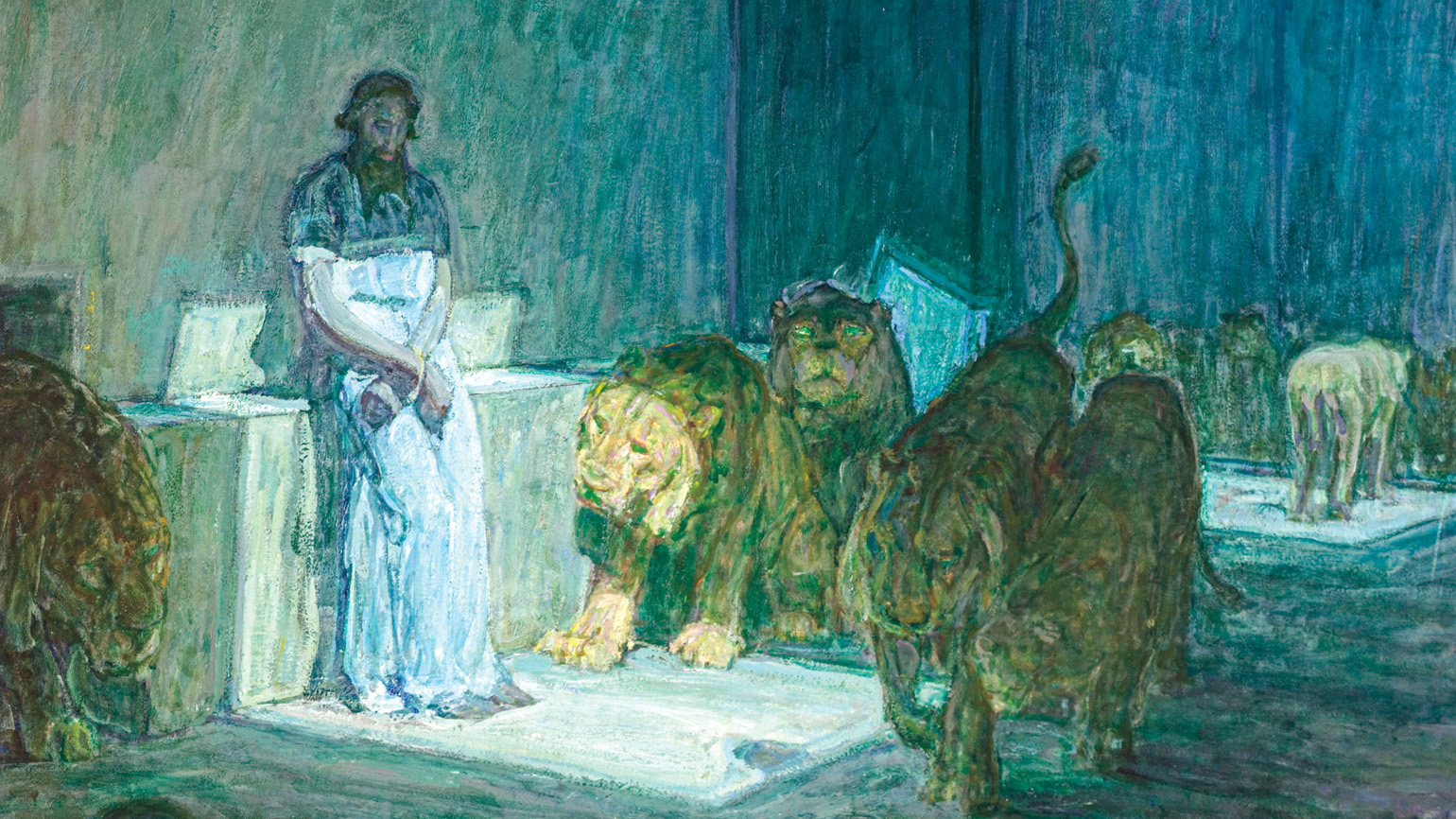
What will happen to Daniel? Three times a day he opens his windows facing Jerusalem and prays. Even though he knows what the penalty will be, he prays anyway in defiance of the edict.

(Note to self: Don’t give up your prayer practice. Ever.)

The king, heartsick at enforcing the law, must throw Daniel into the lions’ den. He retreats to the palace, tossing and turning all night.

At the first light, he rushes to the pit of beasts and calls out to Daniel, hoping against hope that he’s still alive. “Was your God able to rescue you from the lions?” he asks.

“Long live the king!” Daniel calls back, untouched by the fierce predators around him.

Mind you, it wasn’t because the lions weren’t hungry. When Daniel’s accusers were subsequently thrown into the pit instead, they were ripped to pieces.

Now this is what surprised me in my rereading of this familiar story. Daniel was no whippersnapper at the time. Many years had passed since the young, handsome Judean interpreted Nebuchadnezzar’s dreams. Daniel might have been 80 or even 90 years old when he faced the lions. Go to Google images and you can see him with hair even grayer than mine. (You can also see renderings of a young muscular hero with the beasts.) What didn’t change was his faith.

What am I going to do in retirement? I begin training soon to become a spiritual director, someone who can guide people to understand their godly calling. Will I interpret people’s dreams? From the curriculum, it looks as if we will learn how to assist people in seeing how God speaks in many ways, including dreams. The point is, you never really retire from seeking and doing God’s will.

Take a page out of Daniel’s book and use your gifts, no matter how young or old you are.

A Collection of Mysterious Stories About the 5 Senses

My Golden Sign Rhea Sampson from Menlo Park, California

The vet looked concerned as she checked my puppy’s heart. “Shannon has a heart murmur,” she said. “It can be a serious problem if she doesn’t outgrow it.”

I couldn’t believe what I was hearing. Shannon seemed like a healthy golden retriever puppy—energetic and full of life. I made a follow-up appointment in two months to make sure the heart murmur hadn’t worsened. In the meantime, all I could do was worry. Please, God, I prayed one night. Send me a sign that Shannon will be okay.

The next day, I got into my car to run some errands and spotted something on my dashboard. It was a miniature golden dragonfly! How did that get in here? I thought. I picked it up and removed it from the car, but during my drive, I couldn’t get its image out of my head. It had been so beautiful, glistening in the morning light. It was the exact color of Shannon’s fur in the sunshine. After that, every time I started to get anxious about Shannon’s health, that gorgeous golden dragonfly would reappear in my mind’s eye and my fears would subside. Had this dragonfly been my sign?

I soon got my answer. At Shannon’s follow-up appointment, the vet told me that her heart murmur was gone! She is 11 years old now and still happy and healthy.

A Taste of Trout Aaron Stadel from Redfield, South Dakota

I’d been craving the delicious taste of fresh-caught trout ever since my wife, Grace, and I moved to Spearfish, South Dakota, from North Dakota. I’d loved eating fish growing up; it was my comfort food. It would be nice to have it while we were settling into a new place.

Grace and I decided to get our fishing licenses and try to catch some ourselves. I’d fished as a kid, but never for trout. Besides, I thought, how hard can trout fishing be?

Harder than I expected. We drove to a lake that was supposed to have lots of trout. I cast my line and waited. Nothing bit. Grace and I fished all morning but ended up going back to our new home empty-handed.

A few days later, we went for a walk in the park near our house. We saw a fellow angler coming up the hill. He held a stringer full of freshly caught trout. He came right up to me. “Want some of these trout?” he asked. “I have plenty.”

I happily accepted. We fried some up for dinner that night, and it tasted delicious. The perfect comfort meal, divinely provided.

The Sound of Music Mary Jane Matterness from Mountville, Pennsylvania

One Saturday morning, I was feeling One particularly anxious about family situations out of my control. I needed spiritual comfort. I thought some inspirational music might help. I put on my favorite CD and settled into my rocking chair. The first hymn, “How Great Thou Art,” was the best. It always quieted my mind. Soon I was so relaxed that I drifted off to sleep.

I woke up 10 minutes later to hear “How Great Thou Art” still playing. That’s strange, I thought. Was the CD player set on repeat? I checked. It wasn’t. I got up to continue my day. The moment of quiet had helped a bit, but I still felt anxious, so I decided to leave the music playing and do some chores. As soon as “How Great Thou Art” finished, it started again. What in the world? I checked the CD player again, but there was nothing wrong with it.

For the next two mornings, “How Great Thou Art” was the only song that played on the CD. It never felt repetitive, though. Every time the hymn began again, I felt a wave of peace. By the third day, I wasn’t anxious anymore. But what was wrong with that CD? I removed it and checked for scratches. Nothing. I put it back in and hit PLAY. After “How Great Thou Art,” it played the next song. The CD worked normally again every time after that.

Heaven-Scent Diane Stark from Brazil, Indiana

The stink hit me as soon as I opened my parents’ front door. I stopped in my tracks and struggled not to cry. Obviously, I needed to investigate and then clean up whatever was causing the odor, but just the thought was overwhelming.

I’d been struggling with depression for months, ever since my husband had left and I’d had to take my kids and move back home. Even with Mom and Dad’s support, the adjustment to being a single mother wasn’t an easy one. A bad smell felt like more than I could bear.

I started in the kitchen, standing by the refrigerator and sniffing. “God, where are you? Please show me that you haven’t forgotten about me.”

The kitchen smelled fine. I moved into the hallway and breathed deeply. The odor seemed to be coming from the coat closet. Bracing myself, I opened the door and rummaged around.

It didn’t take long to find the source of the smell: my four-year-old daughter’s lunch box. More specifically, the moldy, half-eaten turkey sandwich sitting inside it. She must have tossed the box in the closet with her jacket on her last day of preschool. More than two weeks ago.

I brought the lunch box to the kitchen to clean it. I threw out the sandwich. Underneath I discovered a note from my daughter’s teacher to me. “I know things are hard for you right now,” she wrote, “but please know that God loves you and has a plan for your life. No matter how things seem, you are never alone.”

Saving Touch Linda E. Patterson-Shields from Lexington, North Carolina

After a bad fall eight years ago, I have been unable to put weight on my legs. I’ve had to relearn how to do everything in a wheelchair. I have family nearby who check on me, but I live alone. Though I enjoy my independence, I always worry about what might happen if I fall and need help.

One afternoon, I was organizing some papers on my desk. A folder fluttered to the floor. I leaned down to pick it up. I overshot how far I could reach. I felt myself start to fall out of my wheelchair. It was like it was happening in slow motion.

“God, help me!” I shouted.

Suddenly, I felt something wrap around my midsection. An arm, gentle but firm. I couldn’t see it, but I distinctly felt its touch. It caught me and lifted me away from the floor. Then I felt another arm on my back, guiding me safely into my wheelchair.

It took me a moment to process what had happened. I hardly believed it, but I know what I felt. To this day, I can still recall the sensation of a heavenly hand, catching me as I fell.

A Collection of Divinely Guided Cat Stories

Dogs may be man’s best friend, but as a cat owner, I can tell you there’s nothing quite like the love of a cat. Unlike dogs, who often trust people easily, cats can be standoffish. You have to earn their affection. That’s what makes it all the more special when they finally give it.

Having a cat in your life can be an enriching, rewarding experience. My own feline companion, Des, dropped into my life one day in such an incredible way that I know it was meant to be. Here are several stories of other cats who also seemed to be guided by something more and almost divine.

The Comfort Cat Who Saved This Iraq Veteran’s Life

After years of military service, Josh Marino returned home with a traumatic brain injury and PTSD. Hurting and struggling to readjust to civilian life, he considered ending it all… until a stray kitten stumbled into his life and changed everything.

Read Josh’s story here.

How Faith Helped Her Find Her Lost Cat
Sister Sharon Dillon’s cat, Baby-Girl, had been missing for six months. Her father told her she should prepare for the worst. “Sharon, you have to be realistic,” he said. “She’s been gone too long. You’re not going to find her.” But the nun couldn’t shake the feeling that she’d see Baby-Girl again. It wasn’t just a matter of time—it was a matter of faith.

Read Sister Sharon’s story here.

How 3 Cats Helped Her Heal
Marilyn Sansom’s three cats, Schnookie, Ophelia and Simon, were all rescues. They had always depended on her for everything. But after her open-heart surgery, she was the one that needed help. And her feline friends returned the favor.

Find out how…

The Heaven-Sent Comfort Cat
Willow the cat has been a resident of Madrid Home Communities for years. But when she first arrived, nurse Carla Werre was skeptical. She was worried after a cat underfoot would bother the residents. That couldn’t have been farther form the truth…

Read about Willow here.

Pair of Kittens Reunited After 2 Years
When Catherine Herrera told her daughter that she could adopt a cat, she meant one cat—singular. Their apartment didn’t allow more than one animal. But the two kittens they’d found in the shelter, Caramel and Butter, were a bonded pair. Brothers. They picked one, and Catherine promised her daughter that the brothers would eventually be reunited. Was it a promise she could keep?

Find out here.

The Cat of Her Dreams
Marion Bond West wasn’t ready for another cat, not after the death of her beloved Minnie. She didn’t want to ever go through that kind of heartbreak again. But she kept having an recurring dream. A dream about cats…

Read about Marion’s dream here.

A Cat with a Divine Mission
Sula is a cat with a mission—a divine one. She’s not a housecat, but a cherished member of the congregation at California’s Old Mission San Juan Bautista. There, she ministers to those in need, providing comfort and guidance wherever she goes.

Read more about Sula here.

The Perfect Home for This Stray Cat
Mary Nichols already had two cats, so when her daughter found a stray, hungry and alone in a parking lot, Mary had no intentions of keeping her. “We’ll take her for the time being,” she told her daughter. “But just remember, she can’t stay. God will find a loving home for her somewhere.” They’d know it when they found it…

Read the rest of Mary’s story here.

A Christmas Tree for a Family in Need

Congratulations to Guideposts.org commenter “Caperez42,” winner of the 2011 One-minute Devotions Page-A-Day Calendar. This week, we’ll be giving away the 2010 collection of His Mysterious Ways. Leave a comment below to enter… it makes a great Christmas gift.

Last week, I asked if anyone had a good holiday Mysterious Ways story to share. Becky Dosier of Kemp, Texas answered the call:

“We are country folks and each year at Christmas it was our tradition for everyone to go down into our pasture and pick out our Christmas tree. Everyone included my husband, two daughters (later three daughters) me, and Dolly, our 30-year-old horse. My husband would cut the tree down and tie it to Dolly’s saddle and she would drag it back to the house.

One year my husband was having severe back problems and there was no way he could walk down into the pasture, much less cut down a tree. He commented to me that it looked as if we would have to purchase a tree that year. Late one evening just a few days before Christmas we had just left our home and started to turn on the main farm to Market Road going to town. Right there on the side of the road was a Christmas tree about six feet tall, wrapped in that green mesh like at the store. We stopped and I loaded it into the car and took my daughter’s shoe strings out of her shoes and tied the trunk down to keep it from falling out. That was the prettiest tree we had ever seen. Don’t try to tell me that tree was there by accident, no, I know where that tree came from!”

What do you think? Did Becky and her family just get lucky? Or did somebody hear their prayers?

Hopefully, I won’t get a letter about a family losing a Christmas tree in rural Texas a few years ago…

A Christmas Miracle of Friendship

’Tis the season for miracles! In today’s guest blog post, writer Jeanette Hammel shares the story of a Christmas she’ll never forget. One that proved to her the true miracle of friendship…

My story happened in 1943 when I was 13 years old. Growing up, my dad worked at a lot of jobs. We always had the necessities of life–just more or less some days. And then World War II started. Dad was drafted. Mother went to work in the local defense plant, packing parts for shipping overseas. I learned to cook and help around the house.

As Christmas neared, that first year Dad was away, I wondered what we’d have to celebrate. Mother and I were all alone. Her relatives lived in nearby Greenville, Illinois, but gas was rationed. We didn’t have enough to get us there and back.

Then something happened that I’ll never forget. Our neighbors around the corner invited us over for Christmas Eve, even though they too were affected by the war. They had five kids–two were in the service. No one had a lot to spend.

And yet, as we gathered around the tree, two presents appeared, as if from out of nowhere. Stationary for Mother. A set of lace handkerchiefs for me. How in the world? To my heart, it felt like a miracle.

I used those handkerchiefs for many years, until they were worn out, always remembering that Christmas long ago. We didn’t have much back then. But we had friends. What better miracle could you ask for?

Do you have a favorite Christmas memory or miracle? Share your story below!