

Embrace God's truth with our new book, The Lies that Bind

A Haunting Handprint From Heaven

My husband, Max, died at 12:44 p.m. on a sunny Saturday in May, surrounded by friends and family in the living room of our Sacramento home. His last breaths were labored. He lay on a narrow hospital bed, his emaciated body propped up to face the patio doors so he could feel the warmth of the sun.

I held his hand gently—gently because it felt like all bone, not the hand that had held mine with such strength for the past five years—and read from the Twenty-third Psalm. “He makes me lie down in green pastures, he leads me beside quiet waters….”

A lovely melody suffused the room. Tones so resonant and deep, they could have been coming from one of Max’s classical CDs. I turned and saw the heavy wind chimes over the patio swaying. But the air was still. Not a breath of wind at all. There was no breath from Max either. His hand fell from mine. He was gone.

In late November, Max had received the diagnosis: esophageal cancer, late stage. He didn’t want to die in a hospital. We’d made him as comfortable as we could at home.

We’d sit overlooking our yard and talk. About Tanner, my son from my first marriage, whom Max treated as his own. About music, good food and wine, philosophy—his passions. About the trips we’d taken, like the one to Auberge du Soleil, a resort in Napa Valley, where he’d first told me he loved me. These things were easier to talk about than the future.

I was 53. I’d thought we’d grow old together. Now? “It’s easier for me,” Max said one day. “It will be harder for you because you are being left behind.”

“I don’t know what I’ll do,” I said.

“I will still be here,” he insisted. “My love will never die. It’s immutable.”

What did Max mean? He’d never talked like that. I was the daughter of a Presbyterian minister, but Max was an agnostic. The Twenty-third Psalm was music to him, not Scripture. The idea that anything but a memory of someone could survive death didn’t appeal to his sense of reason.

I couldn’t fault him for it. His intellectual rigor was one thing that had attracted me to him.

I’d met Max in 1999, a year and a half after I’d moved to Sacramento to become the publisher of the Sacramento Bee, one of California’s largest and most respected newspapers. I was divorced, with a nine-year-old son. I didn’t have time for love.

Then Max invited me to a meet-and-greet event held by the political-consulting firm he worked for. I declined—obvious conflict of interest for the newspaper— but agreed to a friendly lunch.

He was a true Renaissance man: an Air Force vet, a mathematician, an accomplished chef, a former college weight lifter. He played trumpet and piano and had even written his own symphony. He read at least a book a week. He astonished me.

Eight months later, we were married. Max, Tanner and I built a home together, a life. Two weeks before our fourth wedding anniversary, we discovered that that life was nearing an end.

In his final months, Max spent a great deal of time with our friend and his caretaker, Helen. He’d insisted that I continue working, so Helen was there when I couldn’t be.

One day she revealed the strangest thing. The two of them were in the kitchen when there was a brief sun shower. “We both stopped and looked,” Helen said. “I told him, ‘I know you don’t believe in God, but this is something God created for us today. If you can find a way, let us know that there’s something out there, that it doesn’t just end.’”

“I will,” Max said. “But it will be up to you two to see it.”

Max said that? I believed in heaven, as my father had understood it, a faraway place filled with love. Max never did. But the nearer death drew, the more cautiously open he became to the notion that there could be more, as if a force stronger than his reason were reaching through to him. He spoke with less certainty about the end. The day before he died, weak and fading, he asked for directions. “Where, Max?” I asked, confused. “To the place I’m going,” he explained.

The afternoon Max died, some friends took Tanner. I waited for the funeral-home staff. I retreated to the master bedroom to try to compose myself. I flipped on the light, but the bulb above the sink had burned out. “I thought these things were supposed to last forever,” I grumbled.

We held Max’s funeral at a church in downtown Sacramento. A friend conducted the service, and people filled the pews. Tanner and the other pallbearers carried Max’s coffin to the front of the sanctuary. I was set to follow behind with my brother and sister-in-law. Will I make it through this? I wondered. Will I fall apart?

Suddenly a sound boomed through the sanctuary. A heavy door to an anteroom had slammed shut. No one was near it. It shocked me out of the downward spiral I was in.

Only back home did I think about the music of the chimes on that windless afternoon. The burned-out bulb. The slamming door. What was going on? The newspaperwoman in me said, “Nothing at all.” A flying bird could have brushed the chimes. We hadn’t changed the bathroom bulb since we’d moved in. A draft in the church could be strong enough to slam the heavy door. Max was logical to a fault. He’d guffaw at “signs” like these.

It was grief that made me notice more little things. Lights flickering when it wasn’t even stormy. Noises coming from the guest bedroom, where Max had slept for most of the last month. One morning, I returned home after taking our yellow Lab for a walk, and glanced up at the large clock over our fireplace. It should have read eight o’clock. Instead, the hands had stopped—at 12:44.

Father’s Day. Tanner was with his dad. I was home alone, listening to Celine Dion’s “Because You Loved Me,” the song we’d played at Max’s funeral. I felt agitated. I wandered into the library, full of Max’s books. I randomly pulled one from the shelf. An envelope fell to the floor. On the front was a woman’s handwriting. It was a card from Max’s mother, from Father’s Day the year before. “I’ve never seen you this happy in your life,” she’d written. “It’s because you have a family.”

I could explain any one of these things, but all of them together? I decided to keep a list of every odd incident, weird feeling and comforting coincidence. Maybe if I saw everything on paper, I’d begin to make sense of it.

I gave away most of Max’s possessions, because that was what he wanted, but it felt like giving away parts of him. His albums and books I donated to the library. His clothes and shoes I gave to Goodwill, saving a few favorite ties and shirts for Tanner. The least important things were the hardest to deal with. His round tortoiseshell glasses, his worn black leather wallet, a tiny hairbrush that he used every morning. They seemed to bear his imprint, his touch. I was beginning to forget what it felt like back when his hands were still strong, when he held mine in his.

Tanner and I didn’t plan anything for the first anniversary of Max’s death. Just a quiet day at home. We sat at a table in the backyard; I caught up on work, Tanner read a book. After a while I went inside to make us a snack. On the way to the kitchen, I paused at the doorway of the guest-bedroom suite. Something drew me inside. I turned toward the bathroom and flipped on the light.

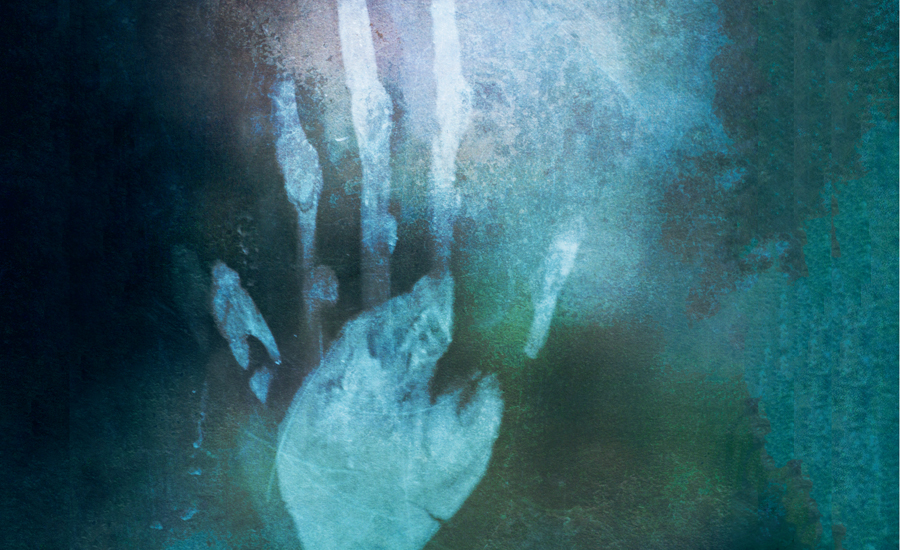
On the mirror was a handprint.

It was no ordinary handprint. Not something revealed by the steam of a shower or left behind by someone’s greasy fingers. It was made of a soft, powdery substance and perfectly formed: I could see every fingerprint, every crease, the life line and love line. It showed all the facets of bone structure, like an X-ray. I’d combed my hair in front of that mirror just hours before. The hand hadn’t been there.

I shouted for Tanner. He came running. “What’s wrong, Mom?” He saw it too. It wasn’t just my imagination.

“You didn’t do this, did you?” I asked.

“No,” he said. He held his hand up to the mirror, so small in comparison. “Where did it come from?”

I didn’t have an answer, any reasonable explanation. But I knew whose hand it was. The same hand I’d held a year earlier, except this was the way I preferred to remember it. The hand that had once pressed the keys of a piano and thumbed through the books in our library. Max’s hand.

I got my camera and took a picture, afraid the image would fade. But it didn’t. It remained until that Wednesday, when Helen came to clean the house. “Do you want me to leave it there?” she asked, astounded.

I did, but it was time to say goodbye. Max had already given me enough to hold on to. Just as he’d promised—if only we were willing to see.

See more signs from beyond that Max never really left Janis.
A Glimpse of the Hereafter Shortly Before Death?

Trudy gets so many questions from Guideposts readers, we decided to make her answers a regular feature on her blog.

Dear Trudy,

I lost my husband almost four years ago. He had several medical problems — diabetes, heart attack — plus he was 85, 29 years older than me. We had hospice care for him here at home with a hospital bed. Mostly he slept and was on oxygen.

The night before he died, a girlfriend of mine was with me. We had gospel music playing softly and we were just watching my husband. Suddenly we saw him lifting his arms as if praising God or greeting a relative or friend. Then he put his arms down for a while. Shortly after this, he raised his arms and clapped very quietly. During both of these moments, he was very much awake and looking up. He passed away peacefully the next morning.

Is this common with people facing death? It was like he wanted to go to heaven. He was a devout believer, and I think he saw the angels who were going to take him home. Have you seen this type of thing in other people you have cared for? Thank you for your information.

Sincerely,
Ann Ferden


Hi Ann,

Thank you so much for writing and telling me of your husband’s experience as he was getting closer to heaven. This is a very common phenomenon, one seen very often by those tending the dying. In my first book, Glimpses of Heaven, I write about this in two stories. One was Mark, a young 47-year-old who could not move anything on his own but who, one night, raised up in the bed and said, “Oh, it is so beautiful!” and then died.

Also Gene, in the same book, after not responding for a few days, raised up as we were praying with him, arms outstretched and praying in a language we did not understand. It was exquisite to see. His family was Native American, and we thought it wonderful that God allowed him to experience his ancestors in his very own tradition.

How blessed you were to have been with your husband and to know he was already seeing those who had gone on before him and very possibly the angel who was coming to take him home. Be at peace now; you have loved him well.

Blessings to you and yours,
Trudy Harris

After September 11

I don't think I even opened my eyes when Derek kissed me goodbye that morning. You remember things like that afterward. Five months pregnant with our second child and worn out from running after 13-month-old Tyler, I grabbed every moment of sleep I could.

The alarm had gone off at 5:18 a.m. that Tuesday, September 11, as it did every weekday. Exactly enough time for Derek to dress, take our dog, Squirt, for her morning walk, then drive to the station to catch the 6:10 a.m. train to New York City.

He worked for the investment and securities firm Keefe, Bruyette & Woods on the 89th floor of Tower Two of the World Trade Center.

Shortly before 9:00 a.m., Derek phoned. "Honey, turn on the TV!" he said. "A plane just hit Tower One. They think it's just a Cessna, but we're evacuating."

We hung up, and I clicked on the TV. I was watching when the big United Airlines jet plowed into Tower Two. I knew I would never again see my husband, never again feel his arms around me, even before the massive building came thundering down.

I knew, and yet a part of me refused to accept it. What about Tyler's nightly ritual of Daddy putting him to bed? What about our unborn child, Lord? A second son. We'd already chosen his name: Chase. Derek had to be there when Chase was born!

Almost immediately people came by—neighbors, friends from Bible study, family. They brought food, played with Tyler, walked Squirt. Someone offered to pick up Derek's car at the station, and I protested, "Then his car won't be waiting when he gets off the train."

I filled out the missing persons description. What had Derek worn that morning? I didn't know. The black shoes he wore with dark pants were still in our closet, so I wrote, "khaki trousers."

By the end of the week it was harder to keep denying the truth. I was asked to supply personal items from which DNA could be extracted and matched with the remains being recovered at Ground Zero. I put Derek's toothbrush and razor in a plastic bag, then sealed it closed.

There was a tangible finality to the act that I hadn't felt before, not even in learning to accept the outpouring of support that continued nonstop—cards, flowers and gifts, donations toward the children's education. Prayer. So much prayer.

Maybe that's why I decided to hold a memorial service 10 days after the attack, though I hadn't quite given up the secret hope that Derek was alive. Our church was packed; some people I didn't even recognize. Each person took the hand of the one next to him. "Our Father…"

We reached across the aisles, praying with one heart, one voice. The Body of Christ had been a phrase to me. Now it was what I was experiencing—others shouldering grief too heavy to bear alone.

Still I found myself thinking about Derek. About when we first met. My apartment had been decorated with sunflowers—curtains, vases, a quilt. He loved to tease me about those sunflowers! The way I teased him about our dog. I'd had to talk him into getting one.

He finally decided a basset hound would be all right because it would just sit around. I'd been holding out for an active breed, a retriever, maybe. Of course, when Squirt came along, half basset, half yellow Lab, Derek fell in love with her. She was a real Daddy's girl.

I wasn't the only one who kept listening each evening for Derek's key in the front-door lock. Precisely at 7:00 p.m., loyal Squirt would be at the window, her tail pumping. For our little dog there was no comprehending Derek's absence. I knew, though, that I had to accept it.

Early in October I went to Ground Zero. I tried to envision the maze of downtown streets, the concourse, the soaring towers. In this wasteland of smoking rubble, how could I have imagined that my husband had survived?

I turned to the support groups for grieving families, met with other young mothers. One hundred five of us were expecting when we were widowed. Sharing fears, hopes, tears helped.

Our new baby was born on January 2, 2002, the day before what would have been our fourth wedding anniversary. I held little Derek Chase for the first time, overwhelmed with joy. And longing.

My husband should have been there, holding our baby, holding me, in his arms. Never had I missed him more. Never had I felt more confused and alone.

My parents were at my house, watching Tyler. I called them with the news. They said a huge bouquet had just been delivered. Sunflowers! There was no card. I figured someone who knew me and Derek well had sent them for our wedding anniversary.

Every day my two boys reminded me that I must focus on the future. Yet how do you do that when your heart's in the past? How do you leave behind how it was for the reality of how it is?

What made it especially hard for me was having no physical entity to say goodbye to. There had been no casket, no ritual of interment, no moment of leave-taking.

To confirm the DNA recovered from Derek's toothbrush and razor, the New York City medical examiner's office requested a sample from one of our children. I'd seen that mountain of debris. It seemed hopeless to search for any individual trace.

Still, if there was a chance some fragment could be identified….I took Derek Chase to our pediatrician. He slept through the procedure of swabbing his mouth. To eliminate my DNA from the sample, the doctor swabbed mine as well.

At the end of May, a few days before what would have been Derek's 31st birthday, I spent the evening with another September 11 widow, talking as usual about our husbands. Reliving those final moments…our last kiss, the gentle press of Derek's lips on my drowsy cheek.

Driving home with the boys asleep in their car seats, I told myself again that it was time to stop looking backward. Time to get a headstone for Derek and start making plans for a future without…Why were two men standing on my doorstep at eight o'clock in the evening?

One of the men was a priest from my church, the other a police officer. Word had come from the medical examiner's office in New York City. A three-inch fragment of bone had been identified as Derek's.

Was this a message for me, I wondered, a confirmation that I needed to move forward? I thought back to another time I'd received something unexpected, the day I had so longed for my husband, when our little Derek Chase had been born.

The day that surprise bouquet had arrived. Those sunflowers, they came when I was the only one who knew about the birth. Someone who knew Derek and me well—better than anyone—did send them, as much to commemorate the past as to celebrate the future.

The next morning, I phoned the florist to ask about that bouquet they'd delivered in January. Yes, they remembered the order well, an unusual one. A man had come into the shop to place it. He had not given his name.

Ah, but I knew his name! His name was love. The love that comes only from God, holding me, supporting me in so many ways after September. Letting me know that the deep connections formed with my husband live on, especially through our children. Assuring me that it was okay to let go and move on—he was with Derek in heaven, just as he has been with me here on earth, every step of my journey through the valley of grief toward the promise that lies beyond.

A Conversation with a Near-Death Experience Expert

Psychiatrist Bruce Greyson has interviewed more than 1,000 people who say they died and left their bodies, and then were given a glimpse of what awaits us in the hereafter. But it was an encounter not long after he began his psychiatric residency that inspired him to devote much of his career to the scientific study of near-death experiences, or NDEs.

He was called to interview Holly, a woman who had been brought to the emergency room after attempting suicide by overdosing on pills. He rushed to her room to give her a psychiatric evaluation, buttoning his lab coat to cover up some spaghetti sauce that had stained his tie earlier. But Holly was still recovering and unable to answer his questions. So he went down the hall to interview her roommate about the events preceding her hospitalization. He unbuttoned his lab coat, forgetting the stain, while trying to get as much information as he could. The next morning, he returned to see Holly. “I saw you yesterday interviewing my roommate,” Holly said. “You had a red stain on your tie.” Fifty years later, he’s still amazed by Holly’s out-of-body awareness. Greyson wrote about his research in his new book, After, and spoke with Mysterious Ways about his findings.

From your research, what have you found about people’s general feelings about death?

They are often afraid of death. It’s very common, even among Christians. There are two specific fears. One is that death is the end. There’s nothing else. I certainly believed that before I started doing research. The other fear that many people have is that they will be punished after death for their sins on Earth.

How does this compare to people who’ve had NDEs?

When people actually experience the afterlife, they lose all doubt. There’s no way you can convince an NDE-er [near-death experiencer] that their experience wasn’t real. They feel comfortable knowing that when they die, they’re going to go back to that same, wonderful place. Because they’re “dead” for just a short period of time, I wonder how they’re so certain that’s what the afterlife is. But they feel as if they’ve tasted eternity and are willing to go back.

Take, for example, the case of 45-year-old Peggy, one of the NDE-ers I interviewed. Her heart stopped during a hysterectomy. She was instantly transported to a place of brilliant white light, surrounded by love and contentment unlike anything she had ever experienced on Earth. When she was revived, along with having a renewed zest for life, any anxieties she’d had about dying disappeared. She felt unequivocally that she was going to return to that place when she passed. She said, “I look forward to dying and have no fear whatsoever. It will be when I can go ‘home,’ where I came from.”

What is the typical NDE, and why is it so comforting?

NDE-ers report a sense of being unconditionally loved when they pass over, as Peggy did. No matter what else happens in the NDE, people usually feel encompassed by this overwhelming sense of love in spite of their wrongdoings. They also often encounter their deceased loved ones. Knowing they’ll be reunited with them after death is tremendously comforting.

About three fourths encounter a warm, loving being. Many of them don’t put a label on it. About a third of them will call the being God. About two thirds of them will say, “Well, I’ll use the word God so you know what I’m talking about, but it’s much bigger than the God I was taught about in church.” About 80 percent of the NDE-ers continue to feel a greater connection to that divine being even after they come back to this life. Once the connection is made, it stays.

How do you respond to people who say NDEs are imagined?

An NDE skeptic will say that people are greeted by deceased loved ones because that’s what they want to believe will happen. And that may be an explanation in some cases. But there are cases where people encounter individuals whose deaths they were unaware of. I published a paper a decade ago with 30 or 40 of these cases, so they’re not unique.

One case was of a young man who had been hospitalized with severe pneumonia. His primary nurse was a young woman named Anita. They were about the same age and became friendly. At one point, she told him she had plans and was taking off a long weekend. While Anita was away, he suffered a respiratory arrest and had to be resuscitated. He had an NDE during that time.

He found himself in a beautiful pastoral scene, where he saw Anita walking toward him. Startled, he said, “Anita, what are you doing here?” She said, “You can’t stay here, you need to go back, and I want you to tell my parents that I’m very sorry I wrecked the red MGB.” Then she turned and walked away.

The man woke up back in his hospital bed and told the first nurse who walked into his room about his experience. The nurse got flustered and left the room. He later found out that Anita had taken the weekend off to celebrate her twenty-first birthday with her parents. They’d surprised her with a red MGB. She had taken the car for a ride and gotten in a horrible accident that killed her instantly.

There’s no way he could have known or expected or wanted her to be dead. Certainly no way he could have known how she died. And yet he did.

In my research, I corroborated that no one who experienced this kind of interaction in their NDE knew beforehand that the person they’d seen had died. Psychological explanations—a hallucination or your imagination creating a scene you find comforting, like being met by someone you know has died—didn’t justify the kind of knowledge and foresight gained in these types of encounters. The most straightforward conclusion we arrived at is that the person who died is still around in some form and able to communicate, and in fact has some free will.

Is an NDE more powerful than other types of spiritual experiences?

Definitely. Not necessarily because of the impact of an NDE on someone’s beliefs about the afterlife, but because of the unique power of NDEs to change people’s lives.

Are there specific markers of change that you’ve noticed in NDE-ers?

They become not necessarily more religious but more spiritual. They say that they feel more compassionate and are more concerned with relationships. They universally say that they now regard the Golden Rule (treating others as you want to be treated) not as a guideline but as a law of nature. It’s not an abstract concept. It’s a fact, like gravity. They also become much less interested in worldly things, in material possessions, in power, prestige, fame, competition. Those things don’t exist in the other realm, and people feel like they are better off for it.

What’s the most dramatic transformation you’ve seen after someone returns from an NDE?

I’ve known people who were career criminals, who were career addicts, who totally transformed their lives after an NDE. As a psychiatrist, I know our usual treatment in psychotherapy can’t do that as quickly, if at all.

What’s the most exciting thing to you about this research, as a scientist?

I find it compelling that the effects of an NDE have not been able to be replicated in a clinical setting. Scientists have tried to mimic the NDE with electrical stimulation to the brain, magnetic stimulation, hypnosis and psychedelic drugs. You can get some unusual experiences that have something in common with an NDE, but they don’t have the profound after-effects that the NDE does.

Are there any negative or challenging aspects of returning to life after an NDE?

It can be difficult for people to relate to others, to return to their job, to live a normal life, knowing that something so incredible awaits them. People are so transformed, so altruistic, that it can cause problems in their closest relationships. I’ve talked to children of NDE-ers who say, “It feels like my mother doesn’t love me like she used to, that she loves everybody the same as me. I don’t feel special to her anymore.” I’ve known NDE-ers who left their homes after Hurricane Katrina or after 9/11 and rushed to the crisis to help. The family feels abandoned. This is most noticeable when the person was the opposite beforehand. If they were selfish or competitive, they’re totally transformed after the NDE.

Can you talk about what NDEs might offer people who’ve never experienced them?

There have now been five studies done by four researchers of college students who took a class in NDEs. In these studies, students’ attitudes were tested before and after the class. The researchers found that students become more altruistic, more compassionate, after having merely studied NDEs. They did follow-up studies with these kids one and then two years after the class was over. The changes persisted. The students were still more compassionate than their peers who weren’t familiar with the subject.

These studies show what we already know anecdotally: that you don’t need to have an NDE yourself to be comforted and inspired by them. Researching all of these NDEs even had an impact on a skeptical scientist like me. I can’t say I’m 100 percent convinced of anything. However, I’m fairly convinced that there is an afterlife. The overwhelming evidence from NDEs, and from other reported spiritual experiences as well, supports that conclusion.

A Conversation About the Healing Power of Shared Near-Death Experiences

William Peters has dedicated his life to the study of end-of-life phenomena. He holds master’s degrees in education and counseling psychology, and is the founder of the Shared Crossing Project, an organization that educates people about mystical happenings during the dying process. He sat down with Mysterious Ways to discuss the Shared Crossing Project’s research into a type of end-of-life phenomena known as the shared death experience and what it teaches us about our enduring connection to each other and the mysterious journey from this life into what lies beyond.

What is a shared death experience?

A shared death experience, or SDE, occurs when a living person observes the transition of a person who is dying. They experience the initial stages of the afterlife together. During an SDE, living experiencers are allowed to witness a dying person’s journey from this life into what lies beyond.

An SDE can happen to caregivers, loved ones and bystanders —seldom between total strangers. They occur between people who may not know each other well, such as a dying person and a nurse, when the experiencer was often a source of comfort for the dying person in the final stages of life.

How did you become interested in studying SDEs?

In 1979, at 17 years old, I was in a skiing accident and had a near-death experience, or NDE. I went out of my body, saw my life in review and went toward the light. I asked God to go back. After I recovered, I had no language or context for my experience and told no one about it.

In 1993, a blood disorder nearly killed me. I had another out-of-body experience, in which I floated over my body in bed. After that, I realized how profound these experiences were and became more curious.

Then while working in hospice, I had my first SDE. I was sitting with a dying man, reading him a story. I had yet another out-of-body experience. But this time, I wasn’t the one who was dying. The man was floating along with me. He smiled at me as if to show he was glad I was with him. He died shortly after. Being able to witness this was a divine gift, even if I still didn’t quite understand it. I wanted to learn more.

What are some examples of common shared death experiences?

Every SDE is different, but some common examples include seeing the dying person young and healthy, witnessing a mystical light or going to a heavenly place with the dying person. These experiences can occur as visions, out-of-body experiences or during sleep.

SDEs can happen at the bedside of the dying person or hundreds of miles away. Our research shows that about 60 percent of people who shared their stories with us had remote SDEs.

Tell us more about how living people “experience” this transition.

Our research team has collected more than 200 accounts of SDEs, and we are systematically analyzing each experience. We’ve observed that these experiences usually fall into four categories: sensing, witnessing, accompanying and guiding.

Sensing means the experiencer has a feeling that their loved one is dying. They might even see the person for a moment.

During witnessing, the experiencer sees what the dying person sees during transition. This might include observing the dying person’s life review or watching them be greeted by a deceased loved one.

Accompanying is when someone experiences the transition with the loved one, journeying alongside the dying person toward a light or through a tunnel. I remember one story from a widow. She recounted how she’d gone with her husband as he ascended, felt the heavenly state of euphoria and then handed him over to his deceased mother. For her, it was an affirmation that her husband was at peace and with his beloved mother.

Guiding occurs when the experiencer helps the dying person transition from this life to what lies beyond. One respondent had his SDE while he was riding in a car. He was relaxing in his seat, and a vision came to him. His father was there, confused about where to go. The son guided him toward a light and watched him go through a portal. When the son arrived at his destination, he learned his father had died.

What about remote SDEs? Do they happen only between two people who have a close connection?

Yes, most remote SDEs are experienced by someone who has a close relationship with the person dying. It can be someone they were close to a long time before. One woman hadn’t had direct contact with her ex-husband in a decade. One day, she felt his presence come to her. She heard his voice in her heart, thanking her for the years they’d shared and saying goodbye. She immediately texted her daughter, who told her that he had just died.

What do SDEs say about our relationships with others?

SDEs can honor our important relationships. Even if a relationship ends, such as the case of the divorced woman, SDEs go beyond the human and the ego. They can give us a sense of profound gratitude for having had the opportunity to connect with each other. SDEs reveal that some bonds are so deep that they can continue after life.

SDEs seem a lot like NDEs. True?

SDEs and NDEs have similar if not identical phenomena.

One reason I find SDEs so fascinating is because they help validate NDEs. Some dismiss NDEs as the body’s biological response to physical trauma. But SDEs happen to a healthy person. And there are so many commonalities in first hand accounts of NDEs and SDEs, it has to be more than a coincidence.

Also, we’ve noticed that some people who have SDEs had an NDE earlier in life, as I did. It’s possible that having an NDE opens you up to having more mystical experiences. We don’t know for sure yet, but we’re studying it.

How do people usually react to their SDEs?

People don’t doubt what they’ve seen. Most view it as a positive experience and describe it as divine or sacred.

Experiencers report knowing that their departed loved one is in a better place. Some say the SDE revealed that they will see their loved one again. Others say it gives their life a greater context or reaffirms their faith, as if something they’ve always known has been reawakened.

One of the most common reactions is a sense of healing from grief. SDEs show that some aspect of us goes on after death; there’s a continued consciousness. So instead of trying to forget their loved one, experiencers feel empowered to let go while staying spiritually connected.

Why study SDEs? What do you hope to do with these stories?

This phenomenon is part of the human experience. We haven’t discovered it; we are rediscovering it.

When people have SDEs in a medical setting, their accounts are often misunderstood, dismissed and sometimes disparaged. With our research, we want to show people how normal SDEs are, so medical professionals know how to handle them when they are reported.

I also want these experiences to help us talk about death. Death and dying are perhaps the greatest human event. Death is largely shrouded in mystery, but it deserves to be studied. It’s wondrous. We shouldn’t fear it. We should honor and prepare for it.

5 Characteristics of the Last Words of the Dying

My interview with linguist Lisa Smartt, founder of the Final Words Project and author of the upcoming Words at the Threshold, continues below. In Part 1, Lisa spoke about her father’s speech in the last weeks of his life. Here she talks about the patterns she’s uncovered in the words of the dying, and what it may reveal about life after death.

You’ve analyzed almost 2,000 end-of-life phrases. What trends and patterns have you found?
There’s a trend away from literal three-dimensional and five-sense language to more metaphoric language. For example, someone might say, “I need my passport” when there’s no real trip planned. Or they might utter nonsensical phrases like, “Introductory offer: Closed for goods and services,” “Drape my legs across the fireplace” and “There is so much so in sorrow.”

Linguist Lisa SmarttThere are often metaphors related to travel or an important occasion coming soon, like getting ready for a big dance. As people die, there are often references to things breaking down, like “I need maintenance for this” or “Everything in pieces, so many pieces.”


Read More: Do Angels Really Have Wings?

In general, things that are deeply meaningful to people in their lives form the architecture for the metaphors people construct when dying. So people who love sailing will speak about ships or boats waiting for them. Repetition is also much more common in the language of the dying than in ordinary speech. For example, “How much wider does this wider go?”

Is there anything in the speech patterns that’s surprising?
Several of the constructs in the language of the dying are relatively complex. It is intriguing to me that as our brains diminish in capacity such language emerges. Sustained narratives are common. Someone might say, “I need my map,” then that will change to, “Who has my suitcase? I need my suitcase,” followed by, “My suitcase is packed. I am ready to go now.”

These metaphors evolve over days, weeks. Most of us would not recall something we said 10 days ago and be able to sustain the narrative. How is it that as we are dying we can have a metaphor, develop it, remember it and articulate it over a period of time? So many of the things that I have observed in people’s language, like this, indicates to me that there is, indeed, some kind of realm beyond this one.

What does the “nonsense talk” of the dying reveal about life after death?
There are several kinds of nonsense we observe at the end of life and each reveals interesting things:

1) A prepositional shift.
Prepositions are those small words we use to indicate where we are in space (up, down, besides, etc.). We hear people talk in really puzzling ways about their orientation in space as they are dying. People lying motionless will say how they’re moving up or need to be pulled down. Technically it’s complete nonsense. But if you look at these statements in the context of research into near-death experiences (NDEs), they make sense.

People who’ve had a NDE talk about moving up and over their bodies. Clearly there is something, a spirit in us that is not our bodies. And that spirit moves in ways that our bodies can’t as we approach the threshold.

2) Hybrid, nonsensical sentences.
Someone might say, “I need my checkbook as I have to pay to get in…” Pay to get in? Where? Again, it’s technically nonsense, but often compelling. The dying person appears to have one foot in this reality and another in some other reality.

3) The observation of beautiful dimensions.
For example, one person said, “A place that is so beautiful, is shining like diamonds, Mom, oh my God, Mom, so beautiful!” This is nonsense because it’s a place not witnessed by the living. But when one hears people refer to these places, we have to ask–if this is just the imagination, then why is it that our imaginations see these things specifically at the end of life? Why do these images seem to comfort people so profoundly if they’re just make-believe?

4) Talk of deceased loved ones.
Often times, the dying see deceased family and friends who feel very “alive” to them. I get the sense that there are two different dimensions rather than the distinction of dead versus living. However, the details of that other dimension are often not articulated.

5) Contradictory language.
We see more paradoxical language in the dying, just as we see with people who’ve had a NDE. Contradictory statements from someone who’s experienced a NDE might be, “I have never felt as alive as when I was dead.” People talk about how difficult it is to speak about a NDE–it is ineffable. In the language of the dying, it’s the same thing. That indicates another experience that can’t be explained by ordinary language.

Stay tuned for part 3 of our interview coming soon. In the meantime, you can ask Lisa a question about last words in the comments below.

Jesus Spoke to Her During Her Near-Death Experience

In 1982, I was a severely depressed thirty-two-year-old in a loveless marriage who also suffered from chronic anemia and had just been told I would never bear children. I wanted to end the pain forever, so I attempted suicide.

I didn’t believe in God, Jesus, or angels, much less an afterlife. But suddenly, in the midst of my attempt, I was immersed in a love and light that was infinite beyond all description. The love was unconditional, and I wanted to stay in that light forever. The light gently receded, and I was back in my bedroom. Jesus was next to my bed. He said, “Don’t waste your life, thinking you’re not loved.”

With that message, all went dark again, and I was sucked back into my body.

I had a new life to live and Jesus’s message to live up to. I had some kind of purpose to figure out. I didn’t even know my experience had a name: the “near-death experience.” Little did I know then how my NDE would someday allow me to help others, including the person I loved most.

I tried telling my then-husband and loved ones about my experience. They all thought I was crazy, so I stopped talking about it. I moved back to my home state, got a divorce, and, some years later, fell in love with a research scientist named Dr. Charles David “Dave” Stout. I didn’t want to marry Dave if I couldn’t share my secret with him. I needed to know he could accept that important part of me.

Not only did Dave not think that I was crazy, but he shared his own spiritual experience of praying for his mother after she had a terrible car accident that could have taken her life. On his way to the hospital, he felt compelled to pray for her. He stopped at a grove of cottonwood trees to pray, and suddenly, he felt transported. The leaves of the cottonwood trees began to glow. He got the unmistakable sense that his mother would eventually heal and be fine. She did.

I knew then that Dave was the one for me. Throughout our long marriage, we talked about God, life’s purpose, the afterlife, and unconditional love. Music lifted our souls. And every summer Dave went hiking in his favorite mountains, the eastern Sierras. He read from his well-worn Bible every day. Dave read every edition of Guideposts magazine cover to cover. He shared the dog-eared pages and underlined passages with me. This precious man was my true soulmate.

Then, in June of 2013, Dave was diagnosed with terminal brain cancer. It was inoperable. They gave my dear husband three months to live, best case scenario fourteen. We vowed to fight it with everything we could. But most of all, we prayed.

We had three more years together. One day in January 2016, Dave fell into a coma. His sons and I rushed him to the hospital. The nurses set up a bed for me in his room. Finally acknowledging that God would soon be calling my beloved husband home, I fervently prayed for a deathbed vision that would comfort him and bring him peace.

The next morning, I found Dave sitting up in bed, smiling. He was pointing to the ceiling. Speaking was difficult; while he understood everything I said, I didn’t know what he was trying to tell me. Then he asked clearly, “You can’t see that? It’s real.” My prayers had been answered. He was having a heavenly vision. I wanted to hear everything about it.

“What do you see?” I asked.

He pointed from one edge of the ceiling to the other and said, “Mountains.” Dave’s spiritual home. “White, feathers, music.”

“Angels?” I asked.

“Yes, angels!”

“Are they singing?”

“No.”

“Are they playing instruments to make the music?”

“Yes.”

“Is it beautiful?”

He gave me a big smile and said, “Oh, yes.”

Three months later, on April 30, Dave was taking his final breaths. He could no longer talk. His eyes were wide, moving from one end of the ceiling to the other.

“Are you seeing your mountains again?” I asked Dave. He nodded. Yes.

“Do you think God is calling you home?” Yes.

“Do you want to go home? Yes!

Within a few hours, he was gone from this life. Only then did I allow myself to break down.

The angels knew how much my husband loved instrumental music. They knew he loved the mountains. They chose to give him this experience in a way that would bring him the most comfort and help guide him in his transition.

By bringing my husband comfort, they brought me comfort as well.

How to Stay Involved With Church When You’re Stuck at Home

Right now, I feel like I need church more than ever. And yet, because of the urgent need to protect everybody’s health, my church is closed. We’re doing worship virtually. I’ll be there—via my computer. But there’s a lot else I find I need to do.

Call People
My faith community has phones. I’ll bet yours does too. Give someone a buzz. Do it for them as well as yourself. Say a prayer together. Chat. Quote a Bible verse. Fear can be contagious. So is hope. Share hope with a loved one.

Sing
No choir means no singing God’s praise together. But it doesn’t mean you can’t sing to yourself. Tune into a song on your phone. Sing in the shower, or while cleaning the house. Worried about how you sound? Fret not. As the Psalmist said, “Make a joyful noise to the Lord.” Nothing there about perfection.

Pray Together
Like I said, you can pray on the phone. You can also pray at designated times even if you’re in your room alone. Someone recently alerted me of a call to pray at 4:00 p.m. EST for those suffering from the health crisis. I thanked her for her email, and at 4:00 I sat on my sofa and prayed. I was not alone.

Wash My Hands with Prayer
As I’ve found, the Lord’s Prayer said with some soap and lather comes out to a satisfying 20 seconds, plus the rinse. Never have I felt so connected to those words. It’s as though as I wash, I’m cleansing my soul.

Do a Virtual Bible Study or Class
Our usual Tuesday night group is still meeting. I’ll admit it’s different not sitting around a table. Instead I’m glimpsing only individual faces on the computer screen, not seeing the whole group. But no doubt about it, it is still community.

Listen to the Silence
These 40 days of Lent we mark the period that Jesus spent in the wilderness before He began his ministry. That aloneness, that solitude, was His preparation. This period of uncertainty can seem like the wilderness to me. Then I remind myself of Who was here before and remember that times of silence can also be times of preparation.

Church is taking on a new shape, but think about it, our faith communities have been reinventing themselves for 2,000 years. Sometimes I feel that right now, we’re closer than ever to the first followers of Jesus. Times were often hard for them but no matter their circumstances they sang, they prayed, they witnessed and they passed on the Word.

Prayers for all of you.

How This Special Cat Became His Source of Motivation

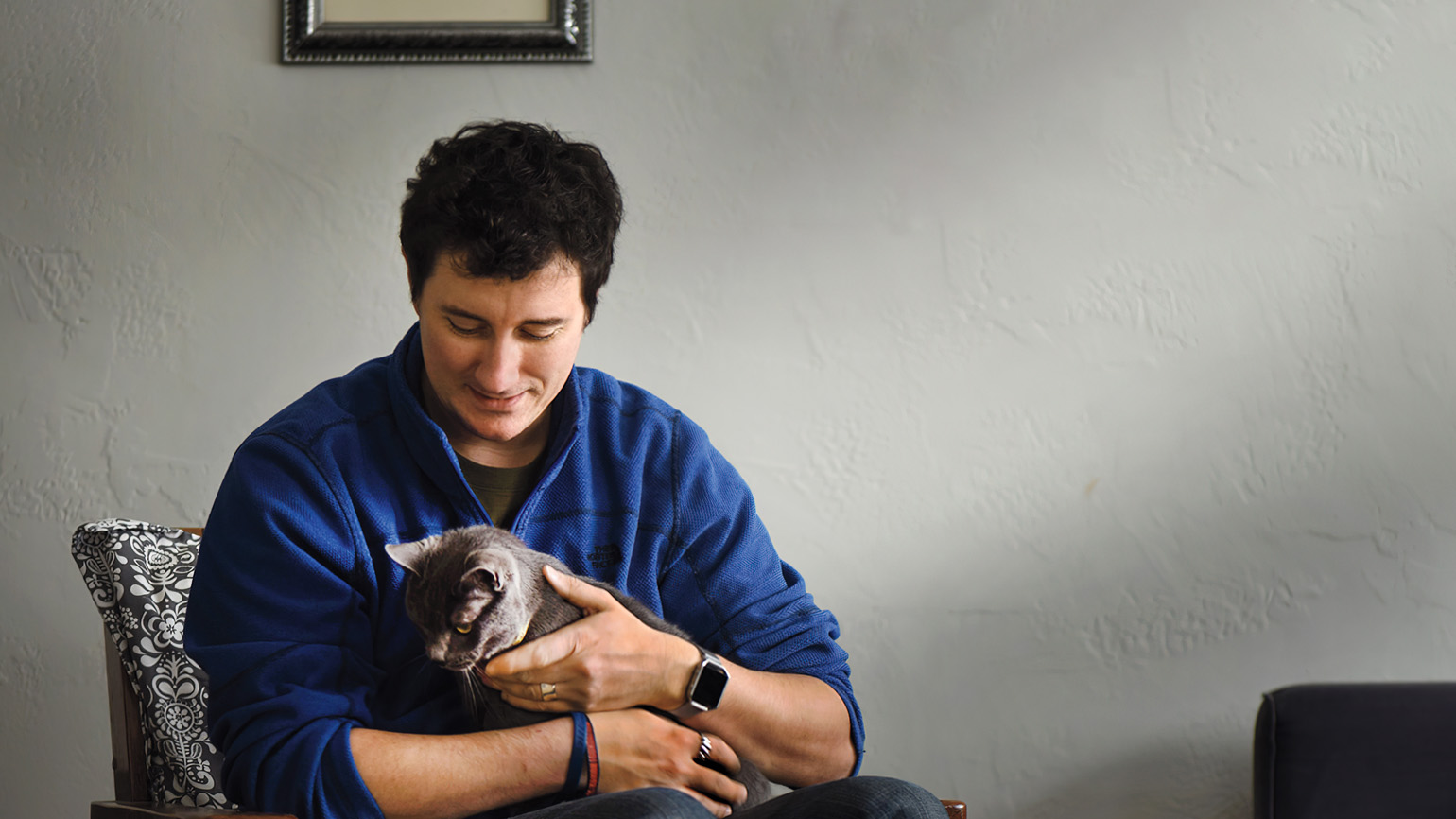
“Here, boy!” I called out again. I walked down the cement steps behind the Army barracks and listened, hoping to hear an answering meow or to see a flash of black and white streaking toward me. But there was still no sign of the cat. Now I was starting to panic. While I had yet to name him, I had been feeding him for months. Seeing him had become the highlight of my day.

I could clearly remember when we first met. Sitting on these same cold cement steps that night, I’d been staring out into the darkness. Rain soaked through my pants, but I didn’t care. The only light came from the glow of my cigarette—my last. Back in my room there was a knife on the bedside table and a suicide note on my computer screen. I hoped that whoever read it first would understand why I had done what I planned to do.

Community Newsletter

Get More Inspiration Delivered to Your Inbox


Six months before that night, my unit had been deployed to the southwest of Baghdad. During an attack, a mortar had exploded 10 feet away from me, leaving me with a traumatic brain injury, a case of PTSD and a one-way ticket home. Since then, I had been living on base in Fort Riley, Kansas, but I wasn’t readjusting well. I was paralyzed by anxiety and struggling to get through each day. Mostly I was tired. I sat there on those cold cement steps just wanting to end it all. Tonight I will, I thought as I took another drag of my cigarette.

“Meow?”

I looked up. A black and white kitten with round green eyes looked back at me. His head poked out from the bushes a few steps away. He meowed again. Then, leaping from his hiding spot, he trotted right up to me. He was tiny and soaked, but he rubbed up against my legs. When I reached down to pet him, he leaned into my touch, purring.

That was all it took. I broke down. I cried, the tears hot on my face in the chilly rain. The kitten just watched me. I hadn’t scared him away. In fact, he stood there as if he knew how desperately I needed a friend. Right at that very moment.

I looked into his big green eyes and he looked back. Clearly a stray. “When was the last time you ate?” I said, stroking his wet fur. My plan to end it all was put on hold. At least until I found this kitten some food. I stood up, my cigarette forgotten. I might not be able to tackle my own problems, I thought. But his problems? I can do something to fix those.

It became a routine: Every day, I’d go to the back steps of the barracks with a packet of tuna and a paper plate. Usually, the kitten was already waiting for me. He became more than something to live for. Over time he inspired me to get help for my depression, and even gave me the confidence to get into a serious relationship. Becky and I had known each other for years. We were high school classmates in our hometown of Pittsburgh and, after I enlisted, continued to keep in touch. Now that connection had deepened.

I hated to go back inside without seeing my usual dinnertime visitor, but roll call was at 5:45 A.M. and I knew I had no chance of spotting a mostly black cat in the dark. I called Becky, worried that I had seen the last of him.

“I’m so sorry, Josh,” Becky said. She knew how much that cat had done for me. There was a time I didn’t know if I would have been able to recover from such a loss. But I was in a better place now, and I’d get through it if I had to. “Hopefully, he’ll turn up,” Becky tried to reassure me.

But he didn’t. I’d still go out behind the barracks most evenings to see if my little buddy had returned, but he never did. I found myself imagining that he’d found a real family to go home to. And he deserved it.

Becky and I were shopping together near the base one day when we stumbled upon an animal adoption event, mostly cats. Becky already had a cat, and she knew there was only one cat for me, but she couldn’t resist. “Come on! We’re just going to look at them,” she said, tugging at my arm. “Show them a little love.” Like one little black and white kitten had done for me one night, I thought.

Becky and I picked our way through the narrow space between the cages. Some of the cats pressed themselves against the bars, yowling for attention. Others watched silently with wide eyes. When a black and white paw shot out from between the bars, smacking me on the arm, I laughed. I leaned down to get a better look at the feisty cat inside. His green eyes met mine. I was stunned. Could it be?

“Becky, it’s him! The cat from the barracks!” I opened the cage and scooped him up, holding him tight. He purred steadily, like he knew there was no way I was letting him go again. And, boy, was he right.

I named him Scout and he became my constant companion in the barracks. As I went through the process of my medical discharge, Scout was there. On bad days, he’d curl up in my lap and purr until I felt better. I officially left the Army in July 2009. Soon after, Becky and I got engaged, and Scout moved with me from Kansas to Pittsburgh to be closer to her.

I was far from the lonely and depressed man Scout had first approached in the rain, but I still had a ways to go. Between Scout and Becky, I had the support I needed and motivation to get there.

I made sure to get regular exercise and eat healthy. I even quit smoking. I went back to school to get my master’s degree in clinical rehabilitation and mental health counseling. I wanted to work with fellow veterans. My greatest hope was to be for someone else what Scout was for me.

How This Christmas Miracle Saved Their Lives During a Flood

It was the night before Christmas Eve, and all through the house, not a creature was stirring, not even my golden retriever mix, Lucky. She was sleeping peacefully, curled up on the floor. My small artificial Christmas tree was set up on a table in the corner of the room. Its lights twinkled merrily.

The rain was coming down hard outside, creating a soothing melody. I decided to take a cue from Lucky and turn in early. As I drifted off to sleep, visions of sugar plums should’ve been dancing through my head. Instead, I woke to a strange hissing sound.

The first thing I saw was the digital clock on my nightstand. 5 a.m. The next thing I saw was the water. I lived in an old building that used to be a post office. Everything—the living room, kitchen and bedroom—was in one large, open area. From my bed, I could see water rushing in under the front door, turning the beige carpet chocolate brown.

I threw off the covers and jumped out of bed, putting on my fuzzy slippers. I knew I was living in a flood zone, so I’d rehearsed this emergency plan in my head many times. The
water could rise in a matter of minutes, trapping people in their homes or washing them away with the current. I had to hurry. I gathered up my always-packed tote with my essential items, snatched up my keys and pulled on my bathrobe.

I tried the back door—a heavy, steel thing—but it was stuck. That wasn’t part of the plan. My truck was parked in the back, and this was the quickest way to it. I pushed with all
my might, but the door wouldn’t open. The water must be higher than I thought. I grabbed a pair of rubber boots and hurried to the front door. It took some doing, but to my relief, it opened. Now I just had to get Lucky.

I turned around and saw that she’d retreated to higher ground—the couch. She sat there, panting nervously. “Come here, Lucky!” I called out. She didn’t budge. “Come on!” My panic was rising along with the water level. About five inches covered the floor now, with more rushing in through the open door. Lucky knew something was wrong, and the desperation in my voice wasn’t encouraging. It was clear she wasn’t moving. With my hands full, perhaps it would be easier to get my truck, put my things in it, then pull up to the front door and carry Lucky out. “Stay, girl!” I said before stepping outside and closing the door behind me.

The hiss of water became a roar. Steadying myself, I stepped into the water, brown and churning. I couldn’t see my own feet. At one point, I stumbled, falling forward with a splash onto one knee. By the time I made it to the truck, I was soaked through and shivering, my knee bleeding.

I opened the door and climbed inside, praying it would start. The engine came to life. I threw the truck into four-wheel drive and hit the gas, gunning it to the front of the house to pick up Lucky. Halfway up the driveway, the floodwater suddenly surged. A wave washed over the hood of my truck, killing the engine instantly. It was a lost cause. I would
just have to get Lucky and walk to higher ground. Kicking off my ruined slippers, I pulled on my rubber boots. I hopped out, wading through the water toward the front door.

With the water still rising, the doorknob was now completely under water. Oh no. I tried it anyway. It wouldn’t open. The pressure of the water was keeping it closed. I pulled
and pulled with all my strength, but the door wouldn’t budge. I pulled until the doorknob came off in my hand, sending me backward into the water. As I scrambled to my feet, I
imagined Lucky inside, sitting on the couch as the water continued to rise. I couldn’t leave her! I wouldn’t!

Get out now. It was a voice, clear and strong. The words rang in my head, separate from my own inner dialogue. Get out now, the voice repeated. To save Lucky, you have to
save yourself.

Though I hated to admit it, the heavenly voice was right. I had to get to higher ground to find help for Lucky before it was too late. I turned around and started walking, uphill,
toward the main road. I leaned forward, using all my strength to take each step. The water was above my waist now and still rising, threatening to sweep me away.

I finally reached the main road. My heart raced as I struggled to catch my breath. I still had my tote slung over my shoulder, but—like me—it was absolutely drenched, along with
everything inside it. I tried my phone anyway, but it wouldn’t turn on. I had no way to call for help. Just then, I spotted a glow in the distance. Headlights, fast approaching. I waved down the driver, and he let me borrow his phone so I could call emergency services.

When the fire department and EMTs arrived, I immediately informed them my dog was still inside the house. They told me they couldn’t go in after Lucky due to their policy about not risking human life to save a pet. I understood, but that didn’t stop the tears. Lucky was my baby! But one kind firefighter saw my distress and volunteered to go after Lucky on his own. He set off with a crowbar and a length of rope, one end tied around his waist and the other end to the bumper of the firetruck.

He returned with Lucky in his arms—unharmed and completely dry. He said he’d found her on the kitchen counter. Apparently, she’d avoided the floodwater completely by climbing to higher and higher points in the house. I hugged her tightly as her tail wagged, a steady thump, thump, thump against my side. We were both finally safe.

A few days later, I managed to secure a rental car. The Red Cross had given Lucky and me enough money to put us in a hotel room for a week. When the rain had stopped and the flooding had receded, I went back to the house.

My front lawn was strewn with my belongings, most of them damaged beyond repair and caked with mud. My truck sat in the driveway, totaled. The front door was hanging open. Inside, it was a mess. The water had risen over three feet. I could tell by the stains it had left behind on the wall. The floor was littered with trash and debris. I felt tears gather in my eyes as I surveyed the damage.

Then, I saw it—the twinkling lights. My Christmas tree! Incredibly, my little tabletop Christmas tree was untouched. There it sat, clean and pristine on its table, lights still on, ornaments still sparkling through the gloom. A small Christmas miracle to remind me that God hadn’t just whispered in my ear. He’d been with me and Lucky all along. And he
would remain with us as I rebuilt my life after the flood.

How The Spirituality of Children Becomes a Lesson in Faith

”Dad, I can’t find my shoe!”

Joe Dusavage from Wappingers Falls, New York, was getting ready for work when he heard his four-year-old son, Jake, call for him. Joe went to find Jake standing in the middle of his room with only one tennis shoe on.

“Just think,” Joe said. “Where was the last place you had it?”

“I don’t know,” Jake said. “But those are my favorites.”

They searched all over the house—in closets, under beds and couches—but it was nowhere to be found. Joe checked his watch. If they didn’t find it soon, he would be late for work, and Jake would be late for school.

“Jake, I think only God knows where that shoe is.” Joe sighed. Jake suddenly stopped what he was doing and looked upward.

“God, where is my shoe?” he calmly asked.

Jake listened for a second. Then, as if following a direction, he went over to a box of toys in the corner of his room and lifted it up. Underneath his was the missing tennis shoe. Joe watched as Jake put his shoe on and grabbed his backpack—like what he experienced was an everyday occurrence.

Did four-year-old Jake really hear a direction from God? Why was the act of asking so automatic for him? And, if he did hear God, why didn’t it startle him? His story begs the question: Do children have a natural connection to the divine?

Stories in the Bible point to yes. Samuel was only 12 years old when, lying in bed one night, he heard the voice of God calling his name. Josiah was eight years old when he became king of Jerusalem and “did what was right in the eyes of the LORD” (2 Chronicles 34:2). Psalm 127:3 tells us children are a direct gift from God, stating, “Children are a heritage from the LORD, offspring a reward from him.”

If children do have a preternatural connection to God, where does it come from? Children exhibit signs of having a strong connection to the divine even without stepping foot in a church or attending religious classes. And this doesn’t seem to surprise them at all.

Dr. Lisa Miller is a professor and clinical psychologist at Columbia University who studies the scientific understanding of spirituality. She became fascinated with the subject after having her own profound spiritual experiences as a child. She remembers how easy it was simply to open her heart and feel God’s presence. “I could just see the numinousness of life all around me,” she said. In graduate school, she decided it would be her life’s work to understand this.

Dr. Miller studies the psychological impact of a relationship with God in our lives. In her book The Spiritual Child, she focuses on the spiritual lives of children and teenagers. “Children are innately spiritual beings,” she explains. “They naturally connect to God. They can feel guided or know something without being told.”

According to Dr. Miller, our brains have what she defines as “implicit spiritual cognition.” She says her own research, as well as other scientific studies over the last 20 years, points to spirituality being a naturally occurring development in our brains, from both a biological and psychological standpoint. Perhaps most fascinating is her discovery that spiritual cognition appears to be well formed in children and something they are able to easily express. “Spirituality is not something that needs to be taught to children, like math or the piano,” she says. “Children are not blank slates; they have a direct knowing.”

This “direct knowing” can come in the form of mystical experiences, such as a divine dream, hearing God’s voice or having insight into something a child normally wouldn’t know or understand.

Charles Myers from Alameda, California, experienced this firsthand. Charles was leaving church one evening when a little girl, around five years old, came up to him and gave him a flower she had picked. “This is for your mom,” she said. Then she walked away. Charles appreciated the thoughtful gift but didn’t know what to make of it. On his walk home, he suddenly remembered what day it was: June 4. The anniversary of his mother’s death, 10 years before.

“I’d seen the little girl and her family around church, but I didn’t know them well,” Charles said. “There is no way she could have known the importance of that day. It was as if God had impressed on this little girl’s mind to give me a flower.”

This powerful connection to the divine doesn’t stop as we leave childhood. In fact, Dr. Miller says we go through a spiritual surge in our teenage years. “During physical puberty, there is an augmentation in our capacity for transcendent awareness and experiences,” she says. The Bible also points to this. David was still a teenager when he was called by God to defeat Goliath. Timothy was a young adult when Paul took him in as a pupil to help spread God’s word. Mystics throughout history have reported their teenage years as being times of great spiritual awakening. Joan of Arc reportedly began to hear the voice of God at 12 or 13 years old. Saint Therese of Lisieux decided to join a Carmelite convent at the age of 15 due to a miraculous healing during her childhood.

Various religions around the world understand this age to be a spiritually important time. In the Jewish faith, children have a bar or bat mitzvah at 12 or 13 years old. Children in Catholic and some other Christian churches have their confirmation between ages 11 to 17. In the Navajo tradition, teenage girls participate in a spiritual coming-of-age ceremony called kinaaldá that includes blessings and singing.

In her book, Dr. Miller also points to important anecdotal evidence she has found while talking with teenagers about transcendent awareness. During a talk she held at a high school, one student shared a profound spiritual experience she had her junior year while on a hiking trip. The student explained how she was sitting by a lake and suddenly felt connected to everything around her. She described the moment as sacred. “Consider the qualities we associate with the most deeply meditative state or spiritual way of being: love and compassion, mindfulness, acceptance, a sense of oneness with all, and innate connection to nature,” Dr. Miller writes in her book. “The child starts there, in a sacred transcendent relationship.”

One of the most important ways a child’s spirituality manifests is through something else they are born with: wonder. This emotion is a vital part of our spiritual lives. Theoretical physicist Stephen Hawking spoke on the importance of holding on to our “childlike wonder” as we study the universe. That childlike wonder Hawking refers to can strengthen our relationship with God and define how we see the world around us.

Joe Dusavage had an experience with this too, years before the moment with Jake and his missing shoe. It involved his older son, Coleman. Jake, an infant at the time, was being christened at their church. During the ceremony, Coleman, five years old, sat in the pews with his father. Afterward, Coleman tugged on Joe’s sleeve. ”Grandpa Joe and Aunt Julie were here!” he said.

Joe stared at his son, confused. His father, also named Joe, and older sister, Julie, had died years ago. Coleman had heard their names in passing, but he’d never brought them up on his own before. Joe told Coleman that Grandpa Joe and Aunt Julie weren’t there.

“Yes, they were,” Coleman said. “They were standing in the back of the church watching.”

Joe felt comforted knowing his father and sister were there in spirit that day. It was the same for Charles Myers, who took the flower the little girl gave him as a sign from God that his mother was still with him. These moments with children not only provide divine solace, but they show us how God reaches out to us and how we can react. Much like how his brother would respond years later, what Coleman experienced seemed a matter of fact for him. It was simple. Yet Joe was not able to see or hear anything in either case.

Children and teens are more spiritually open to mystical experiences like these because they haven’t yet absorbed society’s tendency to approach mystical experiences with skepticism. “Too often we [adults] step back or actively discourage [children and teens] from cultivating their spiritual selves, in essence train them away from the inquiry,” writes Dr. Miller in her book. As adults actively foster a child’s spirituality, it will help them to maintain that connection into adulthood. Even if as an adult we feel less connected to God, observing young people’s unbridled, nonjudgmental connection with the divine can help us reframe our own spiritual perspectives.

Joe’s thoughts on his son’s experience highlight why it’s important to look to children for our own spiritual growth. “God reaches us through our children,” said Joe, “because children are not clouded with the other distractions of life. They are very much in touch with what they see and feel right in front of them.” Burdens and stress can often distract us from the moments when God is trying to reach out to us. After all, 1 Timothy 4:12 tells us that young people can be an example for us “in speech, in conduct, in love, in faith and in purity.” Perhaps looking at how children innately connect and listen to the divine is an important lesson in how to approach our faith as adults.

How These Shells Became a Coincidental Sign from Above

The sun was just beginning to rise over the horizon, painting the water red and gold. I smiled, squeezing Steve’s hand in mine. The scene was breathtaking. Watching the sunrise on the beach was the perfect way to start our honeymoon—our second honeymoon.

Steve and I had been together for 24 years before we separated. At that point, divorce had seemed the only solution to resolving our differences. Though not everyone in my life felt that way. “I know you two will get back together,” one of my friends had said after the divorce papers were signed.

“That will never happen,” I’d scoffed.

Well, never say never!

Three years after the divorce, our children wanted to throw me a big party for my fiftieth birthday. Of course they wanted to invite their father. I agreed. The split had been amicable, after all. But I surprised myself with how much I enjoyed his company at the party. I realized how right we seemed together. How much I’d missed him. How much I still loved him.

We started seeing each other more frequently, spending time together, just talking freely without old hurts and defensiveness getting in the way. After some deep soul searching and prayer, we decided to give “us” another shot.

We remarried in a small ceremony with only our grown children in attendance. Afterward, Steve and I took off to our favorite spot, Cape May, New Jersey. We had vacationed there with our family going back 20 years. It felt like a return to old times…but different too.

As the sun rose on our first full day, I prayed that Steve and I would get everything right this time, and for good. We walked along the shoreline, our feet in the water. We weren’t walking for long when I spotted something in the sand, just out of reach of the waves. It was a seashell! A whelk with a shiny, smooth interior. It was unlike anything I’d ever seen on this beach before. I was used to finding clam, oyster and mussel shells in the past. Nothing this big. And the shell was perfect—no chips or imperfections.

“Look!” cried Steve, pointing. Just a few feet away was another whelk shell. Like the first, it was whole and unblemished but a little smaller and pinkish in color, in contrast to the other shell, which was larger and darker. But they seemed like they belonged together. A perfect match. We took them back to our room, amazed at our find.

The next morning, we got up early and hurried out to the beach to catch the sunrise again. “What if we find more shells today?” Steve asked, teasing.

I laughed. “That will never happen.”

Well, never say never!

We strolled in the opposite direction that morning, toward the cove, the early morning sun warming our backs. We had been walking for only a few minutes when I saw them up ahead. I blinked in disbelief. Two perfectly formed whelk shells. As we got closer, I could see that they closely resembled the pair we’d found the day before—one larger and dark in color and the other smaller and pinkish, just a few feet apart.

I stood there, stunned. The probability that they were there in the first place, that Steve and I had been the beachcombers who found them—two sets of shells—on the honeymoon of our second marriage was…well, infinitesimal.

But I don’t believe in coincidences. I know it was a sign that Steve and I were on the right track. And whenever I look at the whelk shells that sit in our happy home, I’m reminded of love and second chances. And to never say never!