Embrace God's truth with our new book, The Lies that Bind

Finding God in a Painful Place

The LORD is close to the brokenhearted and saves those who are crushed in sprit. (Psalm 34:18; NIV)

It was about a month ago that we learned that our girl greyhound, Sis, had bone cancer. A month of medication. A month of holding her while she whimpered. A month of learning that the best thing for her was to let her go.

“I can’t believe she’s not here,” I whisper into Lonny’s shoulder. We’re in bed but the lamplight is on. Lonny’s arms are warm and familiar, but this feeling, the ache of loss, is not. I’ve just tucked our three youngest in bed. Little boys wresting with a big hurt.

Sis had come from the track and had moved deep into our hearts.

“I know,” he says. His arms pull me close. I listen for Sis’s breath beside our bed. There’s only Flash, our boy greyhound. I don’t want to peer over the edge to look at him.

There’s sadness in his eyes, too. So we sit quiet for a long while, not wanting to push words into the near-darkness. If the words begin to flow, so will the pain.

Logan, our oldest son, had called from college earlier in the evening.

“If she only had a short time to be loved,” he’d said, “I’m glad she was loved by you.”

Shawnelle, her sons and her dogThe sentiment had made me smile, but in truth, I was blessed to have been loved by Sis. She came to us timid and afraid. But in two years she’d blossomed. She’d learned to love and trust and had become a beautiful, thriving creature. She was a treasure unveiled.

And now she was gone.

“Mama,” a voice comes from the hall, pulling my thoughts from a tender place. “I can’t sleep. Is it okay to come in?”

Zay’s head pokes around the corner. His hair is wild and I can tell he tried to sleep. I nod and he rushes in, settling into a warm place between Lonny and me.

But soon there’s another voice.

“Mom,” Gabe says. “I’m sad. I just can’t sleep.” He shuffles in and stands beside the bed. His eyes are red. His pajama top doesn’t match the bottoms and this pulls my heart.

“Come on up,” I say.

He nestles in beside Zay, close against my side. A breath later, Samuel appears. And shortly after that, it’s 17-year-old Grant.

“Do you care if I hang out?” he asks. He sprawls at the end of the bed, legs hanging over and arms tucked behind his head. He stares at the ceiling, and I know he’s hurting, too.

And for a while it’s silent. And then the silence gives way to words.

“She put her head on my lap,” Gabe says, “when she wanted to rest.”

“Her eyes were so brown,” Zay says. “She was gentle like a deer.”

Soon the family is reminiscing. Remembering. And as I listen, something inside me opens, too. We share memories that make us laugh out loud. We share tender things that make us cry. We share until the green digital numbers on our clock tell us that an hour has gone by. Then we share some more.

And I consider, in this sweet circle of family gathered tight on this one bed, that in this world death is a part of life, but the Lord doesn’t leave us alone in this pain. He counts our tears. He binds our wounds. He comes near to the brokenhearted.

And in this moment, His love is powerfully present.

The hour is late. The boys grow tired. Sis is a memory. We hold images of her stretched under the old maple. Curled beside my boys. Running so fast we half thought she’d fly.

But the Lord is here.

Bringing fullness to what was empty.

And grace to this painful thing.

Thank you, God, for the time we had with Sissy. And thank you for gathering us together. For being with us now. Amen.

Finding Faith at the Flea Market

When I was a child, I loved nothing more than to go junkin’ with my daddy. The markets we’d hit up proved to be a mecca for great finds—and great fun. But the older I get, the more I realize it wasn’t just about toting home a car full of stuff. The life lessons I learned at the flea market continue to inspire me today.

I was around 10 years old, when Daddy and I spontaneously checked out a pop-up flea market near our home in West Virginia. Held in a grocery store parking lot, folks were marketing their wares from the trunks of their cars.

While my father sniffed out the old-timey clocks he resold for profit, I wandered the rows of vehicles in search of something to display on my bedroom bookshelf. I had five dollars from helping our neighbor pull weeds in her garden. A metal object shaped like a bouquet of flowers stopped me in my tracks. “This here’s a gen-u-wine antique cast-iron doorstop,” the seller drawled. “Don’t see these babies every day.” Its flashy colors even matched my bedspread. With nary a thought, I handed over my hard-earned money.

I couldn’t wait to show my father my find. But Daddy placed his big hand over mine, pointing my fingers toward the garish paint job. “If this were the real deal, honey, these colors would be softer and worn in places. I’m afraid it’s an old doorstop with a new paint job.”

On the drive home, Daddy said we’d find a dealer who specialized in antique doorstops. That way I could study the real deal; only then could I spot a fake. I didn’t know it that day, but my father and the flea market were teaching me about life. The lesson learned? If you want to know what’s good and true, read The Good Book. When you’re steeped in The Real Thing, you’ll spot an imposter right away.

One of my favorite flea market haunts is held twice a year in the central Texas town of Round Top. It’s a global attraction with 2,000 antiques vendors spread over five towns and 21 miles. I’ll never forget the first time I visited. As I steered my rental down a country road bordered by Longhorn cattle grazing in green pastures and fields of bluebonnets, I made a beeline for the Big Red Barn. A mix of Early American antiques soon had me rearranging my family room back home in West Virginia.

But Round Top folks don’t just create innovative booths and attractions. Recently, while giving a kicked-to-the-curb farm table a second chance in my historic log cabin, I returned to a lesson I learned there from a tall, blonde Texan sporting a cowgirl hat with a silver and turquoise buckle. She noticed me admiring her farm table and seemed to know that I was mentally smoothing away its flaws. With a knowing smile she sauntered up to me and wrapped an arm around my shoulder. “We can’t ever take a table’s story away,” she said. “Perfect is boring. Besides, we wanna always remember where we came from.”

My own life was full of stories, not always of the inspirational variety. After that encounter I viewed them differently. My trials had made me who I was. This was my story—written by the Great Author Himself. No one was going to take it from me.

Whenever I take advantage of early-bird hours at an outdoor flea market I think of Psalm 119:105: “Your word is a lamp to my feet and a light for my path.” It’s usually dark at that time of morning, but you can shop by flashlight while the vendors set up their wares. One morning I was so excited I left my flashlight in the car. But a guy on a bicycle had just what I needed: a lantern welded to a wire basket. I followed his light for a while, then trailed behind a lady with a light clipped to a baby stroller-turned shopping cart.

As my fellow shoppers lit my way, I purchased a wooden child’s chair, a blue graniteware stove, and a primitive ladder perfect for displaying the old quilt I’d discovered. When daylight came, I barely recognized my prized ‘finds.’ The chair was missing a rung. The graniteware stove had more dings than I did, and the quilt was ripped beyond repair. If I’d seen that stuff in broad daylight, I would have walked on by. But in the dark, following the crowd’s make-do light, it had proved irresistible.

I wasn’t looking for a lesson that day. But as sure as treasures found me, so did a memorable tutorial in faith. I thought back to the times I’d tried to live by someone else’s light. It had always landed me in a heap of trouble. God’s light—and the one that burns inside me—would never steer me wrong.

One of my most heart-tugging flea market moments involves Bob Richter, the vintage lifestyle expert best known for his starring role in the PBS series Market Warriors. One crisp autumn afternoon at the wonderful Burlington, Kentucky outdoor market, Bob told me how his adored Nana had loved Guideposts and had left him a basket of her favorite issues when she passed away. The two of us connected immediately, and Bob shared a story which highlights his lifelong fascination with the history and mystery of castoffs. When Bob was a boy he learned about yard sales and flea markets from his beloved older brother Johnny. They were forever looking for the bluebird china their family used while growing up. Whenever they happened upon some, they would sense a little “God nod.”

Johnny died when he was 27; Bob was 15. Bob would always feel Johnny’s presence when he encountered something at a flea market they both had loved. Early one morning Bob decided to wander the aisles at the Chelsea Flea Market in New York City where he resides.

While perusing the stalls, Bob was drawn, as if by a physical force, to a surrealistic landscape painting leaning against a wall. There’s something about that canvas, he thought. He walked away, then felt as if he were taken by the hand to revisit the artwork. On closer inspection, Bob noticed the figure in the painting seemed to resemble Johnny. Were his eyes playing tricks on him? Grief was known to do such things. Nostalgia and loneliness too.

Bob’s eyes travelled to the lower right hand corner of the frame. It couldn’t be. These things only happened in movies. But it was so. Before his very eyes was Johnny’s signature. The painting was of his brother and by his brother. While Bob had known Johnny had once painted, there were very few examples of his work. Even their mother only owned two of them. Did Johnny paint this canvas one summer when he was home from art school and perhaps sell it then?

“I didn’t go looking to find a piece of artwork done by my brother that day,” Bob says. “But that’s what I found. Or, I should say, ‘That’s what found me.’ It’s an example of the spirituality, the unexplainable, I encounter at flea markets. The events that connect the past with the present in a marvelous way.”

It goes to show that all who wander (even the aisles and stalls of flea markets) are not lost at all. Especially when their Heavenly Father is leading the way at these wonderful vintage venues.

Today, Bob, likes to tell flea market devotees: “Pay attention when you are unexplainably drawn to something. These objects were loved, valued, and kept. There is emotional worth to that. They provide comfort, connection, and continuity.” Bob also is convinced that if something seems special while shopping, it likely is. “The great underappreciated value at flea markets is emotional and spiritual. Financial value fluctuates based on trends, tastes, and style. Always trust that inner voice,” he urges.

Bob was not the only person touched by the divine mystery of that painting. “The dealer was blown away by the absolute miracle,” he says. “I still see the man who sold it to me, and we always recall our sacred moment with a smile.”

Today, his brother Johnny’s self-portrait has a place of honor in Bob’s home, a symbol that God will go to any lengths to comfort His children. Each time I recall Bob’s story, I feel God’s care for me as well. I also remember that not all who wander—especially the aisles of a flea market—are lost.

It’s as author Willa Cather once observed: “Where there is great love, there are always miracles.” Mystery and miracles. Even—and especially—on that walk of faith called the flea market.

Fear Not

I keep thinking of a conversation I had at the gym the other day. Another guy like me in his early 50s was going through his usual workout and in between a set of weights he said, “I’m really dreading going to work today.”

“What’s up?” I asked, doing my own huffing and puffing.

“It’s all these layoffs that are so depressing. I keep thinking I’m going to be next. I’ve got a lot of work and my clients seem to appreciate what I’m doing, but I start worrying and there’s no stopping it.”

“Yes, the worrying is the worst of it.”

He grunted under the weight of the barbells and admitted, “I’ll say.”

The stories are starting to pile up, friends, friends of friends, people from church, neighbors, parents of our kids’ friends. An early retirement here, a downsizing there, a severance payment, a pink slip. They put faces on the statistics in the newspaper. Jobs are disappearing and it can be especially hard on the guys of my generation, men with kids in college and dwindling savings that were meant for retirement. But what I also hear from friends is what I heard at the gym. That gnawing fear that can make every day at work an agony.

Last night I was talking to a friend who works for one of those big banks that’s on life support. For months he hasn’t been sure what’s going to happen with his job or if he’s even going to have a job.

“We had a men’s retreat at church last weekend,” he told me, “and it was so helpful. It reminded me of how I had to trust. That whatever is going to happen, that however things turn out, I can trust God will see me through it.”

That’s the right place to be. Fear is endemic in times like these. But fear does no good for anyone. Faith is what it takes to get through the day. A big dose of it. Give it to yourself. Give it to your friends. Remember who will get you through the day…and the weeks and months ahead.

Godspeed.

Father’s Love

I am sure that nothing can separate us from God’s love—not life or death, not angels, or spirits, not the present or the future…Romans 8:38

After my father died, my sister and I helped Mom go through his personal items. I couldn’t wait to get into Daddy’s special drawer, the one in his nightstand he didn’t allow anyone to bother.

He could hear you opening it from a mile away. I remember as a kid trying to quietly ease open the drawer in order to sneak some quarters from his big bowl of change (I wanted to feed the Pac-Man game at the local arcade.) As I started to reach my hand inside, I heard Dad’s voice, “Michelle Leigh Medlock–get out of my drawer!” He didn’t mind giving me money for Pac-Man; he just didn’t want me in his special, private drawer.

For years, I’d wondered what could possibly be in that forbidden treasure trove. Why was he so protective of it?

“I’ll start in Daddy’s chest of drawers,” I called to my mom as I opened the forbidden drawer. I searched through Daddy’s things, finding very ordinary items. His comb. Fingernail clippers. His money clip. Pictures of the family. Lots of change. His special engraved calculator he used in business. And a lockbox.

I was just about to ask Mom if she knew the combination to the lockbox, but thought I’d try it first. Surprisingly, it wasn’t actually locked and it popped right open with just a little pressure. Inside, I discovered important documents like his and my mother’s marriage license, a small wooden bible, a Jesus Saves lapel pin and three tiny plastic bracelets–two pink and one blue. The wording had yellowed over the years, but I could still read “Medlock Girl” and my birth date on one of the little pink bracelets. I held that tiny pink bracelet close to my heart for what seemed like hours.

It was at that moment I realized how very much my Daddy cherished me. He loved me so much that he even treasured my baby bracelet. Today, I keep that baby bracelet in a secret compartment of my purse as a reminder of how much he loved me.

As Father’s Day approaches, I miss my Dad but I am thankful that I have so many wonderful memories of him. He had embarrassing nicknames for me that he loved to call me in front of my friends and dates. He had the most precious chuckle that I could always pick out of a crowd. He loved eating Hostess apple pies with his coffee for breakfast. (Maybe that’s why I prefer a Snickers and a Diet Coke as my “breakfast of champions.”)

But most of all, I remember how much he loved me. It was that unconditional, all-consuming kind of love. I never had to question his love because he showed me every single day.

I hope you have a father who loves you with that same kind of love, but if you don’t, I know that Father’s Day might be a difficult holiday for you. Maybe you are estranged from your father. Maybe your dad was abusive, and you’re still dealing with the emotional scars he caused. Or maybe you don’t even know your earthly father. No matter your situation, I have good news. You have a heavenly father who treasures you, and he has little plastic bracelets–his promises of love—all throughout his Word. Every time you find one like, Jeremiah 31:3 that says, “I have loved you with an everlasting love,” you’ll want to hold it close to your heart, just like I did.

Spend some time discovering how much your heavenly father loves you today. It’ll change your life, and you’ll be able to celebrate Father’s Day this year in a brand-new way.

Faith Inspired Him to Break the Cycle of Domestic Abuse

The sound is seared into my memory. Heavy footsteps. Pounding. Screaming. A storm of violence on the other side of my bedroom wall. More heavy footsteps and a slammed door. Eerie silence.

I was just seven years old when my mom’s boyfriend, the father of my younger brother, terrorized our family. He was a jealous, controlling man with a volcanic temper. If another man as much as looked at Mom on the street, she was in for a beating.

Community Newsletter

Get More Inspiration Delivered to Your Inbox


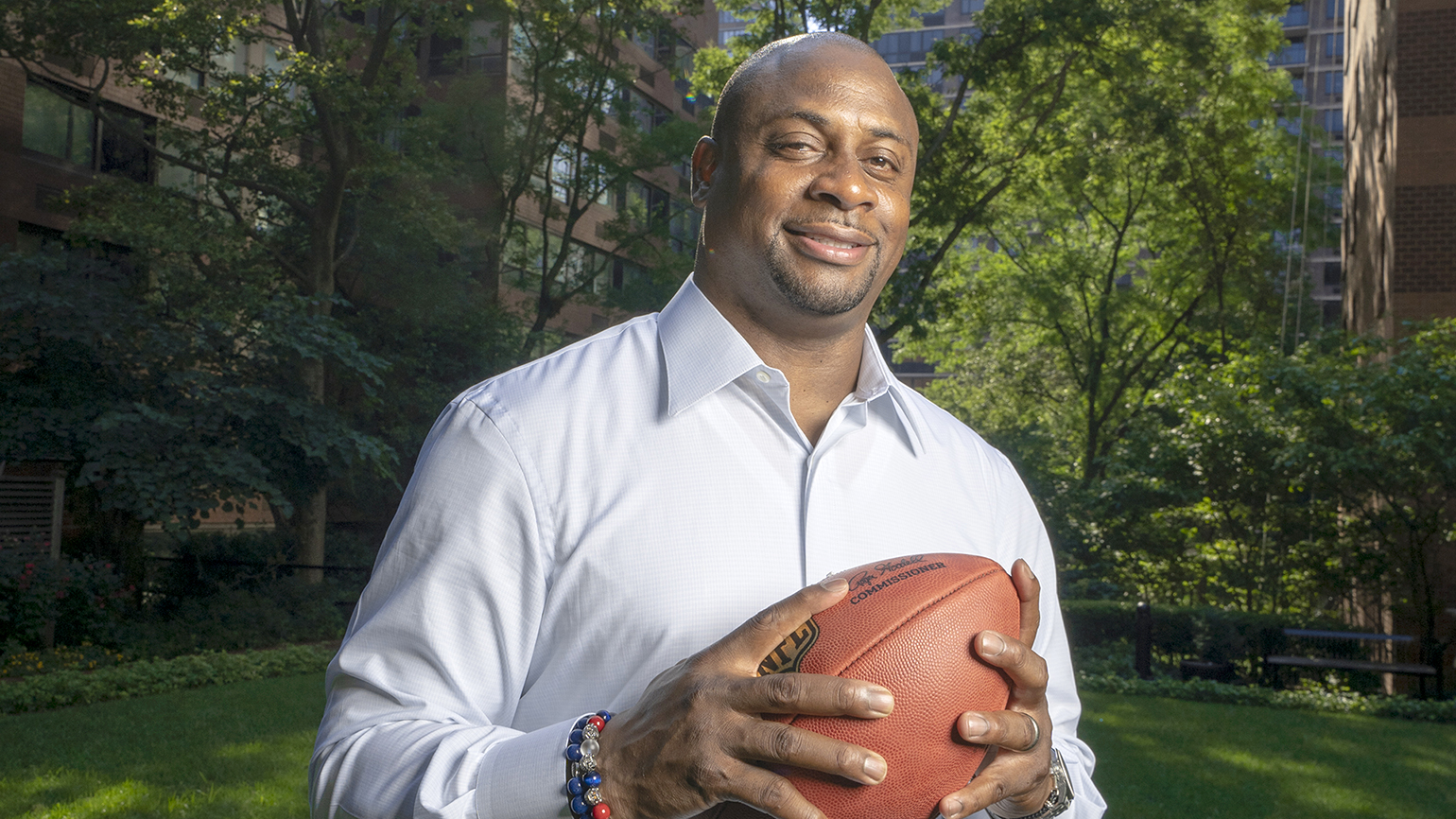
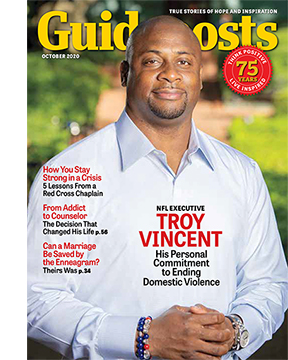
Troy Vincent Sr. on the cover of the October 2020 Guideposts
As seen in the October 2020
issue of
Guideposts magazine

My brother and I cowered, terrified. When the storm had passed, I crept through the apartment, eventually finding my mom sprawled unconscious and bloody. I ran into the hall and knocked on neighbors’ doors. No one dared answer. I had to go to the bar next door to call 911 on a pay phone.

I grew up to become a star defensive player and a high-ranking executive for the National Football League. During my 15 seasons in the NFL, I played 207 games, intercepted 47 passes and racked up nearly 900 tackles. Yet nothing in my career as a hard-hitting defensive back compares to the violence experienced by my family growing up.

Which is why my life on and off the field has been devoted to combating domestic abuse and promoting the dignity of women and the responsibility of men to end this scourge. How does someone who makes his living in an inherently violent sport fight violence in the home?

The answer to that question encompasses a lifetime, but it can be boiled down to one word: faith. It was God who steered me away from a path followed by many kids who experience domestic violence—becoming an abuser myself.

It was God who enabled football to become a transformative force in my life. And it was God who led me to Tommi, my wife of 26 years and the mother of our five children. Tommi also experienced abuse growing up, and she taught me how to be a tender husband and father.

Together we have made campaigning against domestic violence a family mission. Never doubt God’s power to turn tragedy into hope, love and healing.

My mom, Alma, was a good person with an inner reservoir of strength. But she was young when I was born, just 19 years old. She fell prey to domineering men who used violence to compensate for their own insecurities.

Too young to defend her, I did my best to support her. My brother and I nursed her back to health whenever she returned from the hospital, bandaged and in a cast.

Why didn’t she just leave? It’s the age-old question. The answer is complex, but it’s important to remember that many women see no way out.

Some women depend on their abuser financially. Others have been emotionally warped into believing that the violence is their fault. They trust the abuser’s seemingly sincere apology and hope against hope that there won’t be another beating. They fear that if they leave, the abuser will track them down and kill them.

Eventually, Mom’s abusive boyfriend moved on and she found a better path. Being raised with the help of Mom’s parents, Jefferson and Julia Vincent, was a blessing. Grandpa, a World War II veteran, and Grandma were devoted members of Shiloh Baptist Church in Trenton, New Jersey.

I was raised in that church. The decisive moment in my life is not an interception in a championship game or being a first-round NFL draft pick or making the Pro Bowl. One Sunday morning when I was 16 years old, the pastor preached a sermon about Jesus sacrificing himself on our behalf. “God has a plan for your life,” the pastor said.

It was as if he spoke those words directly to me. Studies show that children who witness domestic violence are three times more likely than their peers to commit violent acts themselves. Even though I didn’t know the statistics back then, I knew I didn’t want the violence and fear I’d experienced to become my future.

In the sermon, I heard a promise. If I gave myself to God, God would show me a way out.

I want that, I thought. I don’t have to be what I’m surrounded by. I want a different life.

God instantly put another thought into my head: “Honor your mother. Take up her cause.” I vowed to become a lifelong advocate for victims of domestic violence.

God made good on his promise. I excelled on the football field in high school and was recruited by the University of Wisconsin at Madison.

I honored my own promise by visiting safe houses for abused women while in college and took on additional study under professors specializing in issues surrounding domestic abuse. It was all preparation for using my platform as a football player to become a spokesperson on ending domestic violence.

A few years after becoming a cornerback for the Miami Dolphins, I asked my mom if I could speak publicly about the abuse she endured.

“Absolutely,” she said. “People need to hear. I’m proud of you, son.”

I’m not sure what meant more to me, her blessing on my activism or her pride in the man I was becoming.

I was newly married by then. Tommi and I had met while we were in high school. My best friend was dating her sister. “Who is that young lady who’s always with your girlfriend?” I asked. We started dating while she was in college and I was going into my rookie year with the Dolphins. Tommi and I married two years later.

I thought I understood domestic violence until Tommi told me her own story of being abused by boys she had dated in high school. I realized then there was much more I had to learn.

Now I was the man putting a woman in a position of potential vulnerability. Everything I did—talking, holding Tommi’s hand, hugging her—was an opportunity to demonstrate love, tenderness and support. Or the opposite.

My responsibility extended beyond that. At first, I tried to stay out of it when players talked disrespectfully about women in the locker room. As I gained confidence on the field, I spoke up.

One day, a teammate was joking about women while holding a dirty magazine for everyone to look at. I waited until he was done, then took him aside.

“I’ve heard you say you want to find a nice young lady and raise a daughter and have a good family,” I told him. “Would you want your daughter to hear you talking like that? You’re a leader on this team, but what you’re doing right now is not leading.”

He was mad at first. But he never repeated that behavior. Years later, we appeared onstage together at a benefit. He told that story and said that moment changed his attitude.

I retired from playing after the 2006 season and moved into NFL leadership. As executive vice president for football operations, I oversee all aspects of the game-day experience: referees, stadiums, coaches, rules. I also coordinate outreach to high schools and colleges.

My advocacy continues to be an integral part of my life. Tommi and I started a nonprofit called Love Thy Neighbor, which supports after-school programs, college tours and other character-building activities for students in underserved neighborhoods.

At the NFL, I’ve helped develop training programs to prevent workplace harassment and abuse at home. Players, coaches and other league employees have been taught how to respond if they witness harassment or abuse. I travel the country speaking to men’s groups, colleges and youth.

After Baltimore Ravens running back Ray Rice was indicted in 2014 for punching his fiancée in a casino elevator, I gave an emotional address to a United States Senate hearing on domestic violence in professional sports. I helped rewrite the league’s personal conduct policy and offered to help Rice steer his life back on course after he was suspended from the NFL.

I believe in justice. I also believe in forgiveness. Domestic violence can be prevented only if perpetrators are given the support and education they need to overcome their inner demons.

A few years ago, my principles were put to a severe test when our oldest children, Desiré and Troy Jr., told Tommi and me a terrible secret. They had been sexually abused by an extended family member when they were little. They had been too frightened and confused to say anything.

I was devastated. I confronted the family member and notified law enforcement. The incident had happened too long ago to press charges.

The greater challenge was supporting my children after realizing I had failed to protect them. I held them. I told them I loved them and believed them. I made sure they got counseling.

Thanks be to God, Desiré and Troy Jr. had a strong enough foundation growing up that they were able to weather this crisis. They are both thriving now. Troy Jr. and his wife have three beautiful children, and he is launching a career in homeland security management. Desiré works as a communications strategist in Detroit, and she and her husband have a daughter. All of my kids volunteer.

Tommi and I are now grandparents. I may look like a former football player, but in reality I am Pop Pop. There is a new generation in my family. New parents. New children. New opportunities and responsibilities.

God has blessed me with this family. He has blessed me by opening my eyes to my responsibilities as a man, a football player, a husband, a father and now a grandfather. Domestic abuse is multigenerational. But so are love and tenderness and family members learning to take care of one another.

I let God into my heart, and he interrupted that multigenerational spiral. He replaced it with a life of love and public witness. That’s a victory I celebrate every day. A victory far greater than anything achieved on the gridiron. A victory that I pray will inspire you and strengthen your faith to meet the challenges you face in your life.

For more inspiring stories, subscribe to Guideposts magazine.

Faith Carried Her Through Her First Bodybuilding Competition

The contest was called Battle of Texas. More than 500 competitors. Fifteen hundred fans. A crew ready to slather contestants with tanning oil and body glaze.

I was backstage at the Irving Convention Center, near Dallas. Stage lights blazed on the other side of the curtain. DJ music thumped. The crowd roared for favorite competitors.

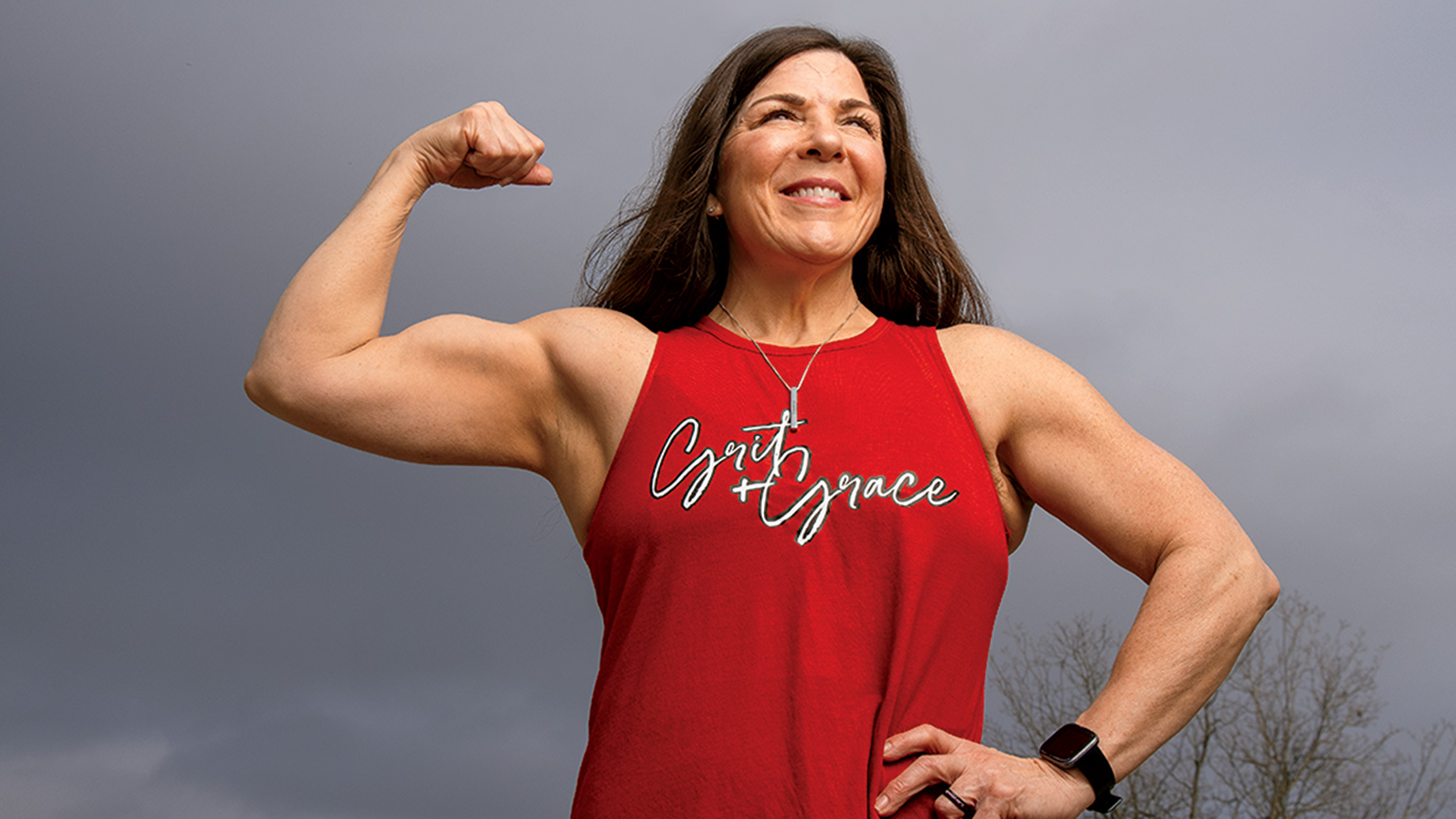
I stood at the head of a line to go onstage, wearing an outfit I wouldn’t be caught dead in anywhere else: a ridiculously small bikini, clear plastic platform heels, hair sprayed stiff, skin brown and shiny with glaze.

I was competing in my first ever bodybuilding contest. I was so anxious, I could hardly stand up.

In just a few minutes, someone would call my number. I would walk upstairs to the stage and flex my muscles in a series of required poses. Lights would blind me. I wouldn’t be able to see my husband and the rest of my family in the audience. Seven judges would scrutinize me from head to toe.

Why had I ever decided to do this? I was 48 years old. A twice-divorced mother of two grown kids and a grandmother of three, whose previous weight-lifting experience consisted of lifting groceries out of the trunk of my car. I looked nothing like the toned, sculpted competitors around me. A year ago, I’d been a flabby 190 pounds. I’m just shy of five-foot-three, by the way.

“Number one, you’re on!” the stage manager called.

I tried to take a step but couldn’t. I felt as if I was going to pass out.

If you saw me in the grocery store, you would not say, “Wow, she looks like a competitive bodybuilder.”

For most of my life, I was so insecure that I would have preferred you just didn’t notice me at all.

Why did I get on that stage last December? (By the way, the event observed pandemic protocols. Crowd size was limited; contestants and spectators were required to wear masks except onstage.)

You could say it was a conversation with my son-in-law that started it. But, really, this story stretches back all the way to my childhood.

My parents divorced when I was eight. There was addiction. Violence. Chaos. Unmanageability. Fear. So much fear.

I made a lot of bad choices after that—and as a result of it, I’m sure. I got married at 16 and had a little girl, Kelsi. The two-year marriage ended shortly after Kelsi was born. Predictably, a second marriage unraveled too, leaving me a single mom with two beautiful daughters.

Kids internalize a lot. The message I’d internalized growing up was: I was unlovable, undeserving of love or a loving relationship. That’s why I kept getting involved with men who didn’t treat me right.

I found a job as a paralegal to support my girls. The work didn’t make me feel good. The attorney I worked for represented massage parlors and strip clubs.

One day, I saw a women’s fitness magazine at the grocery store. A woman bodybuilder was on the cover.

Some people think bodybuilders look weird—too muscly. Not me. I looked at that woman and thought, She’s strong. She’s in charge of herself. I want to be like that. I tossed the magazine in my cart.

I signed up at a gym. I copied the workouts I saw in the magazine. It was fun for a while, but it’s hard to keep up a gym habit when you’re a single mom. I stopped going and gained a bunch of weight.

I joined a few more gyms over the years, even worked with a personal trainer once, but I never stuck with it.

Kelsi grew up and became a paramedic and, eventually, a nurse. She met a good man named Adam, who worked in construction. When he proposed to her, I was thrilled. If anyone could break the Layton marriage curse, it would be Kelsi and Adam. I could tell that Adam was going to be a wonderful husband and father.

Kelsi wanted to get married in a nearby United Methodist church because of its pretty stained glass. I’d taken the girls to a different church sometimes when they were little, but I was never serious.

“Kelsi, you can’t just walk into a church and say you want to get married,” I said. “You have to get to know the place. Make sure you like the minister. I’ll check it out.”

Walking into First United Methodist Church of La Porte felt surprisingly good. Normally churches made me feel insecure. What if people knew my history? Where I worked?

After the service, the pastor greeted people as they left. “You’re new,” he said to me. “What’s your name?”

“Eva,” I said.

“Welcome, Eva. We’d love to see you here again.”

I went back the following Sunday.

“Hi, Eva,” the pastor said.

He remembered my name! Did that mean he actually wanted me to go to his church?

I began attending services regularly. Kelsi and Adam got married at the church, then became members too. Soon I was involved in various ministries. I did a Bible study. Prayer became a part of my life.

During a Bible study session, I mentioned my conflicted feelings about my job at the law firm. Someone must have mentioned my situation to the pastor because, not long afterward, he called to say an administrative position had opened up at the church. Would I like to apply?

I got the job and, a couple years later, became an administrator for the South District office of the Texas Annual Conference of the United Methodist Church. For the first time ever, I was doing work I could feel proud of.

That didn’t mean I was proud of myself. That personal trainer I’d worked with briefly in my late thirties had convinced me to sign up for a bodybuilding competition. I chickened out when I had to send in a photo of myself in a competition swimsuit. I looked terrible! No way would I get onstage looking like that.

I stopped working out regularly and spent evenings and weekends bingeing on junk food. I ballooned to 190 pounds and fell into a depression.

“You have to get out and do something, Mom,” Kelsi said. “I’m worried about you.”

I was introduced to a trainer down the street from church named Ryan. I started working out at Ryan’s gym, and he turned out to be a man of faith.

“Ma’am, fear is not from God,” Ryan would say whenever I got discouraged. “You can do anything with God.”

Adam had started working out too, and he encouraged me.

When a friend from church invited me to watch her compete in a bodybuilding contest, I invited Adam to come along. He always seemed to get overlooked whenever we were celebrating Kelsi’s latest accomplishment. Maybe watching a contest would inspire him to compete too. Then we could celebrate him for a change.

The contest was electrifying. I loved the lights and the music. The sheer energy of the competition. The amazing things that people could do with their God-given bodies. Adam and I stood and cheered for my friend.

“What do you think?” I asked him. “Want to try it?”

“I think so,” he said.

I beamed.

“But only if you do it with me,” Adam finished.

What?! No way! But Adam left me no choice. If I wanted to support him, I would have to enter a contest too.

That was October 2019. We found a trainer and started working out.

In February, Adam called it quits. “I’m just too busy,” he said. He and Kelsi had two boys, and the workouts just didn’t fit their family schedule.

Then the pandemic hit. I was tempted to quit too. Who could blame me? I couldn’t even go to the gym since it was closed.

Around this same time, I married a longtime friend named Brian. People always said he and I were meant for each other, and finally I realized they were right. This time I knew the man I loved, loved me back.

“Don’t quit!” Brian said. He bought me a sledgehammer for my birthday. A sledgehammer? It’s a common bodybuilding workout tool. You hit tires with it. I had a tire in my backyard and some old weights. I began doing routines outside. Sometimes I just flipped the tire around the yard.

I needed a trainer who specialized in competition, so I asked God for guidance. I worried bodybuilding was somehow too self-focused. Who was I to think I could have a beautiful body?

With God’s help, I found just the right trainer: Walter Ray, a man of faith. Whenever I doubted myself, he simply said: “Positive mindset. God is making you strong. Don’t turn your back on his gift.”

Slowly but surely, my flabby, overweight body began to slim down and became hard with sculpted muscle. I signed up for Battle of Texas. I had to send in photos of myself. It was just like before, except now I was nearly a decade older. No amount of working out could disguise that.

Before Brian and the rest of my family drove me to the competition, my previous trainer, Ryan, called to wish me luck and pray for me. I wish I could remember every word of that prayer. It was beautiful. Empowering.

Standing backstage, too petrified to move, I tried to remember Ryan’s words. I closed my eyes and could hear his voice: “Fear does not come from God. You are strong and can do anything with God.”

Was I strong? I had never felt strong, not a day in my life. God would have to be strong with me. I could do this—just not alone. I didn’t have to.

I took a wobbly step, then another. I climbed to the stage. The lights were blinding. The music pounded.

“Ladies and gentlemen, give it up for Eva Layton!”

Somewhere in front of me, judges called out directions for poses. I went through the routine, my exhilaration mounting. And then it was over. I strode offstage on a cloud.

I was a twice-divorced mom with two grown kids, three grandkids and a weakness for junk food.

I was also a strong, beautiful, beloved child of God. A child of love and not fear.

You probably want to know how I did in Battle of Texas. I entered in several categories, placed fifth in two of them and rounded out the top 10 in the others. I even qualified to go to nationals in my age group this year if I want.

I’m no national champion. But I did sign up for another contest coming up next month.

I am incredibly excited that Adam will be there to cheer me on and celebrate his birthday weekend.

Like my trainer Ryan said, I can do anything with God. You’ll find me flipping a tire in my backyard.

For more inspiring stories, subscribe to Guideposts magazine.

Faith as a Force Against Fear

Everyone has their own battles to fight. In turmoil or crisis, lives can unravel; emotions can get the best of us. Too often we try to navigate rough waters on our own, only to find we don’t have the energy or power to do so. This is when we must learn to let our faith sustain and carry us. It’s never easy. Our fears get the best of us, but as Pastor Rick Warren wrote, “Fear is not a sign of weakness; it’s a sign of humanity.”

Recently, I received a text message from a former church member inviting my wife and me to her home for coffee. We weren’t sure what to expect, but I suspected it had to do with the divorce she is going through. (After much counseling, pastoral care and years of trying, the marriage had ended.) Over coffee, she expressed her feelings around this painful event. Although her faith has carried her through good and bad times, her fears were getting the best of her. I explained how God had gotten me through many trying times and how He would do the same for her.

When overwhelmed by troubles, it’s only natural that fear kicks in. Yet we know the greatest force against fear is faith­—faith in a God who knows all our affairs and how much we can endure, a God who can turn our worst tragedies into victories. When we find ourselves lacking in faith, let God’s grace abound in our lives. I like to think of those moments as opportunities to “start over.” Some days our faith will be strong; other days our doubts will seem stronger. The key is to keep pushing through our fears, doubts and obstacles. Our faith can and will sustain us.

Lord, there are days when my troubles get the best of me, help me keep my faith in You.

Encourage Someone for Lent

In this Lenten season of spiritual growth, people often give up things like chocolate or sweets. But you can do just the opposite and take on things. How about encouragement for one?

Let me tell you about an encourager in my life. Freddie. I see him on weekdays when I do my morning run. He sweeps the sidewalk in front of Starbucks.

My morning run. I wish I could tell you that I put on my sneakers and dash out of the front door without a moment’s hesitation. I wish I could say that I savor every footstep. Truth to tell, that first slight incline up the driveway gets me winded, and I’m already wondering how I’m going to get through the next three miles.

By prayer, of course, by a bit of self encouragement, that little engine-that-could voice God gives us that says Yes, I can, yes I can, yes I can. Right, God, I can. I would never win any poetry-in-motion contest. I seem to get slower by the month. Huffing and puffing my way around the park and back down the street that will lead me home.

“Why have you picked a run with so many hills?” I ask myself (huff, puff, huff, puff). Why, in particular, do I follow a route that ends with the biggest hill of all, up to Starbucks and around the corner?

Wouldn’t it nice to be able to coast downhill to home? But no, not a chance. This is just the moment when I could use an encourager, someone cheering me on, urging me forward.

This is when Freddie appears. Somehow his work schedule and my running route coincide. There he is with his broom and dust pan. He sees me and bursts out with a big grin. By the time I get within an arm’s length, he gives me a hug and a pat on the back. “The winner of the race!” Then as I turn the corner and go up the hill he calls after me: “Go, go, go, go, go, go.”

I don’t know his last name, he doesn’t know my name. It doesn’t stop him. He’s an encourager. And hearing his voice urging me on not only makes me smile but keeps me headed in the right direction. Up and home.

Be an encourager. There’s always someone who could use a good word. A friend, a family member, a colleague or a complete stranger huffing and puffing up one of life’s hills.

Embracing the Difficult Path

Recently, I was chatting with a friend who has been through a decade of difficulty—her husband had a work-related accident when the oldest of her three children was only 14, and workman’s comp still hasn’t been settled. We discussed the blessing of boring.

When times are tough we often yearn for Red Sea-style miracles. Instead, God takes us into the desert and gives us manna. Small, daily stuff. We stare in dismay and ask, “What is it?” (which is, according to some scholars, the literal meaning of the word manna). It doesn’t feel like a miracle. And yet it is.

In a crisis we desperately want our ‘normal’ back. We don’t want this new normal, even if the cross we are given can lead us closer to Christ. And still, we find our healing through the ordinary routine, the boring miracles of everyday life. We can find God where we are, rather than where we want to be. We can learn to grow in love of Him as we stumble forward, tripping over our fears and sadness. We can figure out how to serve Him in the midst of our inadequacy, and how to accept His grace in the throes of our self-criticism.

The miracle is, we grow through these kinds of trials and tribulations. Sure, we’d rather get to the same place an easier way. But if the path we have been given to walk is rocky, God is still there with us. He is there every single day, in every single step. And when taking just one step is overwhelming, there is a huge blessing in the fact that He only asks us to take one step at a time. Call it tedious, call it difficult, call it mundane—it’s still real.

There is manna in your life every day, just as there is in mine. That’s boring. But also… it is not. It’s a miracle.

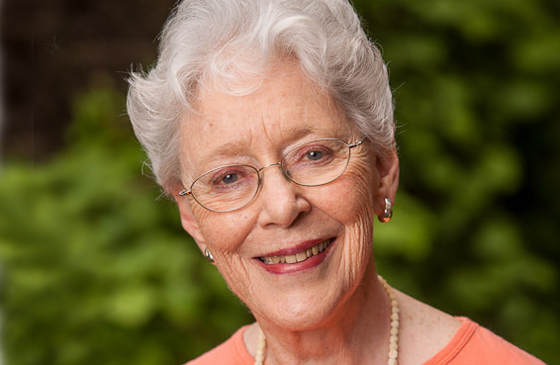
Elizabeth Sherrill: 70 Years a Guideposts Icon

I have known Elizabeth Sherrill since I started at Guideposts in 1984, but I knew her by reputa­tion before that. To say I was in awe of her gifts as an editor and writer would be only a slight over­statement. She was the toughest edi­tor I ever wrote for.

When you thought you had done your best on a manu­script, Tibby—as we know her—was just getting started. She’d take your opus and cut it down to a one-pager. “This works nicely now, Rick.” Ouch! A hard way to learn but probably the best. And Tibby was the best.

For all the lasting influence Tibby imparted to Guideposts in her nearly seven decades as a contributor, retir­ing only recently, she was thoughtful and reserved in her manner, quiet-spoken for a writer of such editorial and spiri­tual conviction. Tibby was as kind and compas­sionate a person as she was tough as an editor.

Behind that unassum­ing exterior is the heart, faith and voice of Guideposts. Amazing then that she was not a person of faith when she arrived at Guideposts. (More on that in a bit.) She was a writer looking for a gig.

That was in 1951, just six years after Norman Vincent Peale founded the magazine with his wife, Ruth Stafford Peale, and one year before he would publish The Power of Positive Thinking, that best seller of spiritual well-being.

For most of those seven decades, Tibby worked alongside her beloved husband, John, also a longtime contributor. Do you love Guideposts’ vivid first-person stories full of heartfelt spiritual struggles and lessons? Do you feel as if you are right there with the writer when you read a Guideposts story? Do stories move you to tears or inspire you to take a step forward in your own spiritual life?

Thank Tibby Sherrill.

She’s the one who shaped and mod­eled Guideposts’ distinctive voice and approach to storytelling. She shared her own often deeply personal stories, and she helped countless others do the same. Generations of writers and editors learned from her at the Guide­posts Writers Workshop, of which she was a founding editor and lead teach­er. And what a teacher!

Today, at 93, Tibby’s vision loss prevents her from doing much writ­ing or even reading e-mails. We felt it was high time to do what she would never do herself: pay tribute to her dis­tinguished career and shine a light on how she shaped the Guideposts you know and love today.

Like many other Guideposts edi­tors and writers, I first got to know Tibby at the Writers Workshop in Rye, New York. In 1984, I was about to start my job with the magazine as an assistant editor. All new staff editors are required to attend the workshop, so there I was, alongside the winners of that year’s contest, in the Wain­wright House library. I stared at the book-lined shelves and the frayed rug on the floor, not quite sure what I was doing there.

I’d graduated from Princeton Uni­versity a few years earlier and done a fair bit of writing. I figured I didn’t have much to learn.

Tibby proved me wrong.

I had to listen carefully to hear ev­erything she said. She spoke softly and deliberately as she laid out a clear and deceptively simple vision of what made a great story.

Tibby’s lessons seem obvious, yet you would be surprised by how many writers—even professional writers—fail to observe them. She taught that a Guideposts story should begin when a narrator’s problem is most acute and show, step by step, scene by scene, how the problem is resolved with God’s help. She called that starting point the contract with the reader and reminded us that the reader had an expectation of a story in Guideposts. It was our mission as writers and editors not to disappoint.

To Tibby, that con­tract had almost the same weight as a legally executed one. She taught that much of a writer’s work is trimming away extraneous filler—like shards of marble—to reveal the story hidden inside a block of stone. No wonder one group of her students refers to itself as the Marble Shapers.

Tibby’s most insistent lesson: The heart of every Guideposts story should be a helpful piece of spiritual wisdom, one that the reader can take away and apply to their own life. How many other magazines have such a service-oriented mission?

I called Tibby not long ago at the retirement community in Massa­chusetts where she lives.

“I listen to books now,” she says. “I find I actually read even more than I used to because I can listen to an audio book as I make the bed and do chores.”

I suspect her discernment and in­sight into other people’s lives was fostered by her father, who worked as a private investigator. Her natural reserve became an asset when she embarked on a career as a writer. She was the quiet, attentive, patient inter­viewer you just couldn’t help reveal­ing your deepest self to.

Her partner in work and life was her beloved John. Outgoing, exuberant, an instant friend, he proved that op­posites do attract.

They met in 1947, just after World War II. John had served in the march through Italy. He was returning to Eu­rope to study. Tibby, also a student, was on board the same transatlantic liner. It was love at first sight.

They married in Geneva, where they were attending school, and Tibby got a preview of what was in store when she became a Guideposts writer inter­viewing celebrities.

A few days before the wedding, an important visitor arrived in Geneva to give a speech about the United Nations: Eleanor Roosevelt. Tibby and the former First Lady wound up talk­ing for more than an hour. “She want­ed to give John and me her blessing,” Tibby recalls.

The Sherrills returned to the U.S. in 1950. They had a young child and college debts. “We needed to find work,” Tibby says. John tried freelanc­ing travel articles but found that they didn’t pay, so he took a job writing for Guideposts.

The irony? At that time, John and Tibby were not people of faith. The job was a paycheck, nothing more. John, the son of a seminary professor, figured he could wing it.

Tibby struggled with her role as a housewife. She wanted to write, and she began to help John with his sto­ries. Len LeSourd, Guideposts’ editor-in-chief at the time, had no idea that more than a few of the stories handed in were Tibby’s work.

“Then I was in Los Angeles by my­self doing an interview—I think it was Alfred Hitchcock,” Tibby says. “Len called and told me he needed the story right away. I wrote it up and sent it to him. He seemed a little stumped. ‘You wrote this,’ he said. ‘Without John.’ ‘Yes,’ I said.”

Perhaps now it’s a humorous story about sexism. At that time, however, the professional barriers deepened Tibby’s lifelong struggle with depres­sion. The mother of three children by this point, she felt isolated and torn between her desire to be a good parent and her sense of vocation. The conflict drove her into a deep depres­sive episode.

“John understood what I needed better than I did,” she says. “He gave me two hours a day in my room to myself. We could hardly afford it, but a caregiver would come in for two hours and give me a break. Over time, I became myself again.”

But what about faith? A few years after starting at Guideposts, John discovered a skin growth on his ear. A doctor removed it. John and Tibby thought everything would be fine. But a biopsy revealed he had melanoma.

The couple drove to the LeSourds’ house in the New York City suburbs, looking for comfort. Len’s wife, writ­er Catherine Marshall, knew about John’s spiritual ambivalence, and she did not mince words. “You must be­lieve that Jesus was God,” she said.

On their way back home, “at a stop sign,” Tibby recalls, all at once John said, “I believe that Jesus is God.

“What does it feel like?” Tibby asked—the quintessential reporter.

“A little like dying,” John said. They visited their neighborhood church and talked to the pastor. He led them into the sanctuary, put his hand on John’s head and read a prayer for heal­ing from the prayer book.

“It was like a bolt of electricity went through John,” Tibby says. “I could feel it too.”

When John returned to Sloan-Ket­tering Memorial Hospital for surgery, there was no tumor left. He had been healed.

John and Tibby started attending that church and remained there until they moved to Massachusetts, a little more than a decade ago.

Tibby speaks of her own, quieter revelation of faith, which came into focus after one of the Guideposts Writers Workshops. Driving away from Wainwright House, she was sud­denly overcome with a profound sen­sation of joy, one she had never known before and had never even imagined could exist—as if it came from outside this world. “Nothing existed but that joy,” she now recalls. It was the joy that comes from knowing and feeling God’s love.

Tibby says writing for Guideposts helped her discover that great love and make it real. Helping other peo­ple tell their stories of faith opened her eyes to how God was working in her own life. Their struggles were her struggles, their triumphs hers. Her spirit was nourished by their faith, and it grew.

She was a natural writer, the way some musicians are born with perfect pitch. Endlessly curious, she noticed everything and knew how to ask the questions that prompted people to open up. She put herself inside the minds and hearts of the people she wrote about. She could feel what they felt.

She taught her first workshop in 1967, shortly after Len LeSourd and Catherine Marshall conceived of the workshops as a way to boost the qual­ity of faith-based writing in America. Her last workshop was in 2010. Those of us editors who have tried to take her place realize that her gifts as a teacher equaled her gifts as a writer. No one has labored so generously to pass on the verities of good Guideposts writing.

John’s and Tibby’s partnership last­ed for 70 years. Shortly before what would have been their seventieth an­niversary, they were in the midst of planning a road trip through Europe when John fell ill. He died that Decem­ber, five years ago.

“I think of him every day,” Tibby says. Then, correcting herself, she says, “Every moment.”

She takes great comfort in the vivid faith John had in a life eternal, one in which she knows she will join him. She herself has a vibrant prayer life, remembering her children, grandchil­dren and great-grandchildren. In fact, that day she and I spoke on the phone, she had just dialed into the morning prayer service at her church, some­thing she does every day.

I will have to read this story to Tib­by over the phone, the way she would read stories she’d written for others, making sure every detail was right. What will probably be hardest for her to take in, though, is being the center of attention.

I will remind her that she should please sit still for it the way we writ­ers sat still for her editing and teach­ing. Guideposts would not be what it is without her.

For more inspiring stories, subscribe to Guideposts magazine.

Related Video

Elizabeth Peale Allen Reminisces about Norman Vincent Peale on ‘Beliefs’ Podcast

Elizabeth Peale Allen, Chairman of the Board of Guideposts and the youngest daughter of Dr. Norman Vincent Peale and Ruth Stafford Peale, was a recent guest on the ‘Beliefs’ podcast, hosted by Dr. William Baker, a professor at Fordham University. The podcast is produced in partnership with Religion News Service, a nonprofit source of news on religion and spirituality.

Baker referred to Dr. Peale as “the first media preacher of any real consequence.” He was the minister of Marble Collegiate Church in Manhattan for 52 years and wrote many books, including The Power of Positive Thinking. He co-founded Guideposts with Ruth in 1945, and the company’s flagship magazine, Guideposts, continues to inspire millions of people around the world with stories of hope and inspiration. Dr. Peale was a sought after public speaker and voiced a popular radio program “The Art of Living,” which was broadcast for more than 50 years. He was awarded the Presidential Medal of Freedom by President Ronald Reagan in 1984.

Allen said what first set her father apart as a minister was his willingness to step outside the pulpit.

“He became popularized because he was interested in reaching as many people as he possibly could,” Allen told Baker.

The busy father of three was not only a powerful speaker, but a prolific writer as well. He is most well known for authoring The Power of Positive Thinking, which has sold more than 20 million copies. He is also the author of You Can If You Think You Can, Enthusiasm Makes the Difference and Power of Positive Living.

“He wrote 47 books in the course of his lifetime,” Allen said. “The Power of Positive Thinking was published in 1952. It is not his first book but it is obviously the most well-known.”

Allen revealed that her father originally had a different title for his most famous book.

“His title for the book was The Power of Faith,” Allen said. “His editor…pointed out that he used the phrase the power of positive thinking many times in the manuscript and suggested that as the [title]…thinking that it would have a broader appeal—no pun intended.”

Despite his prowess as a speaker, Allen said her father was a shy person.

“I have often said that he wrote the book as much for himself as for those who later came to read it,” Allen said. “He needed that sense of belief in himself and belief in God.”

You can listen to Allen’s inspiring interview here.

Elizabeth Jennings: A Civil Rights Icon of Faith and Courage

Rosa Parks is rightly considered an icon of the fight for equality and civil rights for her refusal to give up her seat to a white man on a crowded Montgomery, Alabama, bus, sparking the yearlong Montgomery Bus Boycott in 1955.

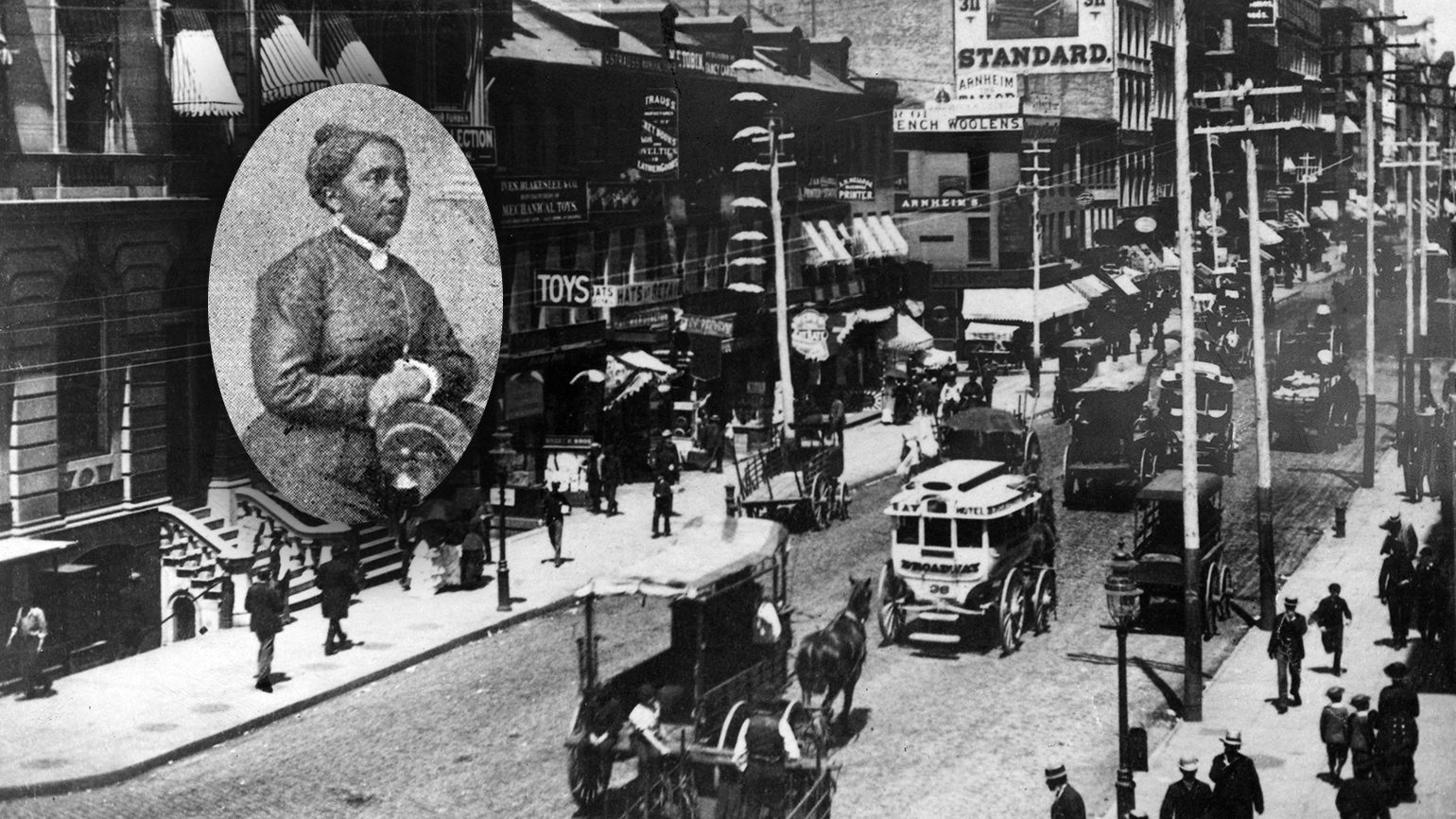
Interestingly, though, Parks was not the first African-American woman to fight back against race-based segregation on public transportation. A full century earlier, a church-going teacher named Elizabeth Jennings stood up for her commuting rights in New York City.

Community Newsletter

Get More Inspiration Delivered to Your Inbox


On a hot summer morning in 1854, Jennings, who played the organ at the First Colored American Congregational Church, near the Bowery in southern Manhattan, was on her way to Sunday services. Horse-drawn streetcars were the public transportation of the day, and most of the lines operated separate cars for white and Black riders. African-Americans could board a whites-only car, but only if no white passengers objected.

Jennings, accompanied by her friend, Sarah Adams, boarded a whites-only streetcar at the corner of Pearl Street and Chatham Street (now called Park Row), but were told by the conductor to wait for the next car, about a block behind them, which had “her people” on it. He insisted she exit his streetcar, but Jennings refused.

As Jennings recalled in her written account of that day, “I…told him I was a respectable person, born and raised in New York, did not know where he was born, that I had never been insulted before while going to church and that he was a good for nothing impudent fellow for insulting decent persons while on their way to church.”

Jennings said the conductor then tried to forcibly remove her, despite her telling him “not to lay his hands on me.”

The conductor, along with the streetcar’s driver, eventually dragged Jennings to the street, although she managed to climb back on board. They continued the route with her until they spotted a policeman on the corner of Walker and Bowery, who then helped remove her from the streetcar. Jennings, bruised and battered, her bonnet ruined and her dress covered in muck, returned home.

The conductor and the police officer, however, didn’t know with whom they’d been dealing.

Jennings, the daughter of Thomas L. Jennings, a free-born Black man, and his wife, Elizabeth, was raised among accomplished Black ministers, journalists, educators and businessmen devoted to the abolitionist cause and knew how to organize and push for change.

Thomas was a successful tailor and a prominent member of the city’s African-American community, who in the 1820s developed an early form of dry cleaning called “dry scouring,” for which he received the first U.S. patent known to have been awarded to an African American.

The money he made from that patented process allowed him to purchase the freedom of his wife, who was born into slavery. New York’s abolition law, passed in 1799, freed the state’s slaves gradually, so Elizabeth was still an indentured servant at the time.

It wasn’t long before Elizabeth also rose to a place of prominence in the Black community. In 1837, she wrote a speech entitled On the Improvement of the Mind” that addressed the importance of education in improving the lot of African Americans. In the speech, she stated that it fell to Black women to educate themselves as well as their families and friends. Jennings herself, at 10 years of age, delivered her mother’s speech at a meeting of the prominent, Black women-led Ladies Literary Society of New York.

Immediately following the streetcar incident, Jennings wrote an account of what had happened to her. Both The New York Daily Tribune, published by the prominent abolitionist Horace Greeley, and Frederick Douglass’ Paper printed her account in its entirety.

She then took her fight further by hiring Chester Arthur, then a 24-year-old lawyer newly admitted to the bar, to file a civil suit against the Third Avenue Railway Company. (Arthur would go on to become Vice-President of the United States under President James Garfield, before ascending to the presidency when Garfield was assassinated in 1881.)

Together, they won their case in 1855, with Brooklyn Circuit Court Judge William Rockwell stating, “Colored persons…had the same rights as others and could neither be excluded by any rules of the company, nor by force or violence.”

Jennings was awarded damages in the amount of $250, plus costs of $25 (nearly $8,000 today), and within a few years, all of the city’s streetcar lines were open to African Americans.

What became of Elizabeth Jennings? Though in the spotlight while her civil suit was adjudicated, she would step away the public eye and lead a quiet life.

In 1860, Jennings married a man named Charles Graham. Their only son, Thomas J. Graham, fell ill and died in infancy in 1863. Charles passed away a few years later in 1867.

Jennings continued to teach, first at the private African Free School and later in the public schools. She also founded the city’s first kindergarten for African-American children, operating it from her home just south of Longacre Square (now Times Square).

Jennings passed away at age 74 on June 5, 1901, and was buried alongside Charles and Thomas in Brooklyn’s Cypress Hills Cemetery.

In 2007, a local school launched a successful campaign to have a single block of Park Row—just a short distance from where Jennings made her courageous stand for equality—co-named “Elizabeth Jennings Place.”