

Embrace God's truth with our new book, The Lies that Bind

The Four Miracles of Dunkirk

You may have seen the hit movie Dunkirk, director Christopher Nolan’s powerful tribute to the real-life World War II drama that unfolded over 10 days in 1940, on the shores of France. But there’s more to the story than what was shown on the screen. To wit, four miracles that changed the course of the war.

For Winston Churchill, the new British prime minister, it all began with an early phone call on May 15 that roused him from sleep.

“We have been defeated,” said the French premier, Paul Reynaud. “We are beaten.”

Churchill was well aware of the Nazi advance. Days earlier, Adolf Hitler’s army had taken Holland, Belgium and Luxembourg, with Denmark and Norway already in his grip. England had sent more than 200,000 troops to France and Belgium. All for nothing, it now seemed.

“Surely it can’t have happened so soon?” the stunned Churchill said.

“The front is broken,” Reynaud said. “The Nazis are pouring through in great numbers.”

The Allies had severely miscalcu­lated the path the Nazis would take. The Germans had swept south, through the supposedly impenetrable Ardennes Forest, a region the Allies had barely bothered to defend. Now British and French troops found themselves surrounded, in disarray. Their only possible escape was across the English Channel. Through Dunkirk, a city in northeast France. A mass evacuation would require funneling thousands upon thousands of soldiers, spread across hundreds of miles, into one space while the Nazis closed in with 1,800 tanks and 300 Stuka dive-bombers.

For days, Churchill resisted that escape plan. It seemed like a suicide mission. They’d be lucky to get 20,000 men home via the English Channel, let alone more than 300,000 Allied troops. But there was no other option. On May 23, Churchill met with the British monarch, King George VI, to brief him. Though a naval rescue operation were under way, pitifully few ships were ready to sail. The lo­gistics of defending against the inevitable German air attack while ferrying the troops seemed impossi­ble. Allied soldiers were scrambling to reach Dunkirk. They barely knew which direction to go.

“We must pray,” King George VI said. “This next Sunday, I’m calling for a national day of prayer.”

Famously nonreligious, Churchill was surely not looking at prayer as the answer. But he could hardly refuse the king. On May 24, King George VI addressed the nation: “Let us with one heart and soul, humbly but confidently, commit our cause to God and ask his aid, that we may valiantly defend the right as it is given to us to see it.”

On May 26, at Westminster Abbey, the Archbishop of Canterbury called on God to protect the troops. Across Great Britain, tens of thousands of people responded to the king’s call, uniting as never before. Cathedrals and churches, mosques and syna­gogues were packed to overflowing. At Westminster Cathedral, the line extended for blocks and hundreds kept vigil outside. The people didn’t know exactly why they were praying, yet they prayed even so. “Nothing like this has ever happened before” was how one English newspaper described the scene.

The following day, though, the Ger­man High Command reported, “The British army is encircled, and our troops are proceeding to its annihila­tion.” The war, it appeared, was over for the Allies. Few would have argued otherwise. Certainly not James Brad­ley, a British machine gunner. His unit had made it to Belgium before en­countering overwhelming force from the Germans.

The soldiers were instructed to “get back to Dunkirk.” Where? Most British soldiers had probably never even heard of Dunkirk. Handed a rifle with a bayonet, Bradley was told he was on his own. “If they had said [get to] New York, I couldn’t have been more surprised,” Bradley recalled, years later. “I didn’t know where Dunkirk was.”

Everywhere, the roads were filled with British and French soldiers. Abandoned tanks and equipment lit­tered the countryside. Thousands of refugees marched with escaping troops, some driving cars, everyone fleeing in advance of the Germans. From out of the skies would come the Stukas, strafing everything in sight. The scene was horrific.

But all was not as it appeared.

Something happened that histori­ans, even 77 years later, can’t ex­plain. With German tanks rumbling just 10 miles from Dunkirk, Hitler did the unthinkable. On May 24, the day King George VI called the nation to pray, Hitler inexplicably halted the offensive. For nearly three days, as England knelt as one, those tanks remained grounded. Nothing moved.

It was the exact window of time the British needed to form a defen­sive perimeter, to temporarily fight back the Germans and establish a funnel for their troops to flow through to the English Channel.

Then came something else. Rain and clouds. German planes bombed Dunkirk on three separate days, but each time, for days afterward, the city was enveloped by inclement weather, making any effective follow-up from the Nazis difficult. What’s more, a breeze seemed to collect smoke emitted from the German bombs and distribute it over the area the British were using to load men into boats. The Allied exodus went undetected for days.

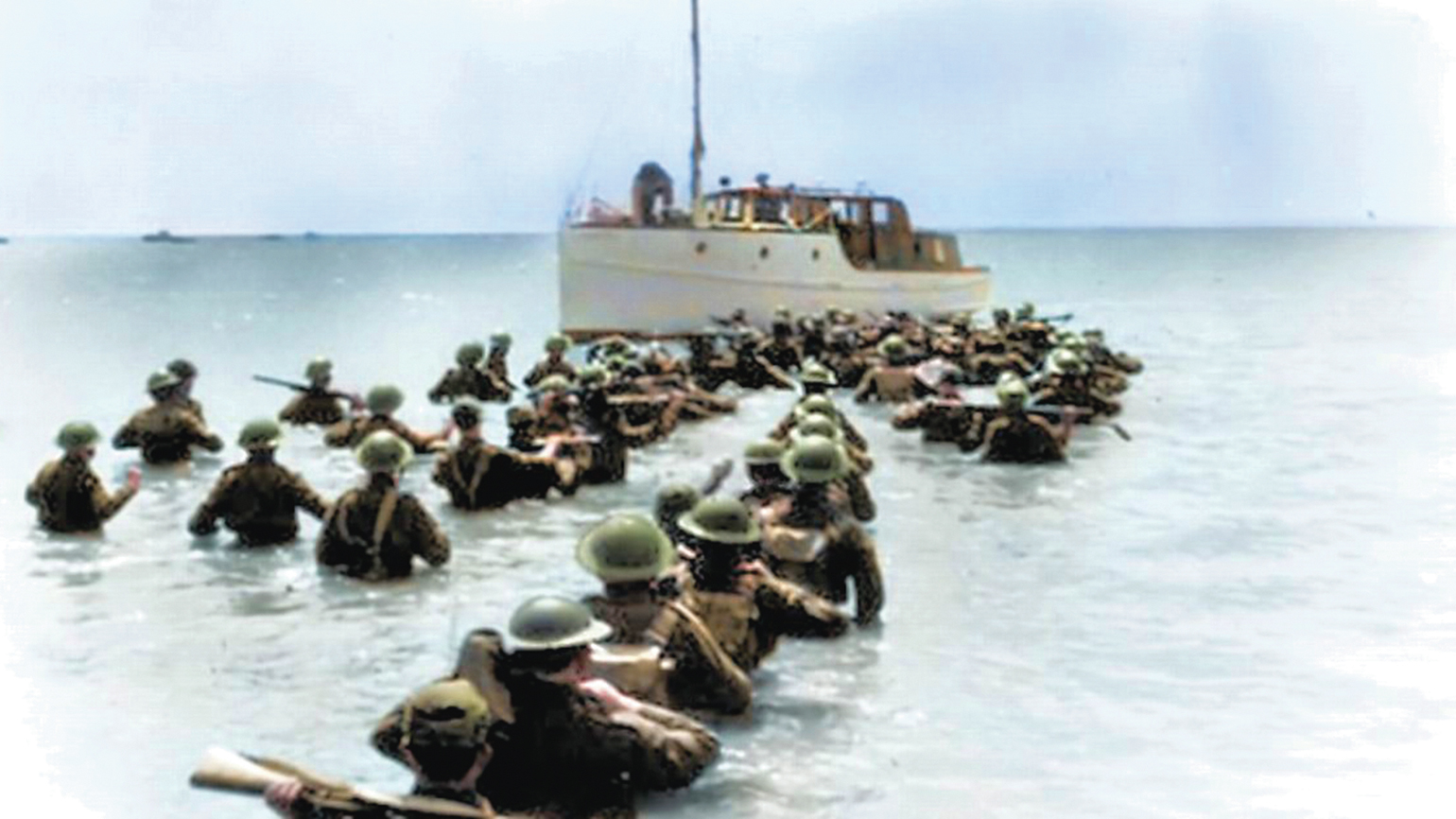
Meanwhile, word was spreading across England of the need for boats to cross the channel to Dunkirk. For what purpose no one was exact­ly sure. Almost any vessel would do. Rowboats. Fishing trawlers. Tugs. Motorboats. Hundreds of would-be skippers responded. Some had nev­er been out of sight of land before. Many of the crafts lacked compass­es. None of them were armed.

Robert Hilton, a physical educa­tion instructor, and Ted Shaw, a cin­ema manager, were among those who answered the call. They joined a makeshift crew with a motorboat, Ryegate II. But when they reached the town of Ramsgate, off the tip of southern England, the only supplies they were given were two cans of water. Not even a cup to drink with. The two of them went to a pub, downed a pint, pocketed the glasses and set off toward France.

The English Channel is notoriously rough, choppy—no place for novice seamen—but once again something peculiar happened. The water Hilton and Shaw encountered was like that of a bathtub, with barely a ripple to disturb the journey. No one had ever seen anything like it. There were so many boats that in places the waters resembled a freeway at rush hour.

James Bradley, the machine gun­ner, eventually reached De Panne, Belgium, just east of Dunkirk. Over the sand hills, he could see thousands of soldiers huddled, a line of small boats coming in to the shore and ferrying the men to larger vessels in the deeper water, guarded over by ships with guns. They’ll never get these people off here, he thought.

But it was happening. From De Panne and Dunkirk. A few boats at a time, offloading a few dozen men, then coming back for more, round the clock, a dizzying spectacle.

The Ryegate II limped into the wa­ters off France, her engines broken, her propeller twisted by wreckage. Robert Hilton and Ted Shaw tied up to a larger boat and manned one of its lifeboats. For 17 hours straight, they rowed soldiers from shore to ship.

In the first five days of the rescue mission, more than 100,000 soldiers were evacuated. That still left more than 200,000 men, tens of thousands desperately fighting to hold the perimeter. They’d be the last to go.

Bradley never forgot the hero’s welcome he received when he at last reached the shores of England. The tables loaded with tea and buns. The crowds of people waving, cheering. This is England, he thought. You’re worth fighting for. Hilton and Shaw would also remem­ber the cheers that greeted them. Exhausted, they and the other crew members somehow managed to get the crippled Ryegate II back to Eng­land, throngs of jubilant well-wishers at every bridge on the Thames River.

By then, 338,000 soldiers had made it safely across the English Channel as well, thanks to the efforts of about 850 “little ships.” There was a feeling of determination, not surrender. Deliverance by a divine hand. It was exactly what the British soldiers—and civilians—needed to forge ahead. Especially so early in the war.

On June 4, Churchill went to the House of Commons to deliver the news. “We shall fight on the beaches,” he thundered. “We shall fight on the landing grounds, we shall fight in the fields and in the streets.”

The Prime Minister called it a mira­cle, a word he was not known to often use. There seemed no other word to describe it. Not just one, but a whole series of miracles. Without any one of them, the entire operation would have failed. Hitler halting the blitzkrieg. The thick, protective cloud cover. The English Channel growing still. The hundreds of tiny boats, appearing seemingly from out of nowhere.

What turned the tide? For the king, there was no question.
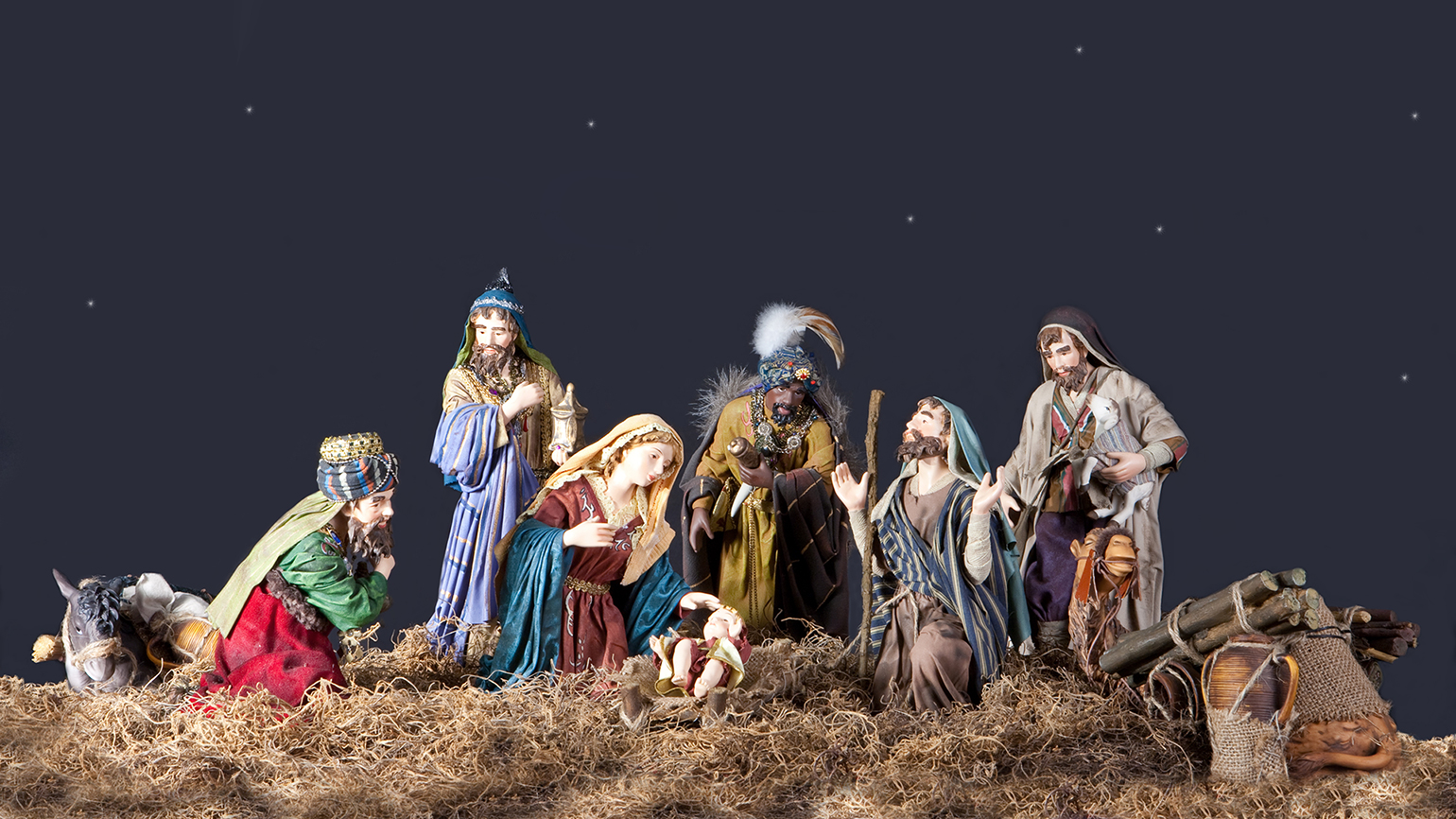
The Feast of the Epiphany: 3 Things to Know

January 6 is the day when we traditionally celebrate the visit of the three kings to the Baby Jesus in Bethlehem, the 12th day of Christmas, as the song goes, the Feast of the Epiphany, a big word that means when you suddenly see something with new understanding, with new eyes, like the wise men. But as I used to like to remind my Sunday school students, it’s worth looking at the Bible to find out just who these first followers of Jesus were.

Here are 3 things to know about the wise men:

1) They weren’t kings.
Don’t mean to botch any casting calls you have for your Christmas pageant, but you can ditch the gold crowns. Nowhere in the book of Matthew, chapter two, does it say they were kings. They were “wise men” or the “magi,” possibly astronomers in that they followed a star to get to Judea.

The undisputed king in the story is King Herod who hears of their mission and asks his experts, the chief priests and scribes, to find out where this new ruler is supposed to be born. “Bethlehem,” he learns. Then he calls the wise men to him and gives them this crucial bit of information, without which these travelers from East might have found themselves wandering forever.

Interesting, isn’t it, that Herod, the bad guy in the story, is also helpful, an instance of God using evil for his own good purposes?

2) There weren’t three.
Back to that pageant again…next year, you can have as many wise men as you want, two, three or 20. The Bible never says three. (Note to the wise: sometimes our favorite Christmas carols can be wrong.) The text just says “wise men,” plural.

So why has tradition made it three, even giving them names, Balthazar, Melchior, Caspar? Probably because in the book of Matthew it says they brought Jesus three gifts: gold, frankincense and myrrh. But all of them could be giving the three things out of their treasure chests or they might have divvied it up.

As for props for next year’s pageant, keep those treasure chests and keep the star that lodged over the house where Jesus was found. Mind you, it’s a house in the book for Matthew and not a stable. But then Luke never says “stable” in his version of the Christmas story, he just puts the baby in the manger.

Strengthen Your Faith with Free ebooks on Prayer, Bible Study and More

3) Their lives were never the same.
My favorite verse in the whole story of these wondrous wise men is the last line, the last we hear of them: “And being warned in a dream not to return to Herod, they departed to their own country by another way.”

Dreams can offer good practical guidance. Herod was seething with jealousy about this new ruler. He eventually has every male child in Bethlehem under the age of two killed. No telling what he might have done to the wise men.

But what a tantalizing tidbit we get here, an indication of faith’s journey. After we’ve seen Jesus, after we’ve worshipped the real king, after communing with God’s son, we can’t go back home the usual way. Our journey through life has a new star to guide us.

That’s why they say, “Wise men and women still seek him.” We do. Happy Epiphany!

The Father of the Fourth of July?

“There’s no place like the United States.” I’ve been hearing those words since I was a kid, especially on holidays like the Fourth of July.

You see, my parents are basically the most patriotic people in the tri-state area! They moved to the U.S. more than 40 years ago from Turkey, where they were a Christian minority. So they’ve always been especially appreciative of the freedoms our country has to offer.

I suppose it’s no wonder they’re a little obsessed with American history. On weekends, you can find them absorbed in Revolutionary War documentaries on TV. They chat about politics at the kitchen table like they’re White House correspondents. And my mom never misses a chance to share a Benjamin Franklin yarn from her archive of Founding Father stories.

I inherited my parents’ love of Founding Fathers (don’t get me started talking about James Madison!) and even studied U.S. history in college and graduate school. I’ve long been fascinated by the many factors that had to come together for America to come into existence. It’s astounding when you think about it. Miraculous really.

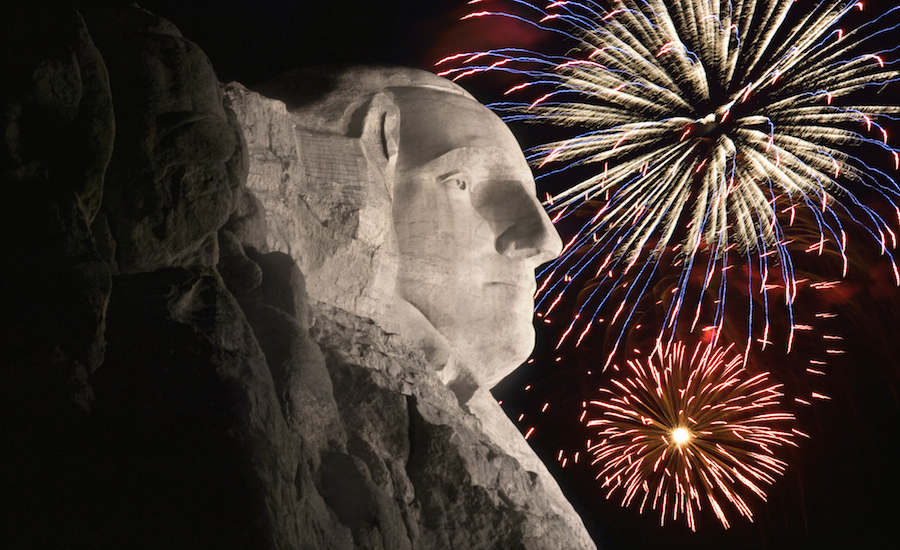
Well, as it turns out, I’m not alone in my wonder. This week I was researching Fourth of July prayers, and I came across George Washington’s first inaugural address from 1789. I was surprised that one of his first orders of business as president was to give props to God, who he refers to as “the Great Author”:

“No People can be bound to acknowledge and adore the invisible hand, which conducts the Affairs of men more than the People of the United States. Every step, by which they have advanced to the character of an independent nation, seems to have been distinguished by some token of providential agency.”

My parents were right! There really is no place like the United States. And for good reason, as Washington points out. God has been working behind the scenes in the affairs of our country since the very beginning. Watching over our great nation, every step of the way.

That’s something to remember on July 4th and always.

What do you think about Washington’s first inaugural address? Share your thoughts–and favorite Founding Father!–below.

The Enduring Miracle of Good Health

Give thanks for good health. It’s so easy to pray when you’re sick. It’s the first thing I do. God, I feel awful. Make me well!

Not for nothing is Jesus referred to as the Great Physician. Healing was crucial to his ministry. Again and again in the gospels we see him getting rid of diseases, “casting out demons,” as it was often expressed. No reason you shouldn’t talk to God when you feel rotten. “Heal me,” we pray.

But if you’re blessed with good health, as most of us are most of the time, celebrate. Good health is just one of those enduring miracles. So miraculous that we don’t even notice it, so miraculous we forget about it.

So put your health on your list of things to be thankful for. You might have an ache or two you’re leaving in God’s good hands, but also give him some praise for all those other things that are going right with your body and soul. That good night’s sleep, that satisfying meal, that invigorating walk, the nerves that let you feel the warmth of the sun and that hug from your best friend. You’ve got a doctor’s appointment on Tuesday? Bracket it with praise for your good health the rest of the week. Put it on the calendar.

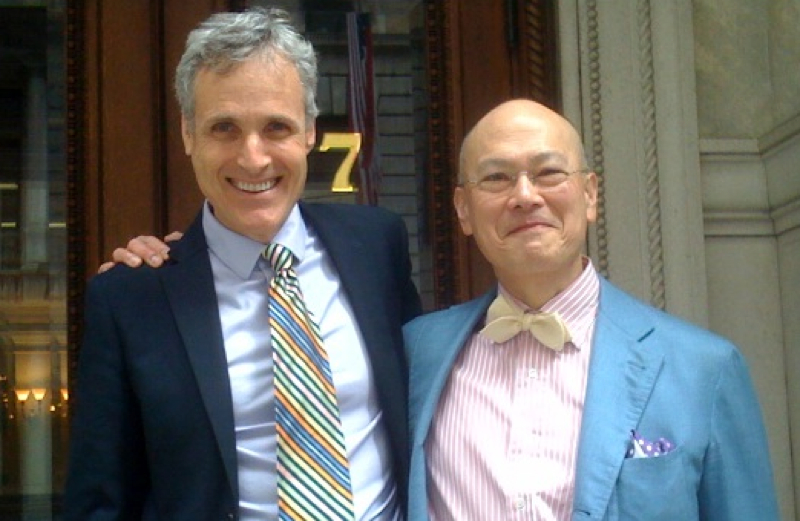
Twenty years ago my friend Ray and I happened to have the same surgery on the same day for the removal of a tumor at the same place. I won’t go into the gory details except to say that both of our tumors turned out to be benign and we both carry little scars behind our ears, mine on the left, his on the right, a mirror image of each other.

So what do we do every spring on the anniversary of our surgery? We celebrate our good health. Here we are this year, two guys who have a lot to be thankful for. Just ask us.

Got an ailment? Got some aches and pains? Worried about a diagnosis? Waiting for the results of that most recent test? Let me pray with you and for you. The rest of the time, let me also join you in giving thanks for the enduring miracle of our good health. It’s a lot to celebrate.

The Divine Gift of Music

The library at the Cleveland Institute of Music was having one of its sidewalk sales, getting rid of carts full of old scores, sheet music, scholarly journals, outdated encyclopedias. I couldn’t resist checking out the titles, running my fingers along dusty spines, opening brittle pages of music. Looking for a bargain but also looking for something I could sing.

Maybe that’s what attracted me to the red hardbound volume. It was large, 14 by 16 inches, with gold lettering on the cover, “Joh. Seb. Bach’s Werke Band IV.”

I was getting my master’s in early music performance at Case Western Reserve University down the street, one of a handful of sopranos in the program. That my degree would be in vocal music and not piano was still something of a surprise.

Although I’d always sung in church choirs and school choruses as an alto, I felt most comfortable behind the keyboard, not in the limelight. Certainly not standing in the front of the stage, a full orchestra and choir behind me.

But at the University of Louisville, where I was a piano major and also sang in the collegium, the music director pulled me aside after a chorus rehearsal and asked, “What are you doing in the alto section, Kathy? You’re a soprano.” He played through some scales and arpeggios, taking my voice higher and higher, the sound bouncing off the walls.

It was scary and thrilling all at once. I had no idea I could sing that high, up in angelic terrain. Finally the director declared, “Not only are you a soprano but you should be singing solos.” And just like that I had a new calling and a new repertoire. I stayed in Louisville after college, performing with the Bach Society before applying to grad school.

There were a ton of arias and oratorios I wanted to learn first. Somehow I made room to add new vocal scores to my shelves. Getting rid of my old piano music—or any music book, for that matter—was out of the question. When I was accepted to Case Western, all my books came with me. Not that an overflowing bookshelf would keep me from a library sidewalk sale!

I balanced the big red volume in the crook of my arm and flipped through the pages. It was part of a facsimile of the complete edition of Bach first printed in 1850 and in beautiful condition. My voice teacher had been telling me that I should study the soprano solos in this very volume. “Someday, I hope you get to sing them,” she said.

In the St. Matthew Passion, Bach set the biblical text to luminous music, with original solos that mirror the disciples’ feelings during Holy Week: the guilt, the pain, the sorrow, the terrible loss. Often the chorus and soloists address Jesus just as one would in prayer, “mein Jesus,” my Jesus.

When Jesus himself sings he is accompanied by strings only, “the halo” as it’s called. At the very last, as he cries out, “My God, my God, why have you forsaken me,” even the halo disappears. He is never more human, never more alone.

I couldn’t believe the price of the score. “Five dollars” was scrawled in pencil on the inside cover. Maybe it was low because it was an orphan from a 46-volume set. Maybe somebody had made a mistake, not realizing what a treasure it was. But I didn’t argue. I bought it on the spot.

Indeed I did study the soprano arias, the music expressing feelings that were almost impossible to put into words. If anything, singing opened me up to the mysteries of faith. It took courage to get up on stage, wondering if I’d be able to reach all the notes, and yet, never did I feel closer to God than when I sang.

After I earned my master’s I returned to Louisville, taking my lone volume of the St. Matthew Passion with me. I joined the board of the Bach Society. We gave four concerts a year and I often did the solos.

One evening we had a meeting at the founder Melvin Dickinson’s house. That night after going through the usual business of budgets and tickets and marketing for our next concert, Melvin announced that a donor had an extraordinary gift for us.

“A set of Bach’s works, a facsimile of the 1850 edition,” he told the board. “The forty-six-volume set has only one flaw. It’s missing a volume.”

I smiled to myself, thinking that my 46-volume set had 45 flaws!

“Which is missing?” I asked.

“Volume four. St. Matthew Passion.” The next day I brought over my copy. Volume IV from the same facsimile printing, the missing volume that completed the set. My orphan had found its siblings. This was one book I had to give away.

Before I moved to New York to continue my career, I had reason to borrow the volume one last time. I was asked, as my teacher had predicted, to sing the soprano solos in the St. Matthew Passion. I wanted to study the score.

Ich will dir mein Herze schenken,” the soprano sings, “I will give my heart to thee…” It’s an expression of love for God, and his infinite love for us. “And if the world is too small for thee, ah, then for me alone shalt thou be more than world and heaven.”

Heaven and its angels never seemed so close than when I sang those words on stage. God gave everything to us. What joy to give this back to him.

Download your FREE ebook, True Inspirational Stories: 9 Real Life Stories of Hope & Faith.

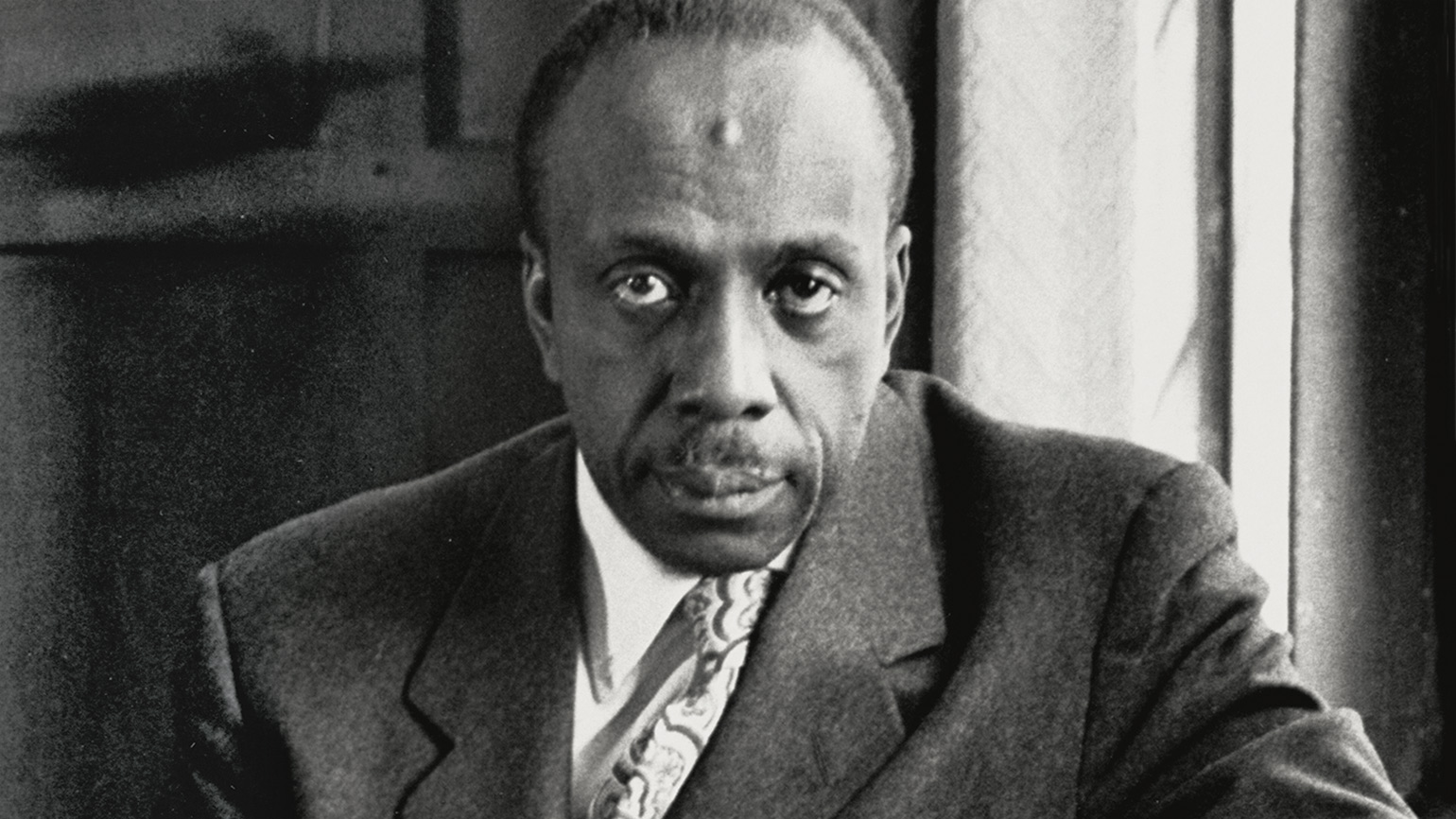
The Divine Encounters of Howard Thurman, Civil Rights Pioneer

It’s difficult to move to another state, another town, another school, especially for a teenager. As a 17-year-old, I was compelled to move—not just to another part of the country but to another family.

My life had changed two years earlier, when I became one of the Little Rock Nine, the teenagers who integrated all-white Central High School in Little Rock, Arkansas. When my teacher asked who would be interested in going to Central High, the pride of Little Rock, my hand shot up.

For as long as I could remember, I’d wanted to break free of the rules that defined—and confined—black people’s lives in the segregated South. It upset me to see my mother, a teacher working on her doctorate degree, kowtow to whites. It hurt to have to drink from “colored” water fountains and sit in the back of the bus.

The warnings from my parents and grandmother made it clear that white people were in charge and not to be disobeyed or confronted. At age five, I’d seen a man hanging from the rafters of our church, and fear of white people and their rules had consumed me ever since. I knew I could not live that way. At first, I was driven by the notion that attending Central would be my ticket to college and out of Little Rock. Just to get the nine of us inside the school’s front doors, President Eisenhower sent the 101st Airborne to escort us through an angry mob. Every day, white students hit, kicked and spit on me. When I went to the bathroom, they tossed burning strips of paper over the stall. I walked the halls in constant fear.

When I complained to Dr. Martin Luther King, Jr., about the treatment we received each day, he said, “Don’t be selfish, Melba. You are doing this for generations yet unborn.” He changed the direction of my commitment. “You can always call on the Lord,” Grandma told me. “He’s as close as your skin.” I’d never prayed harder than that year at Central. I focused on my studies and got good grades—the best revenge, Mother said. The next year, to avoid integration, the governor closed all the public high schools, opening a private school for whites only. Because of legal appeals, I couldn’t register at any school anywhere.

I stayed home, teaching myself with Grandma’s help. We used the many books at home and correspondence courses. In September 1958, Grandma was diagnosed with cancer. She passed on in October. I felt lost without her.

Central High was scheduled to reopen in the summer of 1959. But Mother found out that the KKK was offering a $10,000 bounty to kill any member of the “Nine.” “You can’t stay here,” she said. “The NAACP has a family in California you can live with for your senior year.”

I’d read about California in magazines like Ebony and Seventeen and had seen it on television. Movie stars. Mansions. The ocean. I fantasized on the long flight there that my foster family would have more money than my family and live in a lovely house.

At the San Francisco airport, I was startled to be met by white people who looked like folks back home who wanted to kill me. They said they were NAACP members and would drive me to the family hosting me.

The van crossed the Golden Gate Bridge. We drove far into the countryside. I fretted about whether I had been kidnapped by members of the KKK. Finally, the car turned into a gravel driveway and pulled up to a two-story farmhouse. The front door opened and out stepped a shaggy little dog, barking madly, and a petite, brown-haired… white woman. I gasped.

“I’m Kay McCabe,” she shouted over the barking. “This is Rags. He’s just excited. Welcome!”

“Mrs. McCabe?” I whispered. She extended a hand. I kept mine to my sides. Did she really want me touching her?

“Call me Kay,” she said, which only added to my discomfort. Back home no child dared call an adult by her name.

She greeted the other NAACP members and showed me a bedroom with three single beds where I could leave my things. After the others left, Kay sat me down at the kitchen table. “Come help me with dinner,” she said, handing me a knife and carrots to slice for the beef stew simmering on the stove. Next, she had me set the table. Was she thinking I was going to be her maid?

Minutes later came a deep voice. “I’m home.” Mr. McCabe was tall, dressed in brown tweed trousers, white shirt and plaid bow tie.

“George is a psychology professor at San Francisco State,” Kay said.

“So you’re the new kid?” he said. “How’s it going?”

Mother and Grandma never talked to me so casually. I barely had time to react before the McCabes’ teenage daughters, Judy and Joanie, burst through the door, and three-year-old Ricky woke from his nap. Everyone sat for dinner. No one said grace. That made me nervous. I said a silent prayer. “What day would you like on the chore chart?” Kay asked. “We all pitch in.” I didn’t understand. They weren’t expecting me to be the maid? I was already part of the family? I even shared a bedroom with Judy and Joanie.

That night I wrote in my diary: “Dear God, is this the family you want me to have? The McCabes are very sweet, but can’t you find me one that looks like me?”

The next day, I was astonished to once again be in an all-white school. I saw no other black students but was told there were four others. These white students were very different from those at Central. They smiled, helped me with my locker and offered to show me to my classes. The teachers were just as welcoming. Even so, I kept looking over my shoulder.

I was surprised to discover my classmates dated each other. I hadn’t been allowed to date in Little Rock. They all made plans to go places together. While friendly, students rarely invited me and I didn’t have the confidence to initiate a friendship. Every day I was reminded of how I didn’t fit in. The clothes I wore. The way I talked. I learned that it wasn’t only race that separated people. Only well-off people could afford to live in Santa Rosa.

One day, George took me to the city swimming pool. “She’s not allowed here,” the attendant said. I suddenly felt as though I were back in Little Rock.

“I’ll have your job!” George said.

“You’re violating my daughter’s civil rights.” I wasn’t sure what was more shocking, having this white man call me his daughter or his coming to my defense. George gathered friends from his college, and they marched on the pool continuously for a week. There was never a problem after that.

The McCabes were Quakers. They believed in hands-on helping people. Kay had helped found the Santa Rosa Quaker meeting and the local NAACP chapter. She had marched for voters’ rights and helped establish a preschool for minorities. Judy and Joanie treated me like a sister from Day One. We hung out together, caring for the pigs and cows on the farm. Still I missed Mother and my brother and the AME church I was raised in. The quiet, more contemplative Quaker worship wasn’t for me. I needed to feel the spirit and hear the choir. George drove me to a Methodist church on Sundays. But God didn’t feel close by, as he had in Little Rock.

In late fall, I caught the flu and spent many days in bed. George thought he knew what was ailing me. “You’re homesick,” he said. “It can be unsettling to be separated from everything that’s familiar. Why don’t you go back to Little Rock over Christmas? If you decide to come back, we’ll always have a place for you.” If I came back? It hadn’t occurred to me that I might not return.

In the Little Rock terminal, a white man bumped hard against my shoulder. “Watch where you’re going, you piece of trash,” he snarled. My stomach clenched, but I said nothing.

“Melba Joy!” Mother ran to me, my brother right behind her. On the drive home, she said, “I was thinking that if you told the newspapers you weren’t interested in integrating, maybe the KKK would leave us alone. Then you could come home for good.”

That night I couldn’t sleep. I imagined Grandma beside me, settling me like she used to when I was a girl. “You’re going to be just fine, Melba,” I heard her say. “Stop resisting this new path the Lord has chosen for you.”

But after only a few days back in Little Rock, I found the fear of white people and what they might do to me once again consuming me. At our family Christmas, my relatives talked about whites threatening them. How could you be your personal best if you were frightened all the time?

Finally, I understood. My true home wasn’t a particular place or even with particular people. It was with God. He gave me the vision to see beyond what segregated society dictated. He had given me the courage to raise my hand to enter Central. He would keep giving me the strength and support I needed to follow my own path.

After Christmas, I went back to Santa Rosa. The McCabes greeted me warmly. “What day do you want on the chore chart?” Kay asked my first night back.

A few weeks later, George asked if I’d be interested in leaving high school early and enrolling at San Francisco State College. “I know some people,” he said with a smile. “It’ll be a more diverse experience. I think you’d benefit.”

He went to the campus with me on my first day. “Melba, you can make your life into whatever you want it to be,” he said. “Kay and I are here if you need us. Remember, you’re never anything less than our daughter, never less than an important human being, a person who had strength to set this country on its ear and teach it a lesson in civil rights.”

Tears streamed down my face as I watched him walk away. Then I turned and followed the path the Lord set out for me, an incredible journey that has led me to be a wife, a mother, a TV news reporter, a writer, a university professor and a speaker, telling my story to audiences across the country about how I turn my fear into faith. Fifty-eight years later, I am still a member of the McCabe family, experiencing all the love and comfort they offered me from the very beginning.

The Day the Cows Could Count

I hadn’t wanted to get divorced. I kept hoping my wife and I would be able to work things out eventually. But she was set in her decision. She packed up and moved with the kids to a new place, some three hours from the house we’d once shared as a family. She was already dating someone new.

I looked forward to seeing my two young sons every Friday. But I dreaded the reminder of the way things used to be. We would never again have movie nights on a random Thursday after school. I couldn’t even see my sons on any given Thursday. I’d been relegated to picking them up from a nondescript parking lot every Friday night—a journey that took me six hours round-trip.

I wanted to believe that one day all of this would make sense, like they tell you in those books about finding your life’s purpose. That I would heal, move on and realize my time of suffering was a miracle in disguise. But that was impossible. My heart would never mend itself. Nice guys like me finished last. We didn’t get the miracles.

At least, that’s what I told myself. Until one Friday.

It was pouring rain that night. I’d had to pick up the boys later than the usual time, close to eight o’clock. My ex had been delayed. Something about having to meet up with her new boyfriend after work. The kids lugged their weekend bags from her car to mine. She barely acknowledged me before driving off into the night. We headed in the opposite direction, toward the old highway that cut through field after field of Mississippi farmland.

The boys were usually chatty on this leg of the journey. They’d fill me in on their week at school, play car games and compete with each other to get my attention. I loved every minute. This night, however, maybe because of the later hour, they had zonked out by the time I merged onto the highway. My youngest was in the backseat and my oldest was in the passenger seat, their heads lolling with every bump in the road.

I was actually thankful for the quiet. I needed to concentrate. It was pitch black outside, and I could barely see what lay ahead because of the rain pelting the car. I thought about pulling over, waiting for the weather to let up. But there were no shoulders on the tree-lined, poorly lit four-lane. And to be honest, I just wanted to get home.

How hard would it have been for my ex to meet me on time? She knew how long my drive was. Why hadn’t she considered my plans, my feelings? I couldn’t help but think of the future we might have had. If she hadn’t left, we might be out to dinner right now, the four of us. Laughing over something silly the waiter had said. Instead, I was stuck in this Mississippi monsoon.

I couldn’t see a thing. I switched on my brights. Even that didn’t help. The road went up a hill. I made it to the top and headed down the other side, lightning flashing all around. Then thunder. So close and loud that I almost jumped out of my seat. I glanced at the boys. Somehow they were still asleep.

I turned my eyes back to the road and nearly slammed on the brakes. Something was moving across the highway at the bottom of the hill! I got closer and gasped. Four huge somethings! Four cows crossing the highway in the dead of night, moving from left to right. They must have escaped from a farm. They walked in a straight line and were hardly moving. And I was 50 yards away, headed straight for them.

My mind jumped into overdrive. I couldn’t swerve—the highway had no shoulders. I couldn’t honk—that would do nothing. I couldn’t slow down—I was going too fast. If I made any sudden movement on the slippery road, we’d crash into the trees framing the old roadway. It was an impossible situation. Not sure what else to do, I yelled, “Jesus, help!” and prepared to step on the brakes.

Instantly, the cows stopped moving. And I heard it. A firm but quiet voice. Deep from within. “Don’t hit the brakes. Grab the wheel tight.”

I grabbed the wheel, kept the same speed and headed straight for the line of cows. “Oh God,” I said. “Oh God!”

It happened quickly but like a movie in slow motion. I thought I was seeing things. The cows separated— two rolled forward, two rolled backward. They didn’t walk. They didn’t run. No, they glided out of the way, as if they had roller skates on. Like some bovine rendition of Moses parting the Red Sea.

My car rocketed through the gap, no more than 12 inches of clearance on either side. I was too shocked to stop, too terrified to glance back and take my eyes off the road again. I was grateful—eternally grateful—but totally freaked out too. What on earth had happened back there? The boys never woke through it all; they hadn’t even stirred.

We made it home, and I put the kids to bed. I couldn’t sleep. I just couldn’t put that strange scene on the highway out of my mind. Had those cows moved out of the way on their own? Or had something— or someone—pushed them?

I talked it over with a farmer friend of mine. I told him how the cows had moved forward and backward, as if levitating. “You know, David,” he said, “cows rarely, if ever, walk backward. What happened to you is kind of a miracle.”

Just like how I eventually found my way back on my feet after my divorce. It wasn’t easy. But every time I was beginning to despair, I thought back to that rainy Friday night on that old country highway. And of the four cows that made me believe in the impossible.

The Cross at Ground Zero

I’m an excavation laborer and a member of union local 731. Pick-and-shovel work is my trade. I live in New Jersey, but I’m a New York City native, Brooklyn-born and -bred.

After the Towers collapsed, my city was hurting. When I heard they needed guys like me for search-and-rescue work at Ground Zero, I couldn’t get there fast enough.

I’d seen the news coverage, but that didn’t prepare me for the reality. Down there it was like hell on earth. Fires burned out of control. Destroyed vehicles littered the streets. Everything was blanketed with dust; the air was filled with a choking stench.

I soaked a bandanna with water before wrapping it around my head to cover my nose and mouth. I went to work wondering if I’d be able to get through this.

Six firefighters and I entered World Trade Center building six, which had been flattened by Tower One. We took a smoke-filled stairway down into the garage levels, searching for survivors.

There were no cries for help, no signs of life. We spray-painted orange Xs to indicate where we’d searched and to help us find our way back.

After 12 hours of searching, we’d recovered three bodies. By then I was exhausted, but I couldn’t quit. “Think I’ll take a look over there,” I told the firemen, motioning toward the remains of the lobby atrium.

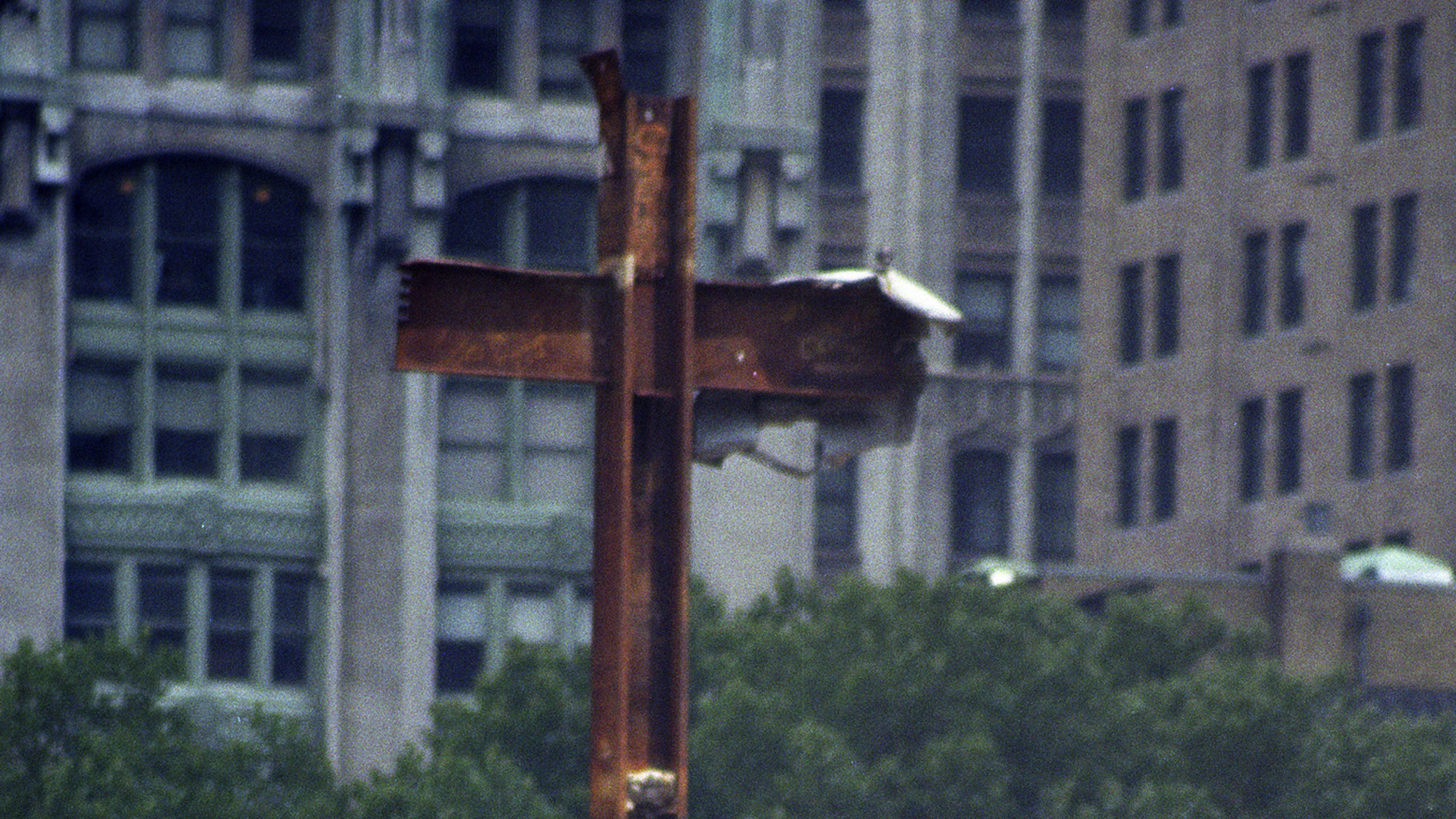
Picking my way through the massive piles of debris, I peered into what had become a sort of grotto. Illuminated by the pale light of dawn were shapes…crosses. What? How did these get here? The largest was about 20 feet high. It must have weighed a couple of tons.

In that little grotto I felt a strange sense of peace and stillness. I could almost hear God saying, The terrible thing done at this site was meant for evil. But I will turn it to good. Have faith. I am here.

I fell to my knees in front of the largest cross. Tears came, and I couldn’t stop them. I cried like a baby.

Finally I was able to pull myself together. I grabbed my gear and left the strange grotto to go back to search-and-rescue work. But first I spray-painted “God’s House” on the atrium ruins.

Digging day after day at Ground Zero was the hardest work I’d ever done. Often I was so drained I felt I couldn’t go on. That’s when I’d go to God’s House. Standing there in front of that 20-foot-high steel-beam cross, I always felt my strength and spirit renewed.

Word spread. The cross had the same healing effect on others too. Firemen, police, volunteers, grieving survivors, visiting dignitaries and clergy. They would walk into God’s House, see the cross and fall to their knees crying, like I had. Some people sang, some prayed. Everyone left changed.

There are some who say that the cross I found is nothing more than steel. That it was just plain physics that broke the steel beam into the shape of a cross when it plunged through the roof of building six. But I believe differently.

So does my friend Father Brian Jordan. He was a chaplain at Ground Zero and is a priest at St. Francis of Assisi in Midtown. When the time came for what was left of building six to be removed, God’s House faced demolition. Father Jordan talked to officials and persuaded them to save the cross.

After it was removed from the site, ironworkers fixed the cross to a concrete base, then hoisted it up and mounted it atop a 40-foot foundation that had been a pedestrian walkway outside the World Trade Center.

It stood high enough that the rescue workers who were down in the pit could see it whenever they lifted their heads.

Ground Zero was not obviously a place of hope. But it was there that I learned we can always have faith. In fact, we must have faith if we are to go on.

New life will rise from the ashes. I know that because the cross was a sign, a promise from God that he is with us even in the face of terrible evil and untold suffering. Especially then.

The Christmas Miracle of 1914

This article is adapted from Kathryn Slattery’s children’s daily devotional, 365 Bible Answers for Curious Kids

War is a terrible thing. Historians agree that one of the deadliest conflicts in human history was World War I, which raged from July 28, 1914, to November 11, 1918, and claimed more than more than 16 million lives. It was the first “modern” war, using mechanized tanks with powerful artillery, airplanes, machine guns, and poison gas. Worst of all for soldiers was the trench warfare, where troops shot at each other from hundreds of miles of deep trenches dug into the ground. Life in the muck and disease-filled trenches was miserable. To leave one’s trench was to risk being shot and killed. The distance between the opposing trenches was known as “No Man’s Land,” and littered with dead soldiers.

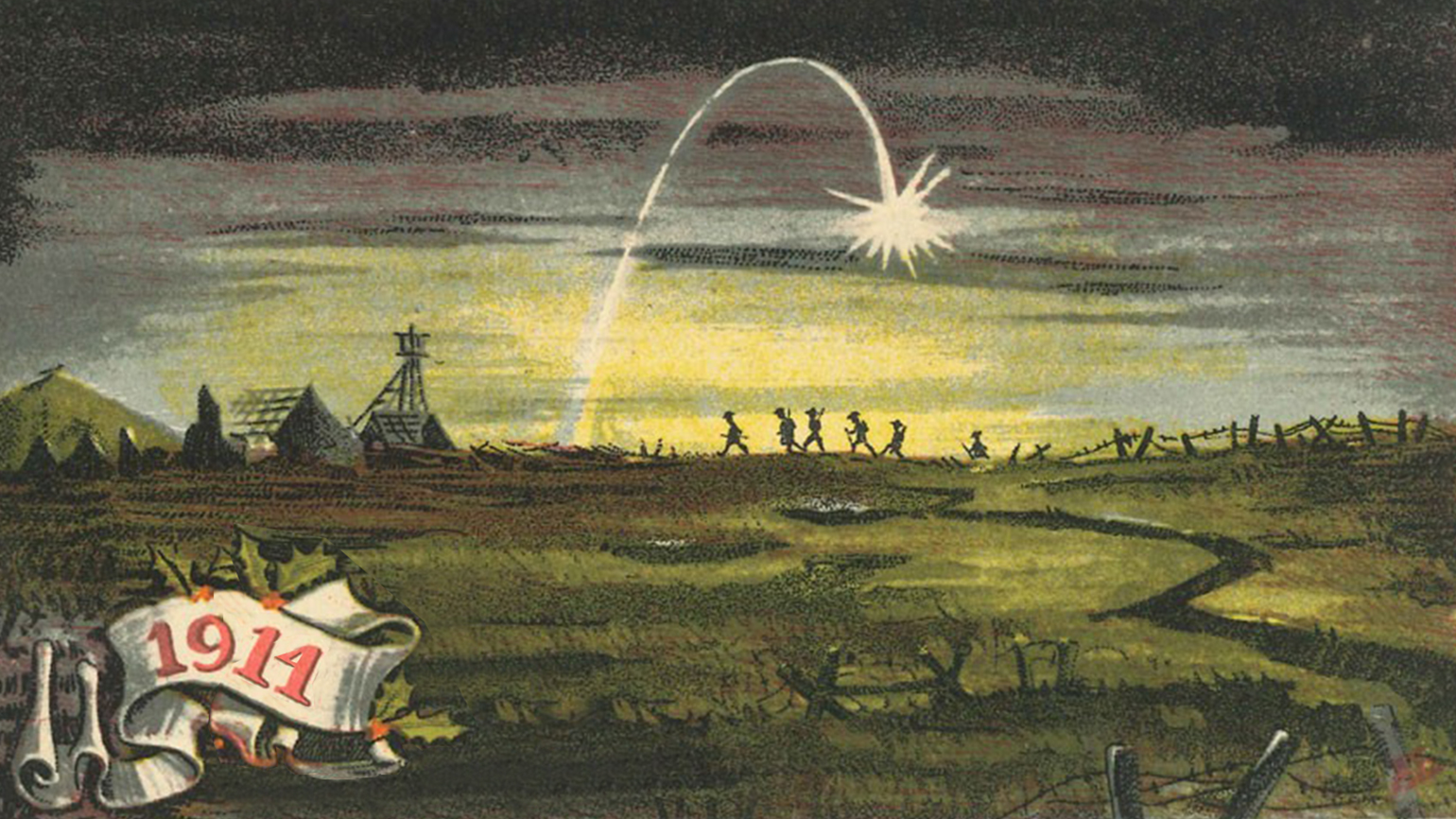
On Christmas Eve, 1914, along the war’s Western Front in Flanders, Belgium, a miracle took place. On one side were the English and the French, hunkered down in their trenches. On the other side, doing the same, were the Germans. The war had been raging for five months. It was a bitter cold night.

Suddenly, an English soldier scanning the German enemy line spotted a small fir tree decorated with twinkling candles. He readjusted his binoculars and squinted, disbelieving. And then, drifting across the frozen ground of No Man’s Land, came a low rumble—not of guns—but of German soldiers singing, “Stille Nacht, Heilige Nacht…“ softly at first, and then louder with each verse. Although the words were foreign, the carol’s tune—and its message—was unmistakable. The English and French troops responded, raising their voices and singing, “Silent Night, Holy Night…” Back and forth, back and forth, the men exchanged verses in English and German. This went on for several minutes. Then, from the depths of a German trench, a soldier raised a crudely written sign: “YOU NO SHOOT, WE NO SHOOT.” In response, the English and French soldiers waved a ragged banner that read: “MERRY CHRISTMAS.”

Cautiously, the unarmed men began to emerge from their trenches. Slowly, they crossed the dreaded No Man’s Land, where they stood face-to-face in the frosty air. For a moment, the highly trained soldiers didn’t know quite what to do. Awkwardly, they extended and shook each others‘ hands. They clapped one another’s shoulders. They embraced. Some turned their heads, to hide their tears. They gave each other permission to collect and properly bury their dead. They exchanged prisoners. And then, for the remainder of that miraculous night and throughout Christmas Day, they sang carols and exhanged gifts of cake, chocolates, biscuits, jam, canned beef, pork and beans, newspapers, postcards, and wine. They even played an impromptu game of soccer with a makeshift ball fashioned from a large tin can.

“For an instant, the God of goodwill was once more master of this corner of the earth,” recalled one French officer.

The Christmas miracle of 1914 was nothing less than the supernatural love and peace of Jesus breaking through and touching human hearts in a very big and powerful way. Although it lasted but one night and day, it was a fleeting glimpse of heaven on earth. It was what Christmas is all about.

Kathryn Slattery is a long-time Contributing Editor for Guideposts and the author of several inspirational books for children and adults. This article is adapted from her new children’s daily devotional, 365 Bible Answers for Curious Kids (Thomas Nelson Publishers).

The Christmas Gift That Kept on Giving

Where did the Christmas basket sitting on our front porch come from?

I’d just returned from the bank, where I’d withdrawn just enough cash to get us through the holidays. Life was a struggle, raising two teenagers as a single mom while working two part-time jobs and taking college courses at night. I was exhausted. The light at the end of the tunnel sometimes seemed very dim, indeed.

I looked for a card or a note with the basket, filled to the brim with all sorts of holiday foodstuffs. There was none. Had someone entered my name into a Salvation Army charity? The timing couldn’t have been better. It would go a long way in tiding us over until my next paycheck.

At that very moment I felt a ripple of guilt. Wasn’t there someone else out there who needed it more? Yes, my kids and I were struggling, but my grandparents and Aunt Shirley, who was deaf, relied solely on social security and disability checks, sometimes pooling their resources to get by. At least I could always pick up extra hours at work. And when I finished my degree, things would improve a lot.

My conscience won the debate. I drove to Grandma and Grandpa’s little two-room house, just across the street from Aunt Shirley’s. Grandma opened the door.

“Merry Christmas, Grandma!” I said.

Grandma was thrilled. “Oh thank you, Connie! We’ll be able to have such a nice dinner this Sunday. This will really help us until our checks come. But what about you?”

“We’ll be fine,” I said. After a short visit I excused myself. “I still have lots of chores, so I should head back.”

On the way home, thinking about Grandma’s smile, I knew the basket had gone to the right place. But like Grandma said… what about us? I still worried about how I could afford to make Christmas special for my kids.

Then I saw it in front of my house, in the same spot as before—an identical Christmas basket, every bit as lovely as the first.

The Choice to Trust God

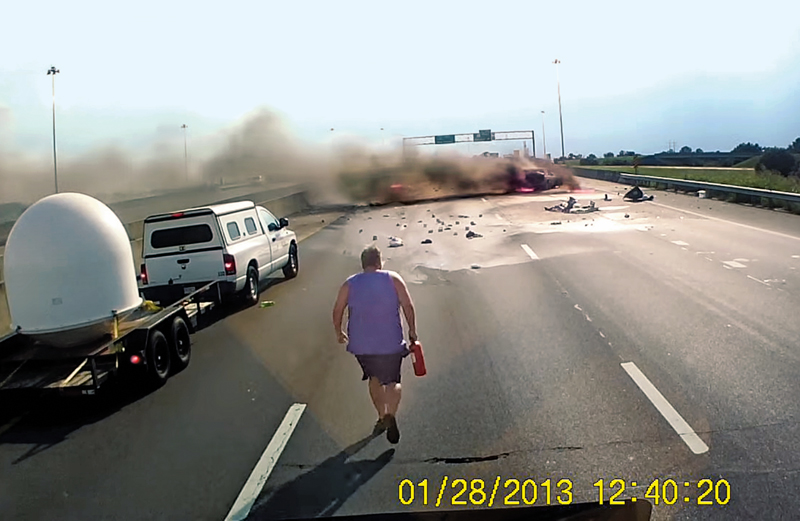
Remember David Fredericksen, the truck driver whose dash-cam video of his daring rescue of a woman and her granddaughter from a fiery crash on I-10 became a YouTube sensation last August? We always suspected there was more to his story than the five-minute footage shows. So we asked him.

How long have you driven long haul?
A little over five years. I’m 36 now. Before that, I did about everything. I worked on a drilling rig in Alaska, had a job in communications. I had to reinvent myself a few times. What’s that saying? Jack of all trades, master of none.

Why did you move around so much?
I was raised Baptist, but my family had lots of problems with drugs. I fell away from faith for many years, partying pretty hard. Too hard. I hit rock bottom. Finally, I prayed to find a woman who wouldn’t let me do drugs, who knew God and wanted a family.

The next day I met my wife. She’s a pastor of a Russian church. We’ve been married for 12 years. I was on the way to worse, but now I’m fixing the problems that I had. I don’t have the anger anymore.

Does your wife worry about you on the road?
My wife prays every day for me. I don’t think she worries because I’m in God’s hands. I tell everybody I have two codrivers, Walter Letterman and my savior, Jesus Christ. Wally is a Christian and we talk a lot about God and the Bible. We pray together whenever issues arise in our lives.

When I go to sleep, my life is in Wally’s hands, but he’s also in God’s hands. So I feel like we’re doubly protected.

Have you run into danger on the road before?

One time Wally was sleeping and I was driving when one truck hit another truck in front of me and turned sideways.

It was weird, it was like in slow motion, and I was able to brake and turn the truck to the right and go around him. Now, these tankers, you’re not supposed to turn when you brake, because the liquid you’re carrying can slosh and flip you over.

But if I didn’t, it would have killed me, because I stopped 10 feet from hitting the other trailer. I wasn’t sure if the slow motion was a miracle or if it was all in my mind. Afterward, I bought this dashboard camera, so if anything happened again I could replay the tape and see if a miracle occurred or not.

On August 11, 2014, something did happen again…
Every week I haul orange juice from Florida to California and bring lemon juice back. On our way to California, we stopped at a truck stop in Biloxi, Mississippi, and I took over driving the evening leg.

About 10 miles down the road, Wally has his shoes off and he’s sitting in the back of the cab getting ready to eat dinner. That’s when I see her—once again, in slow motion. Headlights going in the wrong direction. The car did a 180 and hit the truck in front of me. There was an explosion.

I got the truck stopped and Wally goes, “I think they’re all dead, dude.” I kind of agreed with him because all I could see was a burning fire.

But I said, “I’m going to go out there.”

Wally asked what I was going to do. I thought of the small fire extinguisher next to the driver’s seat. We live in these trucks, so there’s not room for anything bigger. It wasn’t really designed for a fire like this.

I grabbed it, pulled the pin, and started praying as I walked to the wreck. God, please let these people be all right. But I was thinking at least I would try to put out the fire so the bodies wouldn’t burn.

What happened next?
I saw an older lady, trying to kick the door open. It was jammed. I put a little effort into it and it came open naturally. Wally came up behind me with another gentleman.

He said, “I see a hand, it’s moving.” There was a little girl in back, the woman’s granddaughter. I stepped back and used the fire extinguisher to keep the flames back as the others got her out of the car. As soon as we got them out, the fire burned everything.

The little girl was squeezing Wally’s neck and he’s patting her on the back telling her everything will be okay. She didn’t want to let go. Somehow, she wasn’t burned. Her car seat was unbuckled and thrown to the driver’s side of the car, away from the flames. God’s got a plan for that little girl.

Weren’t you afraid of getting hurt?
It’s the most surreal thing. I was praying the whole time, and I didn’t feel the heat. I didn’t burn my hands. Wally asked me later if I knew what was all over the ground—I didn’t even smell the gasoline. It could have lit up and I’d have been burned alive.

The entire time I wasn’t afraid, but when I got back into the truck, I held my hands out and they were shaking. I was back to reality. As soon as the fire was out, I drove down the ramp, went around the accident, and kept going on down the highway.

You just went back to work?
I had somewhere to be. Our only stop was in Texas for a new fire extinguisher. Wally and I made the delivery in California. We didn’t tell anyone about what happened until later. I told my wife that night on the phone and e-mailed her and my three kids the video from my dashboard camera.

One of your sons uploaded that video to YouTube.
Logan did that. My son from a previous marriage. He spends too much time on the computer. But I was happy it had an impact on him.

He was born before I turned my life around. I pray all the time that God will help me claim back the relationship with Logan that I destroyed. I’ve seen a big change in him. Of course, the video made my kids think I’m a hero.

You don’t think you are?
People say we are heroes. We’re not. They say, once you got out and started helping, everybody else came. Maybe they were getting out of their trucks the same time as me. I would hope all of us would actually get out and do the same thing. It was the only choice.

I’m convinced God used me for a vessel that day. If we were 20 seconds earlier that car would have run into us. I believe that we were meant to be right behind them.

I think back to when I was fighting the Lord and my wife would come home and thank God for our paychecks. I was offended. What do you mean, thank God for our paychecks? I’m the one that got up, I’m the one that did this, I, I, I. Now I see what my wife is talking about.

Haven't seen David's heroics? Watch the video!

Download your FREE ebook, Mysterious Ways: 9 Inspiring Stories that Show Evidence of God's Love and God's Grace.

The Case of the Missing Suitcase

“Paging Missie Miller, Missie Miller, please report to the informa­tion desk.”

Me? What did they want with me? Again came the announcement. I stopped and glanced at my hus­band, Jeff. We’d just gotten off our flight from Los Angeles, and I could tell he was thinking the same thing I was. What now?

All I wanted was to get to my home, outside Dayton, and sleep in our big, comfortable bed. Instead, Jeff and I had been living in airports for two days straight. Our vacation to Hawaii had started off great. We’d found cheap tickets to Honolulu. The only catch was we’d have to fly standby. We were willing to take our chances. Big mistake. On our way home, the Friday before Labor Day, we were bumped from two flights out of Honolulu and stranded over­night. We caught an early-morning flight to Los Angeles, only to be bumped from three more flights and stranded overnight again.

Meanwhile, our luggage had made it onto the first flight out of Hawaii and was waiting for us at the Dayton International Airport. In the interim, we’d been living off airport food and the contents of my purse: toothpaste, deodorant, banana chips and a can of Pringles. With every promise of another flight, we asked God to get us safely home.

More The Case of… Stories

An agent offered a Sunday-morning flight to Indianap­olis, a two-hour drive from where we lived. By that point, we were willing to go anywhere, as long as it got us closer to Ohio, so I said, “Book it.” We’d rent a car in Indianapolis, drive to Dayton for our luggage, then head home. I felt a glimmer of hope. God was moving things in our favor.

Now all I felt was nerves as my name was repeated over the airport intercom. “What did you do?” Jeff joked. I couldn’t help but laugh. How much more trouble could we be in? It was as if we were in a real-life version of Planes, Trains & Automobiles! We went up to the information desk

“I’m Missie Miller,” I said to the desk attendant. “You paged me?”

“The police need to talk to you,” the attendant said, then gestured to a cop nearby. Why on earth did the police want to talk to me? Last time I checked, it wasn’t a crime to eat Pringles out of your purse!

Jeff and I walked toward the officer. As we did, I was momentarily dis­tracted by a woman coming up the escalator to our level. She was wearing a yellow peasant blouse, just like one I had. How strange. “Focus, Missie,” I told myself.

The officer sized us up. “Is this your luggage?” the cop said, pointing to a black suitcase. Our suitcase!

“What’s our luggage doing here?” Jeff said. “It’s supposed to be in Dayton. And we had two bags….”

The cop ignored Jeff and asked me if I’d just gotten out of a taxi. “No,” I said. “We got off the plane from L.A. a few minutes ago.”

“You’re sure you didn’t leave your luggage in a taxi?” the cop asked. Two more police officers arrived.

Just then, another voice piped up from the information desk. “I’m Missie Miller,” a woman said. I spun around. The woman in the yellow peasant blouse! What were the odds we’d have the same name and the same blouse? I eyed her more close­ly. Wait a second…. She was wearing my sunglasses…and my favorite cutoff shorts. And toting our second suitcase! What was going on?

The cop waved her over, then asked us both to show our IDs. I pulled mine from my purse. The other Missie Miller said she didn’t have an ID. The officer had her open her purse and then checked her license. She was not Missie Miller. She was handcuffed and led away.

That’s when Jeff and I got the whole story. The woman had taken our suitcases off the baggage carousel in Dayton, changed into my clothes and assumed my name, which was on the luggage. Then she’d hailed a cab to Indianapolis, most likely to steal from baggage claim again, the cops said. When she got to Indianapolis and tried to pay for the taxi, her credit card was de­clined. So she took one suitcase with her, left the other one in the cab and told the driver she’d be back with cash. She never returned, and the cabbie contacted the police. Meanwhile, at the airport, the woman approached the ticket counter and tried to get a flight out by saying that her name was Missie Miller and that she’d lost her ticket. That didn’t work and she was most likely on her way out of the airport when she heard the message on the loudspeaker…

Jeff and I looked at each other, stunned. We’d had no idea that our bags had been stolen! Luckily, God knew where we needed to be.