Embrace God's truth with our new book, The Lies that Bind

Blueberry Almond Muffins

These muffins are wonderful breakfast treats. The blueberries, full of antioxidants and low in fat, make these great for anyone with diabetes.

Ingredients

2 c. all-purpose flour ⅔ c. sugar
1 Tbsp. baking powder ½ tsp. baking soda
¼ tsp. salt ¼ c. vegetable oil
1 egg 1 c. 1 percent milk
½ Tbsp. vanilla 1 ½ Tbsp. almond extract
1 c. fresh blueberries

Preparation

1. Preheat oven to 350°F.

2. In medium bowl, whisk together flour, sugar, baking powder, baking soda and salt until well blended.

3. In another bowl combine oil, egg, milk, vanilla and almond extract until well blended.

4. Pour liquid mixture into middle of flour mixture and stir until not quite all combined.

5. Add blueberries and gently finish combining. Spoon batter into 18 muffin cups, filling each about 2/3 full.

6. Bake until a toothpick inserted in the center comes out clean, about 15 to 18 minutes.

Blessings in Concert

Michael W. Smith is a successful Christian musician. He’s toured with Amy Grant, released 22 albums—many winning Grammy and Dove Awards, and authored ten books.

But as he describes in his latest book, A Simple Blessing: The Extraordinary Power of an Ordinary Prayer, the blessing he says over the audiences at his live performances has become a surprising source of inspiration–for both Smith and his fans. Here it is:

In the name of Jesus Christ,
I bless you with the promises of God,
which are “yes” and “amen.”

May the Holy Spirit make you healthy
and strong in body, mind, and spirit
to move in faith and expectancy.
May God’s angels be with you to
protect and keep you.

Be blessed with supernatural strength
to turn your eyes from
foolish, worthless, and evil things, and to shut out
the demeaning and the negative.
Instead may you behold the beauty of things
that God has planned for you
as you obey his Word.
May God bless your ears to hear the lovely,
the uplifting, and the encouraging.
May your mind be strong, disciplined,
balanced, and faith-filled.

May your feet walk in holiness and
your steps be ordered by the Lord.
May your hands be tender and helping,
blessing those in need.
May your heart be humble and
receptive to one another
and to the things of God, not to the world.

God’s grace be upon your home,
that it may be a sanctuary of rest and renewal,
a haven of peace where sounds of joy
and laughter grace its walls,
where love and unconditional acceptance
of one another is the constant rule.

May God give you the spiritual strength to
overcome the evil one
and avoid temptation.
May God’s grace be upon you to
fulfill your dreams and visions.
May goodness and mercy follow you
all the days of your long life.

Watch our interview with Michael W. Smith!

Download your FREE ebook, A Prayer for Every Need, by Dr. Norman Vincent Peale

Blessed with the Gift of Song

People from all over the world filled the corridors of the cruise ship. My husband, Dale, and I caught snippets of French, German and even Chinese. We were a long way from our quiet life in rural Montana.

Sailing along the Alaskan coast was like a dream, and there were so many things to do: eat delicious food, swim in the pool, relax at the spa. First Dale and I headed to a Bible study. “This ship really has it all,” Dale said. “We can do anything!”

Almost anything, I told myself. But I couldn’t stop thinking about my secret dream: to sing on a cruise ship. I had asked our cruise coordinator about it just after we’d booked our trip.

“Is there anything else I can do for you?” she asked.

“I’d love to sing on the ship!” I blurted out. She must have thought I was crazy. Back when Dale and I went on our first cruise, the music made me want to sing onboard, to share the joy I got from singing about God with others.

But only professionals sang on cruises. I thought I’d forgotten the idea completely—until the words popped out of my mouth.

“I’ll look into it,” she said cheerfully. I was put in touch with a few cruise representatives, but I never heard anything after I arrived onboard. Dale and I took our seats in the Bible study.

We greeted the other passengers, and the pastor read some Scripture to get things started. Then he opened the floor to anyone who wished to contribute. Dale raised his hand. “My wife has a song she’d like to sing,” he announced. I nearly fell off my seat.

The pastor nodded permission. The other passengers looked at me expectantly. This is what you wanted, I thought. Could I just start singing right then and there?

I stood up, my heart pounding. Dale squeezed my hand. “We’re pilgrims on a journey… on a narrow road…” I sang. The group applauded as I finished the final note. I did it, I thought. Thank you, God, for giving me my dream! I sat back down.

I’d barely touched the chair when someone called out, “Sing another one!” Everyone agreed. “Go on, hon,” said Dale. I sang two more gospel songs before we adjourned. What a day! What a trip!

The next afternoon, Dale and I were walking to our room when I heard my name. I spun around. It was a woman from the Bible study. “Won’t you sing something for me?”

Why not? I sang right there in the hallway. Heads turned toward me. One man nodded to my words. A woman smiled as she passed. “They weren’t even from the Bible study,” I said to Dale when I finished.

We continued to our room. But we didn’t make it far. Another couple stopped us. “You have a great gift,” the wife said. “Care to share it again?”

We sailed on, up the Alaskan Panhandle. Ketchikan, Juneau, Skagway. And all the way, people kept asking me to sing. One evening, as Dale and I were leaving the dining room, a family called to me from their table, asking for a song. Dale laughed—he’d gotten used to it by now.

I started a hymn. As I went into the chorus, waiters stopped serving to listen, trays in hand. All of the attention had turned to me.

I finished the song to a ripple of applause. I felt honored, but not because the other passengers liked my voice. I was exhilarated by what God had done for me. We all have dreams. When those dreams come from God, they really do come true.

Download your FREE ebook, Angel Gifts: Inspiring Stories and Angel Crafts to Nurture Your Creativity

‘Black Or White’ Attempts to Bridge the Racial Divide [REVIEW]

Black or White, the Mike Binder-directed film, is a story about love across racial lines that is loosely based on Binder’s real-life story. After major studios passed on the project, it was funded by Binder’s long-time friend and the star of the movie, Kevin Costner. For his part, Costner does an excellent job bringing to life the sad, cantankerous drunk that is his character. As a man recently widowed and left to care for his young, bi-racial granddaughter, Costner gives one of his most vulnerable performances to date and continues to prove how thoroughly watchable he is onscreen. Co-stars Octavia Spencer, Anthony Mackie and newcomer Jillian Estelle also turn in inspired work. The young actress, who had to beat out thousands of other hopefuls for the role of Costner’s granddaughter, Eloise, gives the story the heart it needs.

Unfortunately, Binder relies heavily on racial stereotypes to tell his story. Costner is the predictably affluent white man, a partner at a firm living in a well-to-do neighborhood complete with a pool and Spanish-speaking maid. Eloise’s father (played by Andre Holland) is the dead-beat dad, a street thug who seems to prefer spending his time getting high than being a real presence in his daughter’s life. The beginning half of the movie slowly sets the stage for the ultimate courtroom battle over who should retain custody of Eloise. Should she continue to live with her grandfather, who’s been her parental figure for much of her life, or should she stay with her biological grandmother (Spencer), the maternal presence she so desperately needs after her mother and maternal grandmother have passed away?

There’s no easy answer, though things are wrapped up a bit too tidly in the end, and oftentimes heavy scenes are approached too simplistically to make a real impact. What can and should be admired about the film, though, is its courage. Even when some of its bravado is lost in glossed-over issues and heavily scripted (yet rousing) dialogue, the movie’s purpose remains clear. Both Spencer and Costner’s characters care more about family than they do race, though outside parties try to fuel the argument by bringing color into the mix.

The film attempts to maintain a fair view of both sides. Yes, Costner’s character can provide stability and a financially secure life for Eloise, but he’s also stricken with grief and resentment after the earlier death of his daughter and more recent passing of his wife and can often be found with a glass of liqour glued to his hand. Spencer’s character, on the other hand, is full of tough love and offers Eloise the family, history and culture she’s assuredly missing out on in her solitary life with her grandfather, but her son’s penchant for getting into trouble, his violent outbursts and life-crippling addictions make moving Eloise out to Compton to be with her father’s side of the family so questionable. Meaningful commentary on issues of race and deliberate effort on the part of the director and actors not to shy away from things too sensitive or hard to talk about give the film integrity and the performances greater value.

Black or White is no Selma (a movie which deserves more recognition than it’s received), but its timeliness can’t be ignored. Perhaps it isn’t the most revealing look at race and racial issues in this country (it has that feel-good family tint that promises a happier ending than most similar real-life situations), but at least it has the courage to try.

Berry-Chia Breakfast Crisp

I was tidying up my desk at home when I came across them—my old scripts.

I believe that there are no coincidences. Looking back on my life, I could easily see how one thing led to another. Hobbies that turned into jobs. Interests that developed certain skills. It all made sense.

Except for one thing that didn’t quite fit. The six years I spent writing and producing murder mysteries.

It was a passion that started the summer I joined a writers group at my local library. The librarian mentioned she was looking for plays to be performed at the town’s centennial celebration. That’s how I wrote my first script—Who Stole Widow Murphey’s Cow? The dark comic twist at the end took everyone by surprise. People loved it. The show was performed three times that summer!

I wrote another murder mystery play. Then another. Like the one about a florist who accidentally poisoned herself. Or the one about a deadly wood chipper. And who could forget The Gatekeeper and the Mystery of Life? I kept writing and writing plays. Always comedic murder mysteries, one after the other.

I even put on shows at the RV park where my husband and I worked. They really brought residents together. Some of them volunteered as actors. Others made flyers advertising my plays. A few even teamed up to design and paint the sets.

Eventually, though, my husband and I retired and moved. I retired my murder mysteries too. I’d lost interest, as if a flame had gone out. I flipped through the old scripts now. Why had I been so obsessed? It’s not as if my stint writing clever plots had ever led to something. I wasn’t going to sell a script to Hollywood anytime soon.

And then it hit me. Something I’d read in a book ages ago. At the time, I’d been having nightmares. So one day, browsing in a bookstore, I picked up a volume at random: Edgar Cayce on Dreams. “God speaks to you in dreams,” the first line read. I took it as a sign and purchased the book. Funny thing was, the minute I tried to decipher my nightmares, they stopped. But I did come away with a lifelong love of dream study. And a handy tip: Whenever you have a question, put it to God before you go to sleep.

Maybe I could use that technique now. I sat at my desk, got out a pen and scrap of paper. “God,” I wrote, “why did you put murder mysteries in my life?” That night, before bed, I slipped the note under my pillow and got under the covers. I dreamed vividly. I saw myself in some kind of office building. There was a man standing by a door. I didn’t recognize him. He had that kind of vague, hazy face I’d seen in dreams before. “Right this way,” he said. “We’ve been expecting you.”

“You have?” I said.

He opened the door to a conference room with high ceilings, light and airy. In the middle of the room was a large table. I tried not to stare, but I found it impossible. Around the table sat 12 or so nuns in full habit. Nuns!

I wasn’t Catholic. I’d never even talked to a nun before. But somehow I didn’t feel out of place among them. I felt as if I belonged. “This is your seat,” the man said, pointing to the head of the table.

“Mine?” I said. There had to be some mistake. But the nuns simply looked at me as if my arrival were the most natural thing in the world. I took my seat.

“Welcome to the committee,” the man said. “We create dreams for people on Earth. The kind of dreams that improve and change lives.”

What? A committee for dreams? Ridiculous! And with that I was back in my bed, alarm clock blaring.

“I had the weirdest dream!” I said to my husband at breakfast. I told him all about the office building, the conference room and the nuns.

“What do you think it means?” my husband said.

I took a sip of coffee. The dream was bizarre. But for some odd reason, I knew exactly what it meant. All those years I’d spent writing murder mysteries? All those intricate plot lines, cliffhangers and twists? The kinds that audiences could never see coming? They had been leading me to something all along.

“That’s my job in heaven,” I said. “I’m going to create dreams!”

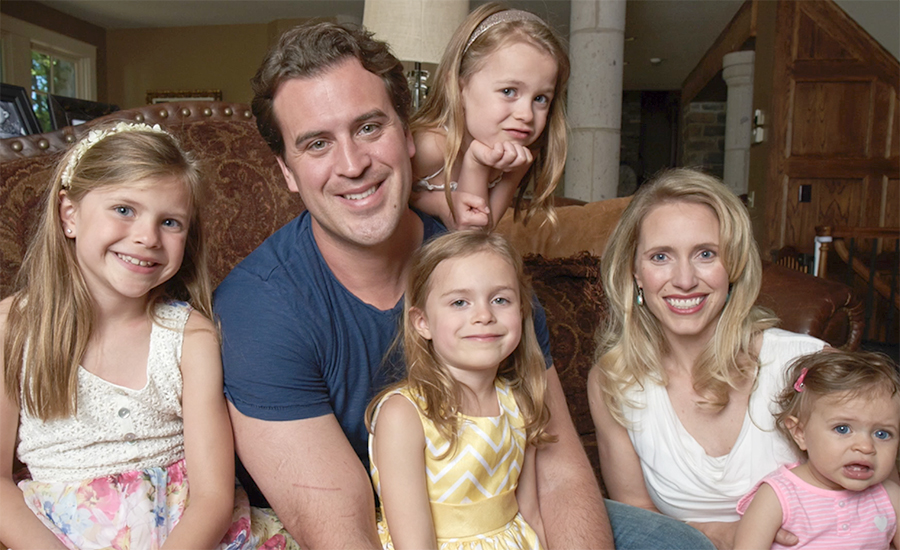
Ben Utecht on ‘You Will Always Be My Girls’

Hi, “Guideposts.” I’m Ben Utecht, former NFL player and Super Bowl champion with the Indianapolis Colts, husband to an amazing wife Karyn, and four beautiful daughters Elleora, [INAUDIBLE], Amy, and Haven. In 2009, I took my fifth documented concussion, and that really led to a very difficult decision in my life which was to walk away from the game that I loved to play. And that was due to some of the cognitive problems that I was facing with memory loss.

I don’t know what would have happened to me emotionally if I didn’t have music, because music provided purpose. I was challenged to write a song that I had never had the courage really to go through. And that was really to kind of go through this therapy of dealing with what the future could hold. And so I sat there on a plane, 30,000 feet above the ground and began to write this letter to my wife and girls.

And I remember just being so embarrassed because I’m this big masculine football player and I’m beginning to weep like a little boy on that plane, and I pulled my hat down. But I just poured myself out into this letter. The intention was that with that we would pull out of that a song that could really be a legacy for my wife and daughters. And also, I think, provide a platform of hope for people who are going through difficult times on their own.

I don’t take my moments, I don’t take those memory moments with my family for granted anymore. Because I don’t know how long they’re going to be there. Every moment is important.

You know without my relationship with the Lord, I don’t know where I would be. That really helped me through this process to stay focused and really begin to understand that there’s so much more to my life than football.

[MUSIC – BEN UTECHT, “YOU WILL ALWAYS BE MY GIRLS”]

I’m in here counting the days, while my mind is slipping away. I’ll hold on as long as I can to you. I may not remember your name, or the smell of a cool summer rain. Everything and nothing has changed, nothing has changed. And I will remember your smile and your laughter long ever after this moment is gone. You’ll always be my girls. You’re the beauty of my world. And no matter how tomorrow unfurls, you will always be my girls.

I can still feel you here. And this pain is beyond all tears. When love does what it does, it stays. Yes, it stays. And I will remember your smile and your laughter long after this moment is gone. You will always be my girls. You’re the beauty of my world. And no matter how tomorrow unfurls, you will always be my girls.

Seasons turn and turn again. Seasons turn. [INAUDIBLE] Remember when. The love in your hearts made this man complete. My Cinderella, you danced on my feet. You will always be my girls, you’re the beauty in my world. You’re the only thing that matters, that matters to me. You will always be the ones, I could run to. And no matter how tomorrow unfurls, till the moment I am done with this world, my [INAUDIBLE] babies in curls. You will always be my girls.

Ben-Hur: How Lew Wallace Found Faith in Epic Fiction

This August, nearly 60 years after MGM’s blockbuster movie, a new version of Ben- Hur, starring Jack Huston and Morgan Freeman, will reach theaters. As with a lot of major studio releases, there will be a book to accompany it, a novel with a picture of Ben-Hur himself in a chariot on the cover. But what’s unusual is that this novel was originally written in 1880.

As it happens, the author was my great-great-grandfather, Lew Wallace, and I wrote this contemporary version of his novel. Along the way, I found out a great deal about my ancestor, how he came to write his masterpiece, and how it defined his faith.

As a little girl, I was very proud of Lew. He had been a Union general in the Civil War. He had put Billy the Kid in jail (we had a letter from the Kid hanging in our back hall). He was a diplomat and, of course, a best-selling author. Editions of Ben-Hur took up serious shelf space in our house. I even have dim memories of my parents bringing home an illustrated program from the 1959 premiere of the film starring Charlton Heston.

READ MORE: MY WIFE REWROTE ‘BEN-HUR

What I didn’t have was familiarity with the book that started it all, because Ben-Hur in its original version is a tough slog for today’s readers. But while adapting it I not only became a great fan of the text but also came to understand the surprisingly moving backstory.

Lew Wallace, it turns out, was a seeker—one of those people whose eyes are on the horizon looking for something more. When he was young, it was adventure. He ran away from home in Indianapolis at 16 to join the Texan war for independence, but got no farther than the banks of the nearby White River. Later, as a soldier, he longed for glory, and it seemed within his grasp until the Battle of Shiloh, in April of 1862.

He was then 34, the youngest major general in the Union Army, a striking figure on a big bay horse, in charge of the 3rd Division—nearly 6,000 hardened soldiers. On the morning of the battle they were held in reserve, waiting for General Ulysses S. Grant to call them up to the field of action.

Yet there was a long delay between Lew’s receiving Grant’s orders and his troops’ arrival at the Union line. In fact, they got there at the close of the first day’s fighting. This was Lew’s disaster.

READ MORE: HOW BOOTH SAVED LINCOLN

Shiloh was one of the first major battles of the Civil War. The casualty numbers were appalling. In Washington, Union leaders demanded to know why Grant’s troops had performed so badly. His excuse: General Wallace didn’t get there in time.

Lew claimed the orders were unclear, but that didn’t matter; he was stripped of active command and the brilliant trajectory of his military career was halted. He never got over it. Years later he was still trying to clear his name. His anger and shame and shock never really died away.

How do we know this? From Ben- Hur. The years after the Civil War were hard for Lew. After a futile military adventure in Mexico, he unenthusiastically practiced law in Indiana. By middle age he was deep in debt. His escape was writing. In 1873 he published The Fair God, a novel about Hernán Cortés’s 1519 conquest of Mexico. The book was only moderately successful, but Lew kept writing.

His next effort was a novella about the Magi—it’s easy to see how this chronic adventurer responded to the story of three men who answered a mysterious call and set out into the desert in search of a redeemer. But he put his novella aside.

What turned that fragmentary story into a sweeping saga was a chance conversation. In 1876, Lew found himself in a train compartment with Robert Ingersoll, a superstar of the day—a sought-after speaker and America’s foremost agnostic. Ingersoll enjoyed grilling new acquaintances about their faith.

Lew had considered himself a Christian, but he didn’t go to church, didn’t pray regularly and barely knew the Bible. He was embarrassed by Ingersoll’s questions. He felt he should know more about his faith. And he decided that the best way to educate himself would be to write a novel set at the time of Christ, about a young man whose life is changed by Jesus.

READ MORE: HARRIET TUBMAN’S INSPIRING LIFE

People often forget that the novel’s full title is Ben-Hur: A Tale of the Christ. And though the film versions have tended to focus on the chariot race, Lew’s book (like my version) goes beyond that to include the hero’s redemptive encounters with Jesus. It was the spiritual content that launched Ben-Hur into widespread success.

When it was first published, in 1880, Lew expected merely respectable sales figures. He went off to Constantinople (now Istanbul) to serve as U.S. Minister to the Ottoman Empire. When he came home, five years later, to his surprise and great relish, he was famous. Ben-Hur’s combination of excitement and inspiration had touched thousands of readers.

Do you remember the plot? The hero, Judah Ben-Hur, is a young prince of Israel, living in a palace in Jerusalem, when his childhood friend Messala returns from years in Rome. As boys, they were inseparable, but Rome’s heavy-handed occupation of Jerusalem, along with Messala’s arrogance, now comes between the young men.

Watching a parade of Roman soldiers from his rooftop, Ben-Hur knocks loose a tile, which wounds a Roman officer. In retaliation, his mother and sister are imprisoned and he himself is carried off in chains to serve as a slave in a Roman galley. Messala does nothing to intervene and Ben-Hur spends five years belowdecks pulling an oar, nursing dreams of revenge.

READ MORE: THE SURPRISING SAGA OF THE CHAINED PRINCE

Like his hero’s, Lew’s life had been derailed in a shocking way. At Shiloh, his trust in a golden future was shattered. His anger and sense of outrage fuel the storytelling; Ben-Hur’s bitterness is Lew’s own. What’s more, Ben- Hur’s violent response to his grievance was one that would have been familiar to Lew, who was first and foremost a soldier. Ben-Hur’s revenge during the chariot race is merciless.

That race is not the end of the book, though. Ben-Hur continues to solve his problems with violence, leaving an impressive body count. Even his encounters with Jesus fail to change his habits until the Crucifixion, when he finally understands the message of peace. In the 1880s, as the national trauma of the Civil War receded, that was a thoroughly welcome idea to the reading public of America.

And though Lew never did become a regular churchgoer, writing Ben-Hur nurtured his faith. His authentic belief and his reverent treatment of Jesus’ message helped his book become a phenomenon.

In an era when fiction was often frowned on, this novel that featured Jesus as a speaking character was recommended from pulpits across the country. Word-of-mouth success was followed by a play seen by millions and, ultimately, multiple film versions.

My experience writing this new book echoed Lew’s. He claimed that he lived with his characters, that they lived and spoke to him in his imagination, and my process is similar. Like my great-great-grandfather, I have imagined myself into Jesus’ presence, not once but repeatedly. I have a feeling you know what I mean.

For more inspiring stories, subscribe to Guideposts magazine.

Behind the Scenes of ‘The Shack’ with Sam Worthington

Sam Worthington, in his story about the making of his new film, The Shack, for the April 2017 Guideposts, reveals that he knew as soon as he read the script that he wanted to play the lead character, Mack Phillips, in the much-anticipated motion picture. His opportunity to star in the movie, Worthington wrote, was “more than coincidence.” In this image gallery, Worthington shares some stills that will appeal to fans of the book and the movie.

Read Sam’s story about the making of the film from the April 2017 issue of Guideposts!

Battling Banana Breads

Two guys walked up to us in the strip mall parking lot just as my husband and I were about to get in our car. They were carrying a cooler. Something about them gave me a strange vibe, so I opened the passenger door and climbed in.

“Would you like to buy some banana bread?” I heard one of the men ask David.

What do they really want? I wondered.

“No, thanks,” David said. “My wife makes the best banana bread.”

“I understand,” the man said. “Please take this, though.” He handed David some sort of paper.

“Sure,” David said casually, no tension in his voice as he opened the driver’s side door. He’s a retired Houston cop, and if alarm bells weren’t ringing for him, I figured there was nothing to worry about.

Besides, it wasn’t as if I didn’t have enough on my mind. The oldest of my three kids, my son Wesley, had been addicted to drugs since his early teens. But I’d never seen him as hopeless as he was now, at 20. Lately every time my phone rang, I expected it to be the morgue asking me to come identify his body.

Really, I’d worried a lot about Wes right from the start. Changes that other toddlers got used to with just a little fussing totally threw him. Everyday things like wearing long sleeves, taking time-outs and putting on sunscreen triggered huge tantrums that took him forever to come down from. It tore at my heart to see the frustration and misery in his big blue eyes. Even worse, sometimes there was nothing I could do to ease his pain. It was as if he didn’t want me to help him.

The only place I could turn was my faith. Every night when I tucked Wes into bed, I would lay one hand on him and ask God aloud to protect him, our family and anyone we knew who was having a tough time. Then I’d say a silent prayer, not wanting to put pressure on my little boy, who already struggled with so much. God, please make life easier for Wesley, I prayed. Bring him peace.

I hoped he’d grow out of his oversensitivity once he was in school, but if anything, his moods grew more extreme. At one point, I tried making all his food from scratch, hoping that if I eliminated additives and preservatives it might help him. We took him to a chiropractor, an acupuncturist, a psychologist and a psychiatrist, who diagnosed Wes with ADHD and put him on medication. Thank you, Lord, I thought. This is what I’ve been praying for. The meds didn’t bring him much relief, though.

When Wes was a teenager, I took a job as a flight attendant, which had me away from home only on weekends so it wouldn’t disrupt the kids’ routines. Still, he had frightening outbursts—he’d bang his head against the wall, beat things with his fists. I worried about his younger sister and brother too. They weren’t getting as much attention from me and Wes’s behavior had to be traumatizing for them.

Wes’s dad and I had our own issues—dealing with a troubled child puts a tremendous strain on a marriage and ours wasn’t the strongest—but we did everything we could for Wes. We gave him love. We gave him rules. He broke them all.

Wes was over at a friend’s one day when I called to check in. He sounded off, his words slurred. “You okay, Wes?” I asked.

“Yeah, Mom…” he mumbled. “I’m…fine.”

He’s lying, I thought. The minute Wes got home, I confronted him. He admitted to smoking pot. “But I don’t have a problem,” he said. I dropped to my knees and sobbed. I knew life was a constant struggle for Wes, but drugs at 14? “Why couldn’t I have seen this coming and stopped it?” I cried out to God. “Why didn’t you? You say in your Word that you love Wes and me, so why are you allowing this to happen?”

Wes was right. He didn’t have a problem. He had a full-blown addiction. He was caught at school hiding a joint. I found more pot and a pipe in the attic above his room. From there it was tranquilizers, narcotic painkillers, hallucinogens. When Wes was 16, his dad and I divorced and Wes went to live with him. Even though we weren’t in the same house, his addiction consumed me.

I managed to keep things together at home, barely, and take care of my other two kids. On the road, though, I’d lock myself into my hotel room and scream, not caring who heard me. I was that desperate to release my own pain. God, why haven’t you brought my son the peace I asked for? Can’t you see he’s suffering? Don’t you care?

If it hadn’t been for another flight attendant I met at work, a wonderful man named David, my spirit would have been completely broken. David was kind, supportive and strong. His background as a narcotics officer gave him insight and understanding about my son’s struggles. And mine. “We’re going to get through this. So will Wes,” he told me. “We’ve got God on our side.” Having David in my life made me want to believe that again, hope again.

David and I got married when Wes was 17. As much joy as our marriage brought me, it was tempered by the heartache of watching my son plummet further and further into the hell of addiction. I can’t remember how many times I confronted him, pleaded with him to get clean. Or how many times he landed in hospitals or rehab, only to start using again as soon as he got out.

Now Wes was 20 and I felt like I was in mourning, with the terrible grief of a mother who knows her child is lost to her, beyond prayer, beyond hope. I wanted to rest my head against the dash and cry. Instead I put on my seat belt and watched the two guys walk away with their cooler. And their banana bread. What was that all about, anyway?

David got in the driver’s seat. “I think you need to see this,” he said, handing me the paper he’d been given.

It was a flyer. “Victory Family Center: The Road to Recovery Starts Here” the front proclaimed. A shiver ran down my spine.

David had started to drive away. “Wait!” I said. “Turn around.”

Back in the parking lot we spoke to one of the men with the banana bread. “Victory Family Center has a six-month live-in recovery program,” he told us. “Residents participate in daily chapel services, group sessions, Bible studies and various work activities designed to motivate and build character. All our services are free.” To help support the center, residents sold banana bread, which also gave them an opportunity to tell others about the ways God had worked in their lives.

I felt that shiver again, and I knew he had to be at work right here and right now. I called Wes on my cell phone. “There’s this place I think you should check out,” I said. “It’s a rehab center that really focuses on God. Please just see how it is. Not for me. For yourself.”

Silence. Was he going to hang up or tell me to stay out of his life? I braced myself.

“Yeah, okay,” Wes said. “I’ll go, I guess.”

David was the one who took Wes to Victory Family Center that very night. I couldn’t bring myself to go. If he refused to check himself in, I wouldn’t be able to take it. As soon as David got home, I ran to him. “Please tell me he stayed,” I said. “Please tell me something good.”

“The first thing the counselors did was open their arms and hug Wes,” he said. “They told him they loved him and were there for him no matter what.”

On my first visit to the Victory Family campus, I saw that love in action. The place was very structured—no TVs, no couches to lounge on. Every resident was given a job, something to take responsibility for. “I love it here,” Wes told me. “I feel like I have a purpose.”

Still, after he finished up the six months, he relapsed. But now I understood that relapse was part of the disease. He got clean again and recommitted to Victory Family for a two-year program. He traveled all over the Houston area with a cooler full of banana bread, helping addicts get on the road to recovery. Helping others get straight helped him stay straight. David and I talked to him all the time, and we visited regularly with his sister and brother too.

One afternoon David and I took Wes out for lunch. “Mom, if I hadn’t gone through everything that I did,” Wes said, “I never would have changed or given my life to Christ.” His big blue eyes were filled with light, with life—and something else I couldn’t quite put my finger on.

“I’m so proud of you, Wes,” I said to him. “I…”

Before I could finish, he spoke again.

“And, Mom, when I wake up in the morning I am at peace. And when I go to bed at night, I have peace.”

My deepest prayer for my son was answered, a miracle as sweet as banana bread.

This story first appeared in the March 2013 issue of Guideposts magazine.

Barb’s Best Waffles

Drizzle with pure maple syrup or Barb’s favorite, boysenberry syrup.

Ingredients

4 cups Bisquick

1 cup millet flour

Pinch baking soda

¼ cup canola oil

3 eggs

3 cups buttermilk (or more to thin)

¼ cup water

Preparation

1. Mix ingredients together and beat well to eliminate all lumps.

2. Pour batter into the waffle iron. Cook waffles till golden brown.

3. Refrigerate any leftover dough.

Serves 10

Read how Barb used this recipe to change her life!

Bananas Foster

Ingredients

6 bananas
6 Tbsp. unsalted butter
3 Tbsp. dark brown sugar
2 oz. dark rum (optional)

Preparation

1. Peel bananas, then sauté the fruit in a lot of foaming unsalted butter in a large pan on the stove top.

2. Sprinkle ground cinnamon and a tablespoon or so of dark brown sugar over them as they grow golden and crisp. This won’t take much more than 5 or 6 minutes. Add a few ounces of dark rum to the pan at the end, if you wish.

3. Place a banana on each plate with a little drizzle of the butter, and serve with vanilla ice cream.

Serves 6.

Nutritional Information (without rum or ice cream): Calories: 230; Fat: 12g; Cholesterol: 30mg; Sodium: 0mg; Total Carbohydrates: 33g; Dietary Fiber: 3g; Sugars: 20g; Protein: 1g.

Read Sam’s inspiring story from the December-January 2021 issue of Guideposts!

Recipe is an edited excerpt from See You on Sunday. Copyright © 2019 by Sam Sifton. Photographs © 2019 by David Malosh. Reprinted with permission by Random House, an imprint of Penguin Random House, LLC.