Embrace God's truth with our new book, The Lies that Bind

Banana Pudding

This delicious recipe has been handed down from mother to daughter, and now you can try it at home!

Ingredients

2 c. plus 4 Tbsp. sugar 1 Tbsp. vanilla extract
4 Tbsp. flour 4 bananas, sliced
1 12-oz. can evaporated milk 1 box vanilla wafers
1 ½ c. regular milk ¼ tsp. cream of tartar
8 large eggs, separated

Preparation

1. Preheat oven to 350°F. Mix 2 cups sugar and the flour in a 2½-quart saucepan (using no heat yet).

2. Add evaporated milk slowly, stirring to make sure all lumps are gone. Rinse can out with about half a can of water and add to mixture.

3. Add regular milk and stir well. Beat egg yolks well with a fork; add to milk mixture.

4. Place saucepan on stove at medium-high heat and cook, stirring constantly, until mixture starts to thicken and comes to a light boil, about 10 minutes. Remove from heat. Stir in vanilla.

5. Layer the vanilla wafers flat on bottom of an oven-safe Pyrex dish, standing some up around the sides if desired, for looks. (You can also use smaller Pyrex dishes for individual servings.)

6. Spread banana slices evenly and pour pudding mixture on top.

7. Beat egg whites with cream of tartar and 4 tablespoons sugar until meringue is stiff. Spread on top, making sure edges are sealed, and bake until peaks are golden brown, around 10 minutes.

Serves 8 to 10.

Nutritional Information: Calories: 330; Fat: 7g; Cholesterol: 15mg; Sodium: 150mg; Total Carbohydrates: 66g; Dietary Fiber: 2g; Sugars: 53g; Protein: 8g.

Don’t miss Adrian’s inspiring story about her banana pudding helped to create jobs and foster growth in her community.

Download your FREE ebook, The Power of Hope: 7 Inspirational Stories of People Rediscovering Faith, Hope and Love.

Baked Tilapia with Spicy Tomato-Pineapple Relish

With warm weather on the way, this is the perfect meal for the whole family.

Ingredients

4 6-oz. tilapia fillets 1 plum tomato, diced
¼ tsp. kosher salt 1 teaspoon hot chili paste, such as sriracha (or more to taste)
½ c. crushed pineapple, well drained

Preparation

1. Preheat the oven to 375°F. Line a baking sheet with aluminum foil; coat foil with oil spray.

2. Place the tilapia on the prepared baking sheet and season with salt.

3. In a small bowl, combine pineapple, tomato and chili paste. Divide topping evenly among fillets.

4. Bake for 12 to 15 minutes, or until fish flakes easily with a fork.

Serves 4.

Nutritional Information: Calories: 180; Fat: 3g; Cholesterol: 85mg; Sodium: 210mg; Total Carbohydrates: 4g; Dietary Fiber: 1g; Sugars: 4g; Protein: 34g.

Baked Stuffed Tomatoes

A twist on the usual stuffed tomatoes, the combination of cheese and garlic give this dish a flavorful aroma and hearty taste.

Ingredients

6 firm tomatoes, at room temperature, washed

2 tablespoons oil

2 tablespoons fresh parsley, chopped

1 tablespoon scallions, chopped

1 clove garlic, chopped

1 cup dry breadcrumbs

6 tablespoons Swiss cheese, grated

Preparation

1. Preheat oven to 325°F.

2. Slice off top of tomatoes. Using a spoon, hollow out tomatoes, keeping an inch of meat on bottom and sides. Discard pulp.

3. Turn tomatoes upside down on paper towel to drain.

4. In a saucepan, heat oil, parsley, scallions, garlic and breadcrumbs. Mix together until just heated through and moist.

5. Place tomatoes in well-oiled casserole dish. Fill with stuffing.

6. Top each with 1 tablespoon cheese. Brush tomatoes with oil.

7. Bake for 45 minutes, basting with oil drippings occasionally.

Find out the story behind Peggy’s tomatoes in Red Thumb.

Baked Spaghetti

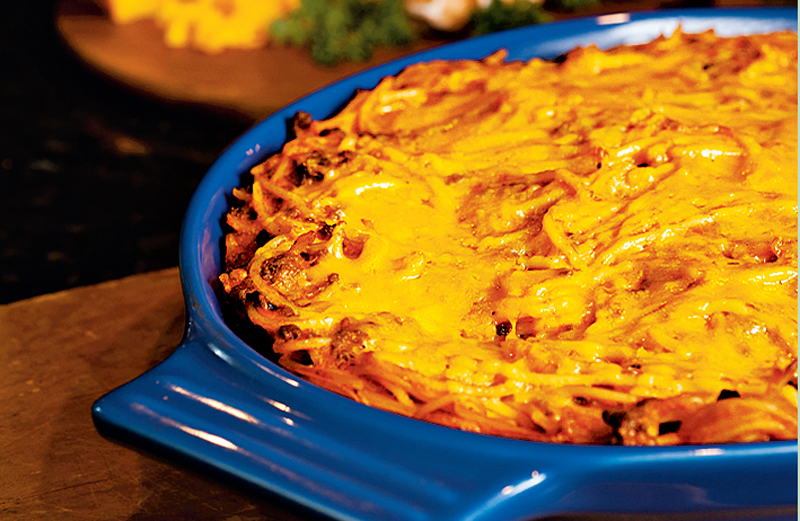
Carol, then in her teens, and the nice young man who would eventually become her husband bonded over this baked noodle dish the first time they met. We can’t promise you’ll find romance if you try this recipe at home, but you’ll enjoy a tasty and satisfying meal!

Ingredients

2 lbs. ground beef 6 tablespoons Worcestershire sauce
1 onion, chopped 2 soup cans water
3 cans tomato soup 1 ½ lbs. shredded cheddar cheese
2 cans cream of mushroom soup 1 16-oz. box spaghetti noodles

Preparation

1. Preheat oven to 350°F. Put water on to boil for noodles. In a large skillet, brown ground beef and onion together until meat is cooked through. Drain.

2. In a large pot over low heat, combine soups and Worcestershire sauce with the meat mixture, mixing well. Add cheese a handful at a time, reserving ½ cup.

3. Stir in water. Cook on low at no higher than a simmer, stirring occasionally, until the cheese melts.

4. Meanwhile, cook spaghetti until tender. Drain. Add to the rest of the ingredients and simmer 5 minutes, stirring occasionally.

5. Pour into two 9×13-inch baking pans. Cover with foil and bake 30 minutes.

6. Remove foil and sprinkle remaining cheese onto spaghetti. Continue baking, uncovered, for 15 more minutes.

Serves 12.

Nutritional Information: Calories: 680; Fat: 34g; Cholesterol: 125mg; Sodium: 1140mg; Total Carbohydrates: 45g; Dietary Fiber: 3g; Sugars: 8g; Protein: 42g.

Don’t miss Carol’s inspiring story about getting to know her future husband over a second helping of this dish!

Baked Potato Soup with Cheddar and Bacon

Ingredients

3 tablespoons butter

3 tablespoons all-purpose flour

5 cups milk

3 reserved baked potatoes, peeled and cubed (about 3 cups)

4 scallions, chopped (green and white parts)

¾ cup shredded Cheddar cheese

½ cup sour cream

4 slices bacon (regular or turkey bacon), cooked until crisp and crumbled

Salt and freshly ground black pepper

Preparation

1. Melt the butter in a large saucepan over medium-high heat. Whisk in the flour and cook for 2 to 3 minutes, until the mixture is blended and smooth. Whisk in the milk until blended. Stir in the potatoes and scallions and bring to a simmer, stirring frequently. Simmer for 5 minutes.

2. Reduce the heat to low, add the cheese, sour cream and bacon, and simmer for 1 to 2 minutes, until the cheese melts. Season to taste with salt and pepper.

Serves 4

Baked Lemon Cod and Broccoli

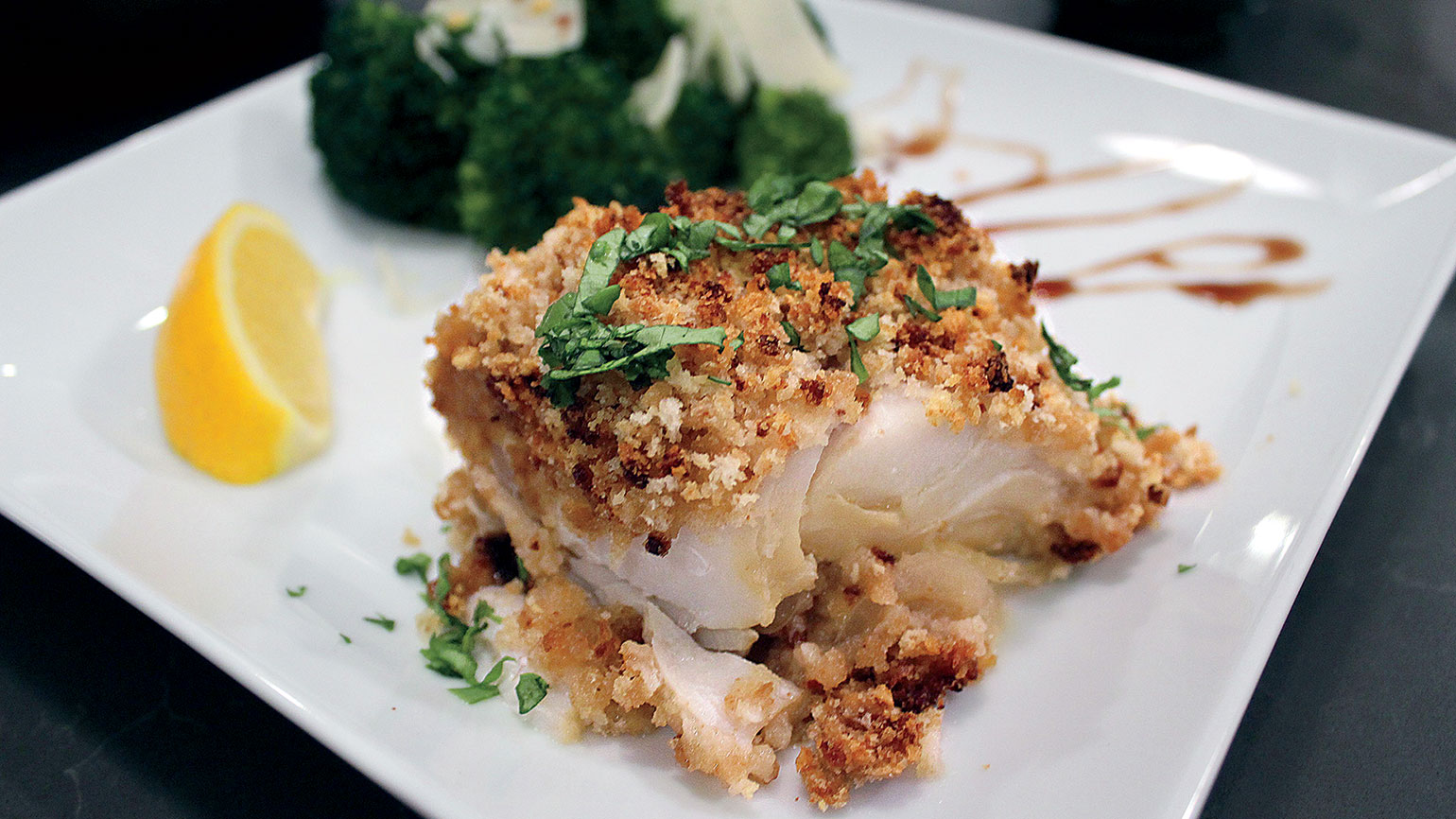
My husband, John, and I moved to Rhode Island shortly after we got married. Rhode Island offered tons of fresh seafood, but so much of it was fried. I wanted a healthier option. Enter baked lemon cod, which has become a staple in our household.

Ingredients

1 lb. cod fillets
1 medium sweet onion, thinly sliced
Olive oil
Juice of 1 lemon
½ c. white wine
½ tsp. red pepper flakes, plus more for seasoning
1 c. bread crumbs
⅛ c. butter
Small handful parsley, chopped
½ head broccoli, cut into bite-size pieces
Parmesan, shaved

Preparation

1. Preheat the oven to 375°. Sauté onions in olive oil in a medium skillet over medium-low heat until translucent, being careful not to let them brown.

2. Add half the lemon juice, the wine and 1/2 teaspoon red pepper flakes and cook for 2 to 3 minutes more.

3. Pour onion-and-wine mixture into an 8 x 8 x 2-inch baking pan and lay cod on top; set aside.

4. In the still-warm skillet, melt the butter, then add the remaining lemon juice and mix; pour over bread crumbs and mix until moist.

5. Cover fish with the moistened bread crumb mixture. Bake for 18 to 25 minutes.

6. Place broccoli in a steamer and cook 5 to 8 minutes or to desired tenderness.

7. Season with red pepper fl akes, to taste, and sprinkle with shaved Parmesan. Plate and serve with cod.

Serves 2.

Nutritional Information: Calories: 940; Fat: 27g; Cholesterol: 130mg; Sodium: 1020mg; Total Carbohydrates: 99g; Dietary Fiber: 4g; Sugars: 14g; Protein: 62g.

A Young Artist’s Surprising Mission

Two little children in Calcutta, India, a teeming city of millions, most of them poor. Urchins, they would have been called in a Dickens novel. The boy maybe eight, the girl 12 or so. They might have been brother and sister. I don’t know.

They tugged at my jacket as I walked down a packed street. “Sir, sir, spare some money?” the girl asked. I tried to move on. Because of the crushing poverty, begging was practically an industry in Calcutta. It was 1988. I was 24, a struggling artist just out of Brooklyn’s Pratt Institute. Like generations of young people before me, I traveled to India in search of something vaguely spiritual. I just wasn’t sure what.

The kids persisted. The boy thrust up his fingers. “Please, sir,” he said. His fingers were mangled stubs. The girl held her hands up too. They were the same. I wasn’t shocked. This was standard begging strategy, and I couldn’t give what I didn’t have.

“We’re lepers,” the girl cried. I didn’t know whether to believe them. I quickened my step. So did they. What did they want from me? I was just a scraggly young American with a backpack. There were many more prosperous-looking tourists all around. “Come and see where we go for lunch,” the boy said, keeping up.

I thought about how I must look to them. A fairly clean pair of jeans and a backpack must’ve seemed so affluent. “Okay,” I said, not sure why. Maybe my conscience had something to do with it. How could I turn them away?

They led me down a back street to a drab stucco building. The girl reached up and pulled on a bell. The door opened. A nun appeared. “Welcome,” she said. From within I heard voices—children’s voices. I was led into a room lined with about 20 cots. “This is our orphanage,” said a nun. “Some, like these two, just eat here.” Maybe it was the look on my face that said I was losing my heart to these kids. “Let me take you to meet the sister who runs our place,” the nun said.

She showed me to an unadorned room off the main quarters. It was empty, save for a plain wooden table, two chairs, a bare lightbulb hanging over the table and a curtain for a door. One of the walls was inscribed with a prayer by St. Francis. A moment passed. I studied the prayer. There was nothing else to do. A nun wearing a white head shawl bordered in blue finally stepped through the curtain. She was short and energetic with a remarkable aura about her. “I’m Mother Teresa,” she said.

I’d never heard of her. But I could see she was smart and charismatic. She drew me right in. I’d come to India to travel and soak up its culture until my money ran out. So I was shocked to hear myself say, “Could I stay here and help you?”

Mother Teresa looked at me appraisingly, then spoke. “Are you a doctor?” she asked, almost sharply. “A nurse? A psychologist? Do you have any medical training?”

“No,” I said.

“Then how can you help us?”

How could I argue with this tiny nun? All I had to offer was my middle-class American sympathy. What they needed were doctors and medicine and therapy, not pity. I’m sure I looked crestfallen. Mother Teresa spoke in a soft tone. “We can use you in Kali temple,” she said. It was a home for the dying, she explained, that she’d established in a Hindu temple in a poor district of Calcutta. “The only skills you need there are gentleness and patience.” I stayed in the old temple for about a month, caring for those in the last days of life. I washed and fed them, and sat and talked with those who could speak.

“I used to be a schoolteacher,” said one. “I was a government worker,” said another. They spoke with honesty and with poignancy—mostly about how they had entered adulthood hoping to better their lives and the lives of their families. “But I had so little money,” said the schoolteacher. “The lack of opportunity just beats you down,” the government worker said. Remorse and sadness seemed to shroud them. Each day some would die and others would walk through the door and take their place. Each day I would ask myself, Is this what I sought when I came to India?

At night I retreated to my room. With my money dwindling, without knowing anyone, there was little to do but sit and think. Here I was just starting out and I was spending my time with people at the end of their lives. The work was hard, but it spoke to me. One thing I knew: When I returned to the comforts of home, India would never be far from my mind.

Broke, I headed back to the States and settled into an artist’s loft in Jersey City, doing sculpture and helping other, better-known artists with their large installations. Nights, though, it wasn’t just my art I was thinking about. The images of the kids, of those dying people, of Mother Teresa, played in my head. Art is meant to be inspiring. But I didn’t see how my talent would better the life of any of those I’d left behind in India. If I would’ve thought to pray I would have pleaded for guidance.

I didn’t need to. One day I was rummaging through an abandoned storage space on the floor beneath my studio loft. I was searching for odds and ends I might use for a sculpture I was working on—a series of wooden panels with everyday objects. I spotted an old frame buried in a pile of junk. I yanked it out. It was a painting—a portrait. I recognized the man in the picture: Ossie Clark, a well-known designer from the 1960s. But more important, I recognized the style of the artist and the signature in the bottom right-hand corner: DH. It was a long-lost work by David Hockney, one of the most important artists of the latter half of the 20th century!

I took it to Sotheby’s, the famous art auction house. The appraiser offered me $18,000, more money than I’d ever had at one time. Friends asked what I was going to do with it. Move to a bigger studio? Be free to create more art? The odd thing was, I knew instantly. I packed a bag and flew to see Mother Teresa. Again I stood in the orphanage, in that same barren room. She walked through the curtain exuding that same energetic strength.

“Mother Teresa,” I said, “I’ve come back.” I explained the circumstances of my return.

She studied me carefully. “So many young people like you cluster in the cities. You should go to a rural area, where there are so few volunteers and so much need. The Lord will show you.”

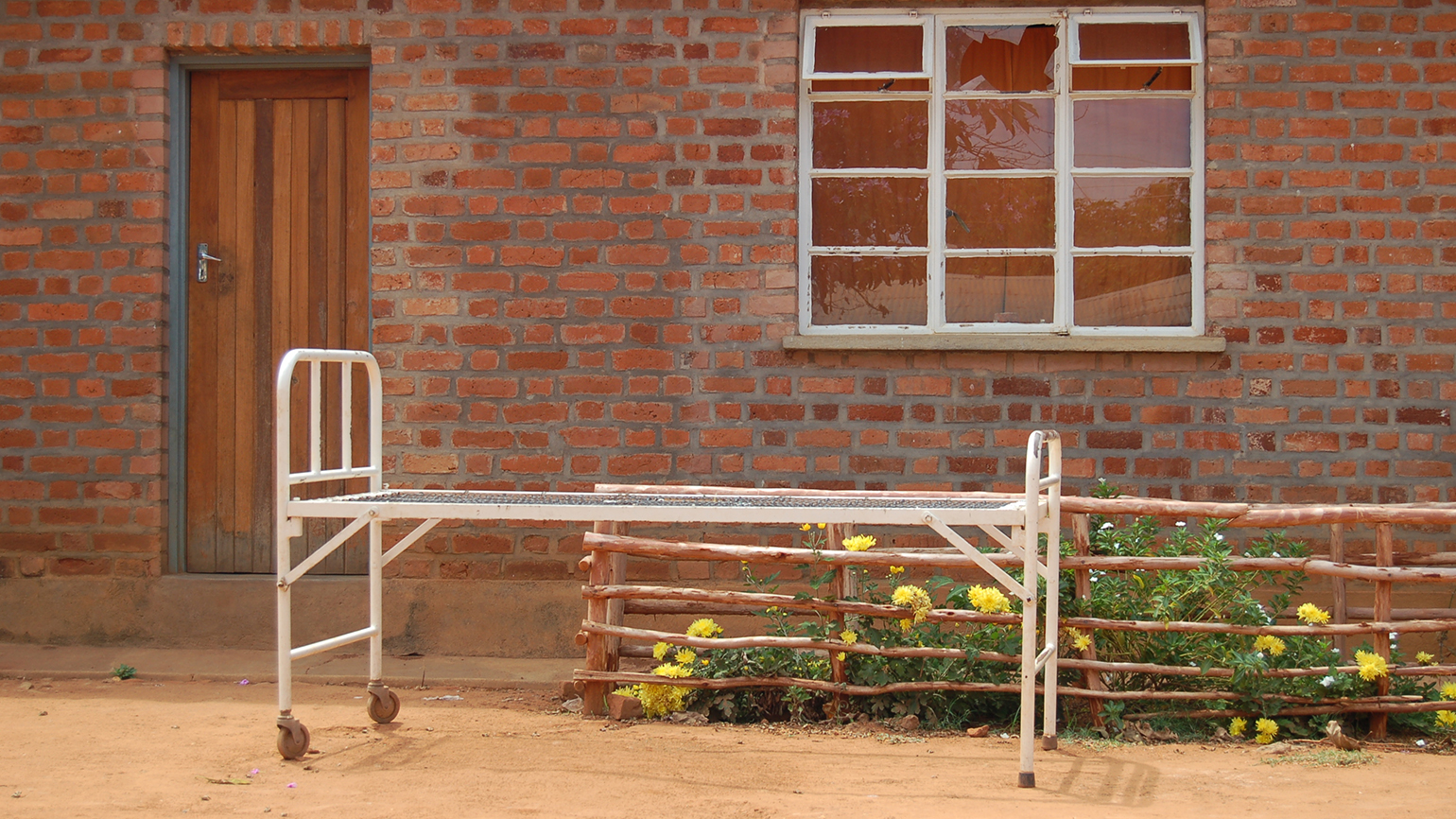
The train took 10-and-a-half hours to get to Orissa, the poorest state in India. I stopped at a destitute village named Juanga. I sat under a shade tree where villagers gathered and, with the help of an interpreter, asked what they needed. “Doctors,” said one. “Medicine,” said another. “People die because there are no pharmacies.”

There, under the tree, the answer came to me, as if this Lord Mother Teresa spoke about had whispered in my ear: Build them a hospital. And staff it.

It took three years, all of my seed money plus a ton of fundraising and the sweat of a lot of locals, but in 1996 we opened a 30-bed hospital with round-the-clock physician care. The day we opened, everyone in Juanga and the surrounding villages came. Some had stitched a huge net of lotus flowers and jasmine, and draped it over the building. That first month, we treated more than a thousand people, many who had never been to a doctor. “You don’t know how much this means,” a farmer, whose wife had been bedridden for months for want of penicillin, said.

I returned home and established Citta (Sanskrit for “compassionate mind”), a charitable organization that provides assistance to destitute communities around the world. We’ve opened hospitals, schools, women’s centers and orphanages in rural India, Nepal and Mexico. Today, I spend much time traveling between them and back to the States.

I started out an artist. I still am in a sense. Like great art, helping others inspires. It empowers both the giver and the receiver and appeals to a deep human beauty. Compassion, I learned from Mother Teresa, illuminates the soul. It may be the greatest art of all.

A World of Wonder Down Under

“How many koalas did you see?”

My wife and I were entering Flinders Chase National Park on Australia’s Kangaroo Island, an island which, despite its name, is known primarily as the home to the world’s largest koala population. There are more koalas than people on the island, our guide had assured us; we were guaranteed to see more than one of the sleepy-eyed lumps nestled among the trees. But the two backpacking women who were leaving as we came in looked frustrated when we asked about their experience. “How many koalas?” one of the women huffed. “None.” Her friend nodded. “Must be the weather.”

No koalas? But we’d come all this way!

A three-week journey to Australia, a trip of a lifetime. We’d flown into Sydney almost two weeks earlier, and immediately caught a prop-plane to Hamilton Island for our first experience: a two-day, two-night catamaran sail around the Whitsunday Islands. There we’d gone swimming with stingrays and lemon sharks amid the blinding white sands and impossibly blue waters of Whitehaven Beach; we’d snorkeled with the tropical fish on the southernmost reaches of the Great Barrier Reef system; and spent the evenings in a sheltered lagoon under a canopy of stars, watching giant sturgeon (so big, we thought they were dolphins) dart in and out of the dim glow of the boat’s taillights.

At our next stop, Port Douglas, we took a tour of the Daintree Rainforest, where we were fortunate enough to catch a rare glimpse at the elusive cassowary—known colloquially as the “last dinosaur”—an odd-looking emu with a bright blue neck, red waddle, and mohawk-like horn atop its head.

Around Sydney, we’d hiked through the Blue Mountains, discovering serene waterfalls and babbling brooks at every turn, before spending New Year’s Eve at the Royal Botanical Gardens, overlooking the Sydney Opera House and Harbor Bridge for the most fantastic fireworks display I’d seen in my life.

Now we’d gone out of our way to stop here, an island off southern Australia, to see one of my favorite animals, koalas, in the wild before flying to meet my wife’s relatives in Perth. I’d fulfilled my dream of holding one at a wildlife park in Port Douglas, but while that was a cute photo op, I wanted the authentic experience. How could there be no koalas here? It was an overcast day, windy, cold—but did that mean the koalas had gone into hiding?

“Just look up,” our guide said. “Look with the right eyes.”

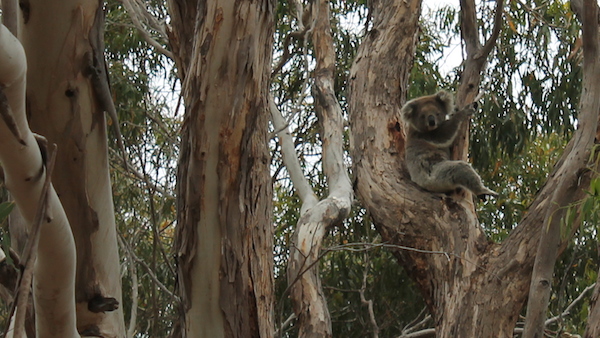
We followed the trail, weaving in and out of the eucalyptus trees, both shelter to the koalas and their primary food source. A poisonous plant, the leaves are so difficult to digest that eating them expends nearly all of a koala’s energy. No, koalas don’t get “high” off the plant—they get the mother of all tummy aches. As a result, they spend most of the time sleeping, curled up in the high branches.

“Look! Up there!” my wife called out.

I looked up. The branches were silhouetted against the sky, it was difficult to make out much of anything. I squinted, then widened my eyes as far as they would open. Where was he?

Then I followed the trunk up from the ground to where it began to branch out. And I saw him. The light seemed to form a halo around him. His furry face stared at me from high above.

My wife proved to be pretty good at spotting koalas—she spotted 11. I wasn’t quite as good—though I did spot some kangaroos, lounging in the shade. As I left the park, I thought about those two women who’d seen nothing. They had koalas all above them! Where had they been looking? Had they known what to look for?

How many amazing things do we miss every day? Walking the path, our minds somewhere else, our eyes fixed on our iPhones. After my day on Kangaroo Island with the koalas, I’ll remember to look up. Look longer, deeper. Pay more attention. There are koalas all around us (metaphorically)… we just need to look with the right eyes.

What have you seen when you’ve stopped to look? What’s surprised you? Tell us about your unexpected discoveries, at home and abroad.

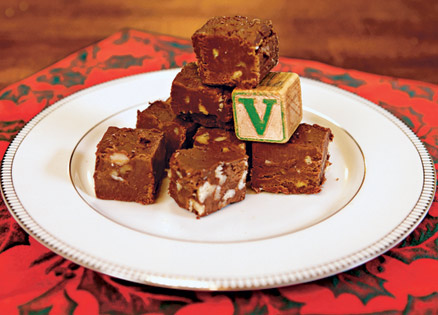
Aunty Ann’s Million Dollar Fudge

The secret’s in the recipe!

Ingredients

1 12-ounce package Hershey’s semi-sweet
chocolate chips
4 ½ c. sugar
3 4-ounce bar Baker’s German’s sweet chocolate,
cut into small pieces
Pinch salt
1 7-ounce jar Kraft Marshmallow Cream 2 tbsp. butter, plus more for pan
2 c. walnuts, broken 1 ⅝ c. evaporated milk

Preparation

1. Butter 13 x 9 x 2-inch pan.

2. Combine chocolate chips, German chocolate, marshmallow cream and nuts in bowl. Set aside.

3. In heavy saucepan combine sugar, salt, butter and evaporated milk. Let stand about 5 minutes.

4. Heat to boiling, stirring constantly. Boil 7 1/2 minutes after it has a good start to boil.

5. Pour at once over chocolate mixture.

6. Stir vigorously until chocolate has melted and mixture is smooth and creamy.

7. Pour into prepared pan. Let stand several hours or overnight to set.

8. Cut into squares. Store, tightly covered. Freezes well.

Makes 48 squares.

Nutritional Information: Calories: 200; Fat: 8g; Cholesterol: 5mg; Sodium: 20mg; Total Carbohydrates: 32g; Dietary Fiber: 1g; Sugars: 29g; Protein: 3g. Serving size: One square.

Don’t miss Mary Fran’s delightful story about her Aunty Ann handing down of this valuable recipe.

Download your FREE ebook, The Power of Hope: 7 Inspirational Stories of People Rediscovering Faith, Hope and Love.

A Texan’s Prayer Is Answered in Michigan’s Colorful Chill

Brrrr. I shivered, stepping out of the rental car into the cold Michigan night. I helped my husband, Carl, unload our bags. He didn’t say a word to me, but after three decades of marriage, I could tell that he was less than thrilled with the vacation destination I had chosen for our weeklong trip.

Carl likes it warm, and it was clear that late autumn here was going to be much colder than even the dead of winter back home on the Texas Gulf Coast. We had taken a late flight and had just arrived at our hotel in Midland.

Carl and I did a lot of things well together, but travel wasn’t really one of them. We had completely opposite vacation attitudes. I loved to wake up early and fill each day with activities and long, scenic drives. Carl’s m.o.? Sleep late, then lounge by a sparkling pool or on a sunny beach.

“I feel like a plow mule hitched to a race horse,” he’d complain.

More than once we had cut a vacation short, relieved to head home to our comfortable routines. I envied those couples who had a regular vacation spot. Carl and I couldn’t seem to agree on anywhere.

“Michigan?!” Carl exclaimed when I mentioned the idea. “That’s the middle of nowhere! You’re kidding, right?” “We have never dipped a toe in a Great Lake!” I said. “Besides, the leaves are supposed to be amazing this time of year.”

Neither of us had ever experienced a real autumn. We were lifelong coastal Texans, and the vacations we took while raising our children were always tied to summers, spring breaks and Christmas holidays.

A few months earlier, however, the manager at my new job sent me to corporate headquarters in Midland, Michigan, on a sweltering June day.

“You’ve got to come back in the fall!” my colleagues insisted, shocked that I had never witnessed the leaves turn. My first real autumn had to be in Michigan!

Grudgingly, Carl had agreed. Before we left I said a prayer: Lord, if only Carl and I can overcome our different vacation styles! Please make this trip special for us.

That first morning, I woke up early. I tugged one edge of the heavy drapes and peeked out the window. The trees in the valley below glowed red, orange and yellow like embers through the morning fog.

I shrugged on a sweater and tiptoed downstairs. I grabbed a cup of coffee in the lobby and went outside. My sandals crunched against frosted blades of grass. I pulled my sweater tighter. Good thing I’d packed a jacket for Carl at the last minute.

I finished my coffee, scooped up a handful of leaves and headed back inside to wake Carl.

“Good morning,” I whispered. Carl muttered something. I sprinkled the flame-colored leaves across the pillow. “Wake up!” I said.

Carl blinked sleepily as I jerked the curtains wide. A sunbeam raced across the valley. The trees looked like they were on fire. “Wow!” Carl said, sitting up.

We set off toward Petoskey, a resort town my colleagues had told us about.

“Let’s not go straight to the hotel,” I begged. “Let’s take the scenic route.”

At Traverse City we traced the Leelanau Peninsula to Sleeping Bear Dunes. We hiked the sandy hills hugging the shoreline. I reached the top of the largest dune and got my first glimpse of the sparkling waters of Lake Michigan. Even by Texas standards, this was big!

We got to our hotel and checked in. “Look,” Carl exclaimed. “They have a hot tub!”

“I guess we can relax for a little while,” I said, as we headed to our room to change.

A few minutes later I settled back next to Carl in the hot tub. “Tomorrow we should probably dip our toes in a Great Lake…?” I suggested.

“You’re going to miss this when you do!” Carl teased.

The next morning, Carl lounged and I paced like a caged animal. “Check out isn’t till noon,” he said, yawning. “Chill.”

We made it to the complimentary breakfast buffet 10 minutes before it closed.

“Let’s get this show on the road!” I exclaimed, then caught myself and asked God for patience, reminding myself our different styles is what makes my husband and me click on some level.

Finally, we got to the lake and parked. I took off my shoes and socks. “Are you sure you don’t want to dip a toe in?” I asked Carl.

“You first.”

Whoa! “Smile!” Carl said, lifting the camera. Click! One frozen smile for posterity, 10 frozen toes for me!

The day was one photo op after another. The road twisted through a tunnel of trees. One curve revealed a stunning vista of Lake Michigan, the next led us into a fern-laced forest populated by wary deer.

We emerged from the woods and stopped for a late lunch at the Leg’s Inn, a rustic building cobbled together from rocks and logs. A pay-per-view telescope looked out over the water. A sign read that we could see four lighthouses in the distance. I’d never seen even one.

“Got a quarter?” I asked Carl. We both took a look. Then we took a picture with the lake behind us. Click.

The next day we drove farther and dipped our toes in frigid Lake Huron, then took the long, narrow Mackinac Bridge, the third longest suspension bridge in the world, to the Upper Peninsula. I twisted myself like a pretzel to capture the moment through the car’s sunroof with the camera.

We followed the rural highway along the northern shore of Lake Michigan. Signs fronting Mom and Pop shops all proclaimed: “Smoked Whitefish” and “Pasties.”

“Let’s make a picnic,” I said.

We picked up the meat pies and smoked fish, along with ripe Honeycrisp apples and fresh cider. We pulled into the parking lot of a church with a picnic table under the trees. We ate in silence, but it wasn’t the uncomfortable silence of that first night. Lord, thank you.

I hummed a favorite hymn, “It Is Well with My Soul.” This was the place we could go Carl’s speed and mine at the same time. The right trip, the right one for both of us.

The leaves rustled in the breeze. A few floated down. Carl reached out and plucked one from the air. He gently tucked it behind my ear. “You wear it well,” he said.

“Maybe I’ll take it with me to remember this place,” I said.

“Well,” he said, “you still have more Great Lakes to dip your toes in! Next autumn?”

My heart soared. “Absolutely!”

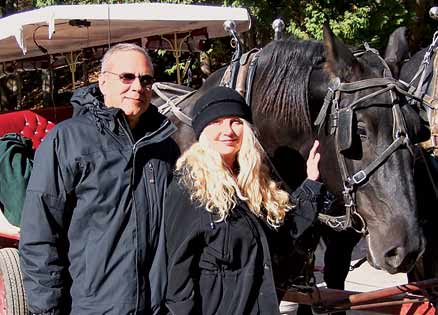
Every fall since, we’ve come back to Michigan. We’ve ridden a horse-drawn carriage on Mackinac Island; we’ve hiked to the root beer-colored waters of Tahquamenon Falls; we’ve eaten our share of smoked whitefish and pasties. We’ve even hung out in the hot tub of a rented cabin, then snuggled up while Texas chili simmered on the stove.

Carl and I have never felt more at home—on vacation.

For more inspiring stories, subscribe to Guideposts magazine.

Download your FREE ebook, Inspirational Quotes About Life, Love, Faith and Hope.

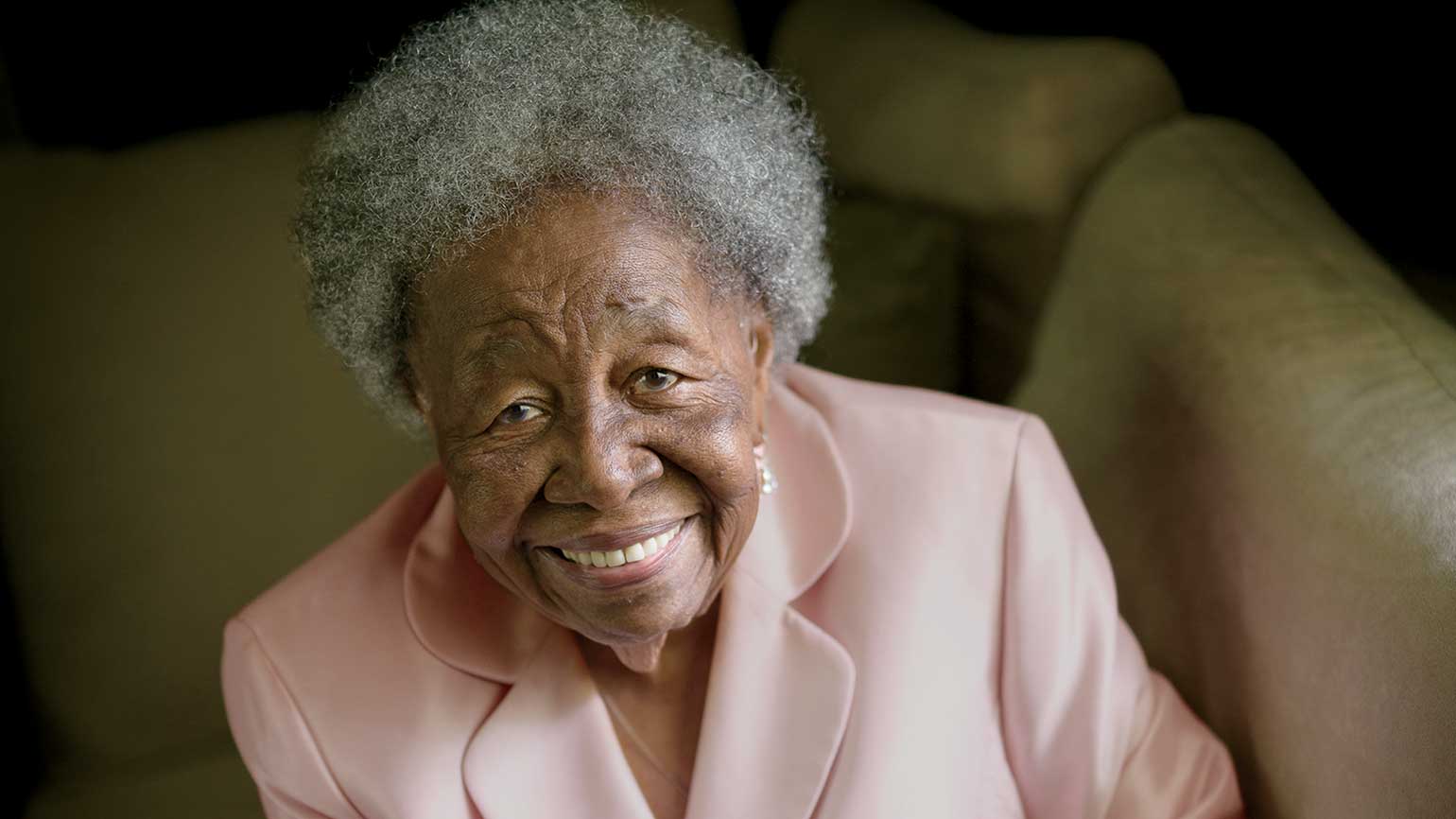
At 92, Dorothy Steel Got a Role in ‘Black Panther’

“Cindy, I’m not interested,” I said, trying not to sound too irritated at my agent. “I’m not auditioning for some dumb comic-book movie.”

“Ms. Dorothy,” she said. “I wish you’d at least think about it. It’s going to be really big.”

“Nope, not doing it,” I said. “Besides, I don’t have the faintest idea how to do an African accent.” I hung up, anxious to return to my baking. My grandson, Niles, was coming over, and I was making sweet potato pie, his favorite.

Ten years ago, if someone had told me that at age 90 I’d be arguing with an agent about a movie role, I would have thought they were flat-out crazy. Me playing a tribal elder in some make-believe African country called Wakanda? Who’d ever heard of such a thing?
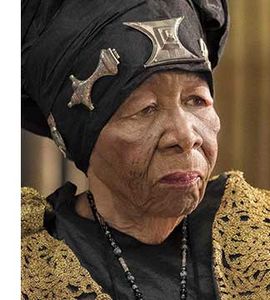
Dorothy Steel; Matt Kennedy © 2017 MVLFFLLC. TM & © 2017 Marvel. All Rights ReservedIt was enough to make me think about retiring from acting. I’d had my fun, been in some commercials—even a soap opera, Saints and Sinners, for a season on Bounce TV; a short film, Black Majik; a full-length movie called Daisy Winters; and a made-for-TV movie, Baby’s First Christmas. That was plenty. I’d never planned on being an actress in the first place, never in a million years.

The whole thing started one day at the senior center when I was 82. They were putting on a play called It’s Christmas and looking for volunteers. Why not? I thought. I figured I could squeeze in the rehearsals between my bowling leagues, church and cooking special meals and desserts for Niles and my son, Scott. They might be grown men, but I never tired of spoiling them.

I got the part of a sassy teenager. Can you imagine? I don’t know what got into me, but on stage I became that girl—wisecracking, self-centered, with attitude to spare. I started ad-libbing my lines. Folks in the audience were cracking up. I fed off their energy. It was great.

The whole experience was so out of character for me. I’d always thought of myself as shy, more interested in watching others than being in the spotlight. “Why are you always analyzing everyone and everything?” my older sister would ask.

I’d worked most of my career for the IRS, a divorced single mother. The last 14 years, I’d worked as a senior revenue officer, assigned to the Virgin Islands. After I retired, I traveled. Everywhere I went, I watched people, studying the way they spoke, noting how some slouched while others held themselves at attention.

At 82, I settled in Atlanta to be close to family. That’s where I found the senior center. After that first play, I was in a couple more, just for fun. A man came to one of our productions and afterward introduced himself as Greg Alan Williams. He was an actor and dean of an acting school called Actors’ Breakthrough. He said that if any of us wanted to study there, we could for half price.

Well, I was interested and told my sister and nephews, who ridiculed me for such an idea. My son said, “Go for it.” Scott, by then retired, had been an award-winning cameraman for WSB, a local TV station. He offered to drive me. Folks in the class joked, “Here comes Scott. Driving Miss Daisy!”

I was the oldest person there by far. The instructor took us through the basics, teaching us how to get into character, not to overdo it, that it should feel natural, picking up on the little quirks and idiosyncrasies that make a person real. The very things I’d been studying for years. We were advised to get a tablet, a good phone, a Facebook account, some head shots and an agent. I signed up with Cindy Butler at iSubmit Talent Agency.

Not long afterward, a casting director called her with a role he thought I’d be perfect for: Mother Harris in Saints and Sinners. That was the beginning of my professional acting career at 88 years old.

I was still worked up over that conversation I’d had with Cindy. A movie called Black Panther? Honestly, what was she thinking? I put the pie in the oven and sat down to read while I waited for Niles. By the time he arrived, I’d nearly forgotten about the whole thing.

Niles had finished off a piece of pie and I was clearing the table when for some reason it popped in my head. “Cindy, my agent, called with the craziest idea,” I said. “Me in some movie called Black Panther. I told her no way.”

Niles’s mouth dropped open. “Are you kidding?” he said. “Grandma, this is Marvel Comics. A billion-dollar company. You know, like Spider-Man.”

I frowned, suddenly wishing I’d never brought it up. “I don’t want to do cartoons,” I said. “And they’re wanting me to have some African accent. I don’t even know how to do that.”

“Grandma, you’re always talking about how we need to step out in faith,” Niles said. “This is huge. Either man up or shut up!”

The nerve of him! “Niles, don’t you be telling me what I should be doing,” I said. Niles gave me one last imploring look and scooted out the door to his truck. “As if he thinks he’s gonna teach me something about faith,” I grumbled.

I sat down and opened my book, but I couldn’t focus on the words. I started thinking about how I’d stepped out in faith.

In September 1958, when Scott was 10, I was hospitalized with an abdominal pregnancy. I was five months pregnant. There was no saving the baby, and the chances of my surviving were slim. My heart stopped during surgery, and the doctors had to give me two shots directly into it to start it beating again. I have scars on my ankle, where they gave me all the B-positive blood they had on hand, and two white marks on my chest, where they gave me the shots to my heart.

Back in my hospital bed, I heard my doctor tell the nurse, “Don’t let her suffer. I know she’s going to die.” My insides were so tangled up, I couldn’t even eat a teaspoon of soup or drink water without unbearable pain. All I could do was lie there and stare at the hospital room wall.

Then I remembered King Hezekiah, who lay dying and prayed to the Lord to give him 15 more years of life. The Lord had. So I prayed, “Lord, give me eight more years, until my son is grown, and I will bless your name all my days.” I heard an inner voice: “Get up from your hospital bed, and walk out to the street. Then come back in, and I will heal you.”

I got up out of bed and made my way down the stairs to the street. It might have looked as if I were stepping out on nothing leaving the hospital, but as the Bible says, the everlasting arms of the Lord were supporting me. I came back inside, exhausted. Slowly, my health turned the corner. I was healed.

I got divorced not long after that and struggled to support Scott on my own. One day I drove from Detroit, where we lived, to Flint because I felt led there. I happened upon an IRS office and went in and asked a supervisor for a job, a position his secretary said didn’t exist. I became the first black female promoted to revenue officer in the Flint office.

I’d been blessed; I surely had. But there’d been so many times when all I could do was trust in God. He’ll always see you through. I’d been telling Niles that since he was a baby, hadn’t I? Why was I so intent on not auditioning? Was I afraid of making a fool of myself? As if I had some big image to protect. Niles, my agent—they thought I’d be perfect for the part. What would it hurt to try? It wasn’t as if I had any realistic chance of landing it.

Mandela. The word came to me with crystal clarity, like a message meant just for me. Nelson Mandela. Now there was someone with a distinct African accent! I got on YouTube and watched several of his speeches, listening to the pronunciation, where the emphasis fell. After a few days, I began to pick it up.

I was watching a speech one night when Scott came over for a meal I’d made. “What’s this?” he said. I told him the whole story. “What are you waiting for?” he said. I didn’t need to hear any more.

The next day, I called Cindy. “I’d like to give that Black Panther part a try,” I said. When the script came over, I reviewed my lines. There weren’t that many. But the character was in a key scene where the lead actor faces a ritual wrestling match to prove himself worthy of being king. And in a palace scene where the elder offers words of wisdom: “We’ve protected our borders for thousands of years, and now it’s your turn to lead. We don’t need a warrior. We need a king.”

I repeated the lines over and over. When I thought I had it down pretty well, I asked Scott if he could tape me doing it. He had a home studio, and I thought I nailed it on my first take. “Let’s do it again,” Scott said. Lordy. He made me do those lines 10 times. He narrowed it to two, then picked one. An hour after Cindy sent off the tape, the casting director was on the phone with her. “Who is this old woman?” they said. “We want her.”

I called Niles first thing. “I got the part!” I said. “And I want to thank you for what you said. I didn’t like it much at the time, but Lord knows I needed to hear it.”

“Grandma, I knew you could do it!” Niles said. That gave me goose bumps. He wasn’t the only one who’d believed in me. God had been opening doors for me my whole life, preparing for the role I was born to play.

Black Panther went on to become one of the biggest movies in worldwide ticket sales ever. It still seems as if I dreamed the whole thing. And to think I got to rub shoulders with actual movie stars like Angela Bassett, Forest Whitaker and Chadwick Boseman. Now when my agent calls, I listen. Even at 90, you never know what role God has in store for you.

For more inspiring stories, subscribe to Guideposts magazine.

Asparagus Almond Casserole

This is Mrs. Voight’s original recipe. Feel free to make your own additions. I use Sunkist Almond Accents™ sliced almonds to add to the flavor.

Ingredients

5 Tbsp. butter 3 15-ounce cans asparagus
5 Tbsp. flour 5 hard-boiled eggs, sliced
¾ c. milk ¾ c. blanched almonds
¾ c. juice from canned asparagus ¾ c. cracker crumbs
¾ c. mayonnaise

Preparation

1. Melt butter in skillet. Add flour and blend. Add milk and asparagus juice. Cook over low heat until thick. Add mayonnaise and mix well until sauce is formed.

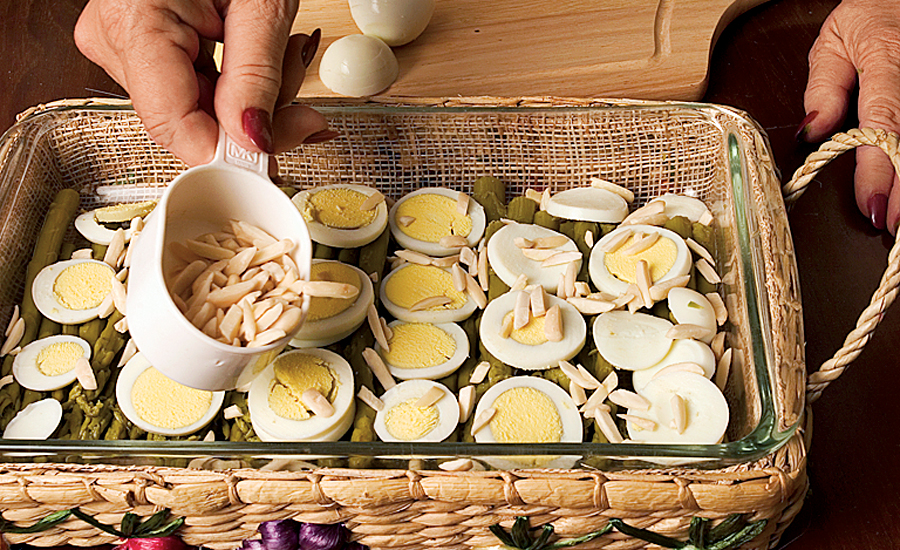
2. In bottom of 2-quart baking dish arrange a layer of asparagus, eggs and almonds. Cover with half the sauce. Repeat. Top casserole with cracker crumbs.

3. Bake at 350°F for 30 minutes.

Serves 8

Read The Hand-Me-Down Casserole to see how the recipe evolved over time.